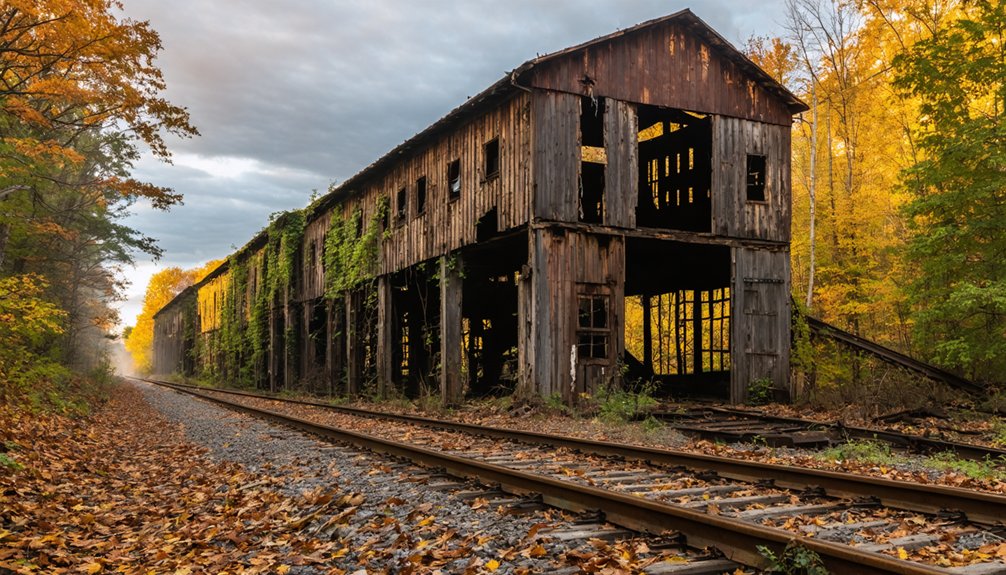
You’ll find Indiana’s most accessible ghost towns scattered across the southern limestone country and reservoir edges. Visit Aberdeen’s concrete steps leading nowhere, explore Hindostan Falls’ 128 mysterious rock carvings, or walk Tunnelton’s haunting 1857 railroad tunnel. During droughts, Monument City’s streets emerge from beneath Salamonie Reservoir like skeletal fingers. Warren County alone hosts eleven dissolved settlements now reclaimed by farmland. Rose Island and Bloomington’s Zoom Flume require no permits—just respect for these time capsules where plague, fire, and flood wrote Indiana’s most dramatic chapters into crumbling foundations and submerged streets.
Key Takeaways
- Hindostan Falls features 128 carved holes in rock marking vanished mills and offers accessible exploration of Southern Indiana’s tragic plague history.
- Tunnelton preserves an 1857 hand-carved railroad tunnel and fire-destroyed ruins, showcasing mid-1800s railroad expansion and decline.
- Salamonie Reservoir occasionally reveals Monument City’s submerged streets and foundations during droughts, exposing 1960s flood-erased communities.
- Rose Island and Bloomington’s Graffiti Zoom Flume provide permit-free access to abandoned landmarks for respectful urban exploration.
- Warren County hosts over a quarter of Indiana’s ghost towns with visible concrete slabs, foundations, and cemetery remnants.
Southern Indiana’s Haunting Abandoned Communities
When you venture into Southern Indiana’s backroads, you’ll discover a landscape where forgotten towns still cling to existence, their weathered structures standing as silent witnesses to tragedy and exodus.
Hidden histories emerge at every turn—from Hindostan Falls, where 138 souls perished during an 1820s disease outbreak, to Tunnelton’s ruins marking Underground Railroad routes and the Wilson gang massacre site.
Every crumbling foundation and overgrown trail reveals Indiana’s darkest chapters—plague, violence, and vanished dreams carved into forgotten soil.
You’ll find architectural remnants like Aberdeen’s concrete steps leading nowhere and Weisburg’s shuttered general store frozen in time.
These thirteen visitable communities offer unfettered exploration of deteriorating buildings and nature-reclaimed streets. Some ghost towns like Mollie thrived during the Indiana Gas Boom from the 1880s to 1920s before railroad tracks vanished and commercial buildings disappeared entirely.
Each location serves as your personal time capsule, revealing Indiana’s approximately 41 ghost towns concentrated throughout the southern region, where freedom-seekers and pioneers once carved out new lives before abandonment claimed their settlements. These sobering reminders of impermanence allow you to visualize how communities once flourished before economic decline, disasters, or resource depletion transformed them into the haunting landscapes you can explore today.
As you navigate these ghost towns, consider participating in annual events in Indiana ghost towns that celebrate the rich history and stories of these forgotten places. Engaging with local historians and fellow enthusiasts during these gatherings can deepen your understanding of the lives once lived there. Each event not only honors the past but also fosters a sense of community among those who appreciate the remnants of history.
Warren County’s Forgotten Settlements
Over a quarter of Indiana’s ghost towns cluster within Warren County’s borders, where eleven extinct settlements have dissolved into cornfields and pasture.
You’ll discover urban exploration opportunities where railroad tracks once connected thriving communities now reduced to concrete slabs and foundation outlines.
What remains to discover:
- Sloan’s silent crossroads – where a general store stood until the 1990s, leaving only rubble-strewn earth
- Locust Grove’s persistent cemetery – gravestones marking lives when mills and schools bustled nearby
- Kramer’s ashes – where Hotel Mudlavia’s burning sparked total abandonment
Hartford clings to existence with fewer than twenty residents, while Briscoe offers mere traces from roadside glimpses.
Historic preservation here means acknowledging absence—reading landscape signatures where economic shifts erased entire towns, returning land to the freedom of open fields. Romney maintains particularly strong historical connections, as the ancestral home of the Romney family that would later produce political figures. These sites function as outdoor museums where visitors can learn about settlement patterns that shaped Indiana’s development.
Ghost Towns of Tippecanoe County
While Warren County concentrates Indiana’s densest ghost town cluster, neighboring Tippecanoe County tells quieter stories of ambition meeting abandonment. You’ll find Harrisonville’s memory absorbed into Battle Ground, while Little Chicago‘s single-paneled house mocks its namesake’s grandeur.
LaGrange’s 1827 layout promised to rival Lafayette—those dreams now rest beneath overgrown foundations. Named for Lafayette’s ancestral home, the settlement featured eight streets, a hotel, and a post office before riverboat trade declined.
Granville offers tangible exploration near its namesake bridge, where bent tombstones overlook the Wabash River valley. The cemetery marks where Wea people once thrived, creating layers of historic architecture and urban legends. Indiana’s flat, fertile land attracted settlers to establish these communities, though many ultimately faded as transportation routes shifted.
Northeast, Yorktown’s cemetery preserves the Caulkins Brothers’ 1841 vision along Stockwell Road. You’re walking ground where freedom-seeking settlers staked everything on communities that refused permanence, leaving only weathered stones as witnesses.
Submerged Towns Beneath Indiana Waters
Beneath Indiana’s reservoirs and managed waterways lie complete communities—drowned neighborhoods where streets became fish habitats and church foundations transformed into underwater landmarks.
Submerged history awaits your underwater exploration:
- Monument City rests beneath Salamonie Reservoir in Huntington County. Its streets and foundations emerge during drought years like 2012 when receding waters reveal the town’s grid pattern—a haunting reminder of the mid-1960s flood-control sacrifice. Civil War graves and monuments were relocated uphill before the intentional flooding preserved these historical markers. The town was established in 1876 before meeting its watery fate nearly a century later.
- Elkinsville in Brown County was condemned for Monroe Lake, though faulty elevation estimates left much above water. You’ll find cemetery stones and lane traces suspended between drowning and survival in Hoosier National Forest’s hollow.
- Old Leavenworth along the Ohio River became a ghost after 1937’s devastating floods destroyed half its structures, forcing 418 residents uphill—leaving original foundations scattered across the flats.
Clay County’s Lost Railroad Stops
Beyond town, coal mine spurs snake through wilderness—ghostly corridors where boxcars hauled black gold from Pierson, Vivian, and Tower Hill operations. That 2-mile spur to Island Valley? It’s yours to explore now, reclaimed by forest.
This industrial heritage speaks to freedom-seekers: Clay County’s brick factories, flour mills, and pottery works thrived independently before abandonment. Walk these vanished rails where economic self-determination once rolled on steel wheels. The old New York Central branch once connected these mines to Petersburg and Evansville, crossing multiple rail lines at grade before falling silent nearly a decade ago. Similar massive realignments reshaped Indiana’s railroad landscape—the Cincinnati-Indianapolis line once employed 20,000 workers who blasted through gorges and moved millions of cubic yards of earth.
The Story Behind Indiana’s Drowned Communities
When Indianapolis needed water in the 1940s, entire communities vanished beneath reservoir surfaces. You’ll find Germantown‘s story particularly haunting—founded in the 1830s, it disappeared completely under Geist Reservoir in 1943.
Monument City met a similar fate in 1966, now resting thirteen feet beneath Salamonie Lake‘s waters.
These drowned towns reveal themselves during drought conditions, exposing industrial ruins and historic landmarks:
- Germantown’s foundations emerge from mud, their wood repurposed in nearby Fortville
- Monument City’s schoolhouse bricks surface where 125 students once studied
- Bridge remnants appear along Fall Creek’s submerged banks
You can explore these sites freely when water levels drop, discovering a world where progress demanded sacrifice.
The Salamonie Interpretive Center preserves photographs and memories of families who watched their homes sink forever.
Cave Country Ghost Towns and Historic Sites
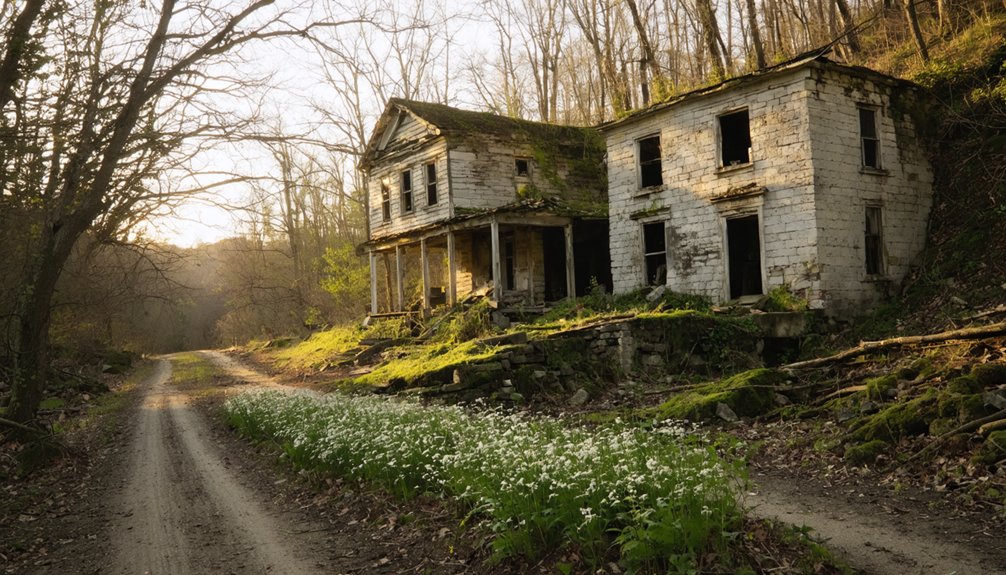
Southern Indiana’s limestone bedrock conceals not only vast cave systems but also communities that faded when railroads rerouted and rivers flooded.
You’ll find Marengo sitting atop extensive cave networks, its empty structures deteriorating near Marengo Cave Park. Cave explorers can discover the region’s underground labyrinths that rival Kentucky’s famous systems.
Fort Ritner offers haunting evidence of past buildings, while Greenville’s Masonic lodge stands where community leaders once shaped generations’ futures.
Mine remnants dot these forgotten settlements, where 128 eighteen-inch holes carved into flat rock at Hindostan Falls mark vanished mills.
These sites blend natural wonder with human ambition’s remnants. You’ll escape cell service and internet, finding freedom in places where frontier dreams met geological reality—communities that thrived, then surrendered to nature’s patient reclamation.
Railroad Era Settlements Frozen in Time
While caves shaped communities through geology, the iron rails that sliced through Indiana’s wilderness in the 1840s and 1850s created instant towns that lived and died by the locomotive’s whistle.
Railroad towns rose like thunder and vanished like smoke, their fate sealed by steel tracks that gave life and delivered death.
You’ll find Tunnelton’s story particularly haunting. Platted in 1859 around Big Tunnel and Little Tunnel, this settlement thrived until November 13, 1907, when a spark from a steam locomotive ignited a fire that consumed everything.
Today’s urban decay reveals:
- One surviving tunnel carved in 1857, resembling a massive cave
- The 1882 massacre site, now classified as a Level 4 ghost town
- Historic preservation efforts documenting burned hotels and vanished businesses
Nearby Woodville, Juliet, and Bonnell share similar fates—railroad-dependent communities abandoned when tracks realigned or extended elsewhere, leaving only remnants for independent explorers seeking authentic American history.
Exploring Indiana’s Most Accessible Abandoned Towns
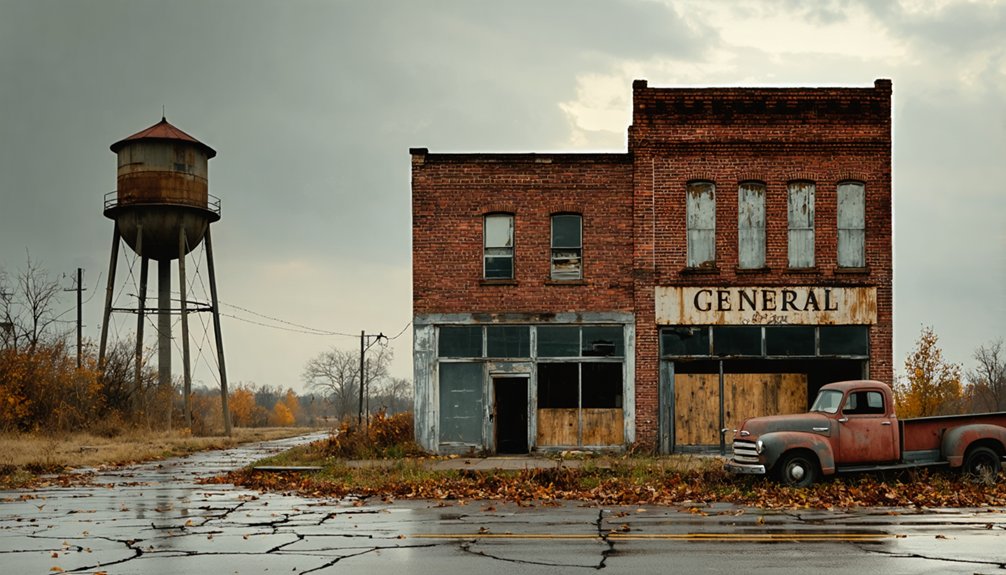
Unlike the railroad settlements that require bushwhacking through overgrown forests, Indiana’s most accessible abandoned sites let you step into history without a machete.
Saline City’s haunted architecture stands exposed in Clay County farmland, where you’ll walk canal-side paths to emptiness 6.2 miles north of Clay City.
Rose Island’s stone swimming pool ruins emerge from Charlestown’s forest trails, their forgotten folklore echoing the 1937 flood that ended the amusement park’s reign.
Bloomington offers double exploration: hike to the graffiti-covered Zoom Flume waterslide, then drive to Knightridge Space Observatory‘s deteriorating dome.
Each site welcomes your curiosity without permits or fees. You’re free to photograph, explore, and connect with Indiana’s abandoned dreams—just respect what remains.
Frequently Asked Questions
What Safety Precautions Should Visitors Take When Exploring Indiana Ghost Towns?
Like swapping your smartphone for a telegram, you’ll need old-school hazard awareness in these ruins. Pack safety gear—sturdy boots, flashlights, and gloves. Test floors before stepping, travel with friends, and you’re free to explore responsibly.
Are Indiana’s Ghost Towns Located on Private or Public Property?
You’ll find Indiana’s ghost towns split between private ownership and public land. Some sites welcome exploration as state memorials or parks, while others sit on restricted property where you’ll need permission before venturing onto the grounds.
These ghost towns in Indiana’s history tell compelling stories of prosperity and decline, with many buildings frozen in time. As you wander through these remnants, you’ll catch glimpses of the past, from crumbling facades to rusted machinery. Each site offers a unique insight into the life and challenges faced by the communities that once thrived there.
What Is the Best Season to Visit Abandoned Towns in Indiana?
Like forgotten pages turning with time’s rhythm, you’ll find fall offers the perfect balance—crisp air reveals decay through thinning foliage, while historical preservation efforts and access restrictions ease before winter’s lockdown, granting you unrestricted exploration freedom.
Can You Camp Overnight at Any Indiana Ghost Town Sites?
You can’t legally camp overnight at Indiana’s ghost town sites. Camping restrictions prohibit unauthorized stays on public property, and private ghost town lands lack overnight permissions. You’ll need designated campgrounds or dispersed camping areas instead.
Which Ghost Towns Have Guided Tours or Visitor Centers Available?
None of Indiana’s abandoned ghost towns offer guided tours or visitor centers. You’ll find historical preservation efforts focus on active historic districts like Irvington and Madison instead, where guided tours explore haunted buildings rather than true ghost town ruins.
However, for the adventurous spirit, there are still hidden gems such as ghost towns in indiana to explore that capture the essence of what once was. As you wander through these quiet remnants of the past, you might uncover stories etched in time and experience the eerie beauty that surrounds them. Each visit provides a glimpse into the lives of those who called these places home before they faded into history.
As you seek out ghost towns to explore in Indiana, prepare yourself for a journey through the remnants of communities that once thrived. These locations often lie off the beaten path, inviting you to step into a quieter world where nature gently reclaims its territory. The forgotten buildings stand as silent witnesses to a past filled with dreams and aspirations, beckoning the curious to discover their untold stories.
References
- https://wkdq.com/southern-indiana-ghost-towns/
- http://freepages.rootsweb.com/~gtusa/history/usa/in.htm
- https://www.onlyinyourstate.com/experiences/indiana/ghost-towns-in
- https://www.geotab.com/ghost-towns/
- https://www.youtube.com/watch?v=45D4dbASJyE
- https://storymaps.arcgis.com/stories/9a3b3f4a63ba4031a46cb53907a0515c
- https://www.youtube.com/watch?v=3J6ZADuP0A4
- https://www.discoversouthernindiana.com/blog/post/the-ghost-town-of-hindostan-falls-indianas-lost-jewel/
- https://www.youtube.com/watch?v=oLM1Cvt5G4A
- https://en.wikipedia.org/wiki/List_of_ghost_towns_in_Indiana