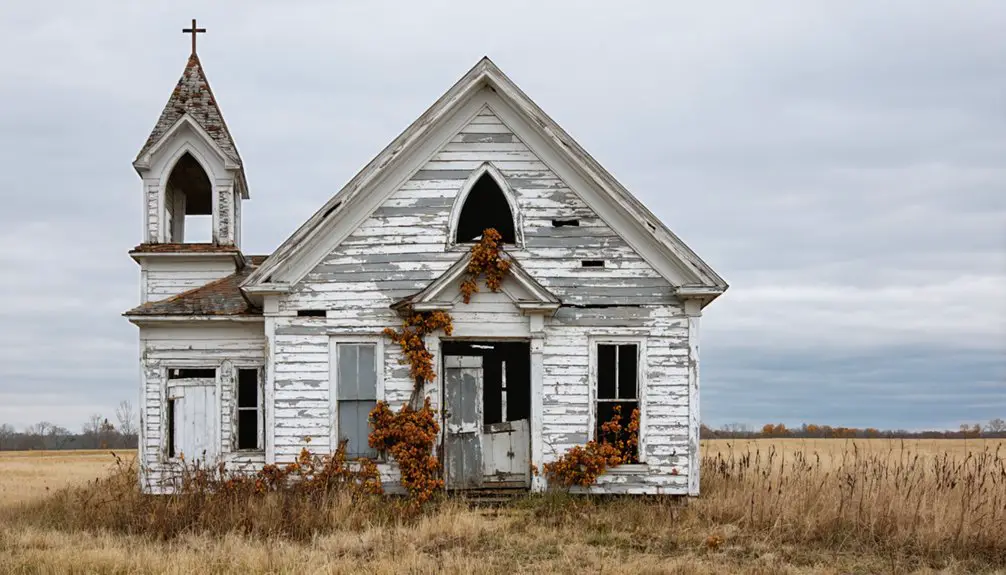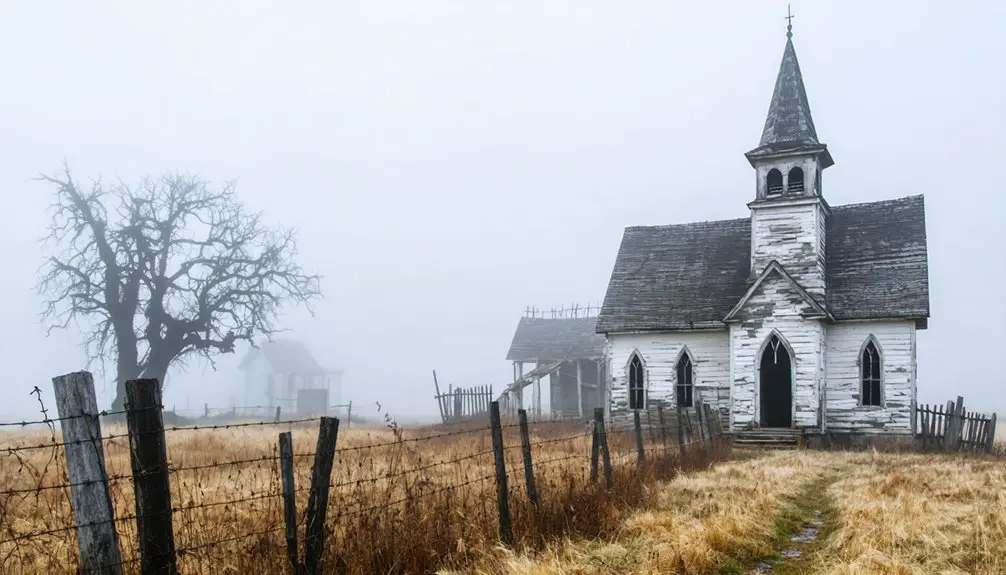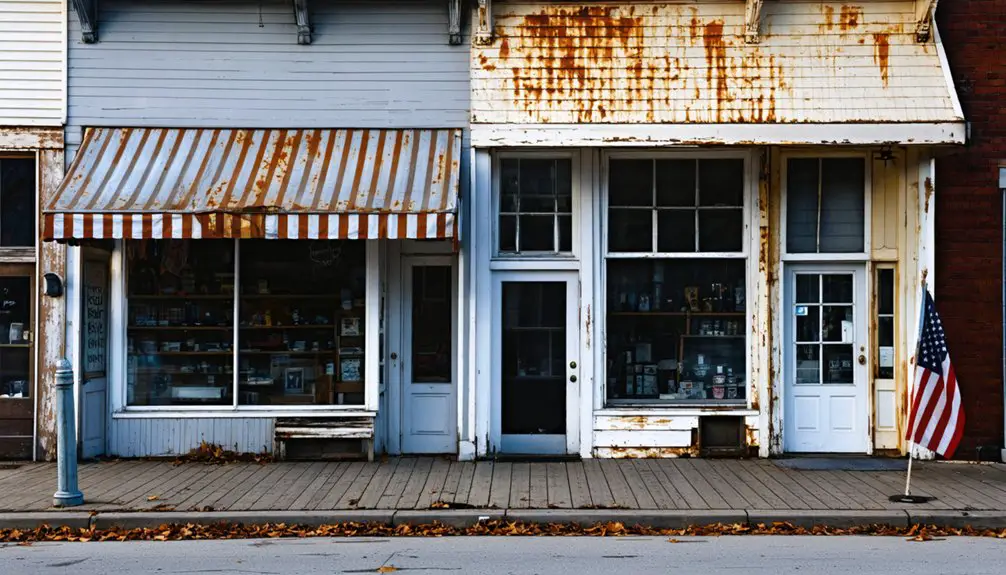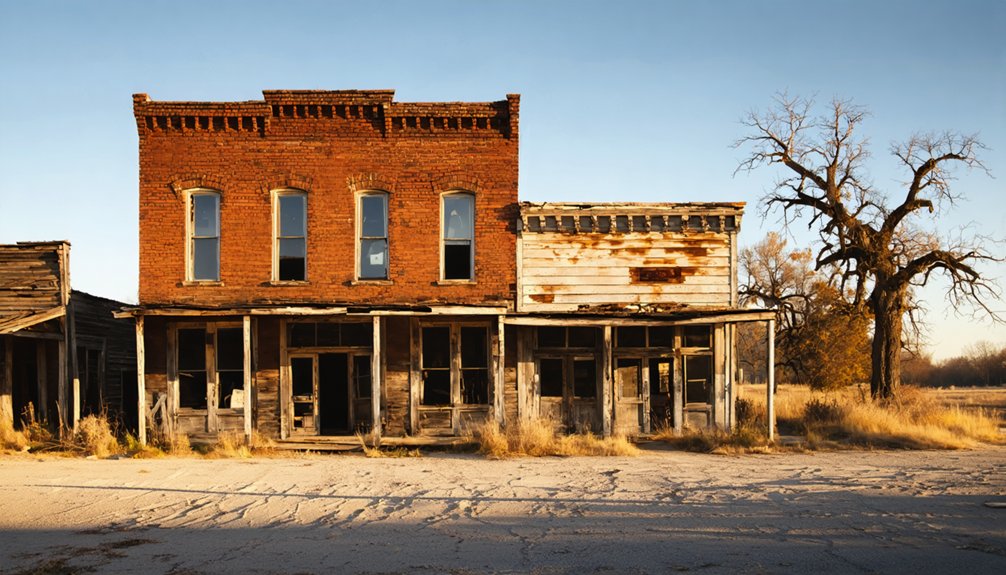
You’ll find Missouri’s ghost towns scattered across haunting landscapes—from Hamburg along Highway 94, where WWII government decrees displaced entire communities for uranium processing, to Times Beach, abandoned after dioxin contamination triggered America’s first federal buyout. Route 66‘s eleven bypassed settlements like Avilla preserve vintage gas stations and roadside relics, while southwest Missouri’s forgotten mineral springs and Ozark trading posts crumble beneath forest cover. These vanished settlements—erased by wartime power, toxic disasters, and shifting highways—offer unmediated glimpses into communities that disappeared within decades, each site revealing distinct stories of displacement and abandonment.
Key Takeaways
- Route 66 ghost towns like Avilla and Spencer feature preserved vintage gas stations, historic buildings, and authentic roadside relics from the highway’s golden age.
- Times Beach, evacuated after dioxin contamination in 1982, is now Route 66 State Park and represents America’s first federal Superfund buyout site.
- Halltown offers antique shopping amid historic streets and access to nearby Chalybeate Springs ruins, established as a health resort in 1867.
- Red Oak II recreates a 1930s community using relocated historic buildings, providing an immersive ghost town experience near Carthage.
- Ozark mountain remnants include Garber in Ruth & Paul Henning Conservation Park, featuring weathered structures and frontier-era cemeteries accessible to visitors.
St. Charles County: Where War Erased Communities
The ghost towns of Hamburg, Howell, and Toonerville didn’t fade through economic decline or natural disaster—they vanished by government decree. In 1940, federal authorities notified residents they’d be displaced for wartime evacuations to construct the Weldon Spring Ordnance Works. By mid-1941, these communities were erased from the map.
You’ll find Hamburg’s remnants along Highway 94, where German settlers once thrived near the Missouri River. The site produced TNT and later processed uranium across 17,000 acres.
Today, you can glimpse Hamburg Quarry from KATY Trail State Park, though habitation remains prohibited. Some displaced families negotiated payments; others fought to the Supreme Court. Nearby St. Charles, established in 1769, served as a historic hub for trappers and traders before these communities disappeared. The town was founded by Louis Blanchette, who established what would become an important Missouri River settlement.
These ghost town legends remind you how quickly government power can override individual rights—communities sacrificed for national security, their stories barely acknowledged.
Route 66: Roadside Relics Along the Mother Road
Missouri’s 34-mile stretch of Route 66 between Carthage and Springfield holds an extraordinary concentration of eleven ghost towns—roadside communities that thrived during the highway’s golden age. Then faded when newer alignments bypassed them.
You’ll discover places like Avilla and Heatonville where historic buildings still stand amid scattered houses, frozen reminders of bustling stops that once served Mother Road travelers. The 1958 interstate construction proved devastating for settlements like Plew Clue and Rescue, which lost their commercial vitality almost overnight when I-44 redirected traffic away from their Main Streets. Some communities converted old saloons into truck stops and coffee shops as the highway evolved, attempting to adapt to changing transportation patterns.
These abandoned settlements, accessible via original 1926 alignments, offer tangible connections to America’s most legendary highway before modern interstates rendered them obsolete.
Historic Stops Worth Exploring
Winding through Missouri’s heartland, Route 66 preserves a remarkable concentration of ghost towns that capture America’s mid-century roadside culture. You’ll discover Spencer’s vintage gas stations and cross truss bridge accessing industrial ruins frozen in time.
Just down the road, Paris Springs Junction welcomes you with its restored filling station and preserved relics. Avilla stands as a living ghost town where you can freely explore historic structures and roadside attractions, including its functioning post office originally built as a bank in 1915.
Near Carthage, Red Oak II offers something different—an artist’s recreation of a 1930s community using relocated buildings from abandoned settlements.
Times Beach tells a darker story, its haunted sites revealing environmental challenges that emptied an entire town. Near the Ozarks, Hooker’s cemetery remains where former residents are buried after the town was bypassed in 1941.
Each stop along this 34-mile stretch delivers authentic glimpses into Route 66’s vanished era.
Bypassed Towns, Frozen Time
Between Carthage and Springfield, Route 66’s original 1926 alignment winds past settlements that highway progress left behind. You’ll discover eleven ghost towns where time stopped when the Mother Road was rerouted.
Start at Avilla, where preserved structures stand as living monuments to Route 66 relics. Continue through Plew’s minimal remains—just road traces marking where community once thrived. Rescue follows, its few surviving buildings offering authentic ghost town preservation without commercialization.
Spencer welcomes you with a vintage truss bridge leading to original gas stations that transport you decades back.
At Paris Springs Junction, you’ll find a restored 1930s-style station serving modern travelers half a mile from the original settlement. Near St. Louis, Times Beach was evacuated in 1985 after dioxin-laced waste oil contamination, later becoming Route 66 State Park.
These bypassed towns offer unfiltered glimpses into roadside America’s evolution, frozen exactly where progress abandoned them.
Southwest Missouri: Forgotten Trading Posts and Healing Springs
You’ll find Southwest Missouri’s ghost towns clustered along two distinct corridors of commerce that once pulsed with activity.
The forgotten trading posts of the James River valley, where merchants like Gillis operated log structures serving Delaware settlements in the 1820s, have vanished into the landscape despite extensive archaeological searches.
Meanwhile, Route 66’s былые trading hubs—places like Spencer and Halltown—transformed from thriving mid-century stops into roadside relics after highway reroutes diverted their lifeblood traffic virtually overnight.
These posts attracted traders who sought to profit from Delaware government annuities paid in silver, creating a competitive frontier economy in the early 19th century.
Halltown now survives primarily as an antique-shopping destination, its historic streets and former garages echoing the vibrant past of Missouri’s Mother Road era.
Route 66 Trading Hubs
Along the forgotten stretches of Route 66 in southwest Missouri, weathered trading posts stand as monuments to America’s automotive golden age. You’ll discover stucco buildings with faded Route 66 murals depicting Native American themes, their false fronts still defiant against decades of neglect.
These mom-and-pop stops once pumped gasoline and sold authentic jewelry to travelers escaping railroad constraints.
The Mule Trading Post in Rolla survives, offering that essential leg-stretch with its massive original signage and friendly counter service. Most others weren’t so fortunate.
When interstates carved new paths in the 1950s-70s, entire economies collapsed. Curio shops closed, structures converted to churches or crumbled entirely. Many operators had mercantile careers serving indigenous communities before capitalizing on highway tourism.
What remains represents genuine Native craft preservation efforts and roadside freedom—unpolished relics where you can still capture that raw, unfiltered Americana without corporate sanitization.
Abandoned Healing Water Resorts
The same forces that strangled Route 66’s roadside commerce—shifting transportation routes and changing American habits—also killed Missouri’s once-thriving mineral springs culture. By the late 1800s, nearly 80 mineral spring health resorts dotted the state, promising miraculous cures through iron-rich and sulfurous waters.
You’ll find Chalybeate Springs’ remnants near Halltown, where D.C. Allen built his resort in 1867. Paris Springs reached its zenith around 1906 before vanishing entirely—its hotel burned in 1917, leaving nothing behind.
Even earlier, Isaac Van Bibber’s Sulphur Spring Resort hosted Daniel Boone in the 1820s before St. Louis swallowed it whole. These abandoned health resorts influenced modern recreational spaces, yet their exaggerated healing claims and promotional schemes couldn’t survive changing times.
Pulaski and Phelps Counties: Hidden Remnants of Rural Life
Nestled within the forested hills of south-central Missouri, Pulaski and Phelps Counties harbor some of the state’s most elusive ghost towns—settlements that thrived briefly during westward expansion before fading into obscurity. You’ll discover Cookville near Fort Leonard Wood, Bloodland, and Big Piney—communities strangled when highways realigned and commerce shifted elsewhere.
These ghost towns in Missouri history reflect the broader narrative of the American frontier, showcasing the transient nature of settlements in the face of economic change. As you explore these remnants, you’ll find echoes of the past in the weathered buildings and scattered foundations, each telling a unique story of its rise and fall. The history of these ghost towns invites an exploration of how progress often leaves behind silent witnesses to what once was.
Interstate 44’s 1981 realignment severed essential arteries, while earlier Route 66 changes left once-bustling stops isolated. Mining history and timber operations initially drew settlers, but improved transportation networks paradoxically doomed these remote outposts.
Today, you’ll find rural architecture reclaimed by forest—weathered store facades, forgotten cemeteries where Revolutionary War soldiers rest, and crumbling foundations marking Polish immigrant settlements like Pulaskifield. These sites offer unmediated encounters with Missouri’s frontier past, accessible to those willing to venture beyond maintained roads.
Taney and Stone Counties: Ozark Settlements Lost to Time
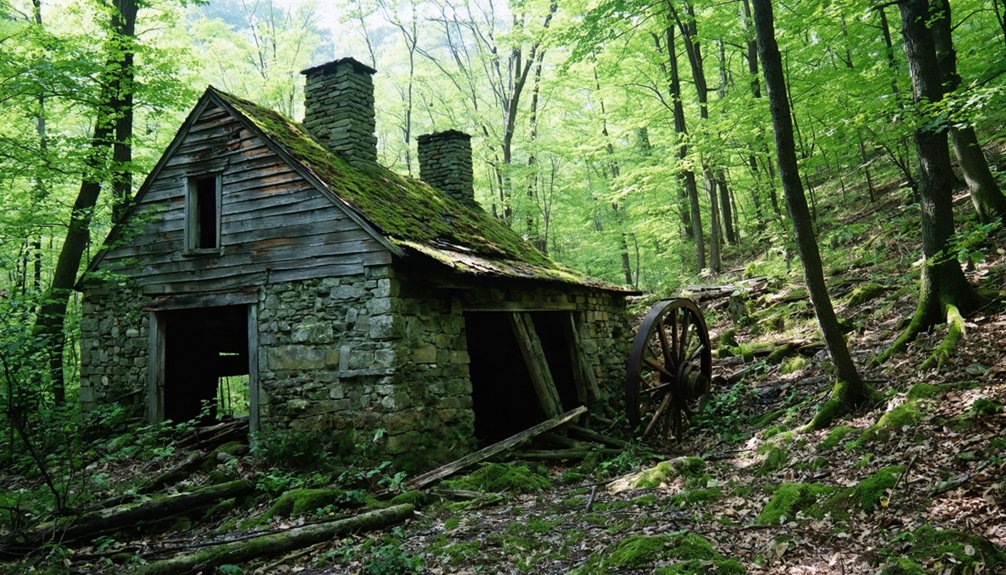
Garber stands apart with its dramatic history—now preserved within Ruth & Paul Henning Conservation Park. You can reach its ruins via Noland Road and Sycamore Church Road, where tragedy marked its final days. After a thief burned the post office and general store, killing postmistress Ada Clodfelter, the 1927 church hosted only her funeral before being repurposed as the new post office.
Stone County adds Possum Trot and Radical to this collection of abandoned dreams, each representing rural communities the Ozarks reclaimed.
Times Beach: The Toxic Town That Vanished
While most Missouri ghost towns faded slowly through economic decline, Times Beach vanished in a matter of weeks—poisoned by invisible contamination that made national headlines.
Founded in 1925 as a Meramec River resort, this community hired contractor Russell Bliss to spray oil on its dusty streets. What residents didn’t know: he’d mixed that oil with dioxin waste from Agent Orange production.
Dioxin contamination reached 300 times EPA safety limits across twenty-three miles of roads.
When catastrophic flooding struck in December 1982, the toxins spread throughout town. The CDC declared it uninhabitable.
Town evacuation became America’s first federal Superfund buyout—2,000 residents forced to abandon everything overnight.
Today, you’ll find Route 66 State Park where families once lived, a stark reminder of government overreach and corporate negligence.
Historic Mormon Settlements and Northern Outposts
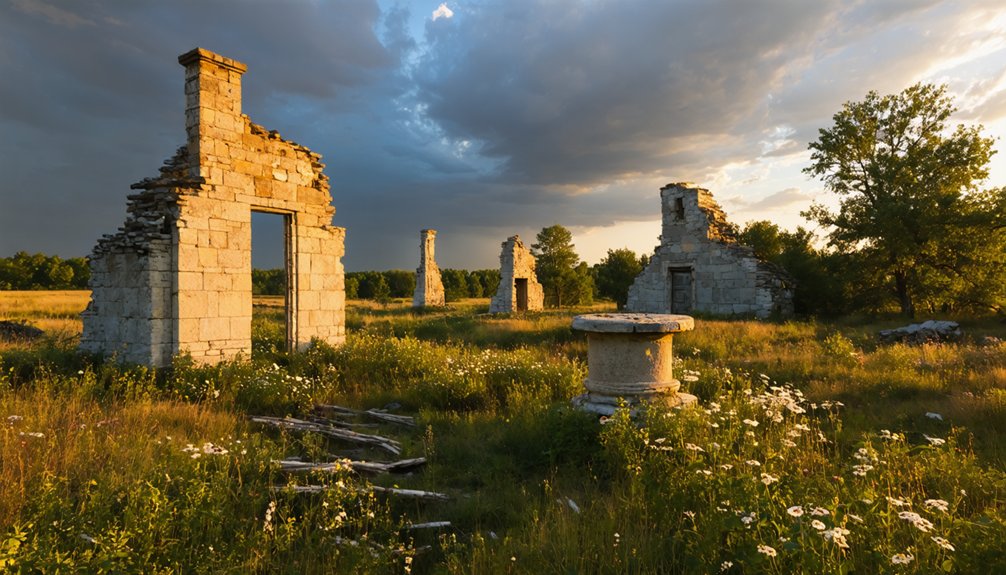
Few Americans realize Missouri once harbored the largest concentration of Latter-day Saints outside of New York—until violence erased them from the landscape entirely. You’ll find haunting remnants of this forgotten chapter scattered across northwest Missouri’s farmland.
Far West, Caldwell County’s seat, once housed 10,000 residents before Governor Boggs’ 1838 Extermination Order emptied it completely. Today, only temple cornerstones mark where this thriving city stood.
Ten miles east, Haun’s Mill commemorates where eighteen were massacred. Liberty Jail preserves the stone cell that held Joseph Smith during the expulsion, while Adam-ondi-Ahman’s Spring Hill overlooks prophesied gathering grounds never fulfilled.
These Mormon heritage sites represent America’s darkest religious persecution—8,000 citizens expelled by state decree, their historic landmarks reduced to whispers across silent fields.
Frequently Asked Questions
Are Missouri Ghost Towns Safe to Explore on Your Own?
Missouri ghost towns present mixed safety levels for urban exploration. You’ll find some preserved sites welcoming visitors, while others harbor structural dangers, environmental contamination, and access restrictions. Research each location thoroughly beforehand, respecting historical preservation efforts and posted warnings.
In addition to these ghost towns, there are also abandoned places in Missouri that tell stories of the past through their decaying structures. Many of these locations offer unique photography opportunities, enticing enthusiasts to capture their haunting beauty. However, always remain mindful of your surroundings and the potential risks involved in visiting these neglected sites.
What Should I Bring When Visiting Abandoned Towns in Missouri?
Better safe than sorry—bring sturdy boots, flashlights, first-aid supplies, water, and insect repellent. You’ll discover historic stories while respecting preservation efforts. Don’t forget your camera to document Missouri’s forgotten places without disturbing their fragile beauty.
Can You Legally Enter Buildings in Missouri Ghost Towns?
You can’t legally enter most Missouri ghost town buildings—they’re private property with trespassing laws enforced. While historic preservation matters, private property rights take precedence. Law enforcement actively warns against entry, and barricades block access to protect both.
Which Missouri Ghost Towns Are Best for Photography?
Over 100 abandoned settlements dot Missouri’s landscape. You’ll find Pink Hill’s Civil War ruins and Phenix’s mining relics best for photography, blending historical preservation with local legends. Their decaying structures offer evocative, atmospheric shots capturing frontier freedom.
Are There Guided Tours Available for Missouri Ghost Towns?
You’ll find guided ghost tours highlighting haunted legends at historic Missouri sites like the State Penitentiary and Hannibal, though preservation efforts focus more on haunted buildings than abandoned ghost towns requiring self-guided exploration.
Exploring the haunted history of Missouri ghost towns can lead you to eerie remnants of vibrant communities that once thrived. These sites often present ghostly tales intertwined with the state’s rich past, inviting adventurers and history buffs alike to uncover their mysteries. As the sun sets, the whispers of the past echo through the crumbling structures, creating an unforgettable experience for those brave enough to wander through.
abandoned towns in Missouri history rich with tales of former inhabitants offer a different kind of exploration. As you traverse the remnants of these forgotten places, you may stumble upon artifacts that tell stories of resilience and decline. Each step through the overgrown paths evokes a sense of connection to the lives once lived in these now-silent communities.
References
- https://kids.kiddle.co/List_of_ghost_towns_in_Missouri
- https://en.wikipedia.org/wiki/List_of_ghost_towns_in_Missouri
- https://www.ghosttowns.com/states/mo/mo.html
- https://www.legendsofamerica.com/mo-ghosttowns/
- https://www.youtube.com/watch?v=ERFnlJ5pjBg
- https://www.youtube.com/watch?v=eXBMX4O1-pQ
- https://www.youtube.com/playlist?list=PL4jqwLUrhjNScUWj03mXzSKyBNMNqZHGw
- https://www.geotab.com/ghost-towns/
- https://www.startribune.com/history-and-haunts-in-st-charles-mo/280229872
- https://www.stlmag.com/news/st-charles-ghost-tours-on-main-street/