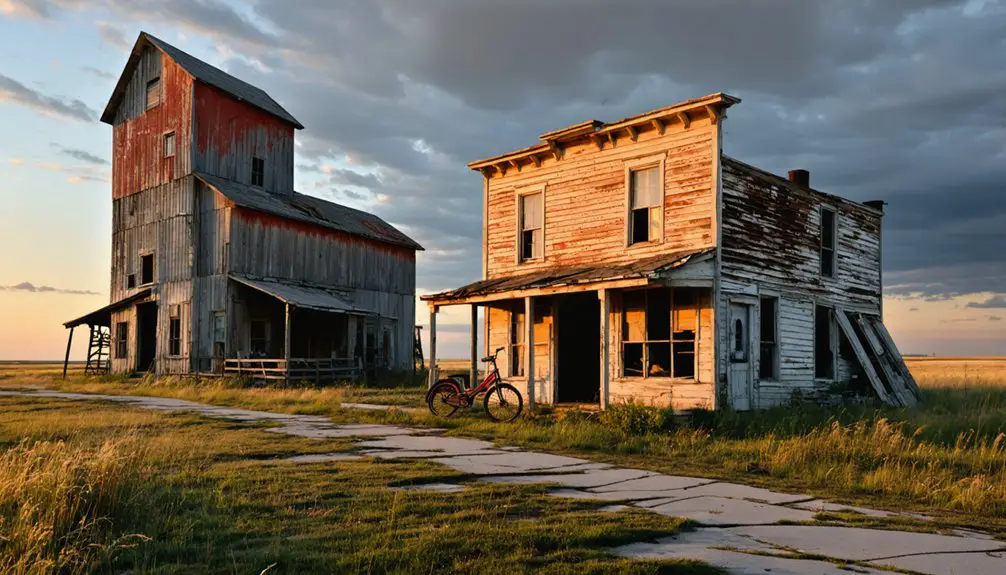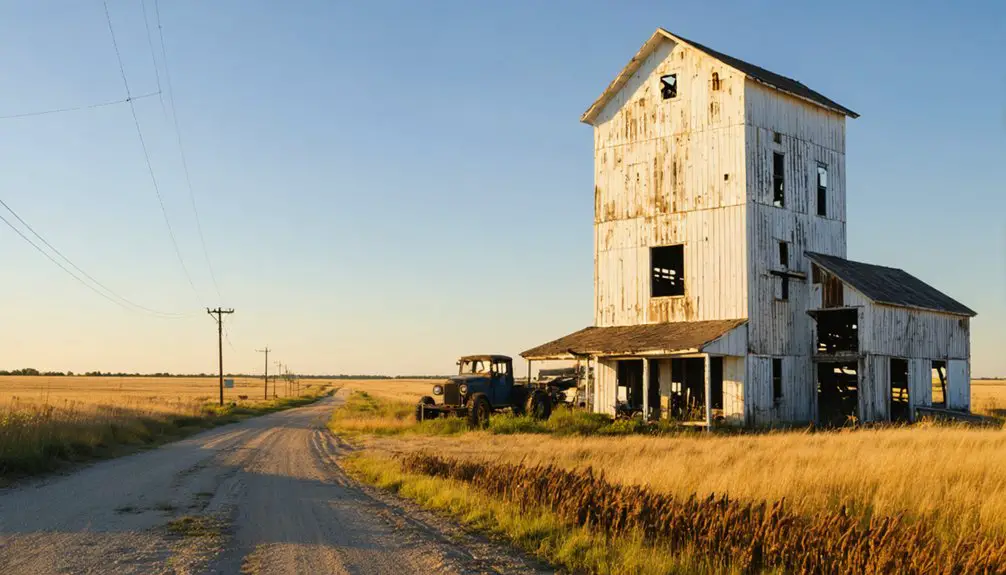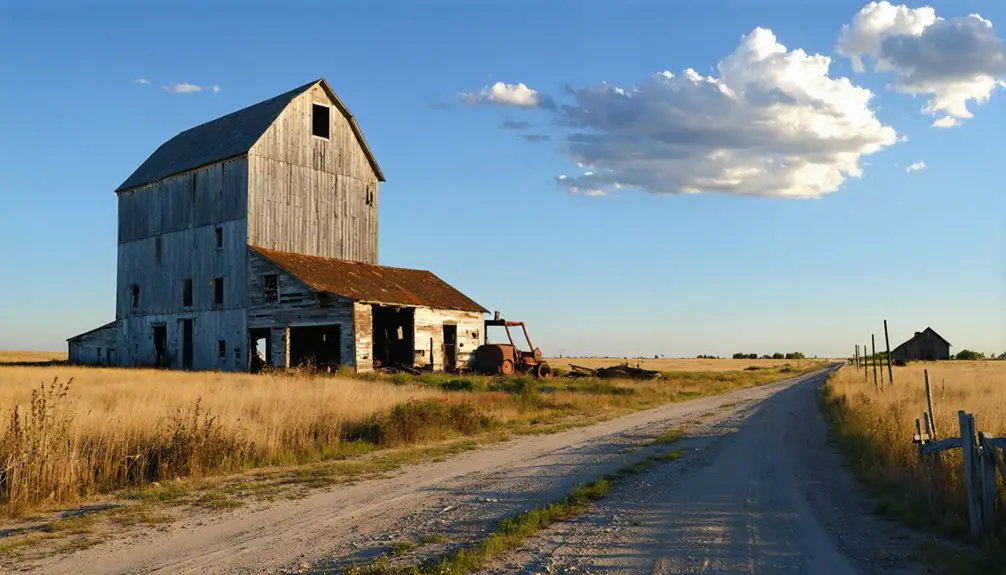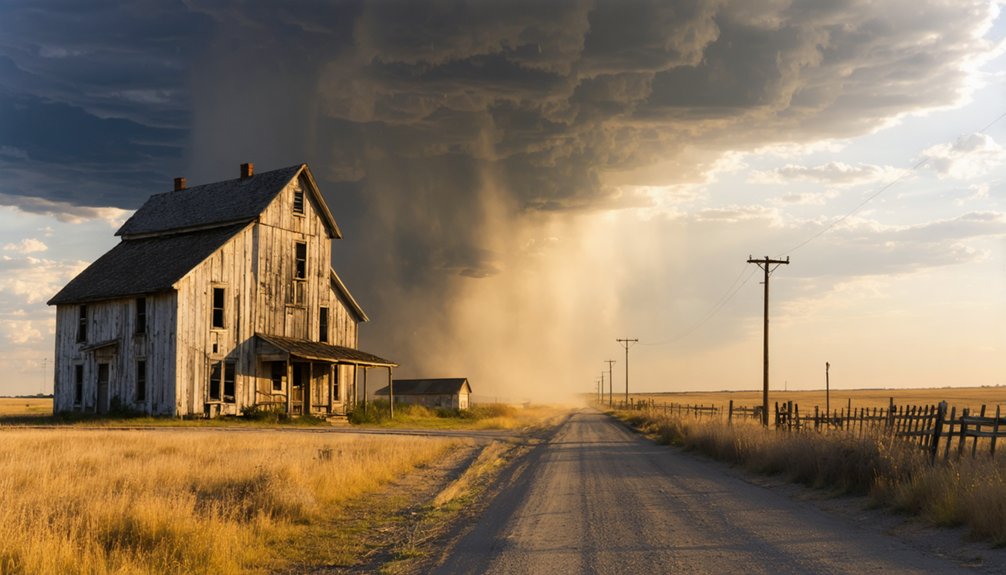
You’ll find over two dozen ghost towns scattered across North Dakota’s prairies, where weathered grain elevators tower above empty streets and abandoned churches still stand against the wind. Charbonneau, Tagus, Griffin, and Arena offer the most accessible ruins, with deteriorating storefronts, schoolhouses, and cemeteries visible from public roads. Sims features a restored Scandinavian Lutheran Church and haunting legends, while Sherbrooke’s crumbling stone walls mark a former county seat. Each site tells a story of railroad decline and Dust Bowl exodus, with specific details about what remains at every location.
Key Takeaways
- Charbonneau near Watford City features grain elevators, storefronts, and a cemetery, accessible via 2WD roads off Highway 85.
- Tagus lies 40 miles west of Minot on U.S. Highway 2, showcasing a burned church and foundation ruins.
- Griffin in Bowman County offers a grain elevator, deteriorated schoolhouse, weathered boxcar, and railway structures along Highway 12.
- Sims houses a restored Scandinavian Lutheran Church with museum and Gray Lady ghost legend in a lush valley setting.
- Most towns are accessible via public roads; visit early summer, respect private property, and avoid entering unstable structures.
Arena: A Burleigh County Settlement Frozen in Time
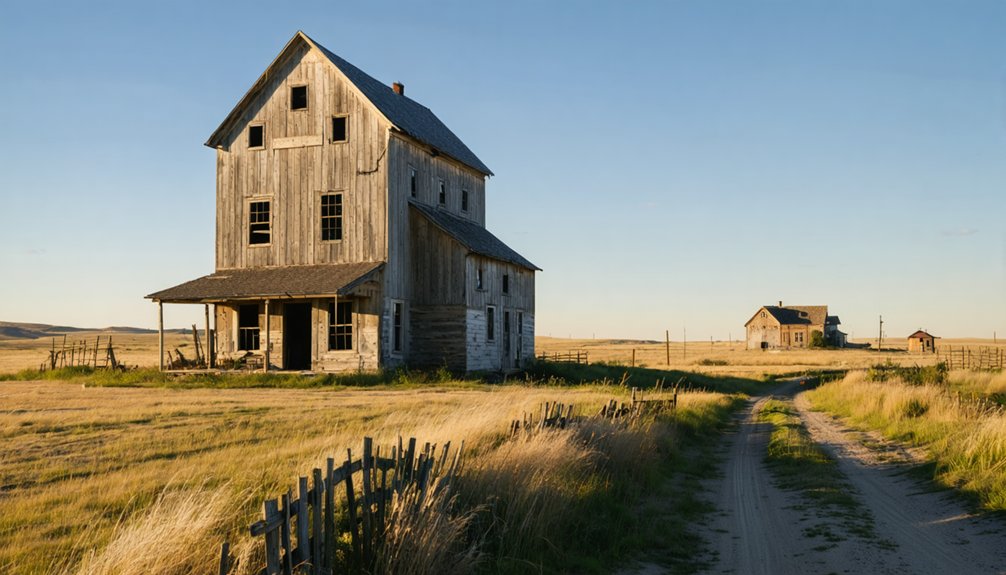
Thirty-five miles northeast of Bismarck, the wind sweeps across empty prairie where Arena once thrived as a bustling agricultural hub.
Founded in 1906, this settlement peaked at 150 residents before the Dust Bowl’s devastation reduced it to just 35 souls by 1935.
You’ll find St. John’s Lutheran Church standing sentinel among scattered ruins—a photographer’s dream against endless sky.
Twin grain elevators rise like monuments to forgotten harvests, while urban decay claims wooden structures that sheltered German immigrants and pioneering farmers.
The yellow house marks civilization’s last foothold here.
Historical preservation efforts never materialized after vandals torched the general store in 1996.
When the post office closed that same year, Arena officially surrendered to time, leaving you free to explore its weathered remnants.
The town’s name came from Postmaster Harry A. Mutchler, who recognized how the natural basin surrounded by rolling hills resembled an arena.
The 1910 railroad line brought prosperity when the Northern Pacific Railroad constructed the Pingree-Wilton connection through town.
You’ll find Sims nestled in a lush valley 30 miles west of Bismarck, where a beautifully restored Scandinavian Lutheran Church still holds services twice monthly. The whitewashed structure and adjacent parsonage—once visited by First Lady Laura Bush—stand as monuments to the Norwegian settlers who built them in 1884.
But locals will tell you the church’s most permanent resident isn’t listed in any congregation records: the Gray Lady, a pastor’s wife whose spirit allegedly opens windows, plays the organ, and draws curtains in the early morning darkness. Her legend has persisted since the 1930s, with stories claiming her presence drove away ministers who attempted to live in the parsonage. The parsonage itself stood vacant for nearly 25 years before Preservation North Dakota and volunteers completed its restoration in 2007.
Active Lutheran Church Heritage
While most ghost towns fade into complete abandonment, Sims defies expectations with its thriving spiritual core—the Scandinavian Lutheran Church still rings its bells every other Sunday, drawing roughly 50 worshippers from the surrounding countryside and nearby Almont.
You’ll discover North Dakota’s oldest Lutheran church west of the Missouri River, built in 1896 after the congregation outgrew their cramped 1884 parsonage where they’d knelt at repurposed hog troughs.
Church preservation efforts in 2006 required 2,000 volunteer hours and grant funding to save this architectural monument to Scandinavian heritage.
The adjacent parsonage, vacant since 1984, now houses the Sims Historical Society Museum. You can explore the building’s dual legacy—first-floor living quarters below the original attic worship space—documenting how frontier faith communities adapted to prairie isolation. The town name itself serves as a disambiguation for multiple historical references and geographical locations across North America.
Beyond the church grounds, a crumbling brick home stands as a testament to Sims’ original splendor, its structure largely intact despite years of abandonment surrounded by active farmland.
The Gray Lady Legend
Beyond the weathered clapboard walls and stained-glass windows, Sims harbors a darker thread in its Scandinavian tapestry—the Gray Lady, believed to be Bertha Dordal, who died in the parsonage’s first-floor bedroom between 1916 and 1918 after a lingering illness cut short her life at just 26.
You’ll find documented spirit encounters dating to the 1930s, when residents wrote their bishop about strange happenings. The church organ—one of the haunted artifacts Bertha once played—reportedly performs by itself. Windows open and close without assistance. Thumping footsteps echo through empty rooms. A 1930s resident named Olga witnessed a gray shape and a moving pump handle, though she considered the presence friendly rather than threatening.
These manifestations drove out two ministers post-Dordal and kept the parsonage vacant after 1984. Located in Morton County, about 50 miles west of Mandan, the town still maintains its active church despite its ghost town status. Today’s Sims Historical Society Museum preserves both the restoration and the legend, where Bertha’s restless presence still wanders the grounds at dusk.
Sherbrooke: The Former County Seat That Hosted a President
Sherbrooke’s crumbling stone walls rise from the prairie grass like tombstones marking North Dakota’s frontier ambitions. You’ll find historical architecture that once housed Steele County’s government from 1885 to 1919, though preservation efforts never materialized after residents voted to relocate the county seat to Finley in 1918.
President McKinley slept at the Sherbrooke House Hotel during his 1896 visit—you can still spot bed frames among the ruins. The town’s fatal flaw was isolation; without railroad access, it couldn’t compete with better-connected rivals.
Walk through the abandoned cemetery and courthouse remains, where charred timbers tell stories of fire and abandonment. The last resident departed in the 1990s, leaving only wind-swept ruins for those seeking unfettered exploration of forgotten places. The site experiences harsh continental conditions with long, cold winters that see nearly 287 cm of snow annually, contributing to the deterioration of remaining structures. Not to be confused with the city in Quebec, Canada, this North Dakota settlement shares only a name with its northern counterpart.
Charbonneau: A Remote Western Outpost Near Watford City
Unlike many ghost towns that fade gradually, Charbonneau vanished completely by the mid-1960s when Montana-Dakota Utilities cut service to the last remaining residents.
You’ll find the townsite on private land about 5-6 miles west of Highway 85, accessible via State Route 200 and a graded county road heading south. Before making the trip, you’ll need to secure permission from the landowner.
Early summer offers the best visiting conditions, falling between winter snows and peak heat.
Vanished Into Complete Abandonment
Deep in the rugged badlands of McKenzie County, the wind whispers through skeletal grain elevators and shuttered storefronts where Charbonneau once thrived as a railroad town.
By the 1960s, every resident had departed, leaving behind crumbling structures along the abandoned Great Northern grade where Old Railroads once promised prosperity.
You’ll find the post office, school, and church still standing—but posted warnings make clear they’re unsafe to enter.
The creamery’s already collapsed westward into rubble.
Spring brings Wildflower Blooms across the empty cemetery and deserted lots where 125 people once called home.
Located fifteen minutes west of Watford City off State 200, this complete abandonment offers you raw freedom to explore North Dakota’s unvarnished frontier past, where nature’s slowly reclaiming what civilization briefly held.
Accessing the Ghost Town
Reaching Charbonneau requires careful planning since you’re venturing into one of North Dakota’s most isolated corners. You’ll find the townsite approximately 15 minutes west of Watford City, halfway between Alexander and Cartwright, accessible via 2WD roads.
Stock up on fuel and supplies in Watford City—there’s nothing out here. The remaining grain elevators, abandoned schoolhouse, and deteriorating post office offer compelling photography opportunities against the prairie landscape. Though you’ll need to respect private property boundaries and stay clear of unsafe structures.
Early summer provides ideal conditions for exploration, avoiding brutal winter snowfall.
While formal heritage conservation efforts haven’t maintained the buildings, the cemetery remains accessible.
Tagus: The Closest Abandoned Town to Minot
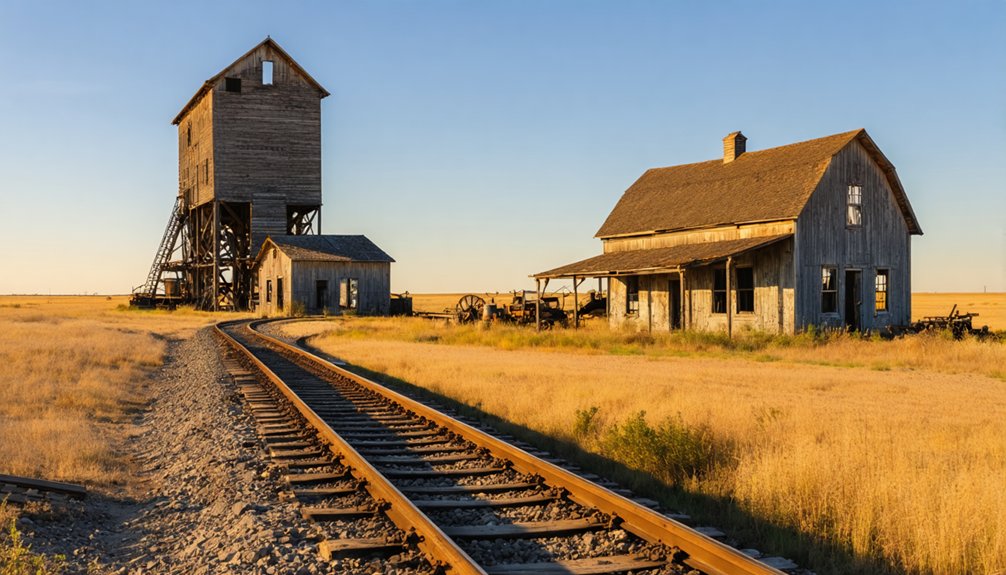
Just forty miles west of Minot along U.S. Highway 2, you’ll spot an old rail car marking what remains of Tagus. This former railroad settlement, founded in 1900, once housed 140 residents during its 1940 peak.
Today, urban decay tells the story of abandoned prairie towns—weathered structures succumb to vandalism while nature reclaims the rolling landscape.
You’ll find Tagus easily accessible from the highway, though historical preservation efforts never materialized here. The prominent St. Olaf Lutheran Church burned in 2001, its site now marked only by a memorial plaque.
What remains offers raw, unfiltered exploration—no commercialized tours or restrictions. The handful of residents won’t bother you as you wander past crumbling foundations where Nels’ store once stood, experiencing authentic abandonment without barriers.
Griffin: A Yellowstone Trail Stop in Bowman County
Along Highway 12 in southwestern Bowman County, Griffin sits quietly between Bowman and Rhame—seven miles from one, six from the other. You’ll spot the grain elevator first, standing a quarter-mile west of what remains.
Griffin announces itself from Highway 12 with a lone grain elevator, a sentinel marking the threshold of absence.
This Milwaukee Road town peaked at sixty-seven souls in 1930, boasting the county’s largest stockyards. When the post office closed that same year, Griffin’s fate was sealed. The 1936 drought finished what bureaucracy started.
Today, a deteriorating schoolhouse dominates the abandoned buildings—no historic preservation efforts here, just honest decay. You’ll find a weathered boxcar, a sagging barn, and structures that might’ve been a store or gas station.
The cemetery endures nearby, along with a curious rotary kiln site bearing radiation warnings from its 1940s-1970s operation.
Exploring North Dakota’s Abandoned Landscapes
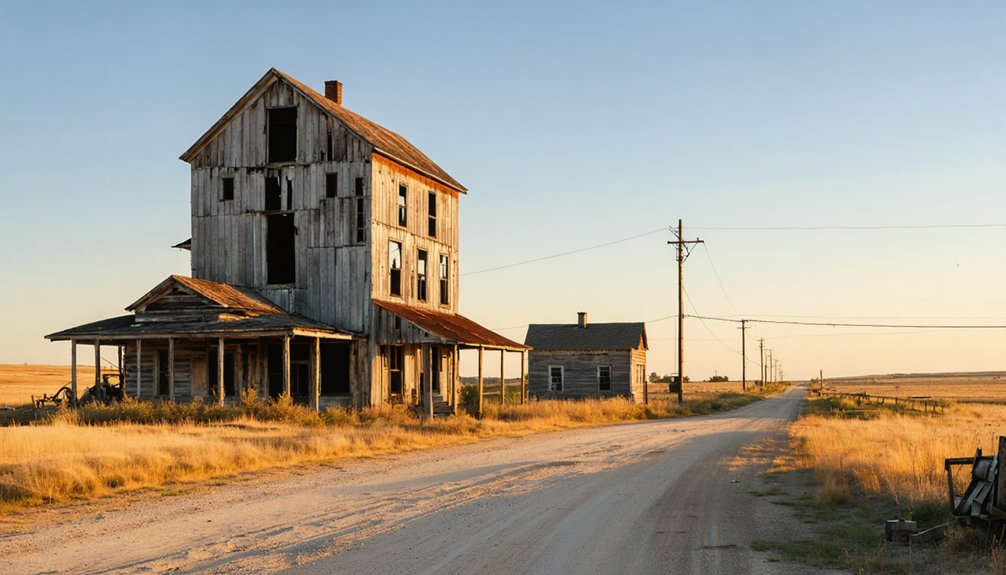
Beyond Griffin’s crumbling schoolhouse and radiation-marked kiln, North Dakota conceals dozens more abandoned settlements where prairie wind now outnumbers people. You’ll find Arena’s St. John’s Lutheran Church standing watch over empty streets, while Sims’ Scandinavian Lutheran Church still hosts services despite its ghost town status.
Sherbrooke’s two remaining homes mark where a county seat once thrived, and Bluegrass exists as Morton County’s truest ghost town—population zero, service station burned to ash.
Historical preservation efforts vary wildly across these sites. Some maintain tended cemeteries and intact structures; others crumble unprotected into prairie soil.
Tourist safety demands caution—rotting floorboards, unstable walls, and unmarked hazards await the careless explorer.
These landscapes offer unfiltered freedom to witness abandonment’s raw progression.
What to Know Before Visiting These Historic Sites
Before you load your camera and head toward these weathered structures, understand that North Dakota’s ghost towns exist on a spectrum between public heritage and private property. You’ll need permission before exploring most sites—respect fences and no-trespassing signs. When access is restricted, photograph from public roads using zoom lenses to capture architectural details.
Exploring the ghost towns of North Dakota can unveil fascinating stories of the past, with many sites showcasing the remnants of communities that were once bustling with life. Take your time to appreciate the unique architecture and the quiet, haunting beauty that these places offer, but remember to bring along extra batteries for your camera as you may find more to photograph than you initially anticipated. Each town tells its own story, waiting for those who dare to delve into their history.
These locations emerged from urban development dreams that couldn’t withstand economic decline. Railroad arrivals sparked communities like Burnstad in 1905, but shifting commerce patterns left them empty.
You’ll find remnants ranging from active churches hosting occasional services to completely abandoned settlements with zero residents since the 1970s.
Research specific locations using the “Ghosts of North Dakota” database before departing. The remote prairie setting ensures solitude while exploring, though standard vehicle safety remains essential on backroad approaches.
Frequently Asked Questions
Are North Dakota Ghost Towns Safe to Visit With Children?
You’ll find most North Dakota ghost towns reasonably safe for family exploration, though you should respect property ownership boundaries and watch for unstable structures. Historic preservation efforts haven’t reached everywhere, so crumbling buildings pose risks.
As you embark on your journey exploring ghost towns in North Dakota, prepare for a unique glimpse into the past. Each town has its own story, often marked by remnants of pioneer life and moments frozen in time. Remember to bring a camera, as the haunting beauty of these deserted landscapes offers countless photo opportunities.
What Is the Best Time of Year to Explore Abandoned Towns?
Autumn paints abandoned landscapes with haunting beauty—you’ll find the best exploration window then. Seasonal weather stays mild for comfortable wandering, while photography opportunities explode with golden foliage framing weathered structures. You’ll dodge summer crowds and winter’s impassable roads completely.
Can You Camp Overnight Near These Ghost Town Locations?
You’ll find excellent overnight camping near North Dakota’s ghost towns, from free dispersed sites at Scoria Pit to developed campgrounds at Fort Abraham Lincoln. Check local camping regulations and prepare for wildlife encounters in these remote prairie locations.
Do You Need Permission to Enter Buildings in Ghost Towns?
Yes, you’ll need permission to enter ghost town buildings. Private property and trespassing laws still apply to abandoned structures. Don’t assume access is free—always seek landowner consent before exploring, or you’ll risk legal consequences and fines.
Are There Guided Tours Available for North Dakota Ghost Towns?
You’ll find guided tours through Photo Cascadia, where photographers lead you to abandoned homesteads and churches. For historical preservation sites, Fargo Frights offers downtown ghost tours, while PocketSights provides GPS-guided exploration of Westfield and Hull’s remaining structures.
References
- https://us1033.com/a-haunting-look-at-some-real-life-north-dakota-ghost-towns/
- https://northernsentry.com/2025/06/26/north-dakota-ghost-towns/
- https://ghostsofnorthdakota892857007.wordpress.com/2015/10/30/true-ghost-towns-population-zero/
- https://www.amyallender.com/north-dakota-ghost-towns/
- https://www.youtube.com/watch?v=8GO57Im_dss
- https://www.onlyinyourstate.com/experiences/north-dakota/ghost-towns-nd
- https://cdn.saffire.com/files.ashx?t=fg&rid=DickinsonCVB&f=DixCVB_Cemetery_Map.pdf
- https://kids.kiddle.co/List_of_ghost_towns_in_North_Dakota
- https://www.quincyvagell.com/arena/
- https://www.legendsofamerica.com/arena-north-dakota/