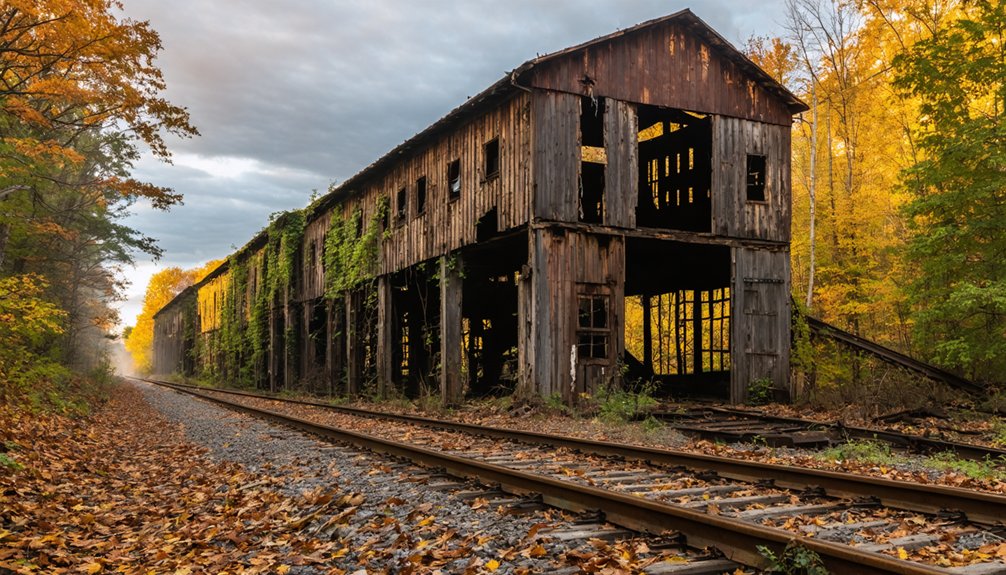
You’ll find Southern Indiana’s most enchanting ghost towns come alive in spring when temperatures hover between 50-70°F and wildflowers bloom among crumbling foundations. Explore Youngs Creek’s fire-ravaged ruins, Tunnelton’s haunted 1,731-foot railroad tunnel, or Borden’s weathered mansion remnants. Spring’s clear foliage reveals faded architectural details while dried trails make navigation easier through sites like Greenville’s Gothic church and Marengo’s abandoned storefronts. Pack sturdy boots, waterproof layers, and a camera—these forgotten settlements hold countless stories waiting beyond their moss-covered thresholds.
Key Takeaways
- Spring’s 50-70°F temperatures and blooming wildflowers create ideal conditions for exploring Indiana’s abandoned sites with clear trails and enhanced visibility.
- Youngs Creek Ghost Town features overgrown ruins, a cemetery, and Underground Railroad history, with wild violets blooming among collapsed structures.
- Tunnelton offers a historic 1857 railroad tunnel with ghost stories, unsolved murders, and paranormal legends alongside active CSX train operations.
- Greenville showcases Gothic Revival architecture, including Simpson Memorial Church, historic cemeteries, and narrow streets reflecting 1800s stagecoach-era prosperity.
- Visitors should bring waterproof layers, sturdy boots, GPS devices, first aid kits, and cameras to safely navigate ruins and document explorations.
English: Crawford County’s Eerie Remnants
When spring breathes life into southern Indiana’s hills, Crawford County’s forgotten settlements emerge from winter’s grip like whispers from another era. English stands as your gateway to exploring these spectral remains, serving as county seat since 1893 after wresting the title from flood-prone Leavenworth.
You’ll find creepy legends woven through Crawford County’s fabric, particularly surrounding Pere Cheney—though technically located elsewhere, its haunted legends echo throughout the region’s ghost town folklore. The county’s seat shifted three times: from Mount Sterling’s modest $195.50 courthouse in 1818, to Fredonia in 1821, before settling in English.
The original site flooded in the early 1990s, forcing the town to relocate uphill where it remains today. Leavenworth itself became largely a ghost town after the devastating 1937 flood swept through, destroying structures and prompting government resettlement efforts to higher ground. Today, you can trace this governmental migration while discovering abandoned cemeteries and crumbling foundations where disease, fire, and floods transformed thriving communities into eerie remnants awaiting your spring exploration.
Youngs Creek: Decades of Haunting Decay
As you wander through Youngs Creek’s scattered ruins in Orange County, spring wildflowers push through crumbling foundations where a bustling community once thrived before the devastating 1908 fire.
The contrast between nature’s renewal and decades of decay creates an unsettling beauty—fresh green vines wrapping around weathered wood, blossoms dotting the edges of abandoned structures.
Originally known as Unionville when founded in 1867, the settlement was later renamed after settler Joseph Young before its post office was discontinued in 1976.
This ghost town’s eerie atmosphere intensifies in spring, when lengthening daylight hours reveal more details of what remains, including sites connected to its Underground Railroad history and the infamous 1882 Wilson gang Massacre. Paranormal researchers have documented unexplained aerial phenomena and strange lights appearing above the abandoned structures, adding to the site’s reputation among those who investigate supernatural occurrences.
Abandoned Community’s Eerie Remnants
Deep in Orange County’s rolling farmland, the skeletal remains of Youngs Creek rise from a low hill at the intersection of County Road 850 North and 600 West. You’ll find scattered homes, a weathered church, and an old Masonic lodge where community leaders once gathered in secrecy.
The 1908 fire that jumped between buildings left its mark, and today’s ruins resemble post-apocalyptic scenes frozen in time.
The cemetery harbors haunted legends that’ll send chills down your spine—locals report ghostly presences and phantom lantern lights flickering through the darkness. Like nearby Locust Grove, where stories persist of ghost soldiers wandering the cemetery grounds after the Battle of Tippecanoe, Youngs Creek’s supernatural reputation draws those seeking Indiana’s most haunted historical sites. Despite minimal preservation efforts, these eerie remnants serve as powerful time capsules.
As one of thirteen accessible Southern Indiana ghost towns, Youngs Creek offers you unrestricted exploration of authentic decay and forgotten history. Nature gradually reclaims the abandoned structures, with vines creeping through broken windows and tree roots pushing through cracked foundations.
Spring Blooms Meet Decay
Where else can you witness wild violets and forsythia bursting through collapsed doorways while phantom stories echo through empty halls? Youngs Creek offers this striking contrast each spring, when nature’s renewal collides with decades of abandonment.
You’ll discover forgotten artifacts scattered among structures where walls crumble and roofs cave inward, creating haunting melodies as wind whistles through broken windows.
The Orange County locale transforms into something unexpectedly beautiful when wildflowers carpet the grounds where families once gathered.
You’re free to wander these remnants at your own pace, photographing weathered foundations overtaken by blooming vegetation. The Delaware once favored this riverside confluence location where Hurricane Creek meets Youngs Creek, making it a layered historical site.
Time has frozen here, preserving both decay and rebirth simultaneously.
Pack sturdy boots for exploring overgrown paths, and bring your camera to capture this ethereal intersection of life and loss.
Marengo: Exploring Caves Beneath a Ghost Town
On September 6, 1883, two Hiestand children stumbled upon one of Indiana’s most remarkable cave systems while playing near a sinkhole in a grove outside Marengo.
Unlike the region’s mining history, this wasn’t a man-made excavation—an underground river carved these passages over millennia, sculpting extraordinary formations through natural underground geology.
You’ll walk through Sherwood Forest, where seven-foot stalagmite totem poles represent 84,000 years of mineral deposits.
In Cave Hill Cemetery, stalactites drape every ceiling inch. Tours began just days after discovery, when those kids mistook flowstone for diamonds.
Above ground, abandoned structures tell Marengo’s decline—gutted theaters, houses with scattered toys, floors collapsing after decades of decay. The town’s deserted structures include an old bookstore still filled with books and a building labeled Morango Lodge with handcrafted benches inside.
This contrast between thriving subterranean wonder and surface-level abandonment creates Indiana’s most surreal ghost town experience. The cave achieved National Natural Landmark status in 1984, recognized for its geological significance while the town above continued its quiet fade into history.
Greenville: The Christian Church and Its Forgotten Stories
You’ll find Greenville’s most striking landmark rising in Gothic Revival splendor—the Simpson Memorial United Methodist Church, built in just 60 days back in 1899. This architectural gem, funded partly by glass industry magnate Captain John Baptiste Ford’s $3,500 donation, stands as evidence to a once-thriving turnpike town that served Louisville-to-Vincennes stagecoaches for 75 years. The church was named after Bishop Matthew Simpson, a U.S. senator and confidant of Abraham Lincoln.
Beyond the church, Greenville harbors peculiar tales, from Joseph Smith’s mysterious four-week stay in 1832 to streets so narrow they measure just nine feet wide.
The Church’s Historic Centerpiece
While stagecoaches rumbled along the Louisville-Vincennes turnpike in 1838, Greenville’s Methodist congregation raised their first proper frame building—a modest one-story structure that would anchor this Floyd County community for over six decades.
You’ll find the real treasure standing today: Simpson Chapel, completed in just 60 days during 1899. This Gothic Revival masterpiece replaced that humble frame church, funded largely by Captain John Baptiste Ford‘s $3,500 pledge—a former resident who’d found fortune elsewhere but remembered his roots.
Andrew Carnegie even contributed toward the pipe organ.
The church architecture tells Greenville’s story better than any history book. Added to the National Register in 2004, it stands among community legends as proof that determination built more than buildings here—it forged identity along forgotten stagecoach routes.
Greenville’s Unusual Past Attractions
Just as Simpson Chapel’s construction dust settled in 1899, another congregation was stirring to life in T.E. Hooker’s home. By 1900, the Greenville Christian Church emerged from these intimate gatherings, adding another layer to the town’s spiritual tapestry.
You’ll discover how these two congregations shaped a community that once thrived along the Louisville-Vincennes turnpike, where stagecoaches rumbled past for seventy-five years. The historical architecture tells stories of determined pioneers—Captain Ford’s generous pledge, Carnegie’s pipe organ donation, and settlers claiming Revolutionary War bounty land.
Walk among Greenlawn Cemetery’s 1,500 graves, where community legends rest beneath spring wildflowers. These weren’t just buildings; they were beacons along a wilderness road, connecting isolated homesteads to something greater than survival.
Borden: Beauty in Abandonment

Tucked away in Wood Township of southern Clark County, Borden stands as a proof to ambitious dreams that once flourished in the Indiana wilderness.
Founded in 1816 by Rhode Islander John Borden, this settlement thrived under William W. Borden’s silver mining fortune from Leadville, Colorado. His 1900 museum showcased remarkable historical artifacts—Revolutionary War swords, ancient coins, and prehistoric fossils from worldwide expeditions.
Silver fortunes from distant Colorado mines transformed a modest Indiana settlement into an unlikely repository of Revolutionary relics and ancient wonders.
After his death in 1906, these treasures found homes at the Smithsonian and Chicago institutions.
Today, you’ll discover architectural remnants telling stories of frontier ambition. While the Institute crumbled into disrepair and was demolished, the hilltop mansion still overlooks the town, and the preserved tavern stands as a weathered memorial to one man’s vision for cultural enlightenment in frontier Indiana.
Tunnelton: Train Tunnels and Unsolved Mysteries
About fifty miles northeast of Borden’s cultural aspirations, a different kind of darkness carved itself into Indiana’s limestone hills. Tunnelton’s 1,731-foot railroad passage, completed in 1857, harbors tunnel legends that’ll make you question what lurks between whistle blows.
Night watchman Henry Dixon’s 1908 murder remains unsolved—his killer vanished, but witnesses claim his lantern still flickers in the darkness. Haunting legends multiply: construction allegedly disturbed burial grounds, leaving bodies entombed within brick walls. You’ll hear stories of decapitated apparitions and the 1882 Tunnelton Massacre victims.
CSX trains still rumble through occasionally, so trespassing means risking more than paranormal encounters. Visitors report screams, cold spots, and vanishing objects. Spring’s longer daylight might embolden your exploration, though shadows persist where limestone meets legend.
Why Spring Is the Perfect Season for Ghost Town Adventures
When March thaw releases Indiana’s forgotten settlements, ghost town explorers inherit a season engineered for discovery. Spring’s 50-70°F temperatures let you wander crumbling structures without summer’s oppressive heat or winter’s treacherous ice.
Wildflowers erupt around abandoned storefronts, transforming desolation into haunting beauty while budding trees reveal hidden pathways winter concealed.
You’ll find exceptional conditions for urban legends research:
- Dried trails grant vehicle access to remote sites inaccessible during muddy months
- Reduced foliage exposes faded signage and architectural details vital for historic preservation
- Minimal crowds mean uninterrupted communion with time-capsule settlements
Clear spring skies illuminate weathered facades while manageable undergrowth lets you safely navigate debris fields. Swollen creeks add dramatic atmosphere without flooding risks, and birdsong amplifies the eerie silence of depopulated streets—freedom seekers discover spring unshields Indiana’s ghostly past perfectly.
What to Bring on Your Southern Indiana Ghost Town Tour
Before you venture into Southern Indiana’s crumbling settlements, pack strategically—the difference between documented discovery and dangerous mishap lies in your daypack’s contents.
Layer waterproof jackets over thermal base layers for unpredictable spring weather near Hindostan Falls. Sturdy boots navigate rocky mill holes while protecting against rusty nails protruding from collapsed structures. Bring detailed maps and GPS devices—cell service vanishes in these forgotten valleys along the Wabash River.
Your camera captures both wildflower photography blooming through foundation cracks and rusted machinery half-buried in overgrown clearings. Pack first aid supplies for scrapes from weathered wood, insect repellent for brushy approaches, and purification tablets for extended explorations.
A headlamp illuminates shadowed interiors where sunlight hasn’t penetrated in decades. Don’t forget notebooks for recording inscriptions before nature erases them completely.
Preserving History: The Importance of These Abandoned Communities

These crumbling foundations and rusted iron furnaces stand as open-air classrooms where Indiana’s industrial backbone becomes tangible.
You’ll discover how historical preservation transforms abandoned sites into powerful narratives—from Eliza Furnace’s 1840s iron operations to Monument City’s rooftops emerging during 2012’s drought.
Community storytelling breathes life into places others forgot.
The preservation efforts you’ll encounter include:
- Interpretive markers revealing Black Lick Valley’s mining legacy and the 230-house town of Wehrum
- National Register sites like Eliza Furnace, connecting you to southwestern Pennsylvania’s industrial origins
- Ghost Town Trail’s 36 miles threading through 41 abandoned communities, documenting why each vanished
You’re free to explore these spaces where cemeteries preserve forgotten names and ArcGIS maps detail abandonment patterns.
Each visit supports regional economies while protecting stories that shaped America’s heartland.
Frequently Asked Questions
Are Any Southern Indiana Ghost Towns Privately Owned or Restricted Access?
These forgotten places aren’t your playground—several southern Indiana ghost towns sit on private land where trespassing regulations apply strictly. Witches Castle’s locked gates and New Harmony’s original site demand you respect abandoned property laws protecting owners’ rights and your freedom.
Can You Camp Overnight Near These Ghost Towns During Spring Visits?
You’ll find excellent camping near Spring Mill’s pioneer village and Rose Island ruins, forsaking roofs for starlit nights among abandoned structures. Spring Mill offers 223 electric and full hookup sites, while Charlestown provides primitive options for adventurous souls.
Are Guided Tours Available for Any of These Abandoned Communities?
Picture moonlit paths through forgotten streets—you won’t find guided tours specifically for Indiana’s ghost towns themselves. However, nearby Crown Point, Indianapolis, Fort Wayne, and Madison offer urban exploration through haunted walks emphasizing historical significance and spectral encounters.
In addition to urban exploration, you can also explore abandoned sites in Indiana that reveal the state’s rich history and intriguing stories. Many of these locations, once bustling with life, are now shrouded in mystery and provide a unique glimpse into the past. The eerie atmosphere surrounding these forgotten places adds to their allure, drawing adventurers and history enthusiasts alike.
What Photography Equipment Works Best in Low-Light Ghost Town Environments?
You’ll want a full-frame camera with high ISO capability, fast wide-angle lens, and sturdy tripod for camera stability. Don’t forget lens filters for controlling light during golden hour exploration and spare batteries for extended shooting freedom.
Are There Entrance Fees for Visiting These Southern Indiana Locations?
You’ll find varied costs for urban exploration here. Spring Mill charges $8-10 park entry supporting historical preservation. Marengo Cave requires $25 adult admission. Fort Ritner and Teleton offer free access, letting you roam abandoned sites without restrictions.
References
- https://wkdq.com/southern-indiana-ghost-towns/
- http://freepages.rootsweb.com/~gtusa/history/usa/in.htm
- https://www.onlyinyourstate.com/experiences/indiana/ghost-towns-in
- https://www.geotab.com/ghost-towns/
- https://www.youtube.com/watch?v=45D4dbASJyE
- https://storymaps.arcgis.com/stories/9a3b3f4a63ba4031a46cb53907a0515c
- https://northernmichiganhistory.com/pere-cheney-michigans-legendary-ghost-town/
- https://www.youtube.com/watch?v=eAx30PfPWkE
- https://tedshideler.com/2024/03/02/crawford-countys-courthouse-ruins/
- https://libsysdigi.library.illinois.edu/OCA/Books2012-06/historyofcrawfor00plea/historyofcrawfor00plea.pdf