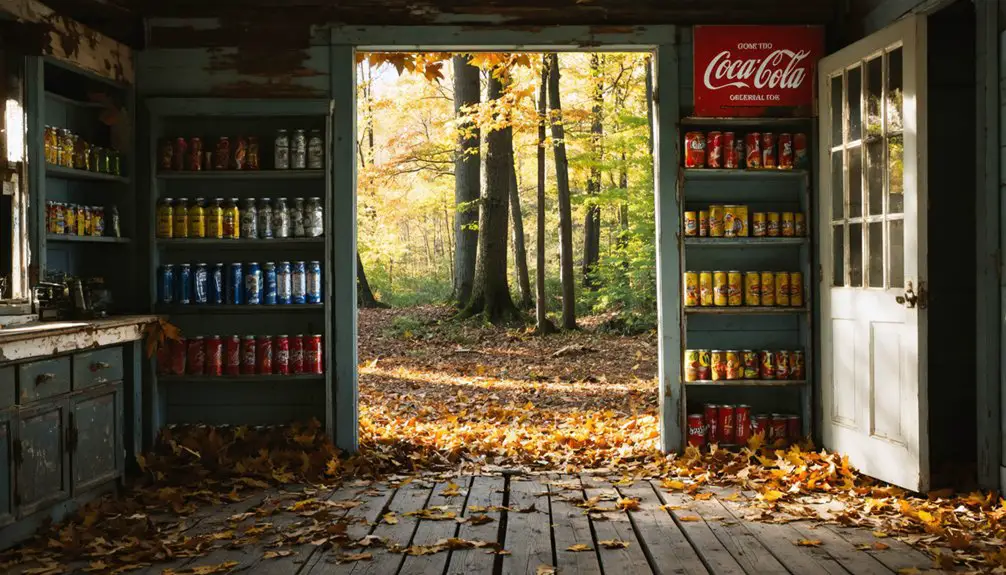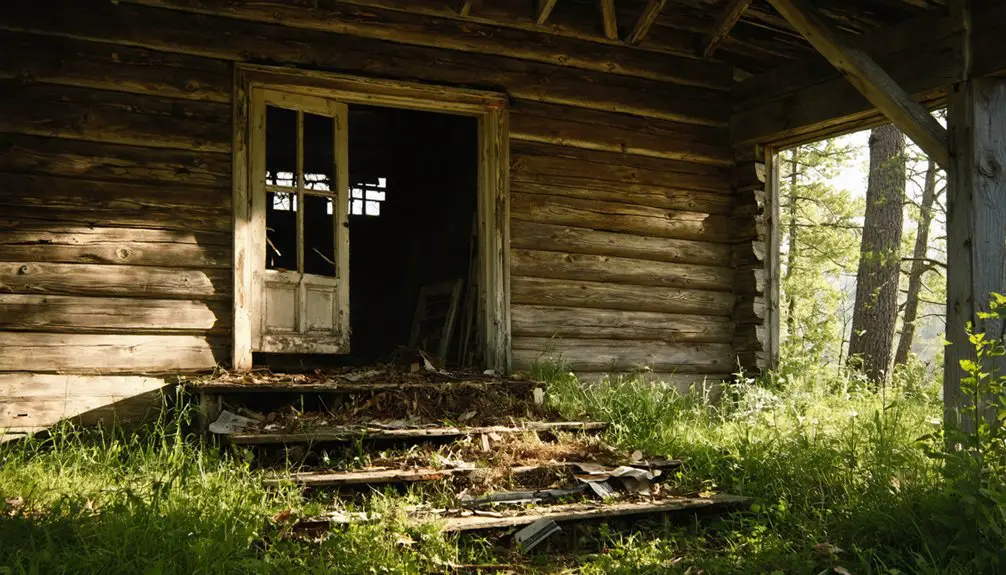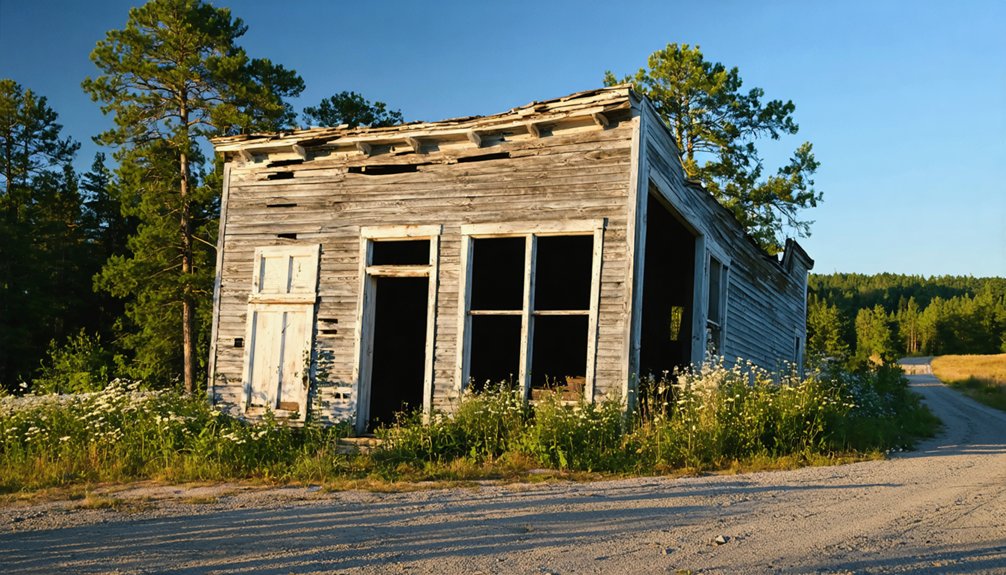
You’ll find Maine’s most compelling ghost towns accessible during summer months, from Swan Island’s overgrown settlement with 1750s saltbox houses and twenty stone cellars (reachable by $8 ferry) to Flagstaff Lake’s submerged 19th-century streets visible at low water. Madrid offers rust-stained mining remnants from its 4,000-resident peak, while Ligonia Village showcases industrial ruins and brick foundations near South Portland. Frye Mountain’s colonial cellar holes dot hiking trails, and Fort William Henry preserves archaeological artifacts from 60-soldier garrisons behind 22-foot walls—each site revealing stories best discovered through careful exploration.
Key Takeaways
- Colonial Pemaquid State Historic Site offers archaeological exhibits, fort ruins, and interactive artifacts showcasing colonial conflicts and settler history.
- Swan Island requires boat access with $8 reservation, featuring 1700s saltbox houses, stone cellars, and wildlife like bald eagles.
- Madrid, Maine has abandoned structures with no signage in Franklin’s unorganized territory, ideal for free summer exploration without amenities.
- Ligonia Village in South Portland displays industrial ruins, brick foundations, and weathered facades from its 1859 kerosene oil industry origins.
- Flagstaff Lake reveals submerged 19th-century town foundations and streets underwater, visible during low water levels after 1950 dam construction.
Fort William Henry: Colonial Military Outpost in Bristol
Today’s Colonial Pemaquid State Historic Site lets you climb the 1908 replica tower, touch original stones from the ruins, and scan John’s Bay from the rooftop.
The on-site museum reveals how Massachusetts spent two-thirds of its colonial budget building this fortress, only to watch it crumble under French cannons. The fort’s garrison of approximately 60 soldiers defended walls that rose between 10 and 22 feet high, anchored by a stone bastion that towered at 29 feet.
The site displays the “Guns, Politics, and Furs” exhibit on the second floor, featuring archaeological collections and personal records that document the complex relationships between English settlers, Native Americans, and French forces who fought for control of this strategic outpost.
Perkins on Swan Island: Wildlife Refuge With Abandoned Settlement
You’ll access this hauntingly beautiful island refuge by boat at its northern tip, where a 4.5-mile dirt road and seven miles of trails wind past five homes standing since the 1700s.
The former Town of Perkins was abandoned by the mid-1940s when industries collapsed and families sold their land to the state. Now, it serves as a wildlife management area where bald eagles nest above fields that once fed shipbuilders and ice harvesters.
As you explore on foot or mountain bike, you’ll encounter the Tubbs-Reed saltbox house, the Robinson House now used by Maine officials, and a weathered cemetery—all preserved reminders of a community that never exceeded 100 souls. The island once hosted notable figures like Aaron Burr and Benedict Arnold during its more prosperous days. You can visit this wildlife refuge for approximately $8 per person, which grants you full-day access to explore the abandoned settlement and observe wildlife.
Historic Village Exploration Opportunities
When you step onto Swan Island’s overgrown trails, you’re walking through layers of history that stretch from Abenaki summer camps to a thriving 19th-century settlement that once built ocean-going vessels.
The 1,500-acre historic district preserves remarkable abandoned architecture—five houses dating to the 1750s showcase saltbox and Italianate styles, while the ruins of over twenty stone cellars mark former homesteads.
You’ll discover the Dr. Silvester Gardiner house from 1763 and the ornate Robinson-Powell House with its decorative brackets and bay windows.
Ghost town conservation efforts have protected Curtis Cemetery and a network of forgotten roads winding through woods. The settlement’s evolution from a small farming and ice cutting community to a bustling maritime center demonstrates the island’s economic transformation over two centuries.
The island’s significance as one of the northeast’s important bald eagle breeding areas adds a compelling natural history dimension to your exploration of the abandoned settlement.
Access requires advance reservation through the wildlife refuge, but you’ll explore freely once there, connecting with a settlement that thrived, peaked at nearly 100 residents, then vanished entirely by the 1940s.
Wildlife Management Area Access
Reaching Swan Island’s abandoned settlement requires planning beyond typical Maine day trips—this 1,775-acre wildlife management area sits in the Kennebec River between Richmond and Dresden, accessible only by water and strictly by advance reservation.
You’ll catch the seasonal ferry from Richmond’s parking lot (May through Labor Day) or launch your own kayak for the 1.75-mile paddle, timing it carefully around 5-7 foot tidal swings.
Once there, wildlife observation dominates the experience. Bald eagles and osprey patrol overhead while Atlantic sturgeon leap from the river below.
The birdwatching hotspots include mudflats teeming with shorebirds and forest canopy filled with songbirds. You’ll find 7 miles of trails winding through habitat where snowshoe hares, river otters, and white-tailed deer roam freely alongside the settlement’s ghostly remnants. The island’s Maritime Spruce-Fir Forest creates dense canopy cover interspersed with mixed evergreen patches that provide diverse habitat zones for resident wildlife. Among the remnants stand several of the 27 homes built during the settlement period when Perkins functioned as an active farming community with 100 residents before its abandonment in 1936.
Former Residents’ Building Remains
Standing among the weathered clapboards and sagging rooflines, you’re walking through what remains of Perkins—a settlement that thrived for nearly 200 years before economic collapse erased it from Maine’s municipal maps.
Five homes from the 1700s still stand on Swan Island, their lonely, dusty interiors frozen in time. The Tubbs-Reed House, once owned by a Massachusetts Militia Mayor, anchors the ghost settlement alongside the Robinson House, now repurposed by state officials.
You’ll find the island cemetery marking where generations rest, long before the Kennebec tribe‘s ancient hunting grounds transformed into failed farmsteads.
These structures tell stories of shipbuilders who launched seven vessels, ice harvesters who worked frozen rivers, and farmers who ultimately surrendered to pollution and progress. Evidence of human activity dating back at least 9,000 years makes Swan Island one of Maine’s longest continuously inhabited sites.
The schoolhouse is gone, but their legacy persists in crumbling foundations. Today, the island operates as part of the Steve Powell Wildlife Management Area, where wetlands and forests have reclaimed much of the former settlement.
Flagstaff Village: Maine’s Sunken Town Beneath the Lake
Beneath the rippling surface of Flagstaff Lake lies what remains of a thriving 19th-century community that vanished in 1950. You’ll find Maine’s largest manmade lake concealing an entire settlement sacrificed for hydroelectric power. When Central Maine Power completed Long Falls Dam, families watched their ancestral homes disappear beneath rising waters.
Today’s Flagstaff Lake tells a haunting story:
Beneath the surface, generations of memories lie silent—a community forever preserved in the depths of progress.
- Foundations and streets rest underwater where mills once processed timber from surrounding forests.
- Urban legends claim you can spot building outlines during exceptionally low water levels.
- The Memorial Chapel relocated to Eustis represents minimal preservation efforts for this drowned community.
- July 4, 1949 marked residents’ final gathering before displacement.
You’re paddling above streets where settlers built their dreams, a submerged reminder that progress demands sacrifice.
Madrid: Remnants of a 19th Century Mining Community
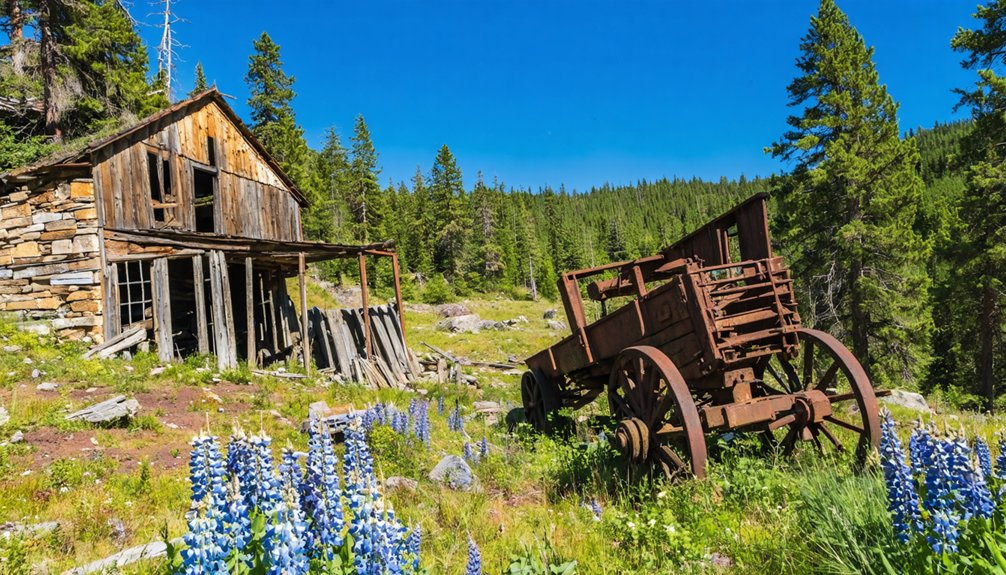
You’ll find Madrid’s story written in rust-stained tipples and sagging mine entrances that still honeycomb the hillsides, where 3,000 miners once extracted 180,000 tons of coal yearly before the boom collapsed in 1954.
The drive out requires careful navigation on unpaved roads past skeletal wooden structures and coal slag heaps that glitter black in the summer sun.
I remember pressing my face against the Mine Shaft Tavern‘s dusty windows, peering at the original mahogany bar where foremen once paid wages in company scrip, the floorboards still groaning with the weight of a century’s worth of boots.
Mining Boom and Decline
Deep in the Ortiz Mountains of New Mexico—not Maine—Madrid rose from a remote mining camp into a thriving company town that once lit up the desert night with 150,000 Christmas bulbs. You’ll discover a mining history that peaked when 4,000 residents extracted coal for the Santa Fe Railroad during WWI and the 1920s.
The town’s dramatic arc tells a story of boom and bust:
- Railroad spur construction in 1892 transformed primitive operations into industrial-scale mining
- Thomas Edison visited in 1900, implementing a power plant that electrified the community
- Oscar Huber’s 1919 superintendent role brought unprecedented prosperity
Post-WWII closure led to near-abandonment until 1975, when 150 buildings sold for $1,500 each.
The town’s decline left weathered structures where coal-dust dreams once flourished.
Accessing Madrid’s Ruins Today
Unlike its New Mexican namesake, Maine’s Madrid sits tucked away in East Central Franklin’s unorganized territory.
Crumbling foundations and weathered timber frames mark what remains of a town that couldn’t outlast the 20th century.
You’ll find no formal signage directing you here—just rural roads leading to abandoned schoolhouses, churches, and businesses from the 1800s gold rush era.
Summer’s your best window for exploration.
Navigate overgrown paths between structures on foot, discovering a cemetery that spawns urban legends among locals.
There’s no admission fee or guided tours restricting your wandering.
The preservation challenges are evident everywhere: sagging rooflines, collapsed walls, nature reclaiming civilization.
Bring supplies—no restrooms or shops exist.
Daylight exploration’s essential for safety.
Pair your visit with nearby Freeman for a full ghost town experience.
Davidson: Forgotten Lumber Town With Visible Machinery
When Ora Gilpatrick purchased an entire township west of Stacyville in 1901, he couldn’t have imagined his bustling lumber empire would one day vanish into the Aroostook County wilderness. Davidson thrived until 1929, complete with sawmill, clothespin factory, and railway station.
Today, you’ll find eerie remnants of the lumber industry scattered throughout overgrown forests.
What remains to discover:
- Cone-shaped waste burner standing sentinel among the trees
- Foundation ruins marking former boarding houses and town hall
- Rusted machinery parts embedded in moss-covered forest floor
- Wooden sidewalk fragments leading nowhere
Access is challenging—roads have grown over and trees block former passages. You’ll need determination to reach this historic preservation site.
Trains still whistle through Davidson, their sounds echoing through empty clearings where loggers once worked.
Ligonia Village: South Portland’s Industrial Ghost Town

Just seven minutes from downtown Portland, brick foundations and repurposed warehouses mark where Ligonia Village once hummed with industrial ambition.
You’ll find traces of the 1859 Portland Kerosene Oil Company at “Kerosene Corner,” where Main and Lincoln Streets intersect. Urban decay tells stories here—walk Brown’s Hill along Ridgeland Avenue, where Revolutionary-era farmers once tended land before French and Indian Wars drove them out.
The village’s transformation reveals Maine’s industrial backbone.
Historical preservation efforts have cataloged factory remnants scattered throughout South Portland’s neighborhoods, though many structures remain undocumented.
You can explore solid starter homes hidden behind weathered industrial facades, where warehouses now serve unexpected purposes.
At 95 Main Street, Henry Bodge’s 1866 building still stands—now housing South Portland Wine Company, connecting you directly to entrepreneurs who built this vanished community.
Frye Mountain Area: Cellar Holes and Stone Wall Clusters
You’ll discover authentic traces of hardscrabble lives:
- Rectangular cellar holes measuring 8′ by 18′ mark early frame houses, with chimney bases extending toward the center.
- C-shaped cellars added later for storing apple harvests and cider barrels.
- Massive stone walls snaking through forest—built from field-cleared rocks during colonial expansion.
- Old cemeteries and lilac bushes still blooming where doorsteps once stood.
Trek these trails with local knowledge if possible. The landscape reveals ordinary freedom-seekers who worked 100+ acre farms until economic collapse forced their departure, leaving foundations and horseshoes behind.
Planning Your Ghost Town Summer Adventure in Maine
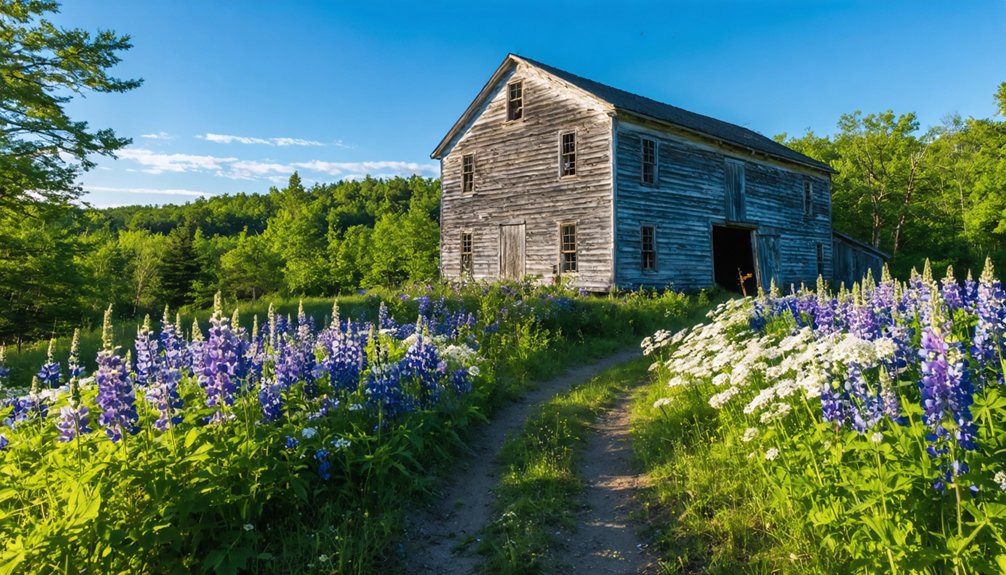
After examining stone walls and cellar holes hidden in forest shadows, your attention shifts to the logistics of actually reaching these scattered remnants. Seasonal weather determines everything—summer’s warmth lets you wade through Flagstaff Lake’s shallows when hydraulic levels drop, revealing the drowned village beneath.
You’ll need boat access for Perkins Township via the Kennebec River ferry, while Kezar Falls’ crumbling woolen mill welcomes your camera from solid ground.
Pack walking shoes, flashlights, and respect for preservation challenges. Searsport’s Captain’s House faced demolition in 2016; sites vanish without warning. Check current conditions before departing—restoration zones shift, private property boundaries exist, and what stood last summer might’ve collapsed by now.
These adventures reward spontaneity, but strategic planning keeps you mobile and legal.
Guided Ghost Tours in Rockland, Portland, and Boothbay Harbor
When darkness settles over Maine’s coastal towns, professional storytellers transform historic waterfronts into open-air theaters where verified history collides with unexplained phenomena. You’ll discover authentic haunted legends through three premier tour companies operating nightly from May through November.
What awaits on these spectral journeys:
- Rockland’s Shore Path reveals sea-sprayed galleries and forgotten corners where spectral sightings merge with maritime folklore ($97 per adult).
- Portland’s Old Port winds through cobblestone streets echoing with phantom piano music, shipwreck tales, and apparitions of spectral sailors ($30, nightly at 8pm).
- Boothbay Harbor’s Opera House harbors unexplained theatrical occurrences and haunted B&Bs during 90-minute walks ($125).
- Private year-round tours let you explore on your schedule with local guides blending eyewitness accounts and documented history.
Self-guided options offer complete autonomy for independent adventurers.
Frequently Asked Questions
Are Maine Ghost Towns Safe to Explore Without a Guide?
You’ll find Maine’s ghost towns reasonably safe for independent urban exploration, though structural hazards demand caution. Historic preservation efforts maintain some sites, but you’re ultimately responsible for maneuvering crumbling foundations, submerged ruins, and unmarked private property boundaries alone.
In addition to exploring these sites year-round, you can also attend various annual events in ghost towns that celebrate their history and unique character. These gatherings often feature guided tours, local artisans, and storytelling sessions that bring the tales of the past to life. Engaging with fellow enthusiasts at these events can deepen your appreciation for the hidden gems that lie within these abandoned places.
What Permits or Permissions Are Needed to Visit Abandoned Sites?
You’ll need landowner permission for private ghost towns and state agency approval for protected sites. Historical preservation rules and private property concerns dictate access—always check ownership status and respect “No Trespassing” signs before exploring Maine’s abandoned places.
Maine is home to a variety of abandoned places to explore in Maine that tell stories of the past. From crumbling factories to neglected railroads, each location offers a glimpse into the history of the region and the people who once inhabited these sites. Just remember to bring your camera, as the haunting beauty of these forgotten places can provide stunning photographic opportunities.
Can I Camp Overnight Near Any Maine Ghost Towns?
You can’t camp directly at most Maine ghost towns due to trespassing laws, but you’ll find dispersed camping on nearby public lands within 14 days maximum. Scout photography opportunities while respecting historical preservation—freedom demands responsibility.
What Wildlife Dangers Should Visitors Watch for at These Locations?
Wildlife encounters demand your attention: watch for moose on roads at dawn, black bears in wooded areas, and disease-carrying ticks in overgrowth. Trail safety means making noise, checking for ticks, and keeping your distance from large animals.
Are Metal Detectors Allowed at Maine Ghost Town Sites?
Metal detecting at Maine ghost towns requires careful navigation of strict regulations. You’ll need written permission since these sites often protect historical artifacts. Most registered locations prohibit detecting entirely, so research ownership and secure permits before exploring.
References
- https://www.mooseriverlookout.com/post/ghost-towns-in-maine-9-fascinating-places-that-rose-fell
- https://greyhavens.com/haunted-places-in-maine/
- https://en.wikipedia.org/wiki/List_of_ghost_towns_in_Maine
- http://strangemaine.blogspot.com/2012/02/ghost-towns-of-maine.html
- https://www.tripadvisor.com/Attractions-g28940-Activities-c42-t226-Maine.html
- https://www.youtube.com/watch?v=iX5zjixvUTo
- https://wblm.com/6-maine-ghost-towns-you-never-knew-existed/
- https://friendsofcolonialpemaquid.org/Fort-William-Henry
- https://www.maine.gov/dacf/parks/discover_history_explore_nature/history/colonialpemaquid/fortwh.shtml
- https://www.mainememory.net/record/7801