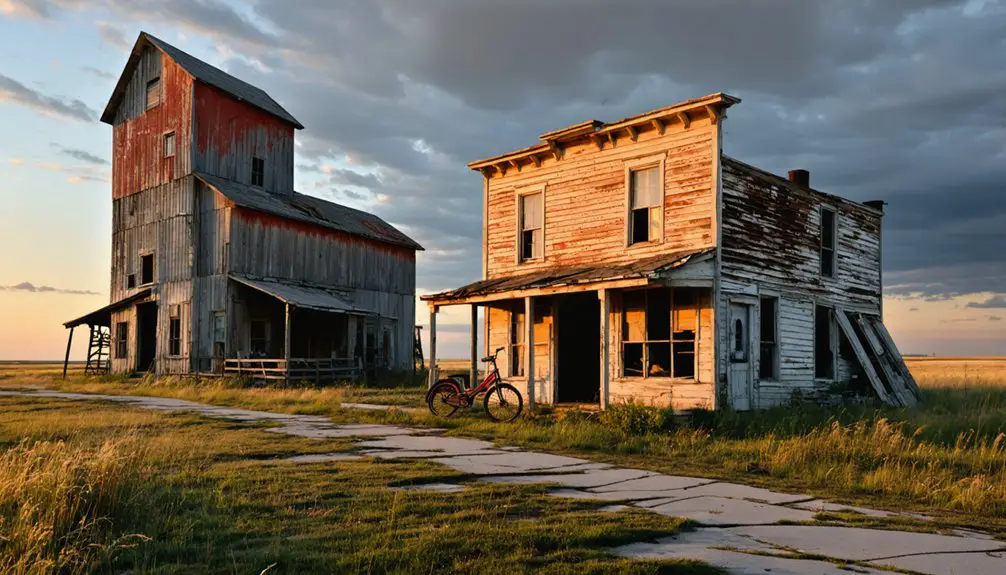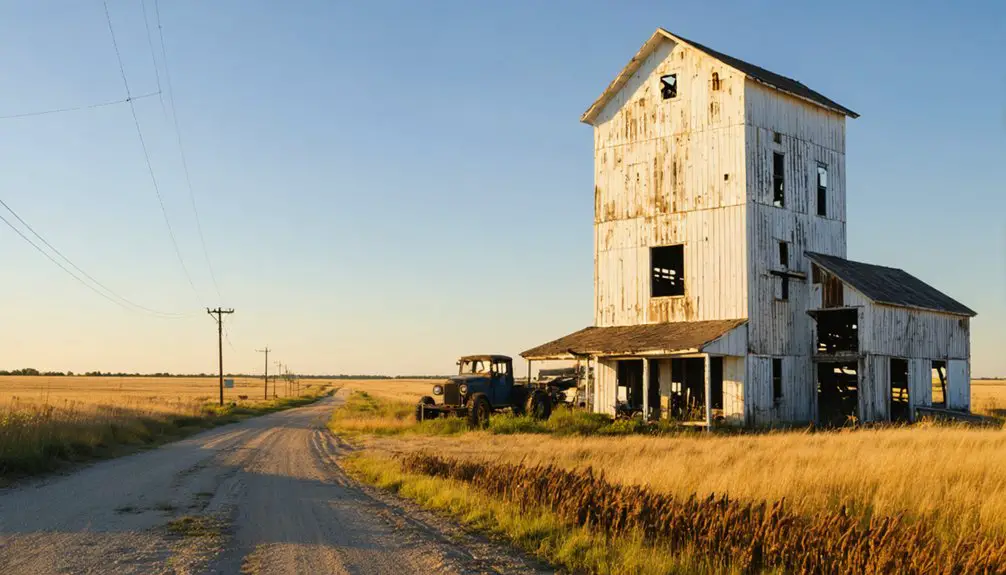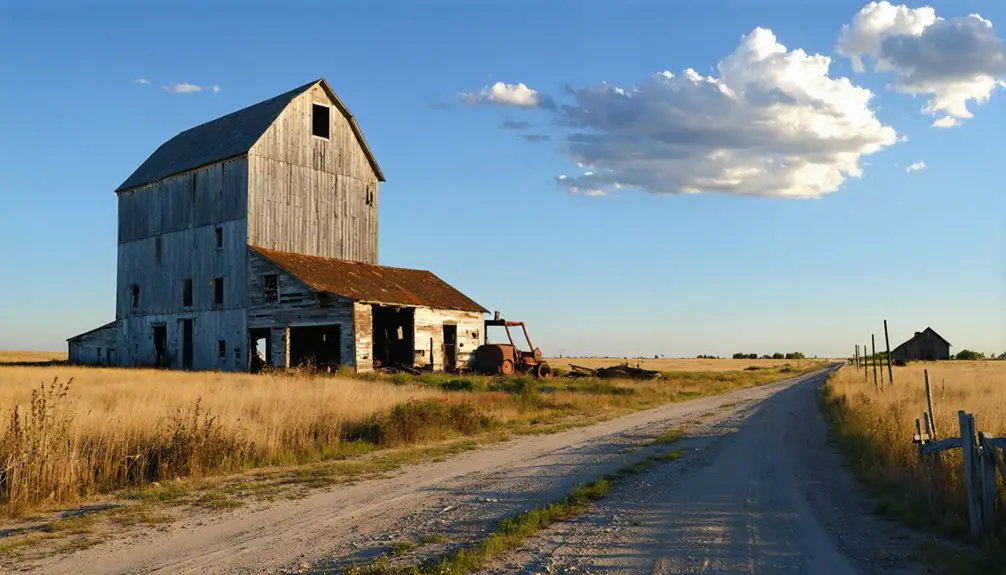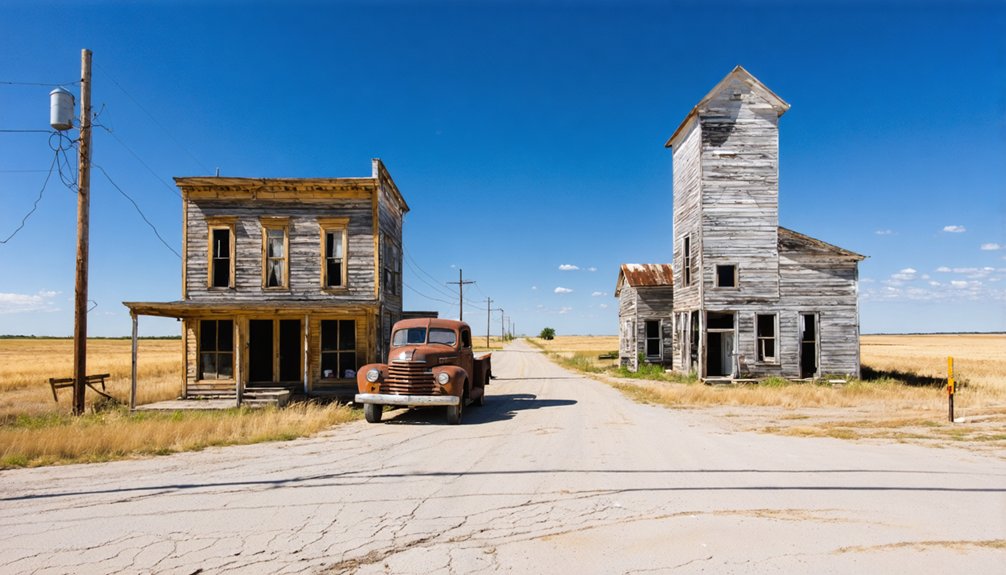
You’ll find fascinating ghost towns across North Dakota’s prairies, with the best clusters near Minot, including Lonetree’s marked church and Carbury’s deserted streets. Central highlights like Arena feature twin grain elevators and St. John’s Lutheran Church, while Sims preserves an active 1884 Scandinavian church amid coal-boom ruins. Blue Grass burned completely in 2014, leaving only prairie. Late summer offers ideal weather for exploring these railroad-era settlements, and nearby engineering marvels like Cartwright Tunnel provide additional historical context for your adventure.
Key Takeaways
- Lonetree, Carbury, Tagus, Sherbrooke, and Hamberg near Minot offer accessible ghost town exploration with deteriorating structures and marked churches.
- Arena features twin grain elevators and St. John’s Lutheran Church, located 35 miles northeast of Bismarck in a natural basin.
- Sims preserves an active Scandinavian Lutheran Church since 1884 and restored parsonage housing the Sims Historical Society.
- Blue Grass, 35 miles northwest of Mandan, is now completely abandoned after its last structures burned in 2014.
- Late summer offers optimal weather for visits; base from Minot, Bismarck, or Watford City and respect private property boundaries.
Ghost Towns Within an Hour of Minot
The Minot area serves as an ideal base camp for ghost town enthusiasts, with several abandoned settlements scattered across the prairie within a 60-minute drive.
You’ll find Lonetree just 15-20 minutes out, where a marked church stands as a monument to abandoned religious communities.
Lonetree’s solitary church serves as a haunting reminder of prairie faith communities that once thrived across North Dakota’s windswept plains.
Carbury’s story is particularly striking—its post office closed in 1984 when fewer than five residents remained in a town that never exceeded 50 people. The settlement even got its name through railroad confusion; officials meant to call it Roth.
Tagus, Sherbrooke, and Hamberg round out your exploration options, each offering deteriorating structures and photographic opportunities. Sherbrooke maintains a well-tended cemetery despite having only two remaining homes and no current inhabitants. These ghost towns emerged during railroad expansion in territorial days, when communities sprouted alongside new rail lines.
Pack local food for impromptu picnics, and scout scenic overlooks between towns to capture North Dakota’s expansive countryside.
Arena: A Central North Dakota Favorite
Nestled in a natural basin thirty-five miles northeast of Bismarck, Arena represents one of central North Dakota’s most accessible and photogenic ghost towns.
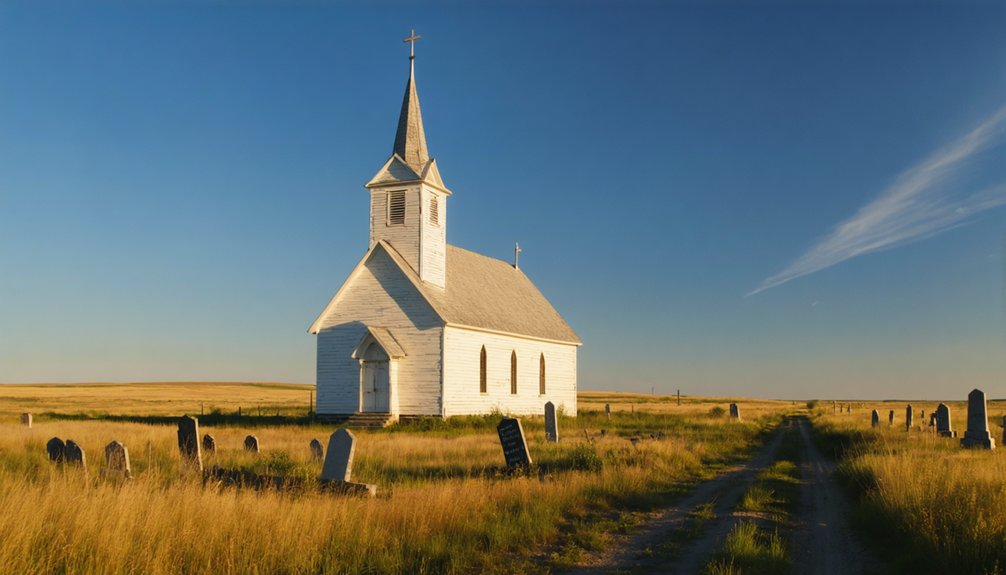
You’ll find St. John’s Lutheran Church standing as the crown jewel of historical architecture—its weathered white paint and crumbling cinderblock foundation tell stories of a community that peaked at 150 residents in 1920.
Twin grain elevators rise alongside scattered remnants, while charred ruins mark where vandals destroyed the general store in 1996.
Local legends speak of experimental farming techniques and diverse settlers who carved out lives on this unforgiving prairie.
The town was named “Arena” in 1906 by Postmaster Harry A. Mutchler, who recognized how the surrounding rolling hills created a natural amphitheater effect around the settlement.
The Northern Pacific Railroad connected Arena to the broader region in 1910 when it built the Pingree-Wilton line through town, bringing prosperity to this agricultural community.
Summer’s the perfect time to explore these rolling hills before harsh winters accelerate decay.
Bring your camera—this atmospheric landscape rewards adventurous souls seeking untamed history.
While Arena captivates visitors with its photogenic decay, Sims offers something remarkably different—a ghost town where history still breathes through active worship.
Sims isn’t your typical ghost town—it’s a living testament to faith, where history refuses to fade into the prairie dust.
You’ll find the Scandinavian Lutheran Church standing proud since 1884, hosting services every other Sunday in a lush valley west of New Salem.
This church history runs deep—it’s the only original structure still functioning from Sims’s coal boom days when over 1,000 residents called this place home.
The adjacent parsonage restoration deserves equal attention. After sitting vacant for nearly 25 years, dedicated volunteers and a Preservation North Dakota grant brought it back to life in 2006-2007.
First Lady Laura Bush called it “best for last” during her 2008 visit.
Today, it houses the Sims Historical Society, preserving this remarkable frontier settlement.
The current church building was constructed in 1896, while the parsonage actually served as the congregation’s original place of worship.
Local legend speaks of the Gray Lady, the spirit of a pastor’s wife who died in the parsonage during the 1930s and allegedly drove away ministers who tried to live there.
Blue Grass: A Railroad-Free Settlement
You’ll find Blue Grass 35 miles northwest of Mandan in Morton County, accessible only by winding county roads through southwestern North Dakota’s rural landscape.
This settlement never attracted railroad service, a critical factor that kept its 1920 peak population at just 20 residents and ultimately sealed its fate as the state’s smallest ghost town.
The community’s complete abandonment accelerated after its last structures—a store and gas station—burned down in 2014, leaving nothing but empty prairie where a determined settlement once stood.
Today, the site serves as a window into early 20th-century rural development, reflecting the harsh realities faced by small communities without transportation infrastructure.
With zero current residents, Blue Grass stands as a true ghost town in the most literal sense.
Remote Location and Accessibility
Located 35 miles northwest of Mandan in Morton County’s windswept prairie, Bluegrass stands as a stark reminder of how geography shaped North Dakota’s settlement patterns. You’ll navigate rural county roads to reach this authentic ghost town, where accessibility obstacles become part of the adventure.
The journey requires careful planning—there’s no modern infrastructure or visitor services awaiting you.
Hidden pathways through the grasslands lead to what remains of this settlement that never saw a railroad.
The 2014 fire destroyed the iconic store and gas station, leaving even fewer traces of the twenty souls who once called this place home.
Your summer visit demands self-sufficiency: bring supplies, plan your route, and embrace the isolation that ultimately sealed Bluegrass’s fate. Like many North Dakota settlements, Bluegrass originated from a rural post office established on a farm before developing into a small community. Harsh weather and vandalism continue to threaten the remaining structures, accelerating the deterioration of what little survives.
Smallest Population Ghost Town
Among North Dakota’s documented ghost towns, Bluegrass holds the distinction of having the smallest peak population—just 20 residents recorded in the 1920 Census.
This Morton County settlement, located 35 miles northwest of Mandan, declined to seven residents by 1960 before complete abandonment. Unlike most ghost towns, Bluegrass never had railroad access, contributing to its isolation and limited growth.
Key characteristics that define Bluegrass:
- Zero current population—a true ghost town without active churches or farms
- Former service station burned down, leaving no structures
- No historical preservation efforts due to complete depopulation
- Zero chance of population rebound given total abandonment
You’ll find this site represents rural depopulation‘s most extreme outcome, distinguishing itself from rail-dependent communities that once thrived across North Dakota’s prairie landscape.
Historical Isolation and Decline
Today, preservation challenges dominate what remains. The 2014 fire that consumed the general store and gas station exemplifies ongoing structural loss.
Without protective measures, North Dakota’s harsh weather continues eroding surviving buildings. You’re witnessing a disappearing affirmation to settlements that couldn’t adapt.
This railroad-free community warns how isolation determined survival on the Great Plains, making Bluegrass essential documentation for understanding frontier settlement patterns.
Cartwright Tunnel and Fairview Lift Bridge: Bonus Attractions
Just beyond North Dakota’s ghost towns lies a pair of engineering marvels that shouldn’t be missed on your summer adventure. The Cartwright Tunnel and Fairview Lift Bridge stand as monuments to an unfinished 1913 railway dream, now open for your exploration.
You’ll find these remarkable structures along Highway 200, where industrial preservation efforts continue battling time and decay. Here’s what makes them worth the detour:
- The 1,458-foot tunnel curves through Badlands rock, plunging you into complete darkness midway.
- 108-foot steel towers mark the lift bridge, which raised only once in 1914.
- Hand-dug construction by over 100 workers using dynamite and mule-drawn carts.
- Accessible walking trails from Sundheim Park with parking and facilities.
Bring your flashlight and experience these engineering triumphs before preservation funding runs out.
More Remote Ghost Towns to Explore
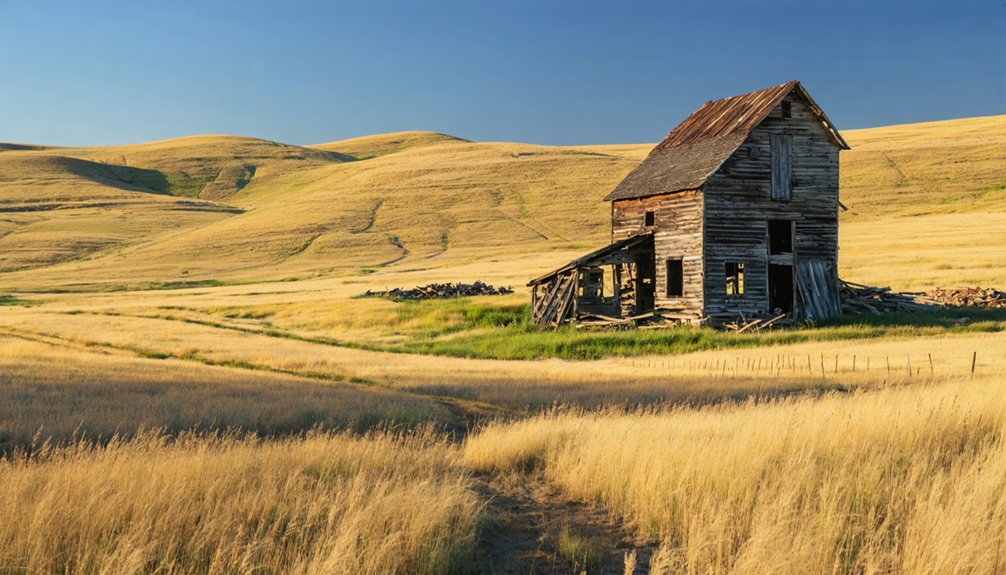
While most ghost towns cling to highways and maintained roads, North Dakota’s most isolated settlements demand genuine adventure from those willing to venture off the beaten path. Nanson in Rolette County represents the ultimate escape—four abandoned homes standing without a single telephone pole in sight.
Exploring ghost towns in North Dakota winter is an experience like no other, where the crisp air and stark landscapes create an atmosphere of eerie beauty. As the snow blankets the remnants of long-forgotten lives, one can almost hear the whispers of the past beckoning you to discover their stories. These secluded locations, far from the hustle and bustle, offer a unique glimpse into the history of a state rich with tales of resilience and change.
Hidden histories await at Deisem, where a former Seventh Day Adventist Church rises from tall prairie grass alongside general store ruins.
Straubville’s abandoned architecture crumbles naturally in Sargent County’s eastern reaches, while Hesper in Benson County became depopulated only recently.
Thelen, southeast of Beach, marks Golden Valley County’s briefest boom—a post office that survived just one year serving twenty souls.
These remote sites reward your off-grid exploration with complete solitude and authentic decay.
Planning Your Ghost Town Road Trip
After discovering these secluded destinations, you’ll need proper planning to maximize your North Dakota ghost town adventure. Start by selecting your base city—Minot, Bismarck, or Watford City—then plot nearby abandoned sites within 30-60 minute drives. Late summer offers ideal conditions with beautiful scenery and natural social distancing at these forgotten places.
As you explore the ghost towns in North Dakota, take the time to appreciate the unique architecture and rich history left behind. Each town tells a story of its past, offering insights into the lives of those who once inhabited these now silent streets. Don’t forget your camera—every corner promises a perfect shot of a bygone era.
Essential Planning Steps:
- Use Ghosts of North Dakota’s searchable database and Google map pins for precise driving directions.
- Research local ghost stories beforehand, like Sims’ “Gray Lady Ghost,” to enhance your experience.
- Scout unique photography spots during morning or evening light when sun-bleached structures create dramatic contrasts against deep blue skies.
- Respect private property near inhabited farms and bring water—prairie heat and remote locations require self-sufficiency.
You’ll encounter authentic history without guided tours or interpretive signs.
Frequently Asked Questions
Are There Any Ghost Towns in North Dakota With Overnight Accommodations Nearby?
Step back in time at Fort Totten State Historic Site, where you’ll find overnight accommodations in converted officers’ quarters. This historical preservation gem offers cultural significance while letting you explore North Dakota’s frontier past freely.
What Safety Precautions Should Visitors Take When Exploring Abandoned Buildings?
When practicing urban exploration, you’ll need essential safety gear: sturdy boots, respirator mask, flashlight, and gloves. Always test floors before stepping, explore with partners, mark your path, and inform someone of your location beforehand.
Can You Enter Private Property at Ghost Town Sites Legally?
No, you can’t legally enter posted private property without owner permission. Even at ghost towns like Sims or Dogtooth, respect boundaries—trespassing on posted land risks class B misdemeanor charges. Legal access requires explicit consent from landowners first.
What Is the Best Time of Day to Photograph Ghost Towns?
You’ll capture stunning ghost town photos during golden hour—shortly after sunrise or before sunset—when soft, warm light enhances weathered textures beautifully. Avoid midday lighting’s harsh shadows and contrast that’ll flatten your images and diminish those mesmerizing decay details.
Are There Guided Tours Available for North Dakota Ghost Towns?
Yes, you’ll find guided photo tours led by professional photographers exploring abandoned homesteads and churches as tourist attractions. Experts also offer walking tours focusing on historical preservation, sharing documented histories and folklore at haunted sites statewide.
References
- https://www.amyallender.com/north-dakota-ghost-towns/
- https://us1033.com/exploring-bismarck-ghost-towns-north-dakota/
- https://ghostsofnorthdakota892857007.wordpress.com/2016/01/31/60240/
- https://www.youtube.com/watch?v=8GO57Im_dss
- https://www.tripadvisor.com/Attractions-g28955-Activities-zft12156-North_Dakota.html
- https://www.atlasobscura.com/things-to-do/north-dakota
- https://www.treasurenet.com/threads/ghost-towns-north-dakota.68039/
- https://en.wikipedia.org/wiki/List_of_ghost_towns_in_North_Dakota
- https://ghostsofnorthdakota892857007.wordpress.com/2015/10/30/true-ghost-towns-population-zero/
- https://northernsentry.com/2025/06/26/north-dakota-ghost-towns/