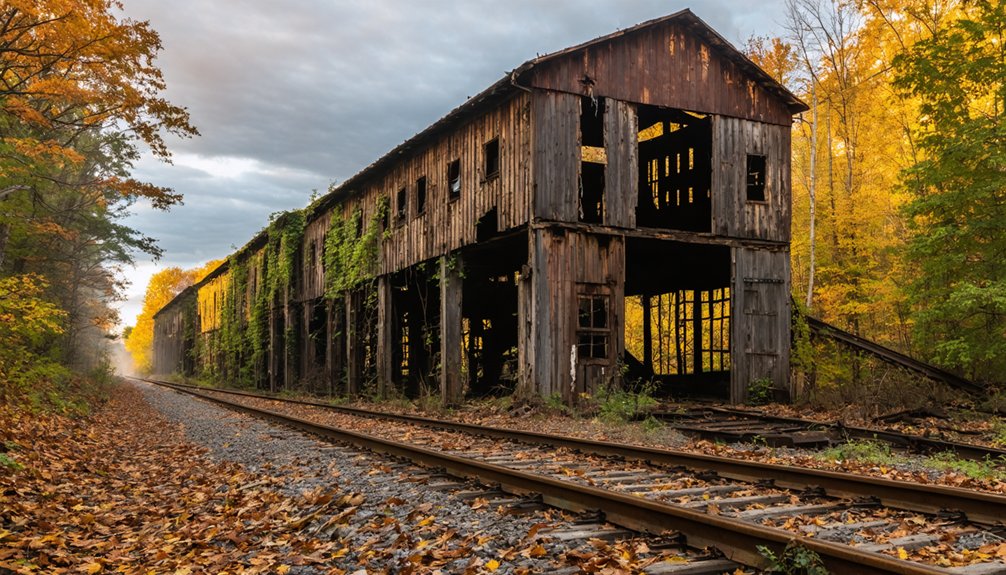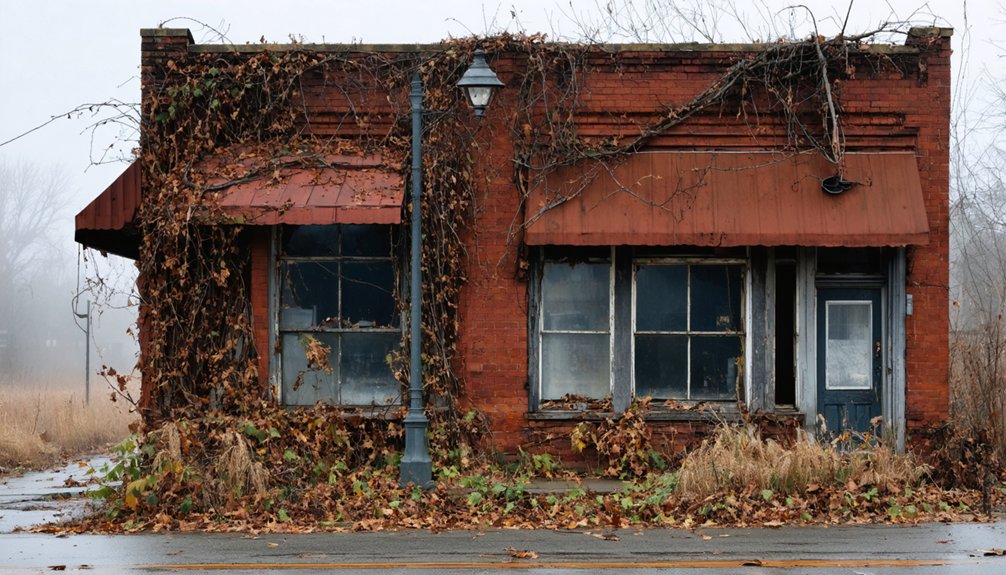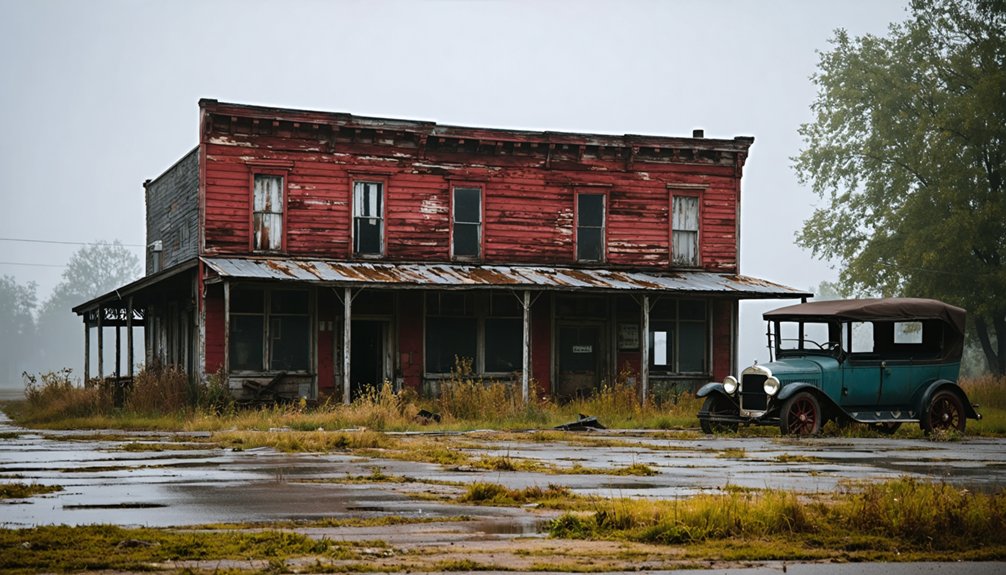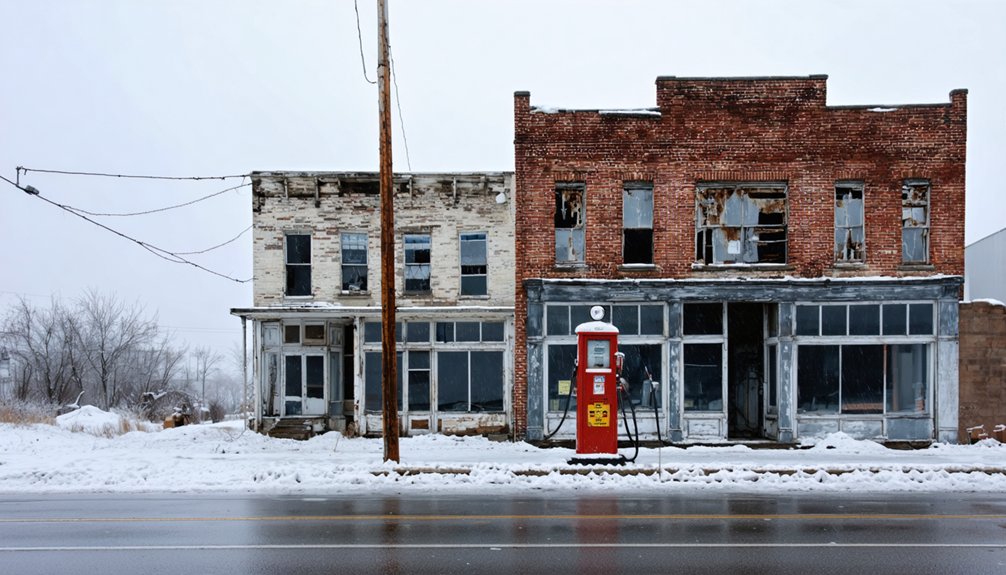
You’ll find Indiana’s ghost towns most accessible during winter when frozen ground and bare branches expose what summer hides. Metamora’s preserved canal district offers heated mills and covered bridges, while Tunnelton’s crumbling 1957 high school stands stark against snow. Aberdeen’s memorial site and Mount Carmel Cemetery’s toppled stones become hauntingly visible without undergrowth. Billie Creek Village’s 38 unheated historic buildings provide authentic pioneer experiences. Pack waterproof boots and emergency supplies—cell service disappears in these forgotten settlements, where winter reveals their complete stories.
Key Takeaways
- Metamora offers a preserved canal town with a working wooden aqueduct, historic mill, and vintage train rides through winter landscapes.
- Billie Creek Village features 38 relocated historic buildings with winter ghost hunts and authentic unheated structures best experienced without crowds.
- Tunnelton displays crumbling downtown ruins and an 1857 tunnel linked to the Underground Railroad with a haunted reputation.
- Winter conditions provide frozen ground and reduced foliage, making abandoned structures clearer to explore and photograph at multiple sites.
- Prepare with insulated layers, waterproof boots, emergency supplies, and all-wheel drive vehicles for limited cell service and seasonal hazards.
Metamora: A Canal Town Preserved in Time
Tucked into the rolling hills of southeastern Indiana, Metamora feels like you’ve stumbled through a tear in time. This canal town’s preserved charm isn’t manufactured—it’s authentic 1840s America, frozen when the Whitewater Canal failed commercially.
Step through history’s portal into authentic 1840s America, where Metamora’s preserved canal town remains untouched by modern commercialization.
You’ll find hidden history around every corner: the nation’s only working wooden covered aqueduct still channels water overhead, while the 1856 mill grinds flour using original canal power.
Winter transforms Metamora into something ethereal. Frost clings to historic storefronts, and you can explore without summer crowds. Walk the towpath where horses once pulled flatboats, peek inside the Canal House, and grab stone-ground flour from the mill. The town sits 67 miles east southeast of Indianapolis, making it an easy day trip from the capital. The entire Metamora Historic District earned its place on the National Register of Historic Places in 1992, recognizing the village’s exceptional preservation.
The Whitewater Valley Railroad runs vintage trains on select dates, rattling past frozen creeks and snow-dusted forests. It’s Indiana’s best-kept secret.
Exploring Southern Indiana’s Abandoned Settlements
Southern Indiana’s rolling hills hide settlements where nature slowly devours what floods and fires couldn’t finish.
You’ll find Tunnelton’s downtown resembling a war zone, its 1957 high school crumbling alongside abandoned homes that tell stories of communities swept away by disaster.
Winter strips away the vegetation, revealing foundation pits in Hindostan and scattered remains in Howesville—skeletal reminders of thriving towns that lost their reason to exist.
Elizabethtown in northern Delaware County vanished entirely, leaving only its cemetery to mark where flower and saw mills once powered the local economy.
The 1,731 ft tunnel built in 1857 at Tunnelton adds to the haunted reputation of this ghost town connected to the Underground Railroad.
Historic Towns Worth Visiting
Beneath the rolling hills of southern Indiana lie forgotten settlements where nature has reclaimed what pioneers once built. You’ll find Tunnelton’s crumbling storefronts and the haunting ruins of its 1957 high school—testaments to urban decay that tell stories of floods, fires, and the Underground Railroad’s brave operations.
Old Leavenworth offers a complete ghost town experience where the 1937 Ohio River floods swept away entire homes, forcing survivors to higher ground.
New Harmony stands apart with restored buildings at its State Historic Site, earning National Historic Landmark status in 1965. English in Crawford County experienced similar relocation after flooding in the early 1990s, with the original settlement now reduced to an empty field while the modern town sits uphill. Hindostan Falls tells perhaps the most tragic tale—once home to 1,200 residents by 1820, the thriving settlement along the White River was devastated by cholera and yellow fever in the early 1820s, causing most to perish or flee. These locations balance ghost town preservation with accessibility, letting you wander freely through history without crowds.
Winter’s bare trees reveal architectural details summer foliage conceals, making it ideal for exploration.
Nature Reclaims Forgotten Structures
While historians catalog dates and events, nature writes its own history across Indiana’s abandoned settlements through creeping vines, crumbling foundations, and trees that split buildings apart one root at a time. You’ll witness this urban decay most dramatically at Tunnelton’s 1957 high school, where weather has stripped away humanity’s mark, leaving skeletal frames exposed.
Winter’s your ally here—bare branches reveal what summer hides.
At White Cloud, foliage consumes former businesses you’d never spot in warmer months. Historic gas pumps stand testament to this small-town atmosphere, preserved yet slowly yielding to the elements.
Empire Quarry showcases natural reclamation on a massive scale, where limestone once destined for Manhattan now cradles pools of rainwater and invasive vegetation. The Empire Pit originally supplied stone for iconic structures like the Empire State Building before abandonment transformed it into a study of nature’s persistence.
Rose Island’s flood-swept amusement park demonstrates nature’s ultimate authority—even concrete swimming pools surrender to river erosion.
You’re free to explore these spaces where wilderness reclaims civilization‘s temporary foothold.
Aberdeen: A Scottish-Founded Settlement in Cass Township
Tucked into the rolling hills of Cass Township, Aberdeen emerges from the winter mist like a whisper from 1814, when Scottish settlers first carved this community from Indiana wilderness.
You’ll find this ghost town at the intersection of Aberdeen Road and Cass-Union Road, off State Road 56, where families named Culbertson, Dalgleish, and Graham once built their American dreams.
The Scottish heritage runs deep here—they named it after their homeland city across the Atlantic. Walk the frozen ground at 883 feet elevation, and you’re tracing immigrant footsteps from Edinburghshire and Ayreshire.
The post office operated from 1852 to 1880, marking Aberdeen’s peak before community decline set in. Like its namesake that received royal charters granting trade rights and independence, this Indiana settlement sought its own frontier prosperity. The original Scottish Aberdeen features a long, sandy shoreline as a North Sea port, contrasting sharply with Indiana’s landlocked prairie setting. Now it’s yours to explore, a preserved testament / memorial / record to frontier ambition meeting inevitable abandonment.
Northern Ghost Towns Along Former Railroad Routes
From Scotland’s highland legacy, your winter ghost town journey shifts northward where iron rails once stitched Indiana’s mining communities together. Railroad history comes alive at Tunnelton, platted in 1859 where crude tunnels carved through hillsides resembled massive caves. You’ll find remnants of what served construction workers before the engines rolled through.
Bonnell along Dearborn County’s 1850s Cincinnati-Indianapolis line tells darker stories—worker deaths filled hospitals during construction.
Mining relics scatter across Ghost Town Trail‘s corridor, where Wehrum once housed 230 families in Warren Delano’s empire. Though most sites sit on private land limiting your exploration, the trail itself offers unrestricted winter access.
Bundle up and walk these historic routes where coal dust and steam once painted the frontier sky black.
Billie Creek Village: Living History Among Historic Structures
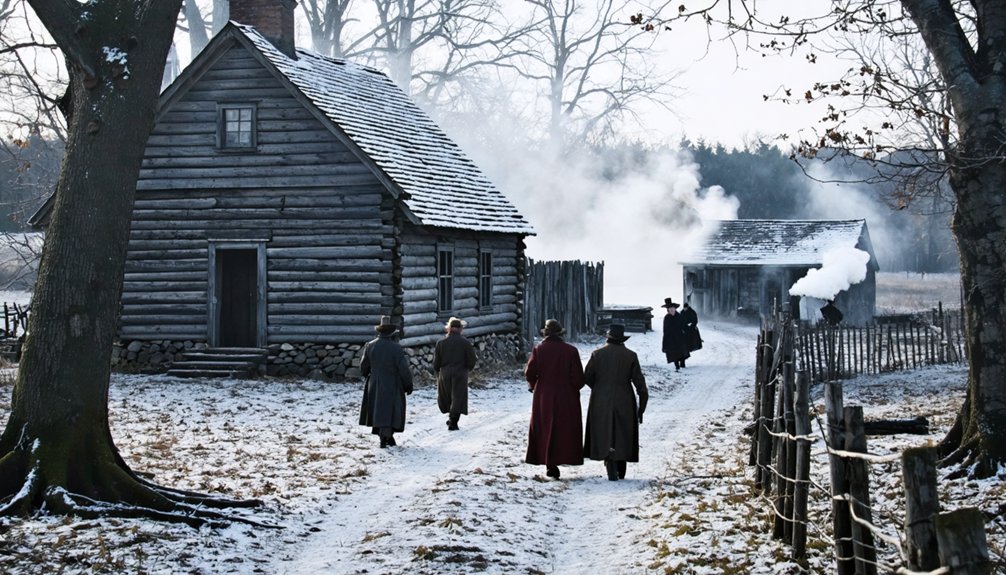
Southeast of Rockville, where Highway 36 cuts through Parke County’s rolling farmland, 38 relocated historic buildings form Indiana’s most ambitious preservation project.
You’ll wander past three covered bridges and structures spanning the 1830s through early 1900s—each with its own character and quirks. The historic architecture tells stories through hand-hewn logs and Victorian details, while working demonstrations in blacksmithing and milling bring the past alive.
Winter’s your best bet for exploring without crowds.
Since reopening in 2014, the village has embraced its eerie reputation, offering ghost hunts through partnerships with paranormal investigators. Those paranormal stories aren’t manufactured—centuries-old buildings naturally accumulate legends.
You can explore freely during daylight hours, experiencing authentic history without tourist-trap theatrics. Pack layers; these unheated structures demand respect for their age.
Granville and the Wea Native American Heritage Site
Along the Wabash River in western Tippecanoe County, Granville’s story begins where most ghost towns end—with a cemetery perched above the water. You’ll find tombstones bearing names like Anderson, Buck, and Sharp, bent by decades of wind but still standing. Thomas Concannon laid out this canal town in 1834, initially calling it Weaton after the nearby Wea settlement.
Winter’s your best season to explore via county roads near Granville Bridge. The bare landscape reveals:
- Native American artifacts scattered across fields where the Wea once thrived
- Fifteen vanished blocks that once surrounded a bustling public square
- Heritage preservation efforts marked only by cemetery stones and silent farmland
The canal’s gone. The railroad killed it. But you’re free to wander where commerce once roared.
Winter Access to Central Indiana’s Forgotten Communities
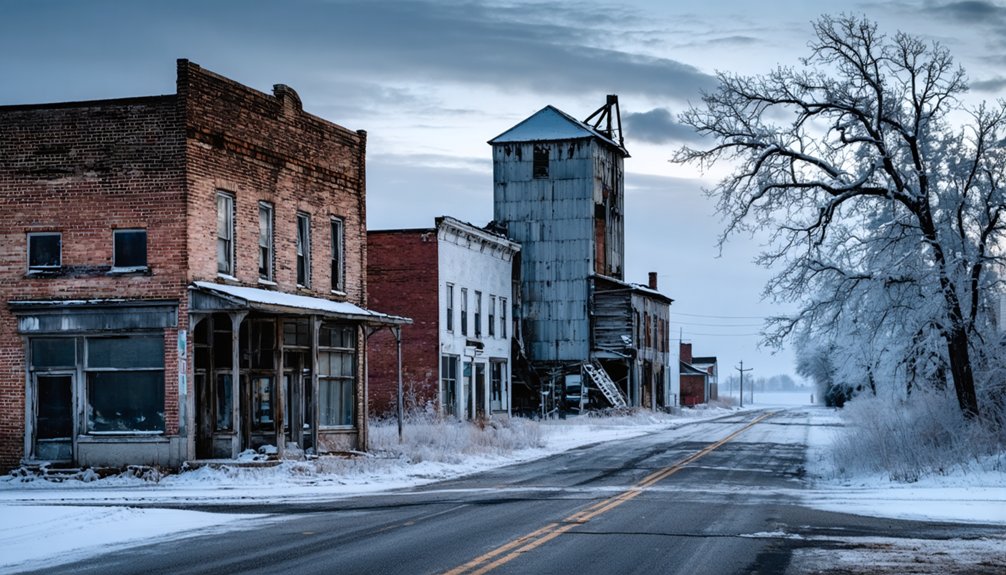
When frozen ground makes backcountry exploration treacherous, southern Indiana’s ghost towns become paradoxically more accessible—their crumbling facades stand in sharper relief against bare winter branches, and you won’t fight summer’s suffocating undergrowth.
Tunnelton’s paved State Road 60 access means you’ll reach deteriorating structures without mud-bogged detours. Lawrence County’s Fort Ritner sits reachable via maintained county roads off SR 458, while Marengo’s SR 64 location and Borden’s US 60 position guarantee reliable passage. Campbellsburg off SR 66 completes this circuit of abandoned communities.
Five southern Indiana ghost towns connected by state highways—your winter expedition needs only warm clothes and a full tank.
Winter wildlife tracks through empty doorways add haunting context to your ghost town photography. Deer prints crossing rotted porches, bare trees framing collapsed roofs—these forsaken places reveal themselves honestly in cold months.
Pack thermoses, dress warmly, and chase Indiana’s forgotten history without seasonal barriers blocking your path.
Mount Carmel Cemetery and the Aberdeen Meteorite
The frame church that once anchored Mount Carmel Cemetery cost Henry Moore $800 to build in 1853, but winter strips away any romanticism about this Hancock County burial ground.
You’ll find over 100 graves at 5697 N 25 W in Greenfield, many toppled and strangled by weeds. Two concrete posts mark where the gate once stood—all that remains of the Methodist congregation that gathered here since 1838.
What you’ll discover:
- Prohibition-era gangsters from Chicago’s Little Sicily rest among pioneer families
- Carved limestone markers lean at angles that reveal decades of neglect
- The silence broken only by wind across frozen ground
Despite meteorite mysteries sometimes attributed to this site, no evidence connects Aberdeen’s celestial visitor here.
Cemetery conservation isn’t happening—this township-owned ground accepts no new burials, only winter pilgrims seeking forgotten stories.
Planning Your Ghost Town Winter Adventure
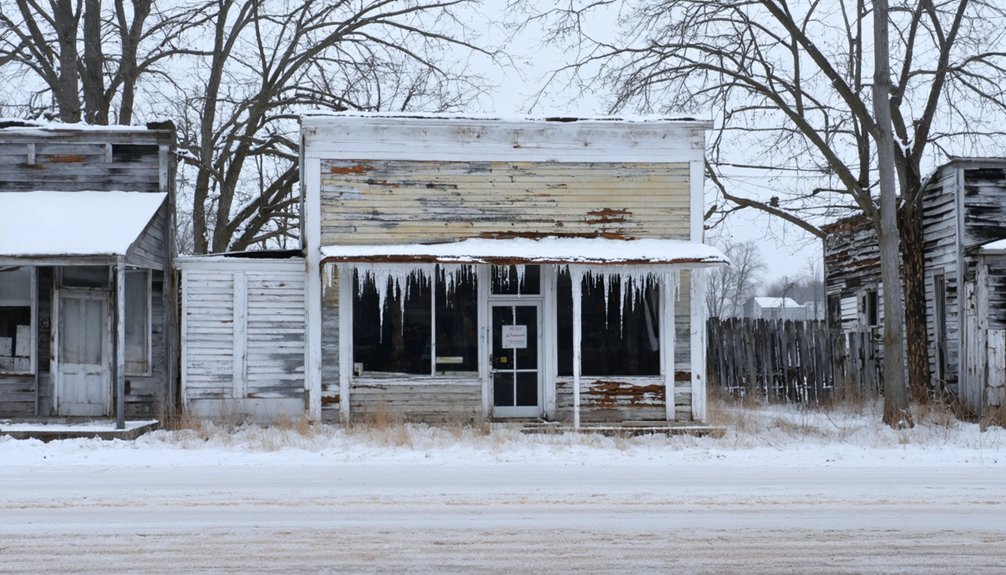
Before you chase Indiana’s phantom settlements through snowdrifts and February fog, understand that winter transforms these already-desolate places into landscapes of genuine hardship. Southern Indiana’s 20-30°F temperatures demand insulated layers, waterproof boots, and thermal gloves—frostbite prevention isn’t optional when you’re exploring Tunnelton’s ruins for four hours.
Pack emergency blankets, flares, and high-calorie snacks for the 13-town loop along State Road 64. Winter wildlife like coyotes prowl near Scotland’s abandoned structures, so carry deterrent spray. All-wheel drive becomes essential on unpaved or unplowed routes, especially to Ooltown after snowfall.
I’ve learned cell service vanishes near remote sites—inform someone of your itinerary before heading to Marengo or Campbellsburg. These frozen settlements reward the prepared, not the reckless.
Frequently Asked Questions
Are Ghost Tours at Metamora Offered During Winter Months?
No, ghost tours aren’t offered during winter months at Metamora. You’ll find guided tours only run October through early November. Save your winter clothing for other adventures—these spooky excursions strictly follow the fall Halloween season schedule.
What Safety Precautions Should I Take When Visiting Abandoned Structures?
Like explorers charting frozen wilderness, you’ll need hazard awareness to spot hidden dangers in abandoned structures. Wear protective gear including sturdy boots with ice cleats, layered clothing, and gloves. Watch for unstable floors, fallen debris, and icy patches threatening your freedom.
Can I Take Photographs Inside the Buildings at Ghost Town Sites?
You can photograph inside ghost town buildings, but you’ll need photography permits for commercial use and must respect historical preservation rules. Use available light when possible, and always get owner permission before entering private properties.
Are Any Ghost Towns in Indiana Accessible by Public Transportation?
No, you’ll need your own wheels to reach Indiana’s ghost towns. Historical preservation efforts haven’t included visitor accessibility via public transit—these remote sites demand the freedom of personal transportation to explore their haunting, abandoned landscapes independently.
Do I Need Permission to Explore Privately Owned Ghost Town Properties?
Trespassing’s a minefield you’ll want to avoid. Legal restrictions protect property ownership rights, even on ghost towns. You’ll need explicit permission before exploring private land—otherwise, you’re risking criminal charges and civil liability that’ll haunt your adventures.
References
- https://www.youtube.com/watch?v=zcDfA7KE4VE
- https://wkdq.com/southern-indiana-ghost-towns/
- https://www.onlyinyourstate.com/experiences/indiana/ghost-towns-in
- https://www.gosoin.com/blog/post/how-to-have-a-spooky-time-in-southern-indiana/
- https://www.billiecreek.com
- https://www.youtube.com/watch?v=3J6ZADuP0A4
- https://en.wikipedia.org/wiki/List_of_ghost_towns_in_Indiana
- https://visitindiana.in.gov/blog/post/unique-historic-village/
- https://donknebel.com/2022/04/metamora-a-nineteenth-century-canal-town/
- https://metamoraindiana.com/metamora-historic-homes-tour/