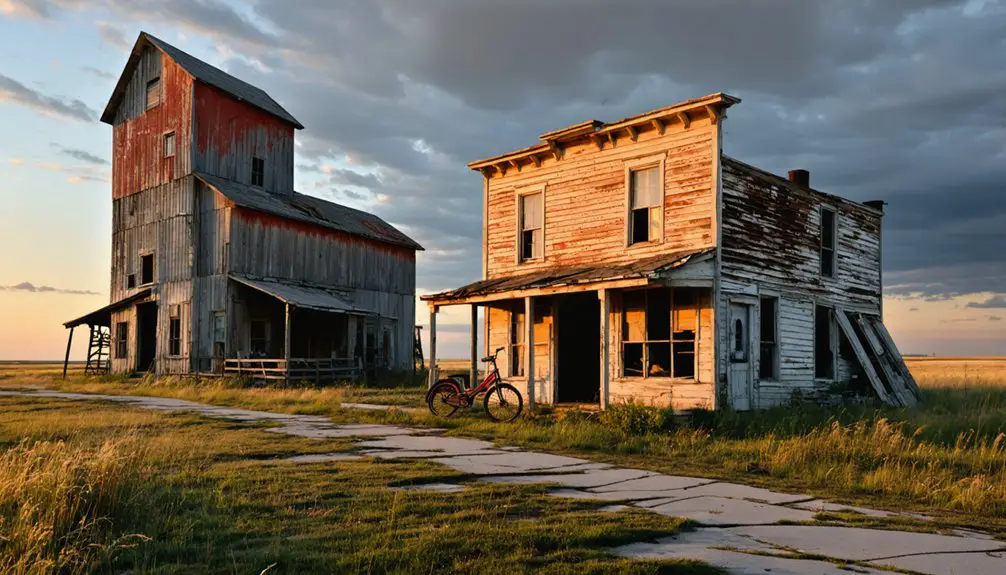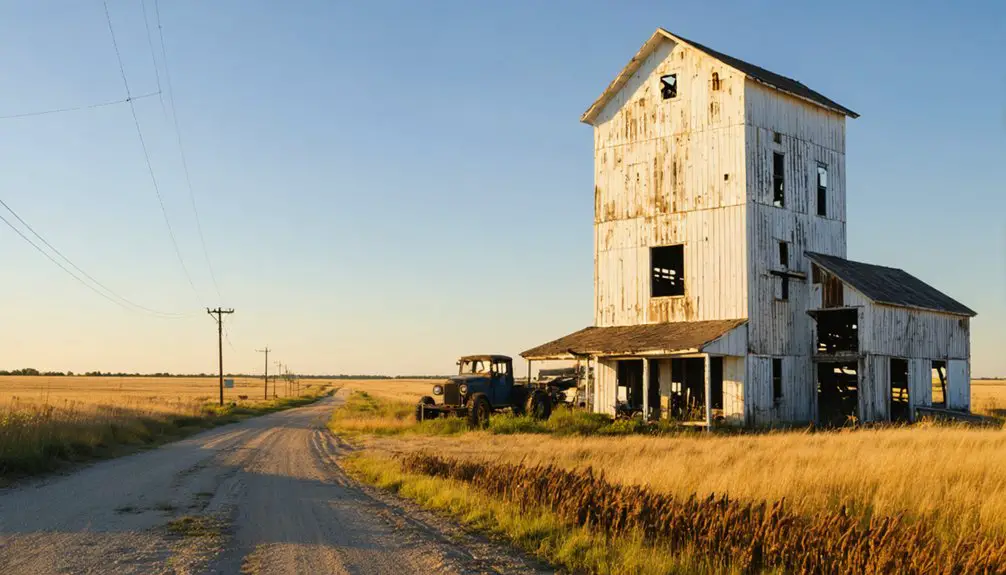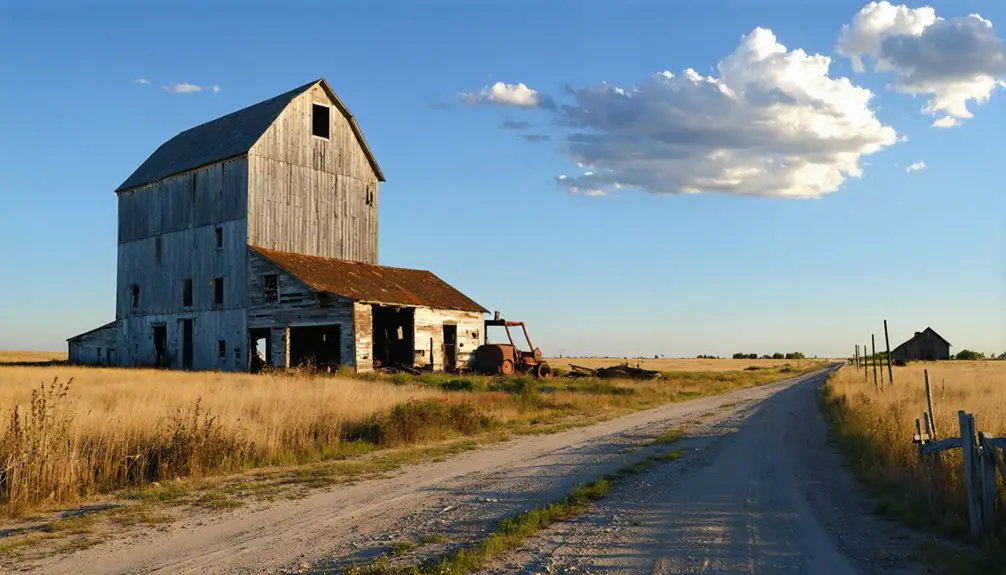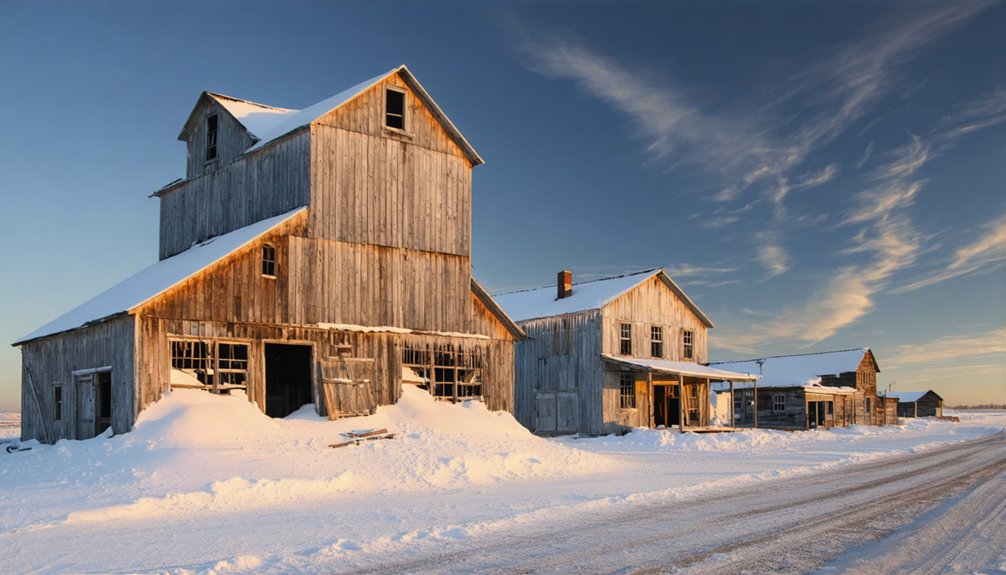
You’ll find North Dakota’s winter ghost towns transformed into stark, snow-covered tableaus where towering grain elevators rise above empty streets and weathered cemeteries mark pioneer graves. Arena’s twin elevators stand sentinel near Bismarck, while Tagus’s abandoned buildings huddle close to Minot amid legends of supernatural activity. Traverse snowbound county roads to discover Carbury’s hidden foundations, Sherbrooke’s charred hotel ruins, and Winona’s frontier remnants along the Missouri River. The heavy prairie snows create haunting isolation perfect for photographers and solitude seekers exploring what remains of these vanished communities.
Key Takeaways
- Arena features twin grain elevators and St. John’s Lutheran Church ruins, accessible via snowbound roads with dramatic winter prairie landscapes.
- Tagus offers weathered buildings, a green-shingled farmhouse, railroad car landmark, and St. Olaf Lutheran Cemetery amid haunting winter atmosphere.
- Sherbrooke displays charred hotel remnants, collapsed stone foundations, and an accessible cemetery with heavy snowfall enhancing exploration ambiance.
- Carbury reveals snow-uncovered foundations and historic markers in complete isolation, with no remaining buildings emphasizing stark winter desolation.
- Winter visits require safety awareness around unstable structures; observe from outside while enjoying tranquil solitude and contemplative prairie silence.
Arena: A Sheltered Valley Settlement Near Bismarck
When you drive 35 miles northeast of Bismarck into Burleigh County‘s wind-swept prairie, you’ll drop into a natural basin ringed by rolling hills—and immediately understand why postmaster Harry A. Mutchler named this place Arena in 1906.
The amphitheater-like landscape shelters weathered remnants of a settlement that once housed 150 souls.
Winter’s stark light reveals St. John’s Lutheran Church with its crumbling foundation, twin grain elevators standing sentinel, and scattered houses receding into prairie anonymity.
Founded when Patterson Land Company sold railroad land to homesteaders, Arena thrived until drought and depression drove residents away.
The Northern Pacific Railroad’s construction through town in 1910 accelerated development, establishing Arena as a thriving agricultural hub.
The economy centered on corn, livestock, and grain, supporting a community that included German immigrants and Jewish merchants.
The post office closed in 1996, cementing its ghost town status.
For rural ghost town exploration enthusiasts, Arena offers unvarnished historical preservation—no tourist trappings, just raw architectural decay against endless horizon.
Tagus: The Closest Abandoned Town to Minot
Just forty miles west of Minot along Highway 2, Tagus emerges from Mountrail County’s rolling prairie like a whisper of North Dakota’s railroad past. Founded in 1900 as Wallace, this settlement once thrived with 140 residents before decline claimed it.
Today, you’ll find weathered structures standing defiantly against winter winds, easily accessible right off the highway.
What awaits your winter exploration:
- Dilapidated buildings casting eerie shadows across snow-covered ground
- St. Olaf Lutheran Cemetery where gravestones mark lives from bustling railroad days
- Railroad car landmark guiding you to this forgotten outpost
- Haunted legends of supernatural activity drawing curious adventurers
The vandalism impact has accelerated Tagus’s deterioration—the church burned in 2001, likely torched by vandals. Among the remaining structures, the farmhouse with green shingles stands out as an eerily beautiful example of the town’s architectural past.
While urban legends about satanic rituals persist, the real story lies in experiencing authentic abandonment without pretense or commercialization. Winter visitors have reported hearing unexplained screams near the former church site, adding to the town’s unsettling atmosphere.
Winona: Pioneer River Settlement With Frontier History
Long before Tagus emerged along the railroad corridor, Winona claimed its place in North Dakota history as Devil’s Colony—a rough-edged settlement that sprouted along the Missouri River during the brutal winter of 1874-1875.
Devil’s Colony earned its name through brutal frontier justice along the frozen Missouri River before civilization took hold.
You’ll find Emmons County’s oldest town served Fort Yates soldiers and farmers, growing into the region’s largest settlement by the 1880s with sixteen log cabins and a whiskey-stocked saloon where two drinks cost just a quarter.
The frontier justice here was brutal—saloon girls killed patrons, bodies stored in sheds until spring thaw allowed burial. An oval race track north of town drew crowds for horse racing events featuring wild Spanish-bloodline breeds. The settlement’s commercial prominence collapsed in the early 1890s when railroads bypassed Winona, shifting trade to nearby centers and sealing the town’s fate. Today, ghost town preservation efforts face unique challenges since Lake Oahe submerged most artifacts for decades.
While historical reenactments can’t recreate Winona’s violent past, you can explore accessible areas post-submersion, discovering remnants of North Dakota’s wildest river settlement.
Carbury: The Town That Never Grew
While Winona’s saloons and violence defined Missouri River frontier life, Carbury’s story unfolds with quieter tragedy—a town that arrived with the Great Northern Railway in 1901 but never found its purpose.
Named through a signage mix-up that was never corrected, this Bottineau County settlement peaked at just 50 residents in 1920.
Norwegian heritage runs deep here—settlers from Minnesota established nearby homesteads in 1883, bringing their resilience to unforgiving prairie. The post office closed in 1984 when fewer than five residents remained, marking the final chapter of this quiet settlement.
What Makes Carbury Compelling:
- Railroad history visible in frozen landscape traces where tracks once promised prosperity
- Abandoned since 2000, offering authentic ghost town isolation
- Winter snow reveals foundations and scattered historical markers from 1901
- No modern interference—just you and stark, windswept plains
- No buildings or roads exist today, leaving only historical references to this forgotten community
You’ll find minimal structures, maximum atmosphere, and the haunting reality of dreams that simply never grew.
Sherbrooke: Former County Seat That Hosted a President
When Sherbrooke’s citizens watched their county government load wagons bound for Finley in 1919, they witnessed the beginning of the end for what had been Steele County’s seat of power since 1885. Despite petitioning the North Dakota Supreme Court, they couldn’t stop the relocation that would doom their town.
The 1919 county seat relocation to Finley sealed Sherbrooke’s fate, ending its 34-year reign as Steele County’s power center.
Today’s snow-covered ruins tell a ghost town history few know: President William McKinley stayed at the Sherbrooke House Hotel in 1896, making this one of North Dakota’s most prestigious presidential visits.
You’ll find charred timbers marking where that hotel likely stood, along with collapsed field stone foundations reclaimed by prairie grass. Among the ruins, an old Studebaker serves as a rusting monument to the town’s automotive era.
The Sherbrooke Cemetery, documented in 2013, remains accessible.
Winter’s bare landscape reveals structures you’d miss in summer’s growth, offering unobstructed exploration. The climate brings approximately 287 cm of annual snowfall, with snow potentially falling as late as May or as early as October.
Charbonneau: Railroad Remnants and Prairie Solitude
From Watford City’s oil boom bustle, a mere fifteen-minute drive west transports you to Charbonneau’s stark silence—a Great Northern Railroad town that time abandoned six decades ago. Named for Lewis and Clark’s expedition guide, this settlement peaked at 125 souls in 1920 before surrendering to the wild prairie that claimed it by 1965.
What awaits you:
- Towering grain elevators standing sentinel over empty streets
- An abandoned schoolhouse and post office (unsafe to enter, but photograph from outside)
- Weathered cemetery where pioneer dreams rest
- Unobstructed winter solitude on snowbound county roads
Historical remnants dot the privately-owned townsite. You’ll find a fallen creamery westward and scattered houses slowly returning to earth. Access requires respecting posted warnings—these structures are dangerous.
Winter’s heavy snows blanket the landscape, offering photographers and solitude-seekers absolute isolation.
Frequently Asked Questions
What Safety Precautions Should I Take When Visiting Ghost Towns in Winter?
Like explorers charting frozen frontiers, you’ll need proper winter clothing layered against biting winds and a vehicle emergency kit stocked with blankets, flashlights, and supplies. Always tell someone your destination before venturing into these abandoned outposts.
Are These Ghost Towns on Private Property or Public Land?
Most North Dakota ghost towns exist in legal gray areas—not explicitly public land, but treated as accessible sites. You’ll find no posted restrictions at Arena, Tagus, Sherbrooke, or Charbonneau, though respecting boundaries and leaving no trace protects future access.
What Photography Equipment Works Best in North Dakota Winter Conditions?
You’ll need weather-sealed camera bodies, extra batteries warmed against your chest, and polarizing filters to capture snow’s brilliance. Essential winter gear includes insulated camera parkas and sturdy carbon fiber tripods. Smart equipment choices mean you’ll shoot comfortably in subzero conditions.
Can I Camp Overnight Near These Abandoned Towns During Winter?
Forget Instagramming your latte—you’ll need serious cold weather gear for winter camping near ghost towns. You can camp 14 days at National Forest sites or state parks, but many amenities close October through spring, limiting your freedom.
Do I Need Special Permits to Explore These Ghost Town Sites?
You won’t need special permits for most ghost town exploration, but respect access restrictions on posted private property and Trust Lands. Stay on public roads, follow Game & Fish rules, and you’ll enjoy legal permissions to roam freely.
References
- https://www.amyallender.com/north-dakota-ghost-towns/
- https://www.treasurenet.com/threads/winona-ghost-town.132143/
- https://www.onlyinyourstate.com/experiences/north-dakota/ghost-towns-nd
- https://us1033.com/5-ghost-towns-that-are-about-50-miles-from-bismarck/
- https://www.youtube.com/watch?v=8GO57Im_dss
- https://ghostsofnorthdakota892857007.wordpress.com/category/lincoln-valley-nd/
- https://en.wikipedia.org/wiki/List_of_ghost_towns_in_North_Dakota
- https://www.quincyvagell.com/arena/
- https://www.legendsofamerica.com/arena-north-dakota/
- https://www.youtube.com/watch?v=JrbLsH8cdps