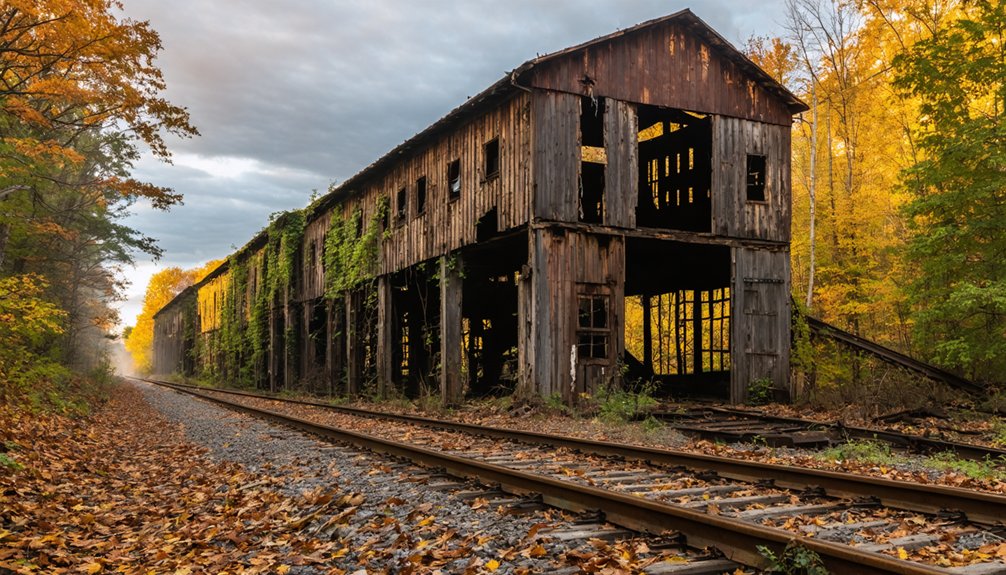
You’ll find three major ghost towns submerged beneath Indiana’s reservoirs: Monument City, which sits under 12-25 feet of water in Salamonie Lake after its 1965 flooding for the Wabash River project; Hindostan Falls, abandoned in the 1820s following devastating epidemics and now preserved as a natural area; and Elkinsville, completely erased when Monroe Lake’s construction displaced over 300 homes in the 1960s, leaving nearly 100 bodies unrecovered. The complete archaeological and historical documentation of these settlements reveals surprising details about their final days.
Key Takeaways
- Monument City, Indiana’s largest sacrificed town, lies 12-25 feet underwater in Wabash River, displaced 30 residents in 1965 for flood control.
- Elkinsville vanished under Monroe Lake (1960-1964) when Army Corps seized 300+ homes, leaving some graves permanently submerged and unlocated.
- Hindostan Falls, founded 1808, was abandoned by 1853 after cholera and yellow fever killed over 138 residents in three months.
- Beaver Lake, once Indiana’s largest lake, was drained for farmland, erasing the Kankakee Marsh ecosystem and Native American historical sites.
- Nearly 50 shipwrecks lie along Indiana’s Lake Michigan shoreline, with 14 documented sites accessible for recreational diving and exploration.
Monument City: A Community Sacrificed for Flood Control
When the U.S. Army Corps of Engineers constructed Salamonie Dam, Monument City became the largest casualty among three towns sacrificed for Wabash River flood protection. You’ll find this settlement archaeology beneath 12-25 feet of water, where a 91-year-old farming community once thrived near the Salamonie River.
The Corps offered residents payment or faced land seizure—a stark choice that displaced approximately 30 people from two dozen homes in 1965. This community displacement extended beyond the living: workers relocated 1,200 burials to a new cemetery one mile north.
Monument City earned its name from its proximity to a Civil War monument erected in 1869 on the Salamonie River’s north bank, which listed 27 fallen Union soldiers from Polk Township. The obelisk-shaped monument, topped with a spread-winged eagle, stood at the crossroads near the river.
Today, you can witness the town’s remnants during fall drawdowns, when foundations, gravel roads, and concrete slabs emerge. The 2012 drought exposed enough infrastructure that DNR conducted guided tours through this submerged settlement.
Hindostan Falls: Indiana’s Largest Frontier Settlement Lost to Disease
Unlike Monument City’s deliberate flooding, Hindostan Falls met its demise through biological catastrophe rather than engineered intervention. Founded in 1808 along the East Fork of the White River, this settlement rivaled Indianapolis with approximately 1,200 residents by 1820.
The history of hindostan falls reveals the town’s rise and abrupt decline, chronicling the impact of agricultural practices and climatic shifts on its population. As the nearby rivers altered their courses, the settlement was forced to adapt or face abandonment, a fate that ultimately sealed its legacy. Today, remnants of hindostan falls serve as a poignant reminder of the delicate balance between human endeavors and the natural world.
Historical epidemics devastated the community when cholera and yellow fever struck in the early 1820s, killing over 138 people within three months. Court records document this frontier settlement decline as families perished and survivors fled. The town’s location on flood plains promoted insect-breeding conditions that heightened disease transmission risk.
By 1828, authorities relocated the county seat to Mt. Pleasant. Complete abandonment occurred by 1853 when remaining residents established Loogootee four miles away.
The area now serves as a 134-acre natural area owned by the state of Indiana, featuring the widest waterfall in the state with the highest water volume. Today, 128 carved holes measuring 18 by 18 inches mark where mills operated, visible evidence of Indiana’s most catastrophic settlement collapse.
Elkinsville and the Creation of Monroe Lake
While Hindostan Falls succumbed to disease, the Salt Creek Valley community of Elkinsville disappeared beneath engineered waters when the Louisville branch of the Army Corps of Engineers constructed Monroe Lake between 1960 and 1964.
Government officials wielded eminent domain to forcibly acquire the entire town, prioritizing Bloomington’s drinking water and flood control over residents’ property rights.
The community displacement destroyed:
- More than 300 homes
- Three schools
- Ten churches
- Eight cemeteries
You’ll find documented evidence that of nearly 400 bodies identified for relocation, only 300 were actually moved—meaning human remains still rest beneath the water.
The eighth cemetery, known as Cutright Cemetery, could not be located despite extensive searches using specialized equipment to detect unmarked graves.
This close-knit farming community’s cultural heritage, built on generations of self-reliance and family values, was erased by bureaucratic decree. Despite the bitterness of displacement, some former residents like Bill Miller eventually returned to the area, with Miller’s property hosting annual reunions that began in 1987 to celebrate the community’s history.
Alice Morrison’s 1986 dissertation “Portrait of a Lost Community” preserves their story.
Beaver Lake Area and the Vanished Towns of the Grand Kankakee Marsh
Not all submerged Indiana communities disappeared beneath reservoir waters engineered for flood control.
You’ll find Beaver Lake’s history demonstrates nature’s deliberate destruction through drainage.
Indiana’s largest lake once covered tens of thousands of acres in Newton County, supporting robust marshland ecology with waterfowl, fish, and bald eagles.
Newton County’s vast marshland once teemed with waterfowl, fish, and bald eagles across tens of thousands of acres.
Native American history intertwines deeply here—Potawatomi families used Bogus Island as refuge following Tippecanoe’s 1811 battle and the 1838 removal.
The Grand Kankakee Marsh supported major landowners like Lemuel Milk, who led drainage programs in the late 1800s to convert grazing land into productive grain farms.
Shipwrecks Beneath Lake Michigan’s Indiana Waters
Lake Michigan’s Indiana shoreline, spanning approximately 45 miles, conceals nearly 50 documented shipwrecks beneath its waters—with only 14 positively located and surveyed.
You’ll find these underwater shipwrecks represent Lake Michigan maritime history from the 1870s through early 1900s, when commercial shipping dominated these waters.
Notable wrecks include:
- Muskegon (Peerless) – 211-foot package freighter burned to waterline in 1910, lies at 32 feet near Mt. Baldy
- J.D. Marshall – 154.5-foot cannaler from 1891, designated significant wreck 12PR0723
- Car Ferry No. 2 – Capsized during 1906 storm, claiming three lives, rests at 45 feet near South Chicago
- F.W. Wheeler and George F. Williams – Documented wrecks with available archaeological records
Most vessels transported industrial cargo such as coal, lumber, and agricultural products vital to the region’s economic growth.
These sites serve as accessible underwater landmarks for diving exploration. Divers can explore these wrecks at recreational dive depths, making them suitable for various skill levels.
Frequently Asked Questions
Can Divers Legally Explore Underwater Ghost Towns in Indiana Reservoirs?
You’re steering murky legal waters here. Legal diving isn’t explicitly prohibited, but you’ll need permission from reservoir managers first. Preservation rules protect these sites, and state agencies control access case-by-case, limiting your underwater freedom considerably.
How Often Does Monument City Become Visible During Low Water Conditions?
Monument City emerges irregularly during severe droughts or winter drawdowns, unlike predictable fishing hotspots or marked boat wrecks. You’ll see it approximately every 5-10 years when Salamonie Lake drops 8-14 feet below summer pool, creating unpredictable exploration windows.
Are There Any Artifacts Recovered From These Submerged Indiana Communities?
You’ll find limited archaeological evidence of artifact recovery from these sites. Historical artifacts remain largely submerged and protected. Monument City’s cemetery items and Somerset’s structural foundations represent the primary documented remains, though systematic excavation hasn’t occurred.
What Compensation Did Displaced Residents Receive From Reservoir Construction Projects?
“Time heals all wounds” rings hollow here. You’ll find historical displacement from Indiana’s reservoir construction offered minimal compensation—residents received basic fair market value payments without relocation assistance, unlike modern standards requiring exhaustive resettlement support and rehabilitation programs.
Do Any Families Still Hold Reunions at These Drowned Town Sites?
You won’t find documented family reunions at Indiana’s drowned town sites. While these locations hold historical significance for descendants, there’s no evidence of family traditions continuing at submerged Monument City, Somerset, or Elkinsville reservoir areas.
References
- https://www.youtube.com/watch?v=6Eok_DcXwjo
- https://www.discoversouthernindiana.com/blog/post/the-ghost-town-of-hindostan-falls-indianas-lost-jewel/
- https://www.indianalandmarks.org/2025/03/regional-partners-raise-awareness-of-indianas-underwater-landmarks/
- https://storymaps.arcgis.com/stories/9a3b3f4a63ba4031a46cb53907a0515c
- https://www.youtube.com/watch?v=iWoZ22wahio
- https://en.wikipedia.org/wiki/List_of_ghost_towns_in_Indiana
- https://theclio.com/entry/181841
- https://www.indianaconnection.org/a-monument-to-memories/
- https://www.youtube.com/watch?v=-0vzqVELrAE
- https://tedshideler.com/2025/05/28/the-monument-of-monument-city/