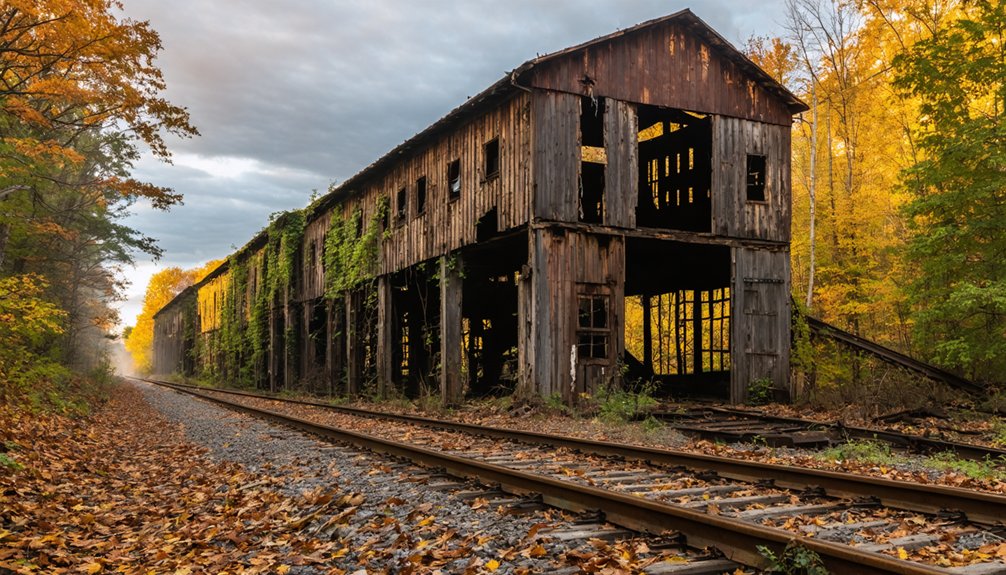
You’ll find Gary’s abandoned structures serving as Hollywood’s go-to apocalyptic backdrops, with nearly 7,000 decayed buildings providing authentic dystopian settings. The City Methodist Church—a Gothic Revival masterpiece closed since 1975—has hosted productions like *Transformers: Dark of the Moon* and *A Nightmare on Elm Street*, while rusted factories and industrial wastelands near Buffington Harbor create convincing post-collapse environments without expensive CGI. Film crews coordinate through local offices to access these blighted locations, where natural decay, dramatic lighting, and skeletal architecture deliver the atmospheric realism major studios need for their productions.
Key Takeaways
- Gary, Indiana features nearly 7,000 abandoned buildings serving as authentic film sets for productions like *Transformers* and *Sense8*.
- City Methodist Church, a Gothic Revival structure closed since 1975, provides dramatic apocalyptic and horror film backdrops.
- Gary’s rusted factories and industrial wastelands create convincing dystopian environments, saving filmmakers millions in set construction costs.
- Accessible filming locations include City Methodist Church, Crown Point’s Old Sheriff’s House, and Knightstown’s Hoosier Gym for visitors.
- Film productions bring economic activity to Gary while complicating preservation efforts and urban renewal initiatives in abandoned areas.
Gary’s City Methodist Church: A Post-Apocalyptic Film Favorite
When production scouts need authentic decay without CGI budgets, they head to Gary’s City Methodist Church—a nine-story Gothic Revival structure that’s been naturally transforming into a post-apocalyptic set piece since its 1975 closure.
You’ll find architectural details that money can’t replicate: soaring arched windows, intricate brickwork, and stone carvings now framed by collapsed roofing and natural dramatic lighting.
The historical significance adds depth—this 1926 building once served 2,000 steel workers before economic collapse emptied it.
Productions like *Sense8*, *A Nightmare on Elm Street*, and *Pearl Harbor* capitalized on these ready-made ruins.
Gary charges minimal fees ($1,550 in 2010), and crews can stabilize sections quickly—RestoreWorks shored up the structure in two weeks.
The sanctuary once accommodated over 900 worshippers across multiple balconies and social spaces spanning eight floors.
The complex originally included a theatre, dining hall, and gymnasium to serve the growing congregation in Gary during the 1920s.
You’re getting authentic urban decay without permits strangling your freedom to shoot.
Transformers: Dark of the Moon Brings Hollywood to Indiana’s Industrial Ruins
- $30 million allocated specifically for 3D camera equipment.
- Dual filming sessions capturing military vehicles approaching derelict structures.
- Josh Duhamel performing soldier scenes under 90-degree heat with fake snow.
- Strategic scouting that prioritized authentic decay over urban renewal aesthetics.
Paramount compensated public safety workers and inconvenienced neighbors, injecting capital into Gary’s economy without traditional economic development frameworks.
Film production dollars flowed directly to Gary residents and city workers, bypassing conventional economic development bureaucracy entirely.
The industrial wasteland‘s cost-prohibitive ambiance delivered sci-fi authenticity while generating referrals for future location scouts seeking unrestricted filming environments. Director Michael Bay’s location selection followed extensive scouting around Gary before settling on the abandoned City Methodist Church for its cinematic atmosphere. The April 12 shoot at Buffington Harbor depicted a Ukraine sequence with vehicles navigating the industrial property owned by Majestic Star Casino.
The Blues Brothers Chase Scene Through Gary’s Steel Mills
You’ll recognize the derelict steel mill structures in *The Blues Brothers* opening chase, though they’re not actually Gary’s—director John Landis filmed at Chicago’s U.S. Steel South Works, a 284-acre industrial graveyard that mirrored Northwest Indiana’s collapsing steel economy.
The production captured authentic Rust Belt decay across the site in 1979-1980, deploying 40 stunt drivers through crumbling infrastructure before the entire mill was demolished.
This stand-in location choice let Landis access Chicago’s logistics while evoking the same ghost town aesthetic that defined Gary’s abandoned Gary Works and surrounding steel corridor. The film’s elaborate automotive chaos helped establish it as the tenth highest-grossing film of 1980, bringing widespread attention to these decaying industrial landscapes. The climactic mall chase sequence featured extensive property destruction as police vehicles crashed through storefronts and retail displays.
Gary’s Industrial Backdrop Choice
Although the subtitle promises Gary’s steel mills, the actual filming location sits 40 miles west of Chicago in West Chicago, DuPage County, where Gary’s Mill Road intersects with S. Neltnor Boulevard.
The production team capitalized on this abandoned service station‘s rustic charm and industrial aesthetics to create the memorable gas station scene where Jake and Elwood push their Bluesmobile.
The location offered distinct advantages:
- Overgrown, desolate lot perfect for depicting an out-of-gas station
- Telephone poles providing authentic roadside atmosphere
- Proximity to Roosevelt Road enabling efficient crew logistics
- Empty space allowing controlled explosion effects for the extended cut
The nearby West Wind Motel, located at 28W721 Roosevelt Road, served as crew accommodations during the production. The motel’s distinctive neon sign from the film was later removed and replaced with a fluorescent version.
You’ll find the area transformed today, though the West Wind Motel and some landmarks remain accessible via Union Pacific West Line, preserving hints of that gritty, industrial filming backdrop.
Iconic Car Chase Legacy
When director John Landis orchestrated The Blues Brothers’ climactic pursuit sequence, he deployed 40 stunt drivers and 60 decommissioned police cruisers across Chicago’s streets to create what remains cinema’s most destructive car chase.
The production commandeered Harvey’s abandoned Dixie Square Mall, transforming its decay into spectacle as the Bluesmobile plowed through reconstructed storefronts—Pier 1 Imports, JC Penney, GM showrooms—scattering toys and mannequins.
Landis rejected process shots, instead capturing real 100-mph runs down Lake Street and harrowing 70-mph sequences through Lower Wacker Drive, where a camera truck’s tire explosion terrified Belushi. The film also featured high-speed pursuits along Northbound Courland Avenue, with assistance from local authorities coordinating the complex choreography. The film’s signature vehicle, a black-and-white 1974 Dodge, became an icon of American cinema through these death-defying stunts.
This $400-per-vehicle demolition derby preceded modern urban restoration efforts, yet demonstrated how community engagement with film production could monetize abandoned infrastructure, turning rust-belt dereliction into cultural legacy worth preserving.
Crown Point’s Historic Dillinger Escape Recreated in Public Enemies
Where Hollywood history intersects with criminal legend, Crown Point’s Lake County Jail became the centerpiece for *Public Enemies*’ most audacious sequence. Johnny Depp recreated John Dillinger’s infamous March 3, 1934 wooden gun escape at the exact location—270 S. Main Street’s Old Sheriff’s House.
At Crown Point’s historic jail, Hollywood and criminal infamy collided when Depp restaged Dillinger’s legendary 1934 wooden gun breakout.
Production transformed the authentic site through:
- Temporary cobblestone installation for period accuracy
- Filming Sheriff Lillian Holley’s automobile theft scene
- Recreating Dillinger’s cheeky hostage-taking of deputy Lunc
- Capturing the jailbreak’s exact choreography
Community engagement exploded when Depp’s black Escalade arrived, triggering “crazy” crowd frenzy. Local extras secured speaking roles while VIP fundraiser screenings supported historic preservation efforts.
You’ll witness how this production-oriented approach honored both cinematic storytelling and architectural legacy, proving authentic locations deliver unmatched dramatic power.
Why Gary’s Abandoned Structures Attract Major Film Productions
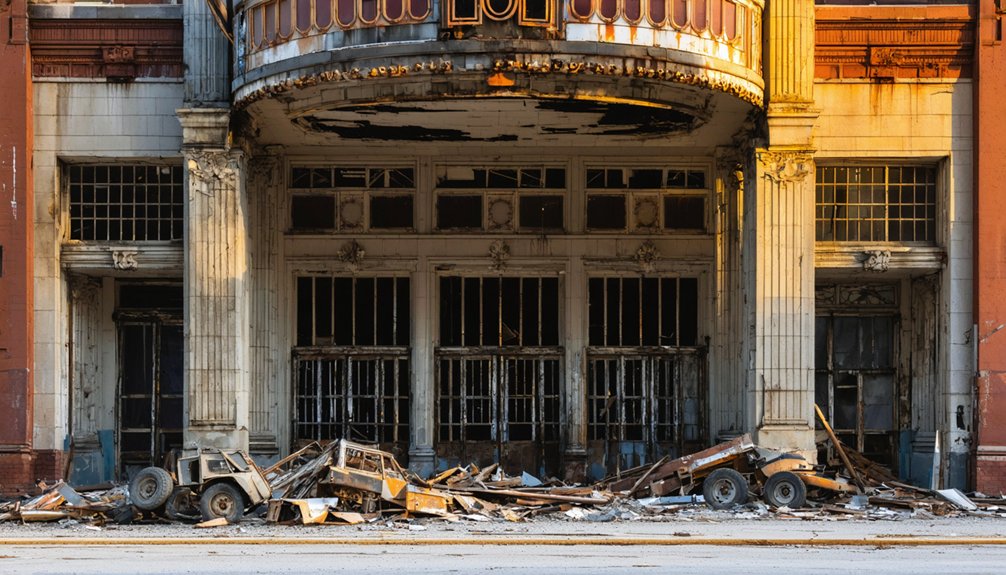
Gary’s post-industrial landscape delivers what Hollywood production designers crave most: authenticity impossible to fabricate on soundstages. You’ll find nearly 7,000 abandoned buildings transforming into ready-made sets where silent stories echo through decay.
City Methodist Church—Gary’s filming crown jewel—saved Michael Bay’s Transformers: Dark of the Moon thousands in construction costs with its Gothic Revival bones and apocalyptic ambiance. The 1926 masterpiece’s natural deterioration creates dramatic lighting through broken windows and roof gaps that studio lots can’t replicate affordably.
Urban legends draw your production scouts to this Lake Michigan ghost town where 37% of structures sit blighted.
Netflix’s Sense8, A Nightmare on Elm Street, and Pearl Harbor leveraged Gary’s dystopian atmosphere. You’re accessing genuine post-apocalyptic environments without permits strangling your creative freedom—just coordinate with local film offices.
From Steel Empire to Cinematic Wasteland: Gary’s Transformation
You’ll witness Gary’s century-long arc from U.S. Steel Corporation’s 1906 powerhouse—boasting the $800,000 Gothic Revival City Methodist Church and a population exceeding 170,000—to a hollowed landscape where 7,000 abandoned buildings now serve as ready-made film sets.
The same church that once held 3,000 congregants became a roofless ruin featured in *Transformers*. Its collapsing infrastructure requiring no set construction for apocalyptic scenes.
Production crews secure permits to shoot across derelict factories, stripped post offices, and vine-covered Union Station. They transform Gary’s economic collapse into cost-effective cinematic backdrops.
City Methodist Church Ruins
Rising from Gary’s urban landscape like a Gothic monument to industrial decline, the City Methodist Church stands as one of Indiana’s most filmed abandoned structures. Built in 1926 for $650,000, this English chapel-inspired edifice served 3,000 congregants before white flight decimated attendance to just 100 by 1975’s closure.
You’ll recognize its haunting silhouette from productions including 2009’s “A Nightmare on Elm Street” remake.
The 1997 arson that collapsed the roof transformed it into filmmakers’ dream location, though accessing it now requires:
- Moving through 10-foot security fencing
- Obtaining proper filming permits
- Accounting for structural instability
- Managing asbestos risks
Despite urban renewal challenges, a 2017 $163,333 grant targets architectural preservation through ruins garden development—balancing Hollywood’s appetite for decay against Gary’s redevelopment aspirations.
Transformers and Hollywood Appeal
While the City Methodist Church earned its reputation through atmospheric horror scenes, Gary’s transformation into a Hollywood hotspot reached blockbuster scale when director Michael Bay recognized the city’s industrial wasteland could convincingly double for war-torn foreign territories. Transformers 3: Dark of the Moon brought 500 crew members to the abandoned Lehigh cement plant in August 2010, generating immediate economic activity for the local community.
Bay’s repeated selection of Gary—having previously filmed Pearl Harbor there—demonstrated the location’s authentic decay offered cost-effective alternatives to constructed sets. The production’s multi-visit schedule throughout 2010 confirmed Gary’s strategic value for depicting deteriorated infrastructure.
However, this Hollywood recognition created preservation challenges: balancing film revenue against maintaining these crumbling structures that attracted productions like A Nightmare on Elm Street, With Honors, and Richie Rich across multiple decades.
Industrial Decay Becomes Cinema
Gary’s steel empire crumbled from 32,000 steelworkers in 1970 to just 7,000 by 2005—a collapse that transformed the “City of the Century” into 100 square miles of abandoned factories, rusted infrastructure, and skeletal buildings that Hollywood couldn’t recreate on any studio backlot.
You’ll find production crews drawn to Gary’s authenticity:
- Zero construction costs: Real decay replaces expensive set design
- Massive scale: Entire city blocks provide dystopian backdrops
- Unrestricted access: Minimal regulatory hurdles in economically desperate areas
- Atmospheric lighting: Industrial grime creates natural cinematography
While filmmakers exploit Gary’s ruins for profit, residents navigate daily realities Hollywood romanticizes. Urban renewal remains stalled despite decades of promises.
Community rebuilding efforts can’t compete with location scouts seeking authentic devastation—your freedom to film amplifies their displacement.
Visiting Indiana’s Abandoned Film Locations Today
Indiana’s ghost towns and abandoned structures offer tangible connections to Hollywood productions, though access varies dramatically by location. You’ll find Gary’s City Methodist Church remains open for urban exploration, where Transformers and Pearl Harbor crews captured industrial decay.
Crown Point’s Old Sheriff House—Dillinger’s actual escape site from Public Enemies—provides foundation-led seasonal tours through preserved jail structures.
Breaking Away’s Bloomington quarry sits filled now, but surrounding neighborhoods and Indiana University campus remain accessible for location spotting. Knightstown’s Hoosier Gym welcomes visitors year-round to walk the original Hoosiers hardwood.
Local legends surround these sites, driving preservation efforts despite deterioration. Whiting’s Rudy residence stays privately owned, viewable only from streets.
You’ll explore most locations independently, accepting risks that accompany Gary’s broader abandonment and crumbling facades.
How Industrial Decay Created Authentic Movie Settings Without CGI
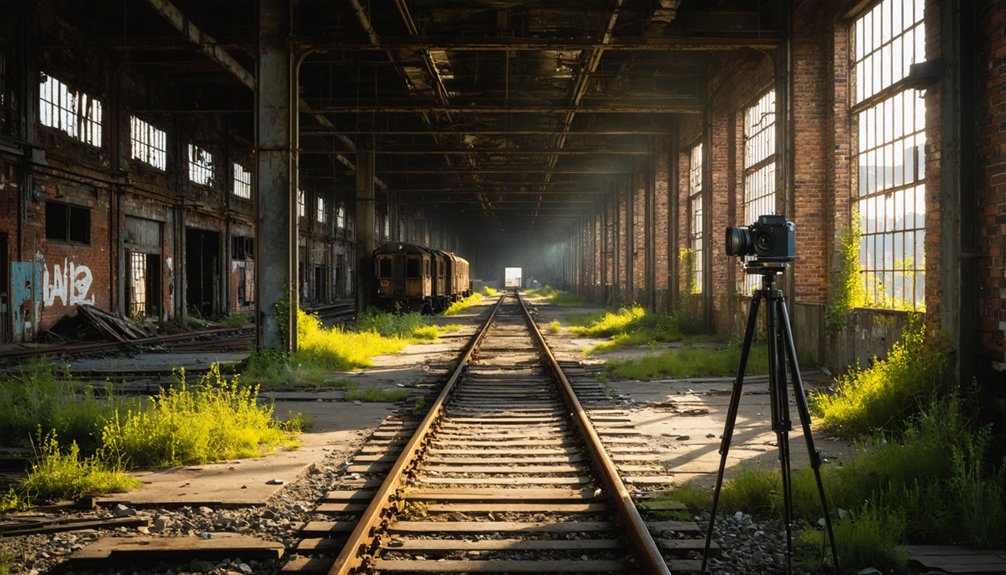
The production advantages were undeniable:
- Zero set construction costs from ready-made ruins
- Organic textures of rust, broken stained glass, and overgrown interiors
- No CGI budget needed for post-apocalyptic atmosphere
- Immediate availability with abandoned structures requiring no permits for alterations
While urban renewal advocates debated community preservation, filmmakers exploited what deindustrialization freely provided. Gary’s collapsing steel-era architecture delivered visceral realism that green screens couldn’t match, proving sometimes reality’s decay surpasses Hollywood’s imagination.
Frequently Asked Questions
Are There Permits Required to Visit Gary’s Abandoned Filming Locations?
You’ll need legal permissions for filming, but casual exploration doesn’t require permits anymore since Gary’s photographer fee program ended. Follow visitor guidelines respecting private property boundaries, and you’re free to document these hauntingly cinematic ruins independently.
Which Other Indiana Ghost Towns Have Been Used in Films?
While Gary’s ruins dominate urban exploration scenes, the background information doesn’t reveal other Indiana ghost towns used for filming. You’ll find authentic locations like Crown Point’s historic jail and Knightstown’s preserved gym supporting historic preservation through cinema instead.
Can Tourists Enter City Methodist Church Where Transformers Was Filmed?
You’ll need permits to enter the Transformers filming location legally. Photography regulations now govern access to this decaying landmark, though historical preservation efforts remain unfunded. Saturday visits attract crowds of urban explorers maneuvering the nine-story ruins.
Has Gary’s Filming Popularity Increased Property Values in Abandoned Areas?
Hollywood’s spotlight hasn’t gilded Gary’s ruins—you’ll find no property investment boom despite filming fame. Urban decay persists unchecked, with no documented value increases in abandoned areas. The city discontinued filming permits, confirming zero economic revitalization from production activity.
What Safety Precautions Should Visitors Take at These Abandoned Sites?
You’ll need thorough hazard assessment before entering, identifying structural weak points and environmental dangers. Wear protective gear including sturdy boots, gloves, and respirators. Bring flashlights, first aid supplies, and communication devices while traveling in groups for maximum safety.
References
- https://www.travelindiana.com/take-a-road-trip-to-some-of-the-most-iconic-movie-locations-in-the-hoosier-state/
- https://b1057.com/playlist/famous-movies-filmed-in-indiana/
- https://www.youtube.com/watch?v=-DmmaRUrGSk
- https://www.businessinsider.com/abandoned-places-used-in-movies-tv-shows-2020-9
- https://www.worldatlas.com/cities/6-indiana-towns-where-famous-movies-were-filmed.html
- https://www.youtube.com/shorts/J-a6J7JFbMY
- https://myfamilytravels.com/the-haunting-indiana-landmark-where-hollywood-stars-come-to-play/
- https://www.restoreworks.com/project/netflix-series-location-city-methodist-church
- http://americanurbex.com/wordpress/?p=407
- https://en.wikipedia.org/wiki/City_Methodist_Church