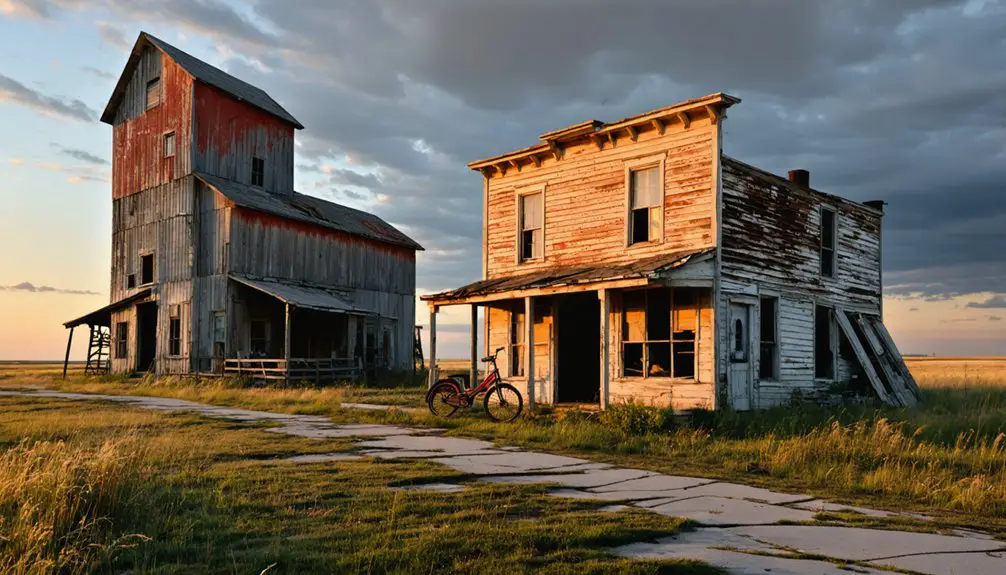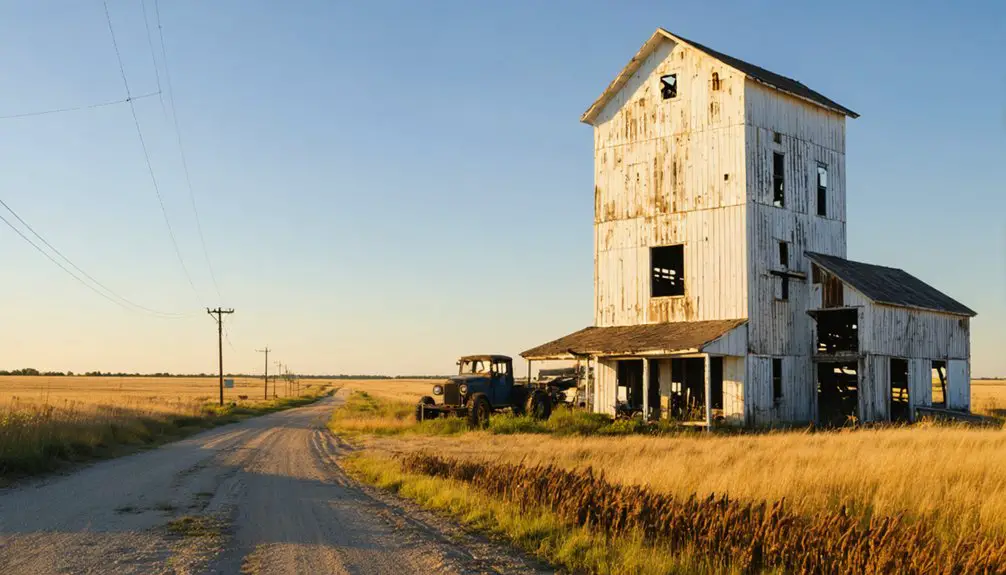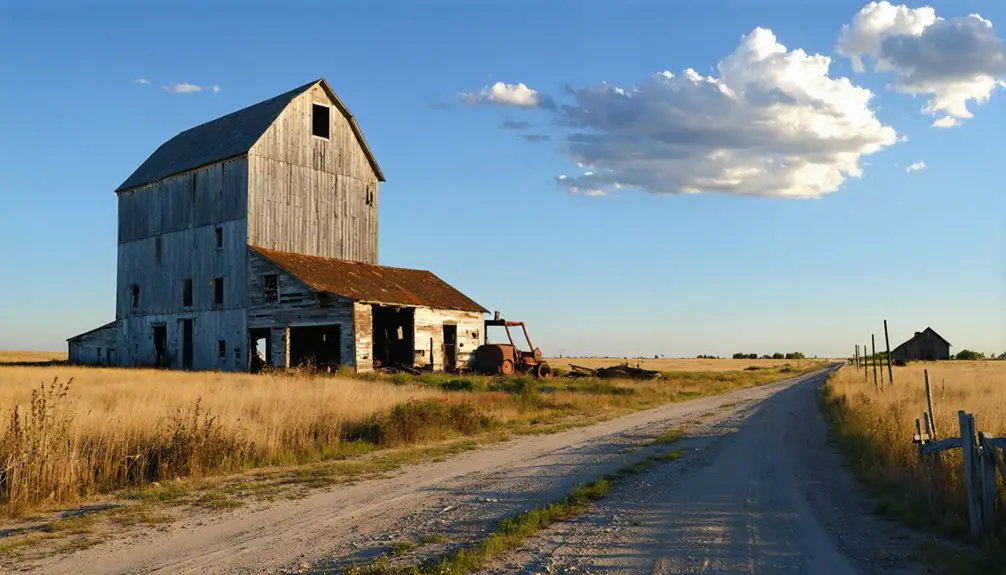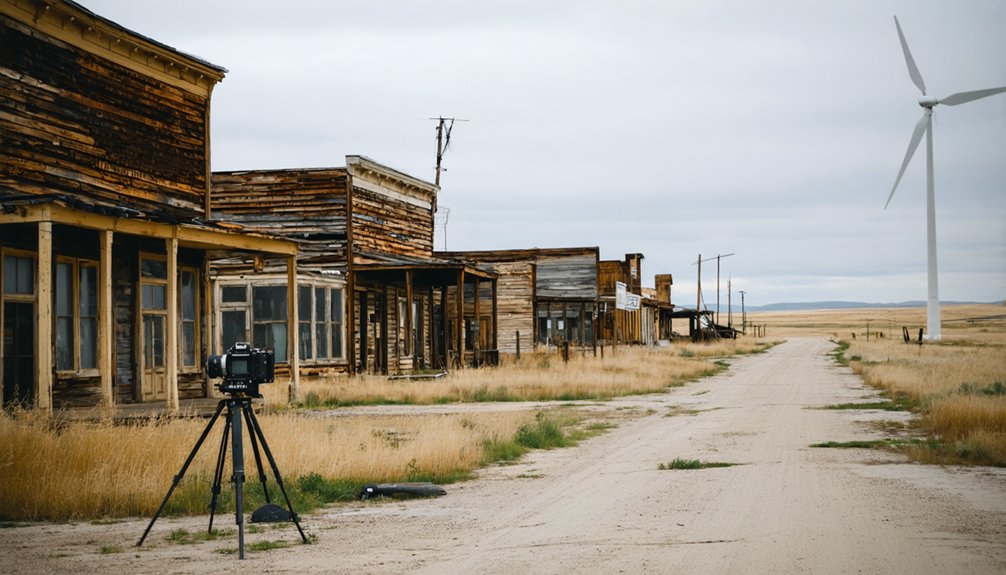
You’ll find North Dakota’s 1,000+ ghost towns—featuring weathered churches, one-room schoolhouses, and Milwaukee Road boxcars across prairie depressions and Badlands—remain virtually unused as film locations despite their authentic Western atmosphere. Sites like Lark, Arena, and Dogtooth offer surviving structures requiring minimal modifications, unlike neighboring Montana’s Bannack State Park (70+ productions) or South Dakota’s 1880 Town (*Dances with Wolves*). These abandoned communities provide cost-effective, atmospheric backdrops with diverse terrains, though their cinematic potential stays largely unexplored compared to regional counterparts that’ve transformed heritage sites into filming destinations.
Key Takeaways
- North Dakota has over 1,000 cataloged ghost towns across six counties that remain entirely unexploited by the film industry.
- Notable locations like Lark, Arena, and Dogtooth feature surviving structures including churches, schoolhouses, and historic buildings requiring minimal modifications.
- Diverse terrains—prairie expanses, Badlands formations, Black Hills forests—provide authentic backdrops for Westerns, frontier films, and period pieces.
- No historical record exists of these sites being used as major film locations, presenting untapped potential for productions.
- Existing weathered structures offer cost-effective filming options with natural authenticity, similar to successful Montana and South Dakota ghost town productions.
The Search for Cinematic Ghost Towns in the Peace Garden State
When you set out to locate ghost towns that have doubled as movie sets in North Dakota, you’ll find yourself steering a curious gap in the state’s cinematic history. The state’s 14 documented films—led by Fargo’s limited Bathgate winter shoots—rarely venture into abandoned settlements like Alkabo, Fortuna Air Force Station, or Charbonneau.
Unlike South Dakota’s preserved Fort Hays set or 1880 Town’s repeated commercial use, North Dakota’s ghost towns remain untouched by Hollywood cameras. You’ll discover sites such as Hamlet, Lonetree, and Burnstad’s two remaining structures near Beaver Lake offering pure urban decay without film crews disrupting their authenticity. By contrast, South Dakota’s Black Hills region has hosted over 40 movies, ranging from classics to modern blockbusters that capitalize on the area’s dramatic terrain.
This absence presents both a puzzle and an opportunity for cultural preservation, where weathered buildings stand as unexploited backdrops awaiting discovery by independent filmmakers seeking genuine frontier atmospheres. The state’s challenging weather issues and logistics have historically deterred major Hollywood productions from exploring these atmospheric locations.
North Dakota’s Documented Ghost Towns Near Bismarck
You’ll find Lark’s pheasant fields scattered 10 miles west of Flasher, where no structures interrupt the hunting grounds that define this minimal settlement.
Travel 35 miles northeast to Arena, where St. John’s Lutheran Church rises above two remaining homes and a country schoolhouse—all established in 1906 by Minnesota’s Patterson Land Company.
Five miles southeast of Carson, Brisbane’s post office opened in 1910 to serve a community that once supported a general store, school, hardware store, blacksmith, and restaurant before its rapid decline. The town now stands as one of the completely barren locations with no buildings or roads remaining.
East of Raleigh, Dogtooth’s molar-shaped buttes mark the site of an 1876 railroad station, its legacy preserved only through a bar name in the nearby town.
Lark and Arena History
While most travelers rush past on Highway 21 today, the ghost town of Lark sits approximately 50 miles west of Bismarck, where a faint trail now marks what was once a thriving railroad community. Silver discovery in 1863 sparked settlement, with Lark officially laid out by 1900 around the Mascotte Tunnel operations.
Peak Development (1906-1920s):
- Hardware store, lumber yard, church, implement dealer, general stores, and blacksmith shop served residents
- Community hall hosted costume dances, while mine whistles marked midnight celebrations
- Northern Pacific Railroad branch connected Mandan to Mott, sustaining commerce
Historic preservation efforts couldn’t prevent Kennecott Copper Corporation’s acquisition, though residents’ organized opposition drew national media attention. The corporation’s community outreach programs later included support for local causes and educational initiatives across mining regions. Many North Dakota communities originated from rural post offices established on farms, which sometimes evolved into small towns.
Community storytelling documents Arena’s parallel fate—founded 1906, devastated by fires in 1916 and 1920, declining to 35 citizens by 1935.
Dogtooth Railroad Station Origins
Though highway travelers today barely notice the windswept prairie two miles west of modern Raleigh, Dogtooth Station once anchored a critical link in the 1876 Deadwood-Bismarck Trail.
You’ll find this Grant County location served as the third stagecoach stop between Bismarck and Deadwood, named for nearby sandstone buttes resembling canine teeth.
The station operated until 1880 when the Northern Pacific Railroad rendered stagecoach routes obsolete.
Robert Pearce established a post office here in 1900, spurring hopes for metropolitan growth.
Those dreams collapsed when Charles Leonard relocated his store to Raleigh in 1910.
The settlement was established as a railroad station in 1876, marking its earliest documented origins in transportation history.
A tragic 1910 accident claimed Ole Wagseth’s life five miles southwest of Dogtooth when his wagon overturned multiple times after driving over a high embankment in dark, smoke-filled conditions caused by distant forest fires.
Historical preservation efforts now classify Dogtooth as a documented ghost town, while community engagement keeps its memory alive through Raleigh’s lone bar—aptly named “The Dogtooth.”
Why Regional Ghost Towns Attract Film Productions
When production scouts search for authentic Western backdrops, North Dakota’s weathered ghost towns offer exactly what green screens and studio lots can’t replicate—decades of genuine decay, period-appropriate architecture, and landscapes untouched by modern development.
These abandoned settlements deliver three critical production advantages:
- Cost advantages eliminate expensive set construction, with existing structures requiring minimal modification for period pieces.
- Authentic ambiance provides weathered wood, rusted metal, and naturally distressed surfaces that would cost thousands to recreate artificially.
- Creative freedom allows crews to modify locations without restrictions typical of preserved historical sites or active communities.
You’ll find filmmakers drawn to these remote locations where vast horizons and minimal light pollution create cinematography opportunities impossible in controlled studio environments.
Meanwhile, isolation from modern infrastructure ensures no contemporary elements contaminate historical narratives.
Towns like Ambrose, which declined from 300 residents to only 17, feature boarded-up Main Street buildings that provide ready-made sets without the need for elaborate props or construction.
Similar to South Dakota’s 1880 Town, which houses relocated authentic structures disassembled plank by plank and reassembled with careful documentation, these ghost towns offer production value through genuine historical materials rather than constructed facades.
Neighboring States’ Success With Ghost Town Film Locations
Montana’s ghost towns have transformed into profit-generating film locations, with Bannack State Park alone attracting major commercial productions like KIA’s multi-vehicle campaign featuring the Sorento, Telluride, and Sportage SUVs against its weathered 1860s storefronts. You’ll find Butte dominating with 70 filmed productions, including the 1923 Yellowstone prequel basecamp hosting Harrison Ford and Helen Mirren.
The Old Montana State Prison in Deer Lodge secured five major films through its authentic historical small spaces. Tourism boosting follows naturally—Virginia City ranks as America’s 6th eeriest ghost town while maintaining summer entertainment operations.
Heritage storytelling drives Nevada City’s appeal with its preserved main street and train station intact for period-accurate shoots. Montana offers practical incentives: 10% rebates for 20+ day equipment rentals, 5% for underserved county expenditures, plus 5% for end-credit Montana branding.
North Dakota’s Untapped Filming Potential in Abandoned Communities
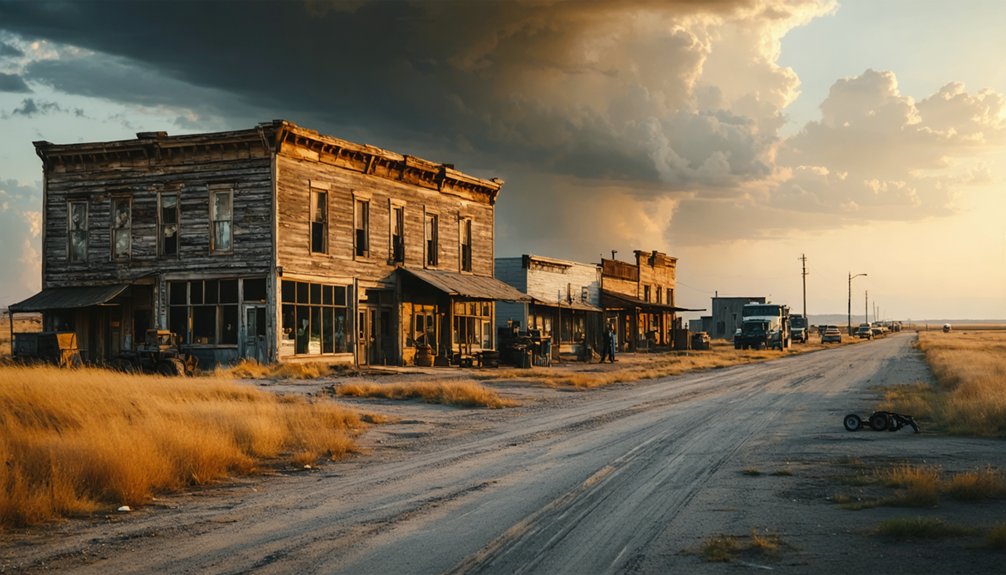
You’ll find North Dakota’s ghost towns offer ready-made film sets with authentic weathered churches, one-room schoolhouses, and Milwaukee Road boxcars requiring no construction costs.
Despite these standing structures—from Arena’s 1906 buildings nestled in natural valleys to Griffin’s Yellowstone Trail remnants—no major film productions have utilized these locations. The state’s abandoned communities span diverse terrain across six counties, providing cinematographers with varied backdrops from Burleigh County’s prairie depressions to Williams County’s northern landscapes.
Yet they remain completely unexploited by the film industry.
Diverse Landscape Cinematic Appeal
- Prairie expanses that replicate Old West settings with vast, unobstructed horizons free from modern intrusions.
- Badlands formations featuring geological drama suitable for action sequences and frontier narratives.
- Black Hills forests providing mountain terrain and valleys for diverse cinematic compositions.
The abandoned structures require minimal modification while maintaining visual authenticity. You’ll access original construction materials, weathered aesthetics, and atmospheric desolation that naturally conveys isolation—perfect for unrestricted creative storytelling.
Ghost Towns Lack Film History
Despite North Dakota’s extensive inventory of abandoned communities—ranging from the 23 completely barren sites documented by Wikipedia to over a thousand ghost towns and near-ghost towns catalogued by RootsWeb—no evidence exists of these locations serving as movie filming sites.
You’ll find thorough documentation of places like Tagus, Carbury, and Nanson detailing their structural remnants, population declines, and haunted reputations, yet filming histories remain conspicuously absent. This gap reveals untapped potential for productions seeking cinematic authenticity without constructed sets.
Remote locations like Nanson, lacking power infrastructure, offer genuine isolation. Crumbling structures in Straubville and Deisem provide decayed realism that historical preservation concerns haven’t erased.
Arena’s abandoned church and Sims’s contrast between active worship and surrounding decay present ready-made dramatic backdrops requiring minimal logistical investment—authentic settings waiting for discovery.
Preserving Ghost Town Heritage Through Visual Media
While North Dakota’s 32 documented ghost towns—from Burnstad’s weathered structures near Beaver Lake State Park to Tagus’s abandoned grain elevators—haven’t yet attracted Hollywood cameras, neighboring South Dakota demonstrates how film productions can breathe preservation life into forgotten settlements.
Cultural revitalization through cinema follows these proven pathways:
- Set-to-Museum Conversion: South Dakota’s 1880 Town transformed a failed 1970s movie set into a permanent attraction, later expanding with *Dances with Wolves* props including Kevin Costner’s horse Cisco.
- On-Location Preservation: Fort Hays preserved the *Dances with Wolves* set after relocation, making it publicly accessible off Highway 16.
- Heritage documentation: Over 40 Black Hills productions created visual archives of regional history.
This framework remains unexplored across North Dakota’s abandoned settlements, despite films like *Welcome to Leith* proving audience interest in Great Plains narratives.
Frequently Asked Questions
What Permits Are Required to Film in North Dakota Ghost Towns?
You’ll need property owner permission since ghost town filming permissions depend on land ownership. For filming permit requirements, obtain location agreements for private land, or contact the Division of Tourism for public property access at least one week ahead.
Are North Dakota Ghost Towns Safe to Visit Without Professional Crew Support?
No, you shouldn’t visit alone—80% of North Dakota ghost towns lack cell service. Without safety precautions like emergency communication and structural knowledge, unauthorized access to decaying buildings, unstable grain elevators, and remote locations poses serious risks you’ll face solo.
Which Ghost Towns Near Bismarck Have the Best Preserved Structures?
Arena offers the best-preserved abandoned buildings near Bismarck, with St. John’s Lutheran Church, two homes, and grain elevators still standing. Sims follows closely, featuring an active church and cemetery, though preservation efforts remain minimal across both locations.
How Much Does It Cost to Film at Abandoned Sites in North Dakota?
Costs vary wildly—you’ll negotiate directly with landowners since there’s no set fee. You’ll face environmental impact assessments, historical preservation compliance, and liability insurance requirements. Expect 30-60 days processing, plus elevated premiums for unstable structures.
Can the Public Access Ghost Town Filming Locations Year-Round in North Dakota?
You’ll find year-round access to most North Dakota ghost town filming locations via public roads, though historical preservation efforts and tourist attraction developments may limit certain areas. Always verify private property boundaries before exploring these visually striking, weathered structures.
References
- https://www.motionpicturevideo.com/top15locations
- https://mountrushmoretours.com/5-must-see-film-locations-in-the-black-hills/
- https://us1033.com/5-ghost-towns-that-are-about-50-miles-from-bismarck/
- https://www.youtube.com/watch?v=8GO57Im_dss
- https://www.southdakotamagazine.com/1880-town
- https://en.wikipedia.org/wiki/Twixt_(film)
- https://www.ndtourism.com/articles/filming-north-dakota-locations
- https://us1033.com/discover-the-hidden-gems-movies-filmed-in-north-dakota-revealed/
- https://www.tripadvisor.com/Attractions-g28955-Activities-c47-t14-North_Dakota.html
- https://en.wikipedia.org/wiki/Category:Films_shot_in_North_Dakota