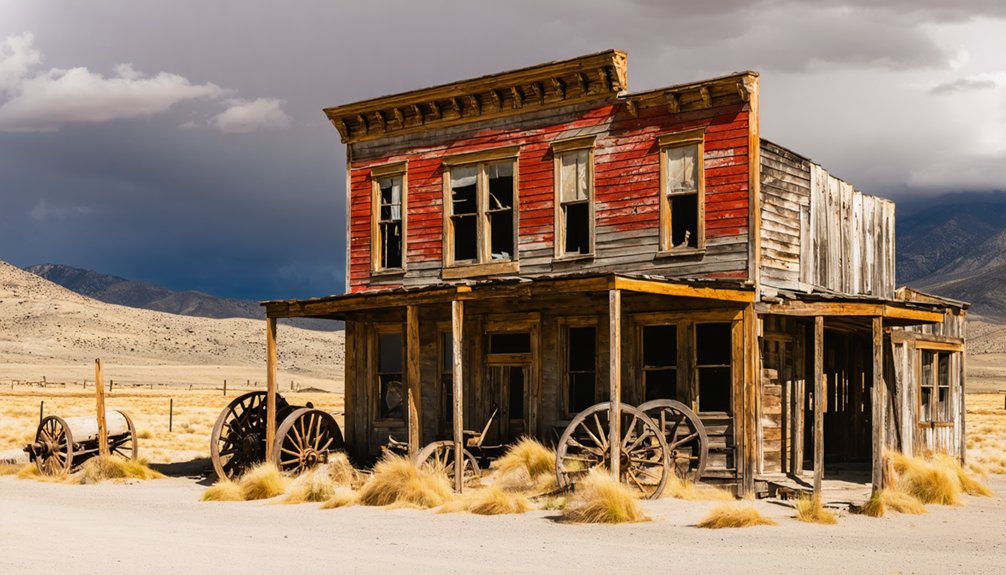
Though you’ll encounter these terms used interchangeably, preservation scholars maintain a essential distinction: ghost towns possess tangible physical remains—structures, streets, cemeteries—that you can document and visit, while abandoned towns may have disappeared entirely, confirmed only through historical records or archaeological traces. The U.S. documents 573 ghost towns across a preservation spectrum, from intact sites like Bodie to 211 barren locations marked solely by cemeteries. Population thresholds further differentiate them, with ghost towns maintaining skeletal residents versus abandoned towns’ near-total depopulation—distinctions that reveal broader patterns of settlement desertion.
Key Takeaways
- Ghost towns retain tangible physical remains like structures, streets, and cemeteries, while abandoned towns may lack any physical evidence.
- Ghost towns often have skeletal populations or minimal residents; abandoned towns typically imply near-total or complete depopulation.
- Abandoned towns suggest recent departure with structures left behind; ghost towns are often older settlements in various preservation states.
- Ghost towns exist on a preservation spectrum from intact buildings to complete disappearance; abandoned towns emphasize the departure itself.
- The terms are frequently used interchangeably, but distinctions involve preservation status, physical evidence levels, and historical documentation requirements.
Defining Ghost Towns and Abandoned Towns: Understanding the Key Distinctions
While contemporary usage often treats “ghost town” and “abandoned town” as interchangeable terms, these designations possess distinct definitional boundaries that merit scholarly examination. You’ll find ghost towns demand tangible remains—dilapidated structures, main streets, cemeteries—accessible for documentation.
Abandoned towns require no such physical evidence; relocated or demolished settlements qualify regardless of urban decay visibility. Population thresholds differ substantially: ghost towns maintain skeletal residency (Oregon’s classification references electorates insufficient for filling offices), whereas abandoned towns imply near-total depopulation without specific numerical criteria.
Ghost towns emerge from failed economic foundations, particularly mineral extraction operations, preserving infrastructure evidence. The transition to ghost town status can result from economic failure, natural disasters, or lack of government action. Abandoned towns encompass broader contexts—from intact buildings to foundation traces. Supply hub towns, often situated in hospitable areas near mining operations, prove less susceptible to complete abandonment than extraction sites themselves.
No universal classification exists; Western Mining History and Ghost Town USA employ varying criteria, reflecting definitional fluidity across jurisdictions.
Why Settlements Become Deserted: Economic Collapse, Disasters, and Transportation Shifts
Throughout history, settlements have faced abandonment through three principal mechanisms: economic collapse following resource depletion, catastrophic events disrupting habitability, and transportation network reconfigurations rendering locations obsolete.
Cities die through three paths: depleted resources, catastrophic disruption, or obsolete connections to the world beyond.
You’ll observe this pattern in Colorado’s mining towns, where ore depletion triggered rapid exodus—extractive laborers fled first, followed by support businesses losing their consumer base.
Economic downturns amplify these dynamics: the Great Recession eliminated 1.9 million jobs in left-behind counties, while left-behind areas suffered a 1.8 million job deficit since 2000.
Infrastructure decay accelerates depopulation—San Francisco’s 7.4% population drop (2020-2023) created cascading vacancies, while Akron recorded a 69% permit decline signaling investment withdrawal. Detroit exemplifies this trajectory with 30% homes vacant over two years accompanying a 1% population decline.
Rural tax bases eroded since the 1980s, forcing service cuts that further incentivized departure, creating self-reinforcing abandonment cycles. Contemporary cities face office vacancy rates exceeding 20% as businesses relocate, transforming once-thriving commercial districts into deserted corridors.
Population Status and Levels of Abandonment: From Total Evacuation to Residual Communities
When you examine abandonment patterns, you’ll find they exist along a spectrum rather than as binary states. Total evacuation characterizes sites like Billmeyer, where quarry closure triggered complete depopulation by the mid-1900s, leaving no operative settlement.
Conversely, residual populations persist in 102 U.S. ghost towns, where communities retain what Daniel Fitzgerald terms “shadowy remnants” of former energy—sparse inhabitants dwelling among period structures without full municipal function. The structures themselves vary widely, ranging from nearly intact buildings to sites where only foundations remain visible. These settlements differ from phantom settlements, which lack physical presence entirely and exist only in maps, stories, or folklore without any standing buildings or infrastructure.
Complete vs. Partial Evacuation
Ghost towns exist along a continuum of abandonment rather than as a binary state, with population levels ranging from absolute vacancy to skeletal residual communities that blur the boundaries of the classification itself.
The factors leading to ghost towns can include economic decline, natural disasters, and shifts in demographics, which all contribute to this gradual process of desolation. As industries collapse or resources dwindle, towns that once thrived may find their populations dwindling, leaving behind empty buildings and memories. This evolution not only reflects the changing fortunes of a community but also serves as a poignant reminder of how sensitive human settlements are to external pressures.
You’ll find 211 barren U.S. sites representing complete evacuation—total abandonment where economic failure or resource depletion drove every resident away. Bodie and Calico, California, exemplify this category with preserved structures experiencing urban decay but zero inhabitants.
Conversely, 102 ghost towns retain residual populations maintaining skeleton communities despite significant depopulation from peak levels. These semi-abandoned settlements feature handfuls of year-round residents among decaying infrastructure, demonstrating partial evacuation’s environmental impact on built landscapes. Towns experiencing population loss exceeding 75% often qualify as ghost towns even when maintaining small populations of approximately 20 residents. Additionally, 46 submerged ghost towns rest beneath the waters of lakes or reservoirs, particularly concentrated in states like Pennsylvania and Ohio.
The spectrum includes 47 sparsely populated “D” status sites and 34 inhabited ghost towns, where you’ll encounter functional dwellings amid widespread abandonment—classification nuances reflecting gradations between complete desertion and minimal occupancy.
Residual Population Thresholds
Classification systems impose numeric thresholds to distinguish degrees of abandonment, yet considerable variation exists among authoritative frameworks. Ghost Town USA’s Class C permits caretakers in completely abandoned sites, while Expedition Utah’s Class 1 requires 75% uninhabited structures.
Western Mining History accepts “handful of part-time residents” within ghost town designation, emphasizing the original settlement purpose has vanished. Population decay manifests differently across classifications—some demand near-total desertion, others allow residual communities.
Baker’s definition prioritizes economic decline over absolute evacuation: when a town’s founding rationale disappears, skeleton populations don’t disqualify ghost status. You’ll find thresholds ranging from Expedition Utah’s 10% boom-time population (Class 4) to 50% reduction (Class 5A), reflecting scholarly disagreement about where occupied settlement ends and ghost town begins. Plymouth, Montserrat exemplifies the extreme case where natural disaster evacuation created the only ghost town serving as a modern political capital. Class 5B represents the opposite extreme, where near boom population levels combine with restored historic structures to create re-living towns.
Physical Conditions: Preservation States From Intact Structures to Complete Disappearance
You’ll find abandoned settlements exist along a dramatic preservation spectrum, ranging from architecturally intact structures to sites where no physical evidence remains. This continuum encompasses 573 documented U.S. ghost towns distributed across five distinct preservation categories: 97 abandoned sites with substantial buildings, 119 neglected locations featuring dilapidated structures, 46 submerged communities beneath toxic waters, 211 barren sites marked only by cemeteries, and numerous destroyed settlements razed by fire or natural disasters.
Understanding this structural integrity spectrum requires systematic analysis of degradation patterns—from deliberate demolition and natural erosion to catastrophic events that erase entire communities from the landscape.
Structural Integrity Spectrum Analysis
When examining abandoned settlements across the United States, the physical condition of remaining structures varies dramatically along a five-tier classification spectrum, ranging from complete disappearance to well-preserved historic districts.
You’ll find 211 barren sites (Class 1) where archaeological investigation proves necessary to determine town layouts, while 119 neglected locations (Class 2) feature caved roofs beyond repair.
Ghost town architecture becomes more evident at 97 abandoned sites (Class 3) where restoration potential exists, and 69 semi-abandoned towns (Class 4) display mixed structural integrity with 75% uninhabited buildings.
Historic towns (Class 5A) number 57, maintaining original structures despite 50% population decline.
These preservation challenges reflect varying forces: relocation, natural disasters, and temporal decay across America’s settlement history.
Total Erasure Documentation
At the extreme end of preservation states, complete physical erasure represents the most challenging condition for ghost town documentation and verification. You’ll find 211 documented barren classifications among 4,531 U.S. ghost towns, where settlements have been “wiped off the landscape completely by time and neglect.”
Open-pit mining operations have demolished entire communities, leaving no apparent structural remains. When total erasure occurs, burial sites become your primary verification method—cemetery locations provide tangible evidence of former habitation even when all buildings have vanished.
Submerged ghost towns constitute 46 cases where dam construction eliminated settlements entirely.
These erasure scenarios require archaeological markers and historical records for identification, as physical verification becomes impossible without documented cemetery access or memorial sites marking former community locations.
Global Distribution and Regional Patterns: Where Ghost Towns and Abandoned Towns Exist
Ghost towns and abandoned settlements appear across every inhabited continent, their distribution reflecting distinct regional patterns shaped by resource extraction cycles, armed conflicts, natural disasters, and economic upheavals.
You’ll find mining-related urban decay concentrated in Namibia’s Kolmanskop and Chile’s Humberstone, where saltpetre depletion triggered exodus.
Conflict zones dominate Central African Republic’s deserted villages—Goroumo, Beogombo Deux—and North Cyprus’s Varosha, frozen since 1974’s Turkish invasion displaced 40,000 residents.
Japan’s Hashima Island exemplifies industrial abandonment, peaking at 5,000 coal miners before closure.
China’s Kangbashi District represents speculative failure: built for 1 million, housing merely 20,000-30,000.
Italy’s Craco demonstrates natural disaster impacts, while architectural preservation efforts maintain Turkey’s Kayaköy’s 350 homes post-1923 population exchange.
Arctic Russia’s Vorkuta region lost over 1 million residents following Soviet collapse.
Cultural Heritage and Modern Appeal: From Historical Time Capsules to Tourist Destinations
As ghost towns shift from sites of abandonment into recognized cultural assets, preservation methodologies have evolved to balance historical authenticity with visitor accessibility. You’ll find arrested decay approaches at Bodie State Historical Park maintaining 110 structures in their deteriorated state, while selective structural maintenance prevents complete collapse without compromising integrity.
Industrial decline and mining economies left behind Jerome, Arizona, now transformed through artist settlement into thriving cultural destinations. Heritage tourism generates sustainable economic activity—Belchite attracts 10,000+ annual visitors despite minimal infrastructure.
Filmmaker partnerships enhance visibility, with Craco serving as a Quantum of Solace location. Adaptive reuse strategies convert weathered buildings into functional spaces, while leave-no-trace principles and strict regulatory frameworks ensure you can explore these historical time capsules responsibly without degrading their archaeological value.
Frequently Asked Questions
Can You Legally Purchase Property in Ghost Towns or Abandoned Towns?
You can legally purchase property in ghost towns through standard real estate transactions. However, you’ll face challenges: historical ownership requires thorough title searches, property rights demand verification across multiple parcels, and environmental assessments ensure contamination-free land acquisition.
What Safety Hazards Exist When Visiting Ghost Towns and Abandoned Settlements?
You’ll encounter hazardous terrain including weakened structures, unstable floors, and toxic contamination. Former military sites may contain unexploded devices requiring extreme caution. Legal consequences, from fines to arrest, also threaten your freedom when trespassing on restricted properties.
How Do Governments Decide Which Abandoned Towns Deserve Historical Preservation Status?
You’ll find governments evaluate abandoned towns using systematic preservation criteria: they assess historical significance through four established standards—association with events (Criterion A), notable persons (B), architectural merit (C), or archaeological potential (D)—plus integrity requirements.
Are Ghost Town Residents Entitled to Government Services and Infrastructure Maintenance?
You’ll find entitlement depends on local regulations and historical context—unincorporated ghost towns with minimal populations rarely qualify for standard services, though preserved historic sites may receive government maintenance prioritizing conservation over resident infrastructure needs.
What Happens to Unclaimed Possessions Left Behind in Abandoned Town Buildings?
You’ll find unclaimed possessions follow escheatment laws—property ownership transfers to the state after statutory periods. Historical artifacts require careful documentation, while mundane items face disposal. Local governments catalog, preserve significant materials, then auction or demolish structures containing abandoned goods.
References
- https://www.britannica.com/topic/ghost-town
- https://blog.batchgeo.com/ghost-towns/
- https://vocal.media/horror/ghost-towns-and-abandoned-places-exploring-the-forgotten
- https://www.youtube.com/watch?v=ZiJctD8Cs70
- https://www.youtube.com/watch?v=XLYmuRk6pJM
- https://www.yardi.com/blog/news/abandoned-america/38780.html
- https://www.lindasellsmoore.com/blog/what-is-a-ghost-town/
- https://westernmininghistory.com/664/what-is-a-ghost-town-wmh-town-classifications-explained/
- https://freepages.history.rootsweb.com/~gtusa/definitions.pdf
- https://planningtank.com/settlement-geography/ghost-towns