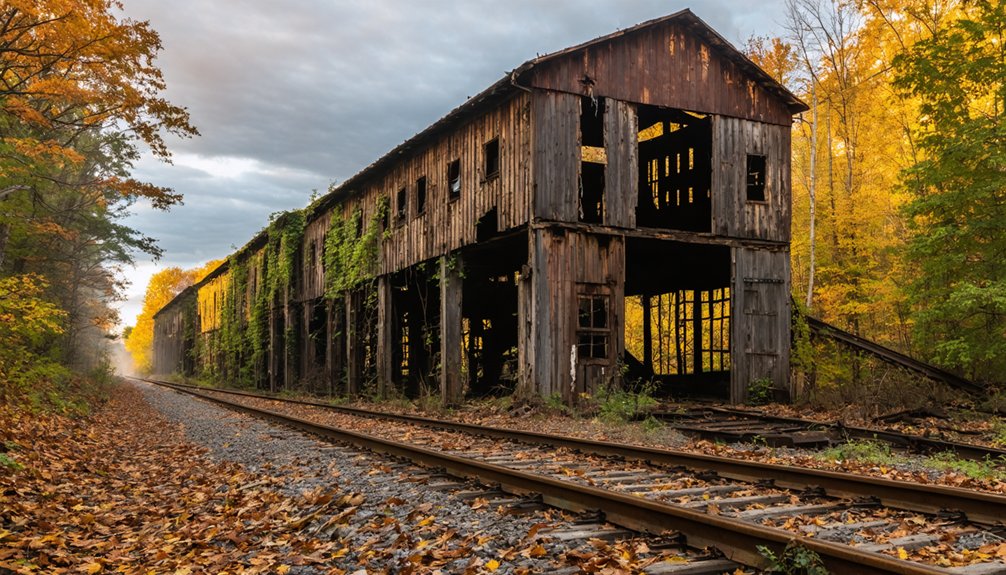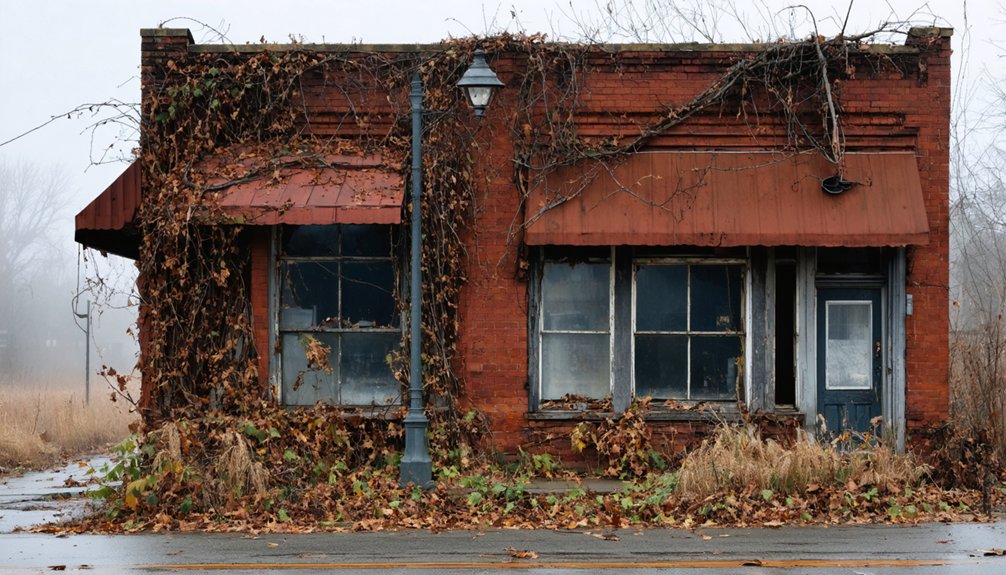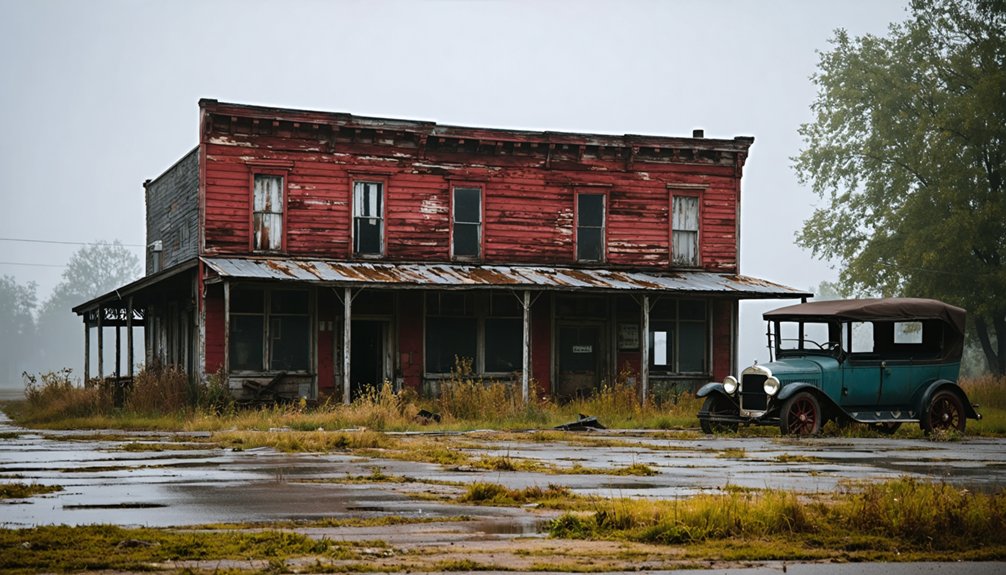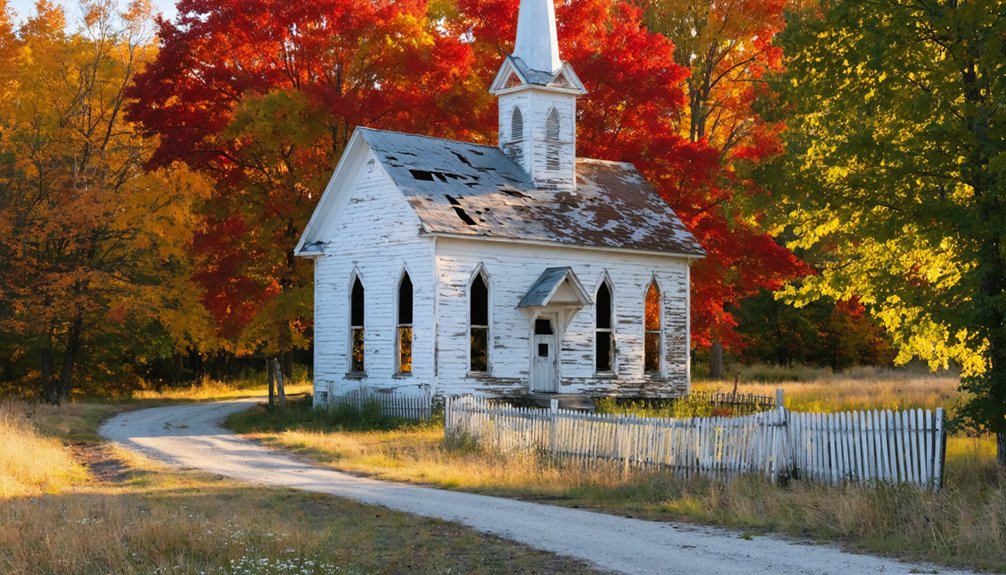
You’ll find Indiana’s most photogenic abandoned settlements in the southern counties, where sites like Elkinsville’s submerged ruins and Hindostan Falls’ 1808 frontier remnants emerge through brilliant October foliage. The 36-mile Ghost Town Trail showcases eight coal mining settlements framed by rust-orange maples, while Brown County’s haunted Story Inn offers paranormal encounters amid amber-hued forests. Peak colors arrive mid-October in the north, late October centrally, and early November in southeastern regions—timing that’ll help you capture crumbling foundations against nature’s most vibrant backdrop before these historical sites disappear completely.
Key Takeaways
- Elkinsville features ruins including a historic bridge and 150 gravestones, framed by maples and oaks during October.
- Ghost Town Trail spans 36 miles through eight abandoned mining settlements, accessible year-round with peak foliage mid-October.
- Hindostan Falls, Indiana’s earliest settlement, displays ancient ruins and hand-carved bedrock surrounded by vibrant autumn colors.
- Southern Indiana contains 13 ghost towns with crumbling structures overtaken by forests, offering dramatic fall photography opportunities.
- Peak foliage timing varies: northern sites mid-October, central late October, southeastern early November, southwestern by November 10.
Elkinsville: A Photographer’s Dream Among Autumn Colors
When William Elkins carved out his settlement in 1817, he couldn’t have imagined his namesake town would one day rest beneath a reservoir’s waters—or that its remnants would become a haunting backdrop for fall photography.
You’ll find the deteriorating Elkinsville Bridge framed by blazing maples and oaks each October, creating dramatic contrasts between rust-colored metal and crimson leaves.
The cemetery off Elkinsville Cemetery Road offers 150 gravestones from the mid-1800s, their weathered stones compelling subjects against autumn’s palette.
Urban exploration enthusiasts capture foundations and building shells before they vanish completely.
Heritage preservation volunteers maintain the site, including a covered picnic area where you can rest between shoots.
Former residents gather annually here, keeping memories alive while you document what eminent domain and time couldn’t completely erase. Brown County’s renowned scenic beauty draws photographers seeking vibrant fall colors that enhance the town’s haunting atmosphere. Lake Monroe’s construction in the early 1960s flooded the original town, leaving these photogenic ruins along the shoreline.
Ghost Town Trail: Where Mining History Meets Vibrant Fall Landscapes
Stretching 36 miles through Cambria and Indiana counties, the Ghost Town Trail delivers Pennsylvania’s most accessible journey through coal country’s forgotten past, where you’ll bike or hike past eight abandoned mining settlements framed by October’s explosive color display.
You’ll discover Wehrum’s 230-house ghost town and Claghorn’s 1917 three-arch bridge while riding the 10-foot crushed limestone path.
Mining artifacts like coal-loading tipples and boney piles punctuate your ride through rhododendron-lined Blacklick Creek valley, where mountain streams cut through mixed forest canopy blazing red and gold.
The trail welcomes visitors year-round for cycling, hiking, and cross-country skiing along its donated railroad right-of-way.
The ecological restoration efforts contrast sharply with visible acid mine drainage—a raw reminder of extraction’s cost.
Eliza Iron Furnace, Pennsylvania’s best-preserved hot blast furnace, anchors this National Register corridor where freedom seekers pedal through authentic Appalachian history.
The route follows the 1903 Ebensburg and Black Lick Railroad, connecting seamlessly westward to the Hoodlebug Extension Trail at Saylor Park and eastward to the Path of The Flood Trail.
Hindostan Falls: Indiana’s Earliest Settlement Wrapped in Seasonal Beauty
Before Indiana achieved statehood, Frederick Schultz’s 1808 land purchase from Vincennes sparked what would become the territory’s most haunting frontier tragedy. Hindostan Falls flourished to 1,200 residents by 1820, boasting mills, factories, and county seat status—until the “Great Sickness” decimated everything.
Today’s historical relics tell the story:
- 128 hand-carved holes (18×18 inches) in exposed bedrock mark the mill’s foundation
- Mass graves holding up to 100 victims remain somewhere beneath the forest floor
- Archaeological research reveals houseboat moorings along the riverbank
- Seasonal waterfalls cascade over the same rocks pioneers once harvested
The town’s strategic position along stagecoach routes between New Albany and Vincennes fueled its rapid early growth. Captain Caleb Fellows, an English immigrant with East India Company experience, named the settlement after his time abroad. You’ll find complete isolation here—no cell service, no crowds. The SE corner of SR 550 and CR 55 offers autumn’s fiery canopy framing Indiana’s most prosperous ghost town, where freedom-seeking settlers met their unexpected fate.
Story Inn: Haunted Hospitality in Brown County’s Peak Foliage
You’ll find the Story Inn nestled at the edge of Brown County State Park, where Indiana’s oldest country inn serves up more than rustic charm during fall—guests consistently report encounters with the Blue Lady, believed to be Dr. George Story’s wife, who leaves behind blue objects and the scent of cherry tobacco in rooms above the restaurant.
The inn’s guestbooks overflow with paranormal accounts, from mirrors that move on their own to photographs capturing unexplained phenomena, evidence so compelling it converted skeptical owner Rick Hofstetter into a believer. Established in 1851, the Story Inn stands as one of the few survivors from a once-thriving village that included general stores, a church, and a grain mill before the Great Depression emptied the settlement. Located at 6404 South State Road 135 in Nashville, the property offers lodging options including both traditional inn rooms and private cottages for those seeking a more secluded autumn retreat.
Time your visit for October, when the surrounding hardwood forests blaze with autumn color and you can toggle the blue light in the renamed Blue Lady Room, ideally around 4 AM when supernatural activity peaks.
The Blue Lady Legend
While most haunted inns whisper vague tales of “former residents,” Story Inn’s Blue Lady comes with a documented pedigree: she’s identified as the wife of Dr. George Story, the timber-clan physician who founded this 1851 logging settlement.
Her presence pervades the historical preservation efforts, with paranormal investigations consistently documenting her activity in the renamed Blue Lady Room.
You’ll recognize her signature calling cards:
- Cherry tobacco scent wafting through rooms around 4 AM
- Mysterious blue objects appearing in guest quarters
- Mirrors moving without physical contact
- A blue light that summons her spirit when activated
The guestbooks overflow with firsthand accounts—when they’re full, they’re archived in the attic. The innkeeper, once skeptical about supernatural claims, now confirms the property’s haunted status based on accumulated evidence.
Beyond the guest rooms, the property includes a cellar bar that offers a distinctive atmosphere separate from the reservation-only restaurant upstairs.
You’re welcome to book the Blue Lady Room yourself at 812-988-2273, though she reportedly appears whether summoned or not.
Autumn Color Surroundings
When mid-October arrives, the hills surrounding Story Inn ignite into a panorama of crimson maples and golden hickories that’ll make you understand why thousands descend on Brown County State Park each weekend.
You’re positioned at the perfect corridor between 16,000 acres of state park and Hoosier National Forest—nature’s canvas stretched across three sides of this ghost town.
The landscape composition shifts dramatically as morning fog lifts through valleys, revealing layers of rust-orange and amber against blue ridge lines.
Seasonal lighting transforms everything: dawn casts long shadows through the forest, while late afternoon bathes the surrounding hills in honey-gold warmth.
Skip the crowded weekends if you can—early weekday mornings offer the same spectacular views without fighting for parking at the park’s capacity-strained lots.
Paranormal Guest Experiences
The Blue Lady waits in the room above Story Inn’s restaurant, and you can summon her yourself—just flip the blue light switch to “on” and see what happens.
This isn’t your typical tourist trap with manufactured urban legends.
Guests and staff have documented spectral sightings in guestbooks for decades, filling volumes now archived in the attic.
What you might encounter:
- Cherry tobacco scent around 4 AM—her favorite—with no earthly source
- Picture frames flipping on their wires in locked rooms
- Blue objects appearing mysteriously after checkout
- Audio and photographic anomalies suggesting three separate spirits
Owner Rick Hofstetter started as a skeptic until he read those guestbooks.
Now he’s convinced this ranks among Indiana’s most haunted destinations.
Southern Indiana’s Hidden Gems: 13 Ghost Towns Worth Exploring
Southern Indiana harbors secrets that most travelers speed past on their way to bigger destinations. You’ll discover 13 ghost towns where nature’s reclaimed what humans abandoned—wildlife habitats thriving in Hindostan Falls’ old mill foundations and Tunnelton’s empty structures.
English offers post-apocalyptic photography opportunities through deteriorating buildings overtaken by forest. Elkinsville, “The Town That Was,” still breathes with a few residents among crumbling houses and that haunting bridge.
Urban legends swirl through Story Inn, where the Blue Lady leaves cherry tobacco scents and mysterious blue tokens. These aren’t sanitized tourist traps—they’re authentic remnants accessible via backroads winding through autumn’s blazing colors.
Orange and Brown Counties concentrate most sites, making multi-town exploration feasible. Pack your camera, respect the cemeteries, and embrace autumn’s eerie beauty.
Best Times and Tips for Visiting Indiana’s Abandoned Sites
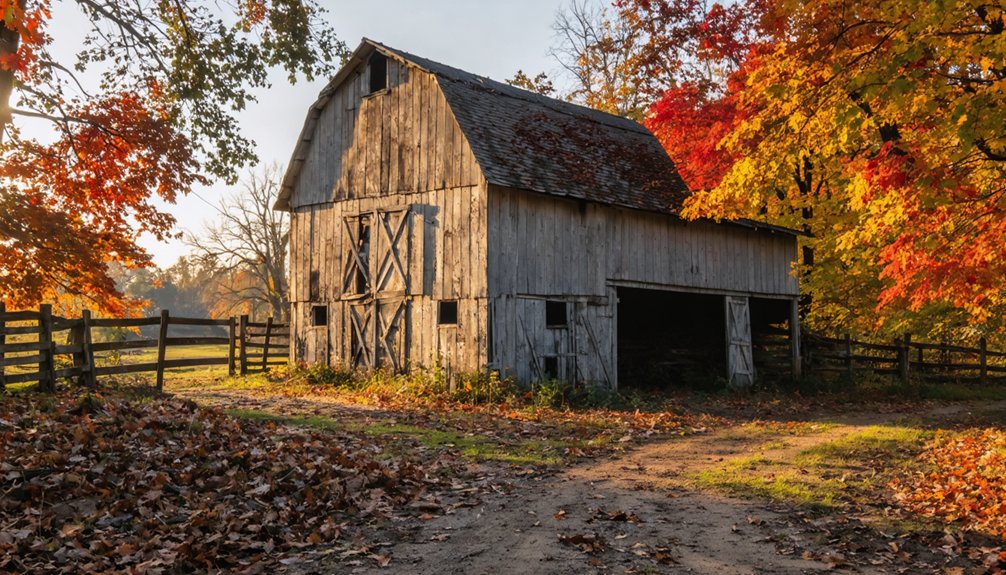
You’ll want to time your ghost town adventures for late September through October, when autumn transforms Indiana’s abandoned sites into photographers’ paradises. The crumbling walls of Elkinsville practically glow against Brown County’s flame-colored hills.
I learned the hard way that hunting season demands blaze orange vests, especially on trails like Ghost Town Trail that cut through state game lands where you’re sharing the path with more than just history buffs.
Pack your camera, wear sturdy boots for traversing overgrown paths, and remember that these decaying structures are beautiful from a distance but dangerous up close—admire the skeletal remains of old houses through your viewfinder, not from inside their collapsing rooms.
Peak Fall Color Timing
- Northern abandoned sites (near Barton Lake): Mid-October delivers your earliest colors.
- Central ghost towns (Indianapolis region): October 20-27 offers prime foliage photography.
- Southeastern locations: Plan for November 6th peak timing.
- Southwestern ruins: Wait until November 10th for maximum color.
Warmer temperatures push these dates later, while dry conditions compress your window. Check Explore Fall’s interactive map from September 1st onward—it updates daily with real-time color reports.
Monitor weather patterns closely, as heat delays peak foliage and drought shortens the vibrant display you’re chasing through Indiana’s forgotten places.
Safety and Access Considerations
Timing your visit around peak colors means nothing if you can’t safely access these forgotten places. Old houses in Elkinsville require external admiration only—entry risks collapse. Respect private property boundaries in living ghost towns where residents remain.
During hunting season on trails through game lands, wear highly visible clothing to prevent wildlife encounters of the dangerous kind.
Pack proper equipment: safety vests, sturdy boots for uneven terrain, and sun protection. Remote areas like Rexis Branch demand caution near streams and unstable ground.
Watch for weather changes on exposed back roads, and maintain stable footing near water edges at scenic spots like Blacklick Creek. Early morning fog affects visibility, so time your exploration accordingly.
Public sites like Hindostan Falls offer safer access to pioneer remnants without trespassing risks.
Capturing the Perfect Shot: Photography Guide for Ghost Town Adventures
When autumn transforms Brown County into Indiana’s most breathtaking canvas, ghost town photography becomes a dance between decay and natural splendor. You’ll want gear that matches your adventurous spirit while respecting historical preservation.
Essential Equipment for Ghost Town Photography:
- Wide-angle lenses frame Elkinsville’s crumbling houses against explosive fall foliage.
- Polarizing filters punch up those saturated oranges and reds surrounding abandoned structures.
- Tripods stabilize cemetery shots in dim, leaf-filtered light.
- Weather-sealed cameras withstand morning dew during golden hour explorations.
Master composition by framing decaying bridges with vibrant autumn contrast. Use overgrown paths as leading lines toward historic remnants. Position ghost town elements off-center following the rule of thirds.
Let decay tell stories through intentional framing—where abandoned architecture meets nature’s reclamation, composition transforms ruins into compelling visual narratives.
Early morning light casts that perfect warm glow across Hindostan Falls’ pioneer cemeteries—and you might capture unexpected wildlife photography opportunities too.
Frequently Asked Questions
Are Permits Required to Explore Ghost Town Properties in Indiana?
Yes, you’ll need permits since land ownership regulations protect these sites. Before exploring, contact property owners directly and check with local historical preservation offices. Trespassing charges aren’t worth the risk—secure permission first for worry-free adventure.
Which Ghost Towns Allow Overnight Camping During Fall Months?
You can’t legally camp overnight at Indiana’s ghost towns due to wildlife preservation restrictions. However, nearby Spring Mill and Charlestown State Parks offer camping with fall access to historic architecture ruins, letting you explore Rose Island’s 1920s remains freely.
What Safety Precautions Should Visitors Take in Structurally Unsound Buildings?
Don’t enter structurally unsound buildings—period. Your risk assessment should prioritize life over curiosity. Building stability can’t be guaranteed in decades-old ruins. Instead, you’ll capture Indiana’s ghost town beauty safely from outside, photographing crumbling facades against autumn’s brilliant colors.
Are There Guided Tours Available for Indiana’s Ghost Town Sites?
No guided tours exist for Indiana’s ghost towns—you’ll explore independently, discovering historical preservation efforts and photography opportunities at your own pace. Bring your camera, wear sturdy boots, and embrace the freedom of self-guided adventure through abandoned ruins.
How Do Hunting Seasons Affect Ghost Town Accessibility in Fall?
You’ll find no hunting season restrictions block ghost town access during fall, but you must wear bright orange for safety. Fall foliage visibility actually peaks now, making trails stunning—just stay alert and visible while exploring freely.
References
- https://www.onlyinyourstate.com/trip-ideas/indiana/autumn-day-ghost-town-in
- https://indianacountyparks.org/our-trails/ghost-town-trail/ghost-town-trail-photo-gallery/
- https://www.gosoin.com/blog/post/how-to-have-a-spooky-time-in-southern-indiana/
- https://www.discoversouthernindiana.com/blog/post/spooky-sites-and-ghost-tours-in-southern-indiana/
- https://www.youtube.com/watch?v=-iNr8SJNJLk
- https://wkdq.com/southern-indiana-ghost-towns/
- https://en.wikipedia.org/wiki/List_of_ghost_towns_in_Indiana
- https://www.youtube.com/watch?v=U2wchT3Yz_Y
- https://www.youtube.com/watch?v=Y3gIbDL3iHo
- https://www.bloomingpedia.org/wiki/Elkinsville