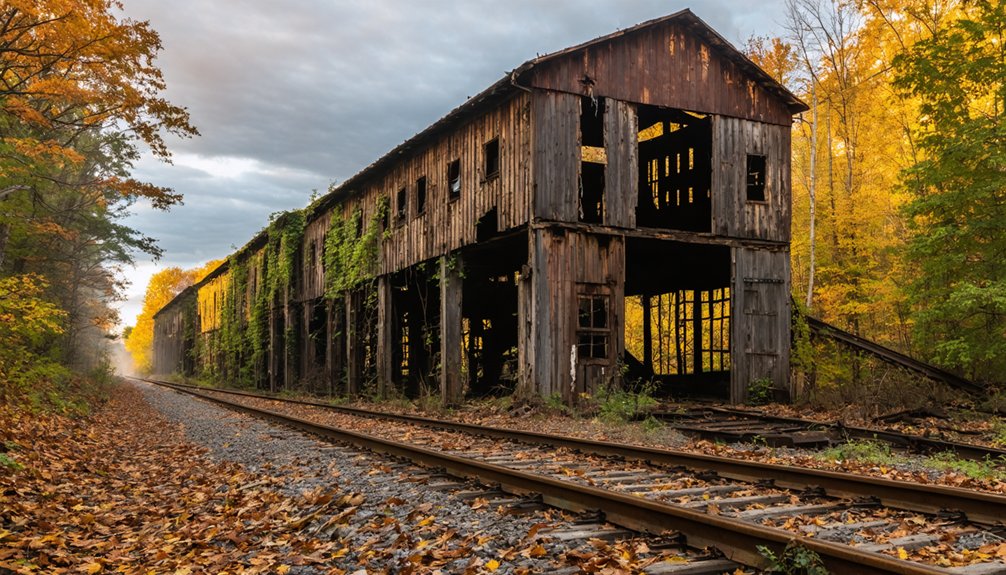
Indiana’s haunted ghost towns reveal documented paranormal activity alongside tragic histories. You’ll find HindostanFalls, where over half of 1,200 residents died in a three-month epidemic before 1853’s abandonment, and Aberdeen, now a Level 4 Ghost Town with only cemeteries remaining. Whispers Estate in Mitchell harbors 10-year-old Rachael Gibbons’ spirit since her 1921 death, while Gary’s demolished Carolina Street house required three exorcisms after 2011’s demonic possession case. Tunnelton’s 1882 massacre and Pennsylvania’s Ghost Town Trail preserve communities like Wehrum, abandoned after mine collapses claimed hundreds of families—each location offering chilling evidence beyond folklore.
Key Takeaways
- Hindostan Falls, abandoned by 1853, suffered a catastrophic epidemic killing over half its population, with victims buried in mass graves.
- Tunnelton features a haunted 1,731-foot tunnel built through a graveyard, with folklore of collapsed graves and the 1882 Tunnelton Massacre.
- Pennsylvania Ghost Town Trail spans 36 miles through abandoned mining towns like Wehrum, featuring crumbling foundations, cemeteries, and eerie remnants.
- Aberdeen is a Level 4 Ghost Town with only cemeteries and road intersections remaining after its 1948 tornado destruction.
- Gas boom towns like Mollie became ghostly remnants after natural gas depletion in the early 1900s caused economic collapse.
HindostanFalls: The Town Claimed by Disease and Legend
Where bustling commerce once thrived along Indiana’s White River, only weathered stone and whispered legends remain.
You’ll find HindostanFalls where Captain Caleb Fellows established a settlement in 1816 along historical trade routes connecting Vincennes and New Albany.
By 1820, 1,200 residents made it Daviess County’s largest town, with early settler stories unfolding on houseboats and stagecoach stops.
The town boasted two mills, a hotel, factories, and ferries that supported the thriving community.
Then catastrophe struck. An epidemic—likely cholera or yellow fever—killed over half the population in three months.
Mass graves swallowed 100 bodies at once.
The 1820 economic depression sealed HindostanFalls’ fate.
Foreclosures mounted, the post office closed by 1830, and residents fled.
By 1853, the town was completely abandoned, with remaining inhabitants relocating to nearby Loogootee.
Stepp Cemetery: Home of the Woman in Black
Deep within Morgan County’s Morgan-Monroe State Forest, accessible only via the Lakes Trail near Walls shelter house, Stepp Cemetery harbors 114 graves dating to the mid-1800s—and one of Indiana’s most enduring paranormal legends.
Hidden among ancient oaks and forgotten trails, 114 souls rest where the living dare to tread after dark.
Cemetery folklore centers on the Woman in Black, a spectral figure mourning her child’s grave while seated on a tree stump called Warlock’s Chair. The Black Lady is known to appear on the grave of a man who was killed during the construction of the Morgan-Monroe County Forestry, keeping visitors away from his burial site. The cemetery’s origins trace back to a violent land dispute between two brothers that ended in a deadly duel, with both men believed to be buried on the grounds. Ghostly encounters include:
- Her humming to a bundled infant near Baby Lester’s tombstone before transforming into a dark, sinister figure
- Apparitions digging at graves, removing and replacing bones
- Disembodied screams, whispers, and weeping echoing through the trees
The site’s reputation intensified after a 1950s murder and frequent vandalism. Local legend warns that sitting on Warlock’s Chair brings death within one year—a curse adding to this remote location‘s spine-tingling allure.
Wehrum and the Ghost Town Trail’s Forgotten Communities
While Indiana’s cemeteries preserve tales of restless spirits, Pennsylvania’s Ghost Town Trail offers a different kind of haunting—the industrial ghosts of communities erased by economic collapse.
You’ll find Wehrum’s crumbling foundations along this 36-mile limestone trail, built on railroad remnants from the Ebensburg & Blacklick line.
Warren Delano’s 1901 mining town housed 250 families before collapsing in 1929.
Mining history echoes through the Russian Orthodox cemetery’s 1927 burials and the lone standing house near the bank vault.
The trail connects seven ghost towns—Bracken, Armerford, Lackawanna #3—where boney piles still leach orange acid into streams.
You’ll pass Eliza Furnace and Vintondale’s Mine No. 6 Memorial, witnessing how Pennsylvania’s bituminous coal seams created and destroyed entire communities within decades.
Claghorn, constructed in 1903 and closed by 1924, once contained 84 houses and a hotel before the Vinton Colliery Company mine’s shutdown led to complete abandonment.
The hard-packed limestone dust surface follows the former railroad grade through west-central Pennsylvania, making navigation easy with mile markers guiding you past these forgotten settlements.
Whispers Estate: Where Young Rachael Still Roams
In Mitchell, Indiana’s Whispers Estate, the 1894 Victorian home harbors the restless spirit of ten-year-old Rachael Gibbons, who succumbed to severe burns two days after her Christmas 1921 fireplace accident.
You’ll hear her phantom footsteps skipping across the second floor, her disembodied giggles echoing through hallways, and—if you call from the front parlor—she may respond to your voice.
This bed-and-breakfast-turned-paranormal attraction houses up to two dozen entities, but Rachael remains the most active presence among the tragic souls who never left Dr. John Gibbons’s former medical residence. Dr. Gibbons purchased the property in 1899, transforming it into both his family home and office for patient consultations. The estate’s supernatural portal allegedly extends from the front parlor all the way to the third-floor attic room, where guests have reported nightmares and attempted entries by unseen forces.
Tragic Fire Claims Rachael
Christmas morning 1921 should have brought joy to the Gibbons family, but instead it marked the beginning of an unrelenting chain of tragedies at Whispers Estate. Ten-year-old Rachael left her bed to examine presents near the fireplace when her clothing ignited. She suffered severe burns and died two days later in an upstairs bedroom.
The fire’s devastating impact reveals how historical fire safety**** standards failed to protect families:
- Open fireplaces posed significant risks to long clothing common in the era
- Limited medical treatment options left burn victims with minimal survival chances
- Absence of early warning systems prevented quick response to clothing fires
Rachael was one of several orphaned children adopted by Dr. John and Jessie Gibbons, who had opened their home to those in need. Today, paranormal investigation techniques document Rachael’s presence through recorded footsteps, childlike giggling, and unexplained movements throughout the estate’s corridors. Visitors participating in flashlight tours and overnight investigations frequently report encountering activity in the upstairs bedroom areas where Rachael spent her final moments.
Orphan Girl’s Restless Spirit
Young Rachael’s death in 1921 transformed Whispers Estate into one of Indiana’s most documented paranormal locations. Visitors and investigators continue reporting encounters with the orphaned girl’s spirit nearly a century later.
You’ll hear her phantom footsteps racing through corridors where Dr. John and Jessie Gibbons once raised their adopted children.
The house’s conversion into a paranormal attraction following the 2006 restoration intensified activity. Guests report disembodied whispers in their ears, violent bed shaking, and doorknob jiggling in the third-floor attic room.
Psychics identify a shadow entity called “Big Black” alongside Rachael’s presence, suggesting multiple spirits inhabit this former medical practice.
The backyard graves and medical remains create ghostly legends rivaling Indiana’s haunted orchards, cementing Whispers Estate’s reputation among paranormal enthusiasts seeking authentic encounters.
Paranormal Activity at Mitchell
On Christmas morning 1921, ten-year-old Rachael’s decision to sneak downstairs sealed her fate when her clothing caught fire near the front parlor fireplace at what would become Mitchell’s Whispers Estate. She died two days later in an upstairs bedroom. Her spirit is now central to local urban legends and folklore traditions.
Built in 1894, the house served as Dr. John Gibbons’s medical practice for nearly three decades.
Multiple tragedies followed Rachael’s death, including infant Elizabeth’s sudden passing and Jessie Gibbons’s fatal pneumonia two weeks later.
Today’s documented paranormal phenomena include:
- Physical manifestations: flying candles, violent bed-shaking, unexplained scratches
- Auditory experiences: disembodied whispers, footsteps, slamming doors
- Bedroom-specific activity: labored breathing in the master suite, closet doors jiggling five times rapidly
You’ll find activity intensified during the 2006 restoration.
Aberdeen: Ohio County’s Fading Settlement
When Dr. Robert Gillispie arrived from Aberdeen, Scotland around 1819, he established a crossroads settlement that would define Ohio County’s rural character for 150 years.
You’ll find settlement origins rooted in strategic location near State Route 56, where local architecture reflected practical frontier needs.
The Aberdeen United Methodist Church, organized in 1897, anchored community life until a March 1948 tornado destroyed the original structure.
Commerce thrived through the general store at Route 56 and Cass Union Road, operating from 1907 until the late 1970s.
The Phillips and Kelly families sustained this hub, stocking everything from guns to ice cream.
Today, Aberdeen exists as a Level 4 Ghost Town—completely faded.
Only cemetery sites and road intersections mark where this settlement once flourished.
The Demon House of Gary’s Carolina Street
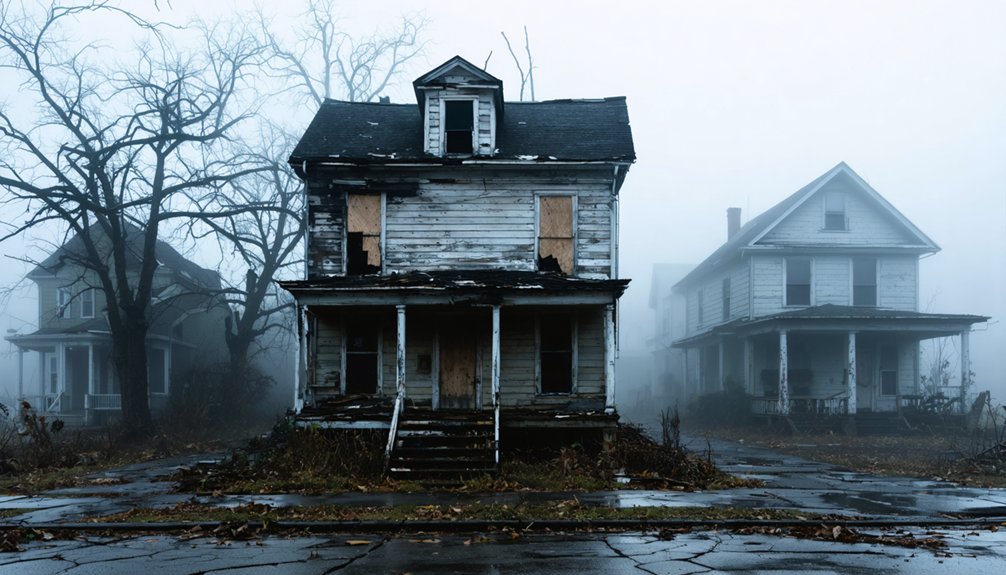
At 3860 Carolina Street in Gary, Indiana, a modest one-story bungalow became the epicenter of one of America’s most documented demonic possession cases. When Latoya Ammons moved her family there in November 2011, they encountered phenomena reminiscent of medieval legends:
- Inhuman manifestations: Children spoke in demonic voices, with one walking backward up a hospital wall and across the ceiling.
- Physical evidence: Police equipment malfunctioned, capturing shadowy figures and disembodied voices.
- Religious intervention: Father Michael Maginot performed three exorcisms after witnessing the activity.
Despite skepticism from landlord Charles Reed, Police Captain Charles Austin confirmed paranormal events.
Zak Bagans purchased the property for urban exploration in 2014, filming a documentary before demolishing it in 2016.
The case inspired “The Deliverance” film.
Tunnelton: Underground Railroad Hub With a Dark Past
Deep within Lawrence County, the small town of Tunnelton emerged in 1859 around one of Indiana’s most ambitious engineering projects: the 1,731-foot Big Tunnel, carved through solid rock between 1855 and 1857 for the Ohio and Mississippi Railway.
Tunnelton’s 1,731-foot tunnel, carved through solid rock between 1855-1857, transformed wilderness into one of Indiana’s boldest railroad achievements.
The tunnel construction initially served as a work camp for laborers before the town’s official platting. You’ll discover Tunnelton’s railroad history intertwined with a noble cause—a small brick building near the 1880s tavern served as an Underground Railroad station, sheltering enslaved people seeking freedom.
However, darkness followed liberation. Folklore claims the tunnel was built beneath a graveyard, with graves collapsing during excavation.
The February 10, 1882 Tunnelton Massacre and rumors of murder victims placed on tracks to destroy evidence haunt this community where unexplained phenomena persist along active railroad lines today.
Gas Boom Towns Lost to Time
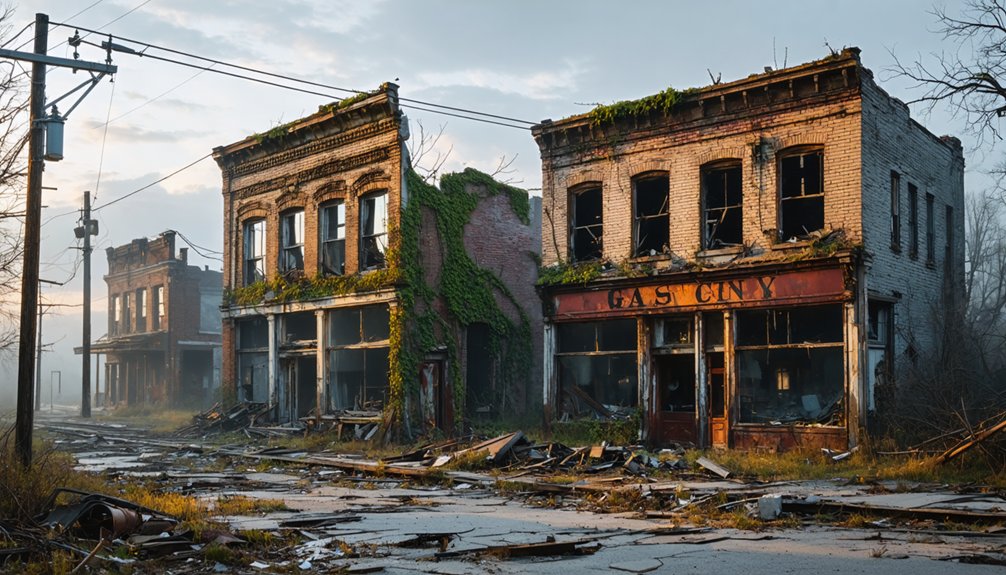
While Gas City and Muncie survived Indiana’s gas boom collapse, smaller settlements like Mollie weren’t so fortunate.
You’ll find Mollie’s remnants near Matthews in Grant County, where the 1890s gas discovery transformed a quiet farming crossroads into a thriving industrial hub with a glass factory, grain elevator, and over 300 residents before wells depleted by 1905.
Elizabethtown in Bartholomew County followed a similar trajectory. Its gas-fueled industries attracted hundreds of workers between 1888 and 1900, only to abandon the town when manufacturers relocated after pressure dropped in 1902.
Mollie’s Boom-Era Prosperity
When natural gas erupted from the ground near Eaton in 1886, it triggered an economic frenzy that reshaped East Central Indiana’s landscape within months.
Harrisburg residents seized this opportunity, rebranding their town as Gas City in 1892 to attract manufacturers hungry for cheap fuel.
The industrial boom transformed settlements overnight through:
- Population explosion – Gas City surged from 145 residents in 1890 to 3,622 by 1900, a staggering 2,400 percent increase
- Rapid factory relocation – Eight manufacturers moved to town within three months of its renaming
- Infrastructure development – Banks, hotels, opera houses, and business offices emerged while workers camped in tents
Elizabethtown’s Industrial Decline
The natural gas that fueled Indiana’s industrial revolution couldn’t sustain the reckless consumption that defined the boom era. By 1900, the Trenton Field’s once-limitless supply was faltering under wasteful practices like flambeau burning and unmetered industrial use. Indiana squandered over 90% of its reserves, forcing the state to import West Virginia gas by 1913.
Towns like Gas City transformed overnight from industrial powerhouses with twelve glass factories into agricultural communities. The collapse devastated thousands who’d relocated for manufacturing jobs. Natural resource management became an afterthought until depletion forced costly economic recovery efforts.
The Wilson Gang Massacre and Southern Indiana’s Haunted Ruins
Southern Indiana’s bloodstained frontier history reached one of its darkest chapters through the brutal violence that engulfed Clark and Scott Counties during the 19th century, creating a legacy of haunted ruins that persists today.
Violence and vengeance carved deep scars across Southern Indiana’s frontier, leaving behind ruins where darkness still lingers.
The Wilson Gang and associated outlaws operated alongside the notorious Reno Gang, whose activities culminated in vengeful lynchings and abandoned structures that now draw paranormal investigators.
You’ll find three primary haunted sites marking this dark era:
- Rockford Reno Homestead ruins near the world’s first train robbery location
- Hangman’s Crossing in Floyd County, where masked vigilantes executed gang members
- Charlestown’s abandoned structures connected to the 1871 lynching of George Johnson
These locations underscore frontier lawlessness, where chains, padlocks, and mob justice created spectral presences that reportedly manifest through shadowy figures and unexplained sounds.
Frequently Asked Questions
Are There Guided Tours Available for Indiana’s Ghost Towns?
Yes, you’ll find guided tours exploring Indiana’s haunted locations through companies like Unseenpress.com and Chaos Trips. These tours blend historical preservation with ghost stories, covering haunted sites in Crown Point, Fort Wayne, Madison, and New Harmony year-round.
What Safety Precautions Should Visitors Take When Exploring Abandoned Sites?
You’ll need sturdy safety gear like boots and flashlights, plus emergency plans including companions and communication devices. Always obtain permission, avoid structural hazards like rotten floors, and respect property boundaries while exploring these abandoned locations responsibly.
Can You Legally Enter Private Property Ghost Town Locations?
Ironically, ghost towns aren’t free-for-all destinations. You can’t legally enter private property without owner permission—trespassing regulations apply fully. Private property laws protect abandoned sites equally. Indiana’s neighbor-entry provisions don’t authorize recreational exploration, only maintenance activities.
the forgotten history of indiana’s ghost towns offers a glimpse into a bygone era where thriving communities once flourished. These locations are rich in stories, standing as silent witnesses to the passage of time and changes in society. Preserving their legacy requires respect for their current status, as the remnants of these towns continue to evoke curiosity and intrigue.
What Time of Year Is Best for Visiting Haunted Locations?
Fall offers ideal season planning for Indiana’s haunted ghost towns, with October drawing peak paranormal tourism. You’ll find comfortable weather conditions, active haunted attractions, and Halloween events that enhance your exploration freedom while avoiding summer heat or winter accessibility challenges.
How Do You Distinguish Between Ghost Towns and Active Small Communities?
You’ll distinguish them by checking for active residents, functioning businesses, and maintained infrastructure. Ghost towns lack these but often feature historical preservation efforts and urban legends, while small communities sustain ongoing economic activity and inhabited structures.
References
- https://indianacountyparks.org/our-trails/ghost-town-trail/ghost-town-trail-history/
- https://history.howstuffworks.com/historical-events/haunted-places-in-indiana.htm
- https://www.discoversouthernindiana.com/blog/post/the-ghost-town-of-hindostan-falls-indianas-lost-jewel/
- https://www.youtube.com/watch?v=3J6ZADuP0A4
- https://www.onlyinyourstate.com/experiences/indiana/ghost-towns-in
- https://wkdq.com/southern-indiana-ghost-towns/
- https://www.youtube.com/watch?v=45D4dbASJyE
- https://en.wikipedia.org/wiki/List_of_ghost_towns_in_Indiana
- https://usghostadventures.com/haunted-cities/the-top-ten-most-haunted-places-in-indianapolis/
- https://www.onlyinyourstate.com/state-pride/indiana/untold-story-hindostan-falls-in