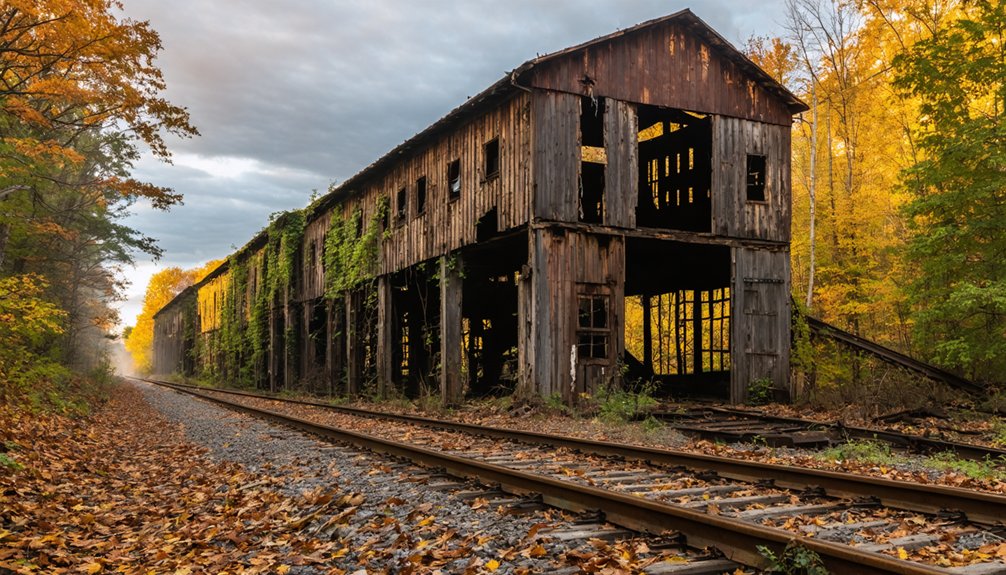
You’ll find at least 41 documented ghost towns throughout Indiana, though extensive counts exceed 60 when including partially abandoned settlements and submerged communities beneath reservoirs. Southern Indiana alone contains approximately 41 sites, ranging from completely deserted foundations to towns with remaining residents. Indiana ranks 28th nationally for ghost town abundance, far behind Texas’s 511 or California’s 346. These abandoned settlements span from well-preserved structures like Aberdeen to entirely submerged towns like Germantown under Geist Reservoir, each with distinct stories of industrial decline, railroad rerouting, and catastrophic flooding that shaped their fate.
Key Takeaways
- Indiana contains approximately 41 to over 60 ghost towns statewide, depending on the source and definition used.
- Southern Indiana alone accounts for around 41 ghost towns, including English, Marengo, and Tunnelton.
- Indiana ranks 28th nationally for ghost town abundance, significantly behind Texas (511) and California (346).
- At least nine Indiana communities were submerged beneath reservoirs between the 1940s and 1960s.
- Ghost towns range from completely deserted foundations to settlements with a few remaining residents still present.
Counting Indiana’s Ghost Towns: The Numbers Explained
Determining exactly how many ghost towns exist in Indiana depends largely on how researchers define the term and document abandoned settlements. You’ll find estimates ranging from 41 to over 60 locations across the state.
ArcGIS StoryMaps provides the most thorough count at 41 towns through rigorous historical analysis, while other documentaries explore 15 in greater detail. These variations stem from different methodological approaches—some researchers include sites completely erased by urban development, while others focus solely on locations with remaining structures.
Modern tourism has increased interest in cataloging these sites, though many vanished settlements leave no visible trace. Southern Indiana alone contains approximately 41 ghost towns, including communities like English, Marengo, and Tunnelton. Indiana ranks 28th nationally for ghost town abundance, considerably trailing western states like Texas (511) and California (346), where mining booms created temporary settlements. Indiana County, Pennsylvania, which shares its name with the Hoosier state, contains 36 documented ghost towns, making it one of the most concentrated areas for abandoned settlements in the eastern United States.
What Defines a Ghost Town in Indiana
You’ll find Indiana’s ghost towns defined by two primary criteria: significant population loss from their historical peak and the presence of abandoned or deteriorating structures.
Unlike Western mining towns that emptied overnight, Indiana’s ghost towns typically experienced gradual decline as railroads rerouted, mills closed, or rivers changed course. These settlements often contain substantial remaining buildings and infrastructure that serve as evidence of their former vitality. The classification of these sites requires visible tangible remains that visitors can observe, whether abandoned mercantile buildings, churches, or historical cemeteries.
These communities range from completely deserted settlements with only foundations remaining to nearly abandoned towns where a handful of residents still occupy what were once thriving main streets.
Abandonment and Population Decline
A ghost town emerges when the fundamental reason for a settlement’s existence disappears, forcing residents to abandon what they once called home. Industrial decline triggers this exodus—when mines exhaust their resources or factories shutter, supporting economies collapse.
You’ll find Indiana settlements that thrived along MONON railroad lines now reduced to skeletal populations of thirty or fewer residents.
Environmental hazards accelerate abandonment, particularly brownfields contaminated by hazardous substances that render sites uninhabitable.
Population metrics reveal the transformation:
- Junction towns dwindled from bustling hubs to mere thirty residents by 1990
- Complete disbandment occurred, exemplified by New Harmony’s 1829 evacuation
- Near-total resident departure marks the threshold between struggling community and ghost town
Transportation shifts compound these factors—bypassed settlements faced insurmountable supply costs, forcing remaining inhabitants toward accessible locations. Baltimore witnessed this pattern when the Wabash and Erie Canal diverted traffic away from the town, causing its population to plummet from seventy residents to complete abandonment by 1900. Natural disasters also contributed to Indiana’s ghost town phenomenon, as landslides and fires destroyed structures and drove residents to seek safer ground.
Physical Remnants and Structures
Indiana’s ghost towns leave behind physical evidence that ranges from well-preserved structures to obliterated landscapes where only archival records confirm human settlement once existed. You’ll find Aberdeen’s level 4 classification preserves homes and commercial buildings amid evident urban decay, while Bonell’s level 3 status shows only two homes after business demolitions.
Architectural evolution appears at Spring Mill’s restored apothecary, grist mill, and sawmill complex. Palmer’s store near Aberdine stands reduced to concrete steps and a single wall.
Tunnelton’s 1,731-foot tunnel, completed in 1857, remains alongside former hotels and schools.
Level 1 sites like Sloan and Elkinsville have vanished completely—military development and dam projects erased them.
Mount Pleasant Baptist Church retains foundation portions, while Chatterton dwindled to one mailbox and house. The Aberdine United Methodist Church exemplifies community transformation, with a 1968 replacement structure standing after the original 1897 building gave way to modernization. Gary’s Broadway features boarded-up stores and a Methodist church built in 1926 with European Gothic Revival architecture, illustrating how economic decline transforms once-thriving commercial districts into deserted corridors.
The Thirteen Most Accessible Ghost Towns in Southern Indiana
Southern Indiana harbors thirteen ghost towns that remain accessible to visitors seeking tangible connections to the state’s abandoned settlements. You’ll find documented sites ranging from English to Worthington, each offering distinct remnants of vanished communities.
Adventures With Roger’s thorough March 2025 video provides roadmaps to all locations, featuring ghost town legends and haunted locations that attract both historians and urban exploration enthusiants.
The most compelling sites include:
- Tunnelton – Displays the most substantial evidence of former community life with visible structural remains.
- Fort Ritner – Preserves flood and fire damage from catastrophic events that ended settlement.
- Marengo – Combines ghost town exploration with its renowned cave park system.
These thirteen accessible locations represent Southern Indiana’s portion of the state’s estimated forty-one total ghost towns, offering unrestricted exploration opportunities across multiple counties. Many of these abandoned settlements mirror the decline patterns seen in northern communities like Mollie, which prospered during the Indiana Gas Boom before commercial buildings and infrastructure completely vanished. Towns often originated around springs of clean drinking water during the 1800s, establishing communities that would later face decline through natural disasters and economic shifts.
Famous Indiana Ghost Towns Worth Visiting
Elizabethtown in Delaware County showcases urban decay where flower and saw mills once thrived—only its cemetery preserves this cultural heritage.
Warren County’s Granville, inhabited by Wea Native Americans during the 1830s, maintains a cemetery across the Wabash River marking its vanished community.
The Two Drowned Towns Beneath Indiana’s Waters
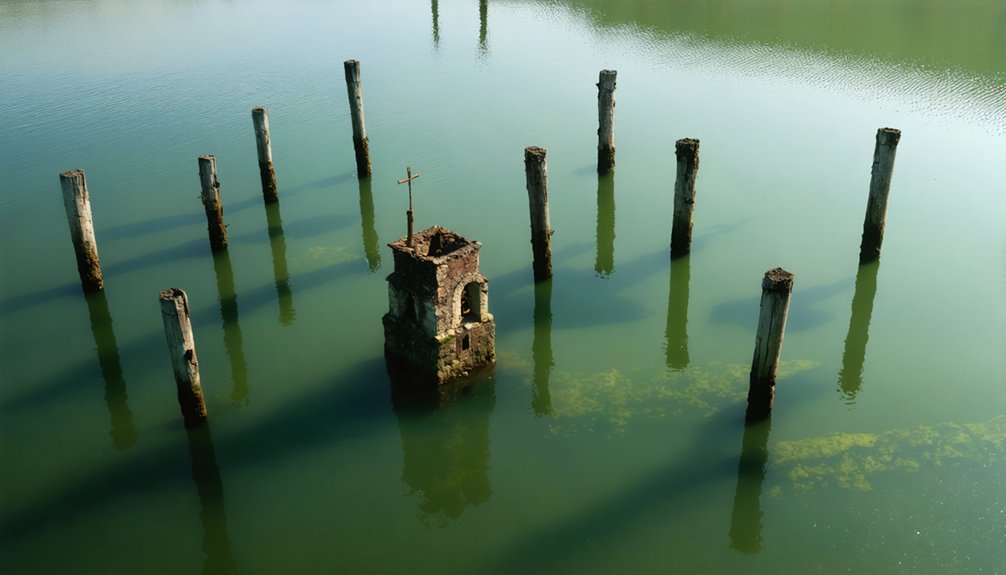
You’ll find more than two drowned towns beneath Indiana’s reservoir waters—at least nine communities disappeared when the U.S. Army Corps of Engineers and water companies constructed flood control and municipal supply projects between the 1940s and 1960s.
Germantown lies submerged under Geist Reservoir since 1943, while Monument City rests beneath Salamonie Lake’s surface after 1966.
These engineered floods relocated hundreds of families, moved over 300 bodies from cemeteries, and destroyed schools, churches, and Indiana’s last covered bridges in affected counties.
Towns Lost to Reservoirs
Beneath the placid surfaces of Indiana’s reservoirs lie complete communities that once thrived along the state’s creek valleys. You’ll find Germantown submerged under Geist Reservoir since 1943, where Indianapolis Water Company cleared 1,800 acres to meet the city’s growing demands.
Monroe Reservoir consumed over 300 homes, 3 schools, 10 churches, and 8 cemeteries during the 1960s, displacing hundreds of farming families. Newton-Stewart vanished beneath Patoka Lake’s waters.
Before flooding began, contractors systematically demolished everything:
- Houses, post offices, and mills reduced to foundations
- Fences, bridges, and vegetation cleared to bare earth
- Cemeteries relocated, erasing generations of history
These weren’t cases of urban decay or economic decline—they were deliberate erasures. Army Corps of Engineers prioritized water supply over preservation, sacrificing your heritage for progress.
Preserved Underwater Ruins Today
When water levels drop at Salamonie Reservoir, Monument City’s skeletal remains emerge from depths that’ve hidden them since 1966. You’ll find bricks, foundations, and the cemetery—the most intact structure—when drought conditions expose what’s normally beneath 13 feet of water.
The interpretive center at Salamonie preserves this underwater archaeology through photographs and oral histories, documenting what forced displacement erased from the landscape.
Down in Salt Creek Valley, Monroe Reservoir conceals an even larger loss: over 300 homes, three schools, and ten churches. DNR naturalists share folklore stories during rare exposure periods when you can view these sites from State Road 105.
Somerset and Fairfield rest beneath other Indiana reservoirs, their treasures surviving only in residents’ memories and archival collections that map communities the Corps deemed expendable.
Relocation and Community Impact
The Army Corps of Engineers forced approximately 150 families from their homes in Monument City and Elkinsville between 1964 and 1965, implementing federal flood control projects that erased both communities from Indiana’s map.
You’ll find no cultural preservation efforts protected these settlements—residents faced compensation or seizure, with limited negotiating power against federal authority.
The displacement destroyed:
- Multi-generational family farms where agricultural traditions passed through decades
- Local businesses and employment networks that sustained regional economies
- Social institutions including churches, schools, and community gathering spaces
What followed resembled accelerated urban decay—entire towns vanished beneath reservoir waters.
Property values became meaningless as infrastructure investments disappeared forever.
Monument City’s Civil War memorial statue and established neighborhoods now rest underwater, visible only during drought conditions that expose this submerged heritage.
Why Indiana’s Communities Became Ghost Towns
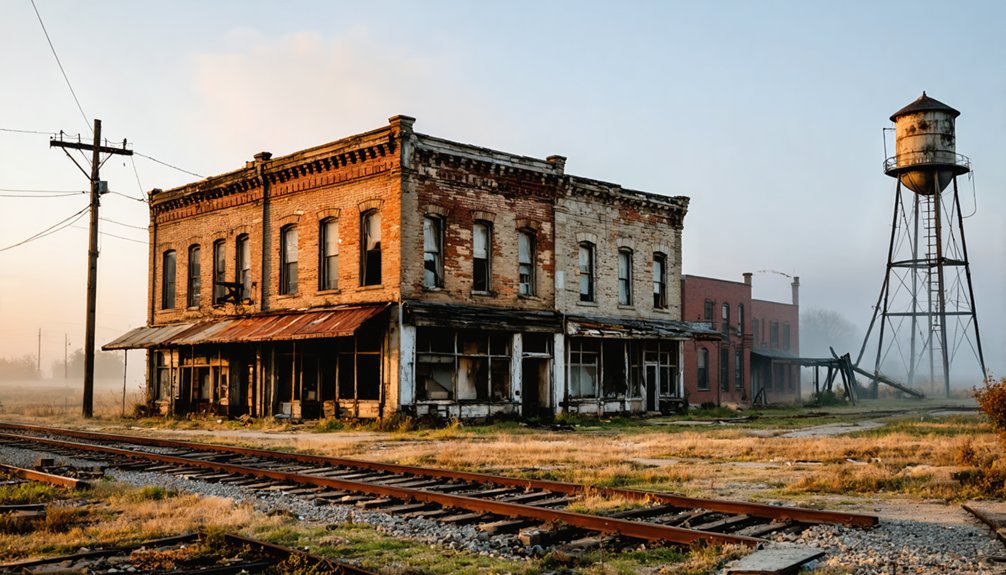
Indiana’s ghost towns emerged from a volatile combination of natural disasters, economic collapse, and infrastructure transformations that unraveled communities throughout the 19th and 20th centuries. Flooding disasters devastated settlements like Hartford, where the 1937 deluge destroyed mills along Laughery Creek.
While Harrisburg’s 1862 flood forced complete relocation. Industrial decline stripped towns of their economic foundations—New Harmony disbanded by 1829 after funding evaporated, and railroad-dependent settlements vanished when tracks rerouted.
You’ll find infrastructure shifts erased entire communities: Sloan disappeared beneath military development, while Monument City and Elkinsville drowned under reservoir projects designed to control future flooding. Fire compounded these losses, reducing Kramer’s Mudlavia resort to stone foundations.
These converging forces left 41 documented ghost towns scattered across Indiana’s landscape, monuments to communities that couldn’t adapt.
The Role of Railroads and Mining in Town Abandonment
Railroad decisions determined which Indiana settlements would prosper and which would fade into obscurity, with surveyor Asa Brown’s 1847 rejection of rail service through Lisbon proving fatal to his carefully platted community.
While Brown favored plank roads, neighboring Kendallville secured the railroad expansion, leaving Lisbon to stagnate despite its Underground Railroad heritage.
The railroad’s power extended beyond routing decisions:
- Tunnelton emerged in 1859 specifically to serve railway tunnels, housing construction workers in two hotels before a 1907 locomotive fire destroyed the town
- Dearborn County’s 1902 line straightening eliminated entire communities along abandoned routes
- Mining boom towns like Wehrum housed 230 families serving rail-accessible coal operations before abandonment
You’ll find these corridors marked communities whose independence depended entirely on railway accessibility.
Ghost Town Characteristics: From Ruins to Semi-Inhabited Sites
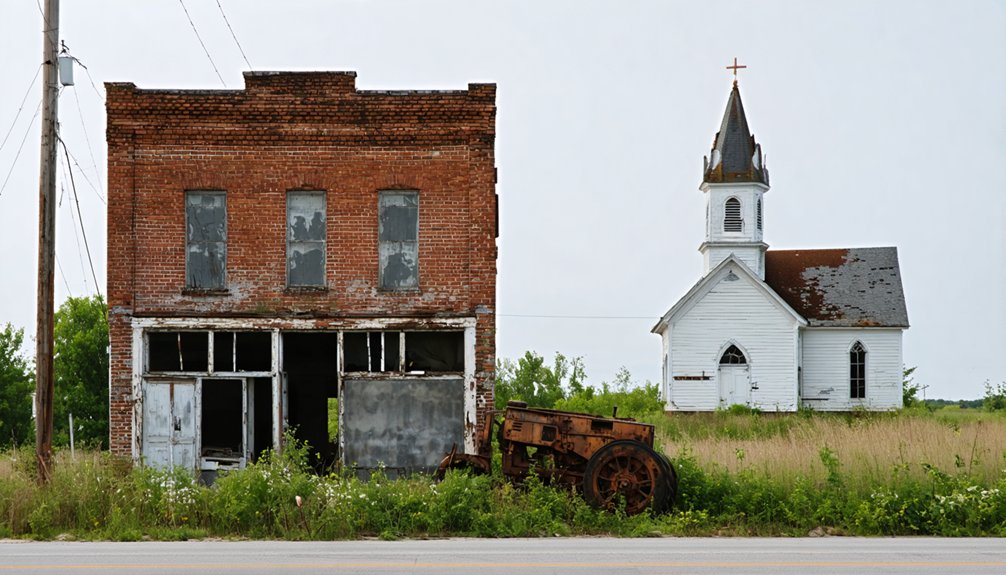
Across Indiana’s landscape, ghost towns exist on a spectrum from complete erasure to semi-inhabited limbo, with the state’s 41 identified sites defying simple categorization.
Indiana’s 41 ghost towns span a haunting spectrum from total disappearance to barely-alive settlements that resist easy classification.
You’ll find ruins-only locations where concrete slabs and foundation pits mark 1970s-era communities consumed by fire. Minimal remnant sites preserve single mailboxes or isolated gas-boom houses amid vanished infrastructure.
Semi-inhabited settlements still housed 30 residents in 1990 censuses, creating poverty-stricken zones where occupied homes blur with abandoned structures along highway corridors.
Nature-reclaimed features include flood-swept amusement parks and forest-overtaken observatories resembling post-apocalyptic shells.
These hidden landmarks concentrate in north-central agricultural belts, with southern Indiana offering 13 visitable sites.
Each location represents legendary tales of economic collapse, from drowned towns to extinct map notations persisting long after communities vanished completely.
Preservation and Historical Significance of Indiana’s Lost Communities
While most of Indiana’s 41 ghost towns face erasure through private property restrictions and natural decay, preservation initiatives reveal scattered attempts to salvage their historical significance.
You’ll find cultural heritage documented through the Ghost Town Trail’s mining corridor and Gary’s historic tours, which transform urban decay into architectural narratives of the steel industry’s rise and fall.
Physical remnants offer tangible connections:
- Hindostan Falls: 128 carved holes from former mills embedded in flat rock, marking a site where court records documented 138 cholera and yellow fever deaths
- Yorktown: Surviving cemetery on Stockwell Road where five Caulkins Brothers established settlement in 1841
- City Methodist Church: Graffiti-covered ruins standing among Gary’s 20% abandoned buildings
Detailed histories like *Delano’s Domain* preserve narratives otherwise lost to time.
Frequently Asked Questions
Are Indiana’s Ghost Towns Safe to Explore Without Permission?
Trespassing laws turn exploration into legal quicksand—you can’t safely explore Indiana’s ghost towns without permission on private land. Their historical significance deserves respect through proper access. Visit public sites like Millville’s state memorials to explore freely and legally.
Can You Camp Overnight at Abandoned Ghost Town Sites in Indiana?
You can’t legally camp overnight at Indiana’s abandoned ghost towns. Historical preservation laws and trespassing statutes prohibit it on both state and private lands. Urban exploration enthusiasts must limit visits to daylight hours or risk substantial fines and legal consequences.
What’s the Best Season to Photograph Indiana’s Ghost Towns?
Fall paints Indiana’s ghost towns in photographer’s gold—you’ll capture stunning shots when autumn’s golden hour and bare branches reveal hidden structures. Follow these photography tips: seasonal lighting from September through November delivers sharp, shadow-rich images perfect for documenting abandoned sites.
Do Any Ghost Towns in Indiana Have Paranormal Activity Reports?
Yes, you’ll find paranormal activity reports at Tunnelton, where haunted legends include an unsolved murder mystery and documented ghost stories. Marengo Cave’s underground system also features mysterious sightings, with flood and fire victims contributing to its spectral reputation.
Which Indiana Ghost Town Is Closest to Indianapolis?
Borden stands closest to you at just 35 miles south via I-65, making it the most accessible among Indiana’s forgotten settlements. You’ll find historic ruins from its railroad era still visible amid nature’s reclamation in Clark County.
References
- https://wkdq.com/southern-indiana-ghost-towns/
- https://www.loveexploring.com/gallerylist/188219/the-us-state-with-the-most-ghost-towns-revealed
- https://ghost-towns.close-to-me.com/states/indiana/
- https://www.youtube.com/watch?v=45D4dbASJyE
- https://www.geotab.com/ghost-towns/
- https://storymaps.arcgis.com/stories/9a3b3f4a63ba4031a46cb53907a0515c
- https://en.wikipedia.org/wiki/List_of_ghost_towns_in_Indiana
- https://kids.kiddle.co/List_of_ghost_towns_in_Indiana
- https://www.geotab.com/press-release/american-ghost-towns/
- https://www.youtube.com/watch?v=GQuQJldC2fY