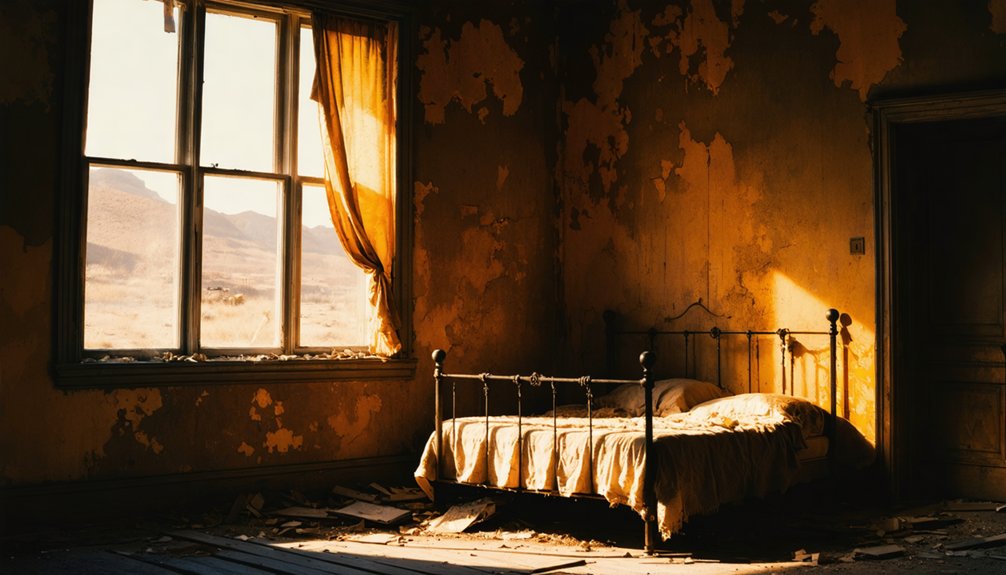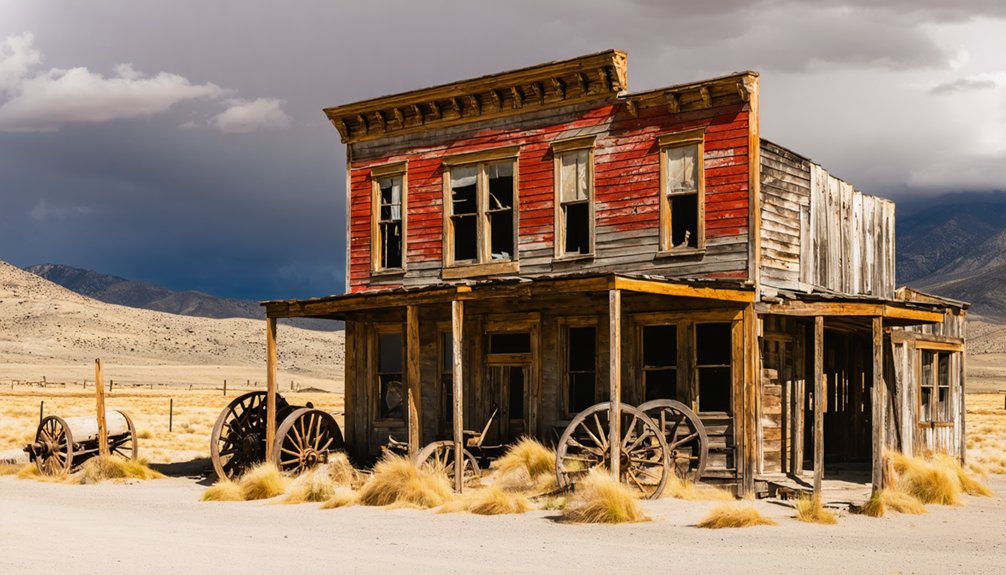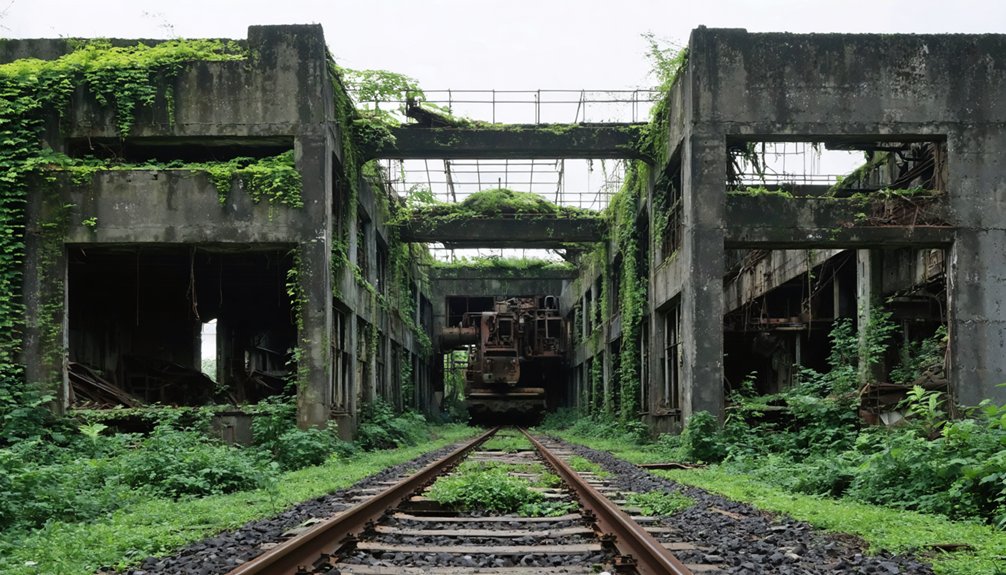
You’ll find some of the Soviet Union’s most dramatic ruins scattered across Abkhazia’s Aldzga river valley, where towns like Akarmara and Dzhantukha have collapsed from populations of 15,000 to fewer than 200 residents following the twin shocks of the 1992-1993 war and the closure of all eight regional coal mines. What remains are overgrown apartment blocks, silent factories, and dismantled railways — a preserved record of Soviet collapse that tells a far deeper story than the ruins suggest.
Key Takeaways
- Abkhazia’s mining ghost towns—Akarmara, Dzhantukha, and Polyana—collapsed after the Soviet Union’s dissolution and the 1992-1993 Abkhaz-Georgian war.
- Tkvarcheli’s population plummeted from 40,000 in the 1980s to around 5,000 today, reflecting widespread regional depopulation.
- All eight coal mines closed following economic collapse, leaving Soviet-era factories, schools, and cultural centers abandoned.
- Fewer than 50 remaining residents per settlement survive through subsistence farming, cattle breeding, and beekeeping.
- These ghost towns attract urban explorers seeking unmediated encounters with decayed Soviet architecture and collapsed industrial infrastructure.
What Happened to Abkhazia’s Mining Ghost Towns?
Once thriving coal communities, Abkhazia’s mining settlements collapsed under the twin pressures of the Soviet Union’s dissolution and the brutal Abkhaz-Georgian war of 1992–1993.
You’re looking at places like Akarmara, Dzhantukha, and Polyana — once densely populated, now swallowed by urban decay. Pre-war populations of 15,000 have dwindled to roughly 200 residents scattered across these settlements. Most Georgians fled, and nearly half of Abkhazia’s 500,000 people abandoned their homes entirely.
What remains carries a heavy cultural nostalgia — Soviet-era architecture, silent factories, and overgrown apartment blocks built by German prisoners of war. Nature’s reclaiming the infrastructure, locals dismantle buildings for materials, and the eight surrounding coal mines have permanently closed.
These aren’t just abandoned towns; they’re frozen records of a vanished political order.
Where Are Abkhazia’s Ghost Towns Located?
Understanding the collapse of these communities becomes sharper when you trace them on a map. You’ll find Polyana, Dzhantukha, and Akarmara clustered within the Aldzga river valley, roughly 10-12 kilometers east of Tkvarcheli. Their ghost town geography isn’t accidental — coal deposits dictated their founding, and industrial logic shaped their placement.
Tkvarcheli itself sits along the Ghalidzga river, once connected to Ochamchire by railway. The surrounding settlements linked to it through roads and rail lines since dismantled.
That infrastructure erasure reinforces their historical significance — these weren’t peripheral villages but purposefully engineered Soviet industrial nodes.
You’re looking at a concentrated cluster where geography, resource extraction, and political collapse intersected. The valley fundamentally became a controlled archive of abandoned ambition, frozen mid-collapse after the early 1990s.
How Coal Mining Built an Entire Soviet Society in the Mountains
Coal didn’t just fuel a regional economy — it engineered an entire way of life. When mining expanded through Akarmara and surrounding settlements during the Stalin era, planners didn’t simply dig shafts — they constructed an entire Coal Community from scratch.
Coal didn’t just power machines — it built entire worlds, reshaping lives from the ground up.
Hotels, schools, hospitals, cinemas, and cultural palaces rose from mountain terrain, built partly by German prisoners of war in the 1940s and 1950s.
You’re looking at a Soviet Legacy designed for total self-sufficiency. Russians, Greeks, Abkhaz, Georgians, and Armenians lived and worked inside an insular, state-engineered ecosystem.
The state controlled everything — labor, housing, culture, identity. It wasn’t organic community-building; it was calculated population engineering.
Understanding that distinction helps you recognize why, once the Soviet system collapsed, these towns had no independent foundation left to stand on.
The War and Soviet Collapse That Emptied the Towns
When the Soviet Union collapsed and the Abkhaz-Georgian war erupted between 1992 and 1993, these mountain settlements didn’t decline gradually — they emptied almost overnight. The war’s impact drove most Georgians out, alongside half of Abkhazia’s 500,000 residents.
Economic collapse followed closely, shutting down all eight coal mines near Akarmara, Jantukha, and Polyana. Tkvarcheli’s population crashed from 40,000 in the 1980s to roughly 5,000 today. The Tkuarchal District fell from 43,000 residents in 1989 to just 15,000 by 2003.
You’re looking at communities that once housed 15,000 people now sheltering barely 200. Two forces — armed conflict stripping people of safety and economic collapse stripping them of purpose — converged simultaneously, ensuring these towns never recovered.
Who Still Lives in Akarmara and Dzhantukha?
If you’re trying to understand who remains in Akarmara and Dzhantukha, you’ll find a skeletal population of roughly 35-50 residents per settlement, clinging to daily life through subsidiary farming, cattle breeding, and beekeeping.
You can trace their survival strategies to a forced self-sufficiency, shaped by the collapse of the coal economy and the near-total absence of commercial infrastructure—save for a single road stall in Akarmara.
What you’re examining, then, isn’t just demographic remnant, but an active, if precarious, adaptation to abandonment.
Remaining Residents’ Daily Lives
Despite the near-total depopulation of Akarmara and Dzhantukha, a small number of residents have chosen to remain, shaping daily life around subsistence rather than industry.
You’d find their daily routines anchored in cattle breeding, beekeeping, and vegetable growing — practical adaptations to an economy that no longer functions at scale.
Community bonds, though stretched thin across near-empty apartment blocks and overgrown streets, still hold meaning among the roughly 35-50 people who inhabit each settlement.
A single road stall in Akarmara serves as both news hub and supply point, functioning as the informal center of what remains of civic life.
These residents aren’t waiting for restoration — they’ve quietly restructured existence on their own terms, outside the reach of industrial collapse.
Survival Strategies Of Locals
Those who’ve stayed in Akarmara and Dzhantukha aren’t passive survivors — they’re pragmatic architects of a self-sufficient existence. Their survival tactics bypass the collapsed industrial economy entirely.
You’ll find them raising cattle, keeping bees, and growing vegetables on land the Soviet system once ignored. These aren’t hobbies — they’re deliberate economic alternatives.
Local resilience here operates outside state dependency. With Tamsaş employing only a fraction of residents and facing its own bankruptcy pressures, locals can’t afford institutional reliance.
They’ve reclaimed autonomy through subsistence, harvesting what the land offers rather than waiting for a system that’s already failed them.
You’re looking at communities that chose rootedness over evacuation — trading urban convenience for self-determination on their own terms, in a landscape the modern world largely abandoned.
What Do Akarmara and Dzhantukha Actually Look Like Today?
Walking through Akarmara and Dzhantukha today means confronting a landscape caught between collapse and stubborn persistence. Abandoned architecture dominates every sightline—overgrown facades, gutted factories, burnt vehicles frozen mid-decay. Local legends circulate among the roughly 200 remaining residents about the Soviet-era grandeur that once defined these streets.
Collapse and persistence share every sightline here—overgrown, gutted, frozen, yet stubbornly inhabited by those who remain.
You’ll notice:
- Five-story apartment blocks, structurally intact but nearly empty
- A single road stall serving Akarmara’s 35-38 residents
- Buildings stripped of materials by locals needing resources
- Nature aggressively reclaiming former industrial zones
- Dzhantukha functioning as the most populated settlement, housing approximately 50 people
What you’re witnessing isn’t pure ruin—it’s active negotiation between human endurance and entropy.
These spaces document what happens when industrial purpose evaporates and political upheaval accelerates abandonment beyond any community’s capacity to reverse.
What Do People Actually Do for Work Here Now?
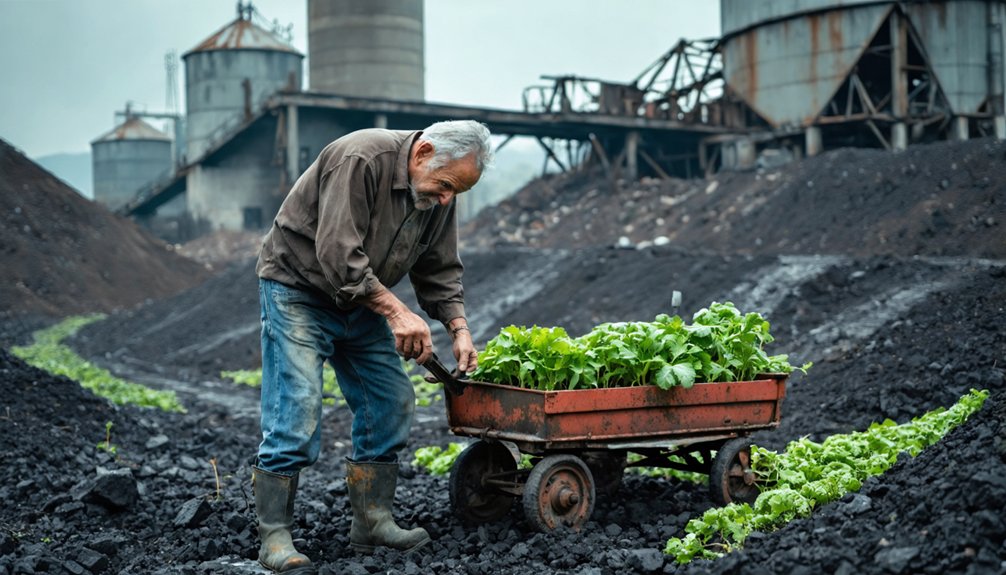
How do roughly 200 people sustain themselves inside an economy that no longer exists in any recognizable form? Local employment is scarce, but not entirely absent. The Turkish firm Tkuarchalugol operates open-pit mining and absorbs most available workers, while its parent company Tamsaş funds over 75% of the district’s budget through taxes.
Beyond that, you’re looking at subsistence-level survival: cattle breeding, beekeeping, and vegetable growing fill the gaps that wages don’t cover.
The economic challenges here aren’t temporary setbacks — they’re structural. Georgia periodically arrests coal shipments, threatening Tamsaş with bankruptcy and destabilizing the district’s only meaningful revenue stream.
A single road stall handles news and basic sales. You won’t find a market economy here; you’ll find people improvising independence within collapse.
Can Abkhazia’s Ghost Towns Ever Be Restored?
Restoration talk exists, but you’d be hard-pressed to find anyone serious about funding it. Abkhazia’s unrecognized status freezes outside investment, making restoration challenges nearly insurmountable.
Tourism potential exists — Akarmara already draws post-apocalypse enthusiasts — but converting curiosity into infrastructure requires capital nobody’s committing.
Consider what you’re actually dealing with:
- Unrecognized sovereignty blocks international funding channels
- Buildings are actively dismantled by residents for raw materials
- Georgia intercepts coal shipments, strangling the primary revenue source
- Population bases are too small to sustain restoration economies
- Nature reclaims structures faster than any realistic repair timeline
You can admire the architecture, document the decay, and acknowledge what once stood here.
Restoration, however, remains an expensive conversation Abkhazia’s circumstances won’t realistically support anytime soon.
Why Akarmara and Dzhantukha Now Attract Post-Apocalypse Tourists
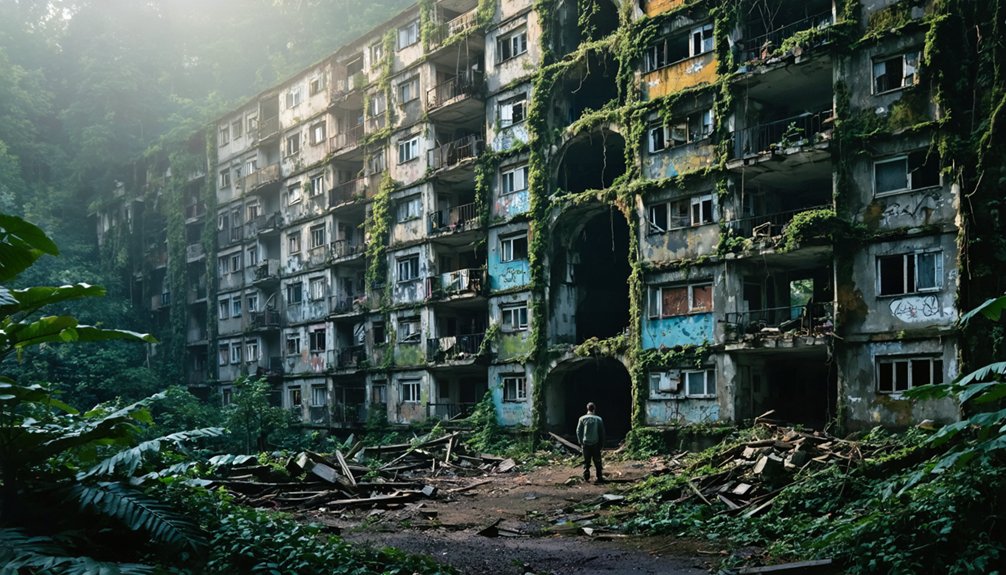
If you walk through Akarmara or Dzhantukha today, you’ll encounter a landscape that feels frozen mid-collapse—abandoned apartments, overgrown factories, and burnt-out vehicles that Soviet-era residents left behind decades ago.
These ruins draw a growing wave of “urban explorers” and post-apocalypse enthusiasts who see the decayed infrastructure as a rare, unfiltered archive of late Soviet life.
You’re not simply touring a ghost town; you’re reading a material record of industrial ambition, ethnic displacement, and geopolitical rupture inscribed across crumbling concrete.
Eerie Abandoned Landscapes Appeal
Though coal once defined Akarmara and Dzhantukha’s identity, their abandonment has paradoxically recast them as destinations for post-apocalypse tourists drawn to the raw, unmediated texture of collapse.
You’ll find eerie atmospheres layered across crumbling Soviet architecture, where haunting beauty emerges from decay rather than preservation.
These landscapes offer what curated spaces can’t:
- Overgrown apartment blocks reclaimed by forest
- Burnt-out vehicles frozen mid-disintegration
- Dismantled railways converted to grazing land
- Intact five-story structures standing beside gutted ruins
- Soviet-era facades stripped bare by time and salvagers
Here, freedom means witnessing history unfiltered—no restoration, no narrative management.
The settlements’ pre-war population of 15,000 now holds roughly 200 residents, leaving vast architectural evidence of collapse entirely accessible, unguarded, and analytically rich for those who seek honest ruins.
Soviet Ruins Draw Explorers
What draws explorers to Akarmara and Dzhantukha isn’t nostalgia—it’s the absence of mediation.
You’re not viewing Soviet architecture through a museum’s curatorial lens. You’re walking through it unfiltered—burnt-out vehicles, overgrown apartment blocks, collapsed factories exactly where history left them.
Urban exploration here carries genuine archival weight. These structures, built by German prisoners of war during the 1940s and 1950s, represent a specific ideological moment frozen mid-collapse.
No restoration distorts the record. No tourism infrastructure softens the encounter.
You’re reading the Soviet project’s failure directly from its material remains. That’s the draw.
Akarmara’s post-apocalyptic atmosphere isn’t manufactured for visitors—it predates them entirely. The authenticity isn’t curated. It’s simply what happens when a system collapses and nobody cleans up afterward.
Frequently Asked Questions
Are the Ghost Towns Safe to Visit Without a Guide?
You can visit, but you shouldn’t go without taking safety precautions. Unstable structures and local legends of the war-scarred ruins demand you respect the environment. A knowledgeable guide enhances your freedom to explore safely.
What Language Do the Remaining Residents of Akarmara Speak?
Scattered survivors speak several Slavic and Caucasian tongues — you’ll encounter Russian primarily, woven into the Akarmara dialect, reflecting local culture’s complex, multi-ethnic Soviet legacy, blending Abkhaz, Armenian, and Georgian linguistic threads that still linger freely.
Did Any Famous Soviet Figures Ever Visit Tkvarcheli’s Mining Towns?
The knowledge doesn’t confirm any famous Soviet leaders visited Tkvarcheli’s mining towns, but you can’t ignore their historical significance — Stalin’s era shaped Akarmara’s construction, reflecting Soviet industrial ambition you’d recognize in its grand, now-abandoned architecture.
Are There Any Schools Still Operating in These Ghost Towns?
Can you imagine the school history here? You won’t find operating schools in these ghost towns. Education decline mirrors the population collapse — with only 200 residents scattered across settlements, there’s simply no community left to sustain them.
What Wildlife Has Moved Into Akarmara’s Abandoned Buildings?
The knowledge doesn’t specify what wildlife has moved in, but as you explore Akarmara’s abandoned structures through urban exploration, you’d likely witness remarkable wildlife adaptations, with nature actively reclaiming buildings overtaken by vegetation and animals.
References
- https://www.youtube.com/watch?v=Noj-t2Em7c4
- https://romanrobroek.nl/photographing-forgotten-towns-in-abkhazia/
- https://www.youngpioneertours.com/the-ghost-city-of-tkvarcheli-abkhazia/
- https://oc-media.org/in-the-ruins-of-eastern-abkhazias-ghost-towns-life-goes-on/
- https://en.wikipedia.org/wiki/Tkvarcheli
- https://www.youtube.com/watch?v=BrKZJHfw_Hk
- https://www.rferl.org/a/georgia-abkhaz-ghost-town-photos/32521040.html
- https://www.tripadvisor.com/Attraction_Review-g7262258-d14921274-Reviews-Akarmara-Tkvarcheli_Abkhazia.html