Planning a ghost town road trip to Vernetta, California starts in Ridgecrest, where you’ll stock up on fuel, water, and supplies before heading north on CA-178 toward Panamint Valley Road. You’ll navigate isolated desert landscapes until reaching Ballarat junction, where pavement gives way to rough dirt tracks. The final 3.5 miles demand a high-clearance 4WD vehicle. Vernetta’s crumbling adobe walls, rusted stamp mill, and pioneer graves make every mile worth it — and there’s far more to uncover ahead.
Key Takeaways
- Start your trip in Ridgecrest to stock up on fuel, water, and supplies before heading north on CA-178 toward Panamint Valley Road.
- The final 3.5 miles to Vernetta from Hell’s Gate require a high-clearance 4WD vehicle to navigate rough dirt tracks.
- Pack at least two gallons of water per person, a spare tire, recovery gear, and a first-aid kit for safety.
- Vernetta offers authentic ghost town ruins, including stamp mill remains, collapsed adobe walls, and pioneer grave markers under BLM’s arrested decay policy.
- Nearby ghost towns like Ballarat, Rhyolite, and Chloride City make ideal stops to extend your California mining history road trip.
What Makes Vernetta a Must-See Ghost Town?
Why trek hours into the Mojave desert for a ghost town most people have never heard of? Vernetta’s historical significance lies in its raw, unfiltered authenticity.
Vernetta’s power isn’t in its fame — it’s in its radical, unpolished authenticity that no curated tourist destination can replicate.
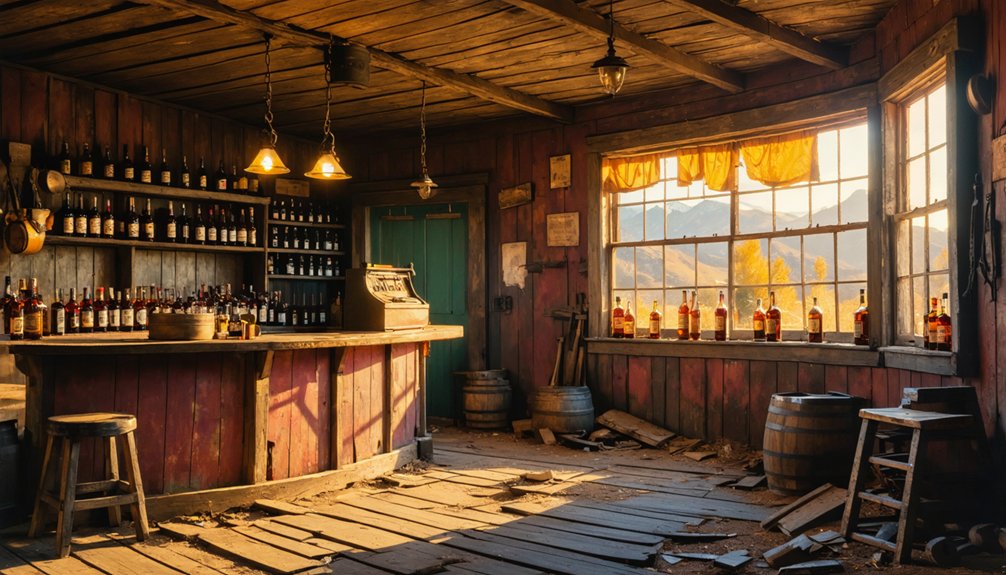
No gift shops, no guardrails, no crowds — just collapsed adobe walls, weathered stamp mill remains, and tailings dumps that speak directly to the mining legacy of California’s silver rush era.
You’ll stand where ambitious miners once hustled through boom-and-bust cycles, surrounded by panoramic Panamint Range views stretching toward Death Valley’s horizon.
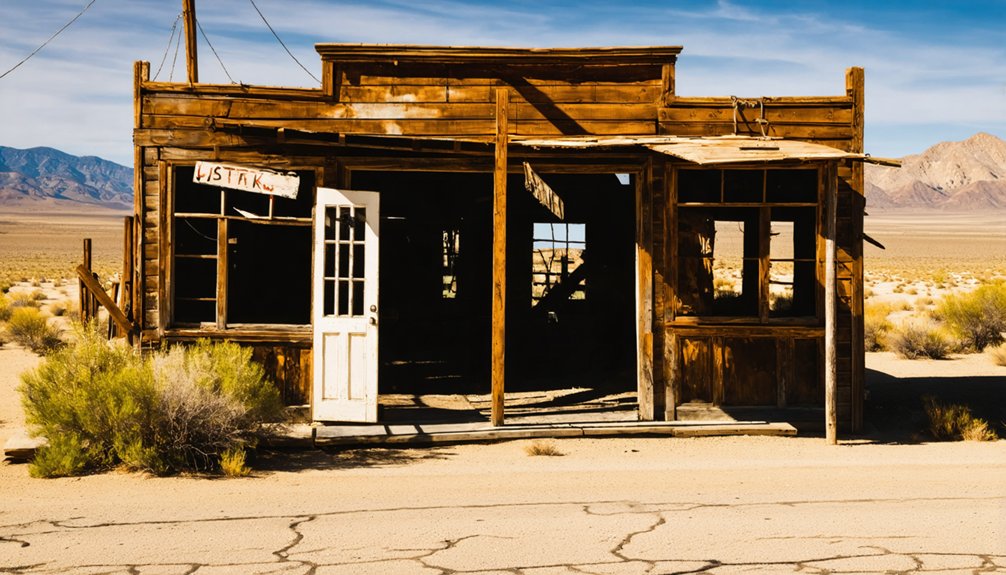
Scattered pioneer graves and original wooden shacks remain exactly as time left them, preserved under BLM’s arrested decay policy.
Vernetta isn’t manicured history — it’s real history. If you crave unscripted exploration on your own terms, this forgotten desert outpost delivers exactly that.
BLM Rules and Access Conditions at Vernetta
Before you point your 4WD toward Vernetta, it’s worth knowing exactly what governs this site and what conditions you’ll encounter.
BLM regulations classify Vernetta as a historic site under an “arrested decay” policy, meaning no restoration occurs and structures stay frozen in their original abandoned state. You’re free to explore, but leave everything untouched — removing artifacts violates federal law.
Access guidelines are equally straightforward but demanding. There’s no entry fee, no ranger station, and zero services on-site.
You’ll navigate 3.5 miles of rough dirt track from Hell’s Gate requiring genuine 4WD capability and off-road experience. Cell service disappears well before arrival.
Stock water, a spare tire, and recovery gear in Trona before heading out. Respecting these conditions keeps this wild, unfiltered slice of history accessible for everyone who follows.
How to Get to Vernetta From Ridgecrest

Your journey to Vernetta begins in Ridgecrest, where you’ll stock up on fuel, water, and supplies before heading north on CA-178 toward Panamint Valley Road — your main artery into the remote desert terrain.
Once you’re on Panamint Valley Road, you’ll navigate roughly 1-2 hours of increasingly isolated landscape until you reach the Ballarat ghost town junction, where pavement gives way to a rougher path.
From there, you’ll tackle a 3.5-mile 4WD-only track from Hell’s Gate, demanding a high-clearance vehicle and steady off-road experience to reach Vernetta’s scattered ruins.
Starting Point In Ridgecrest
Ridgecrest serves as your last real outpost of civilization before the desert swallows you whole, so stock up on gas, water, and supplies before leaving town.
From here, you’ll head west on CA-178, tracing the edge of the Mojave before dropping into the raw, sun-baked expanse of Panamint Valley. The drive itself sets the mood perfectly — wide open skies, jagged mountain silhouettes, and zero crowds.
Once you reach the Trona junction, you’re officially cutting ties with convenience. Vernetta history stretches back to the silver boom of the late 1800s, and you’ll feel that isolation the moment pavement disappears beneath your tires.
Plan your route carefully, because the mining artifacts waiting at the end demand that you actually arrive in one piece.
Once you’ve topped off your tank and loaded the cooler in Ridgecrest, the route to Vernetta begins on CA-178 heading west — a paved stretch that quickly trades suburban sprawl for open desert as the Panamint Range rises ahead of you.
Among California’s most rewarding scenic routes, this corridor drops you into Panamint Valley with sweeping views of sun-bleached flats and jagged ridgelines that feel genuinely untamed.
Turn north onto Panamint Valley Road and follow it toward Ballarat, where pavement eventually surrenders to dirt.
From the Ballarat junction, you’ll navigate 3.5 miles of rough 4WD track toward Hell’s Gate before reaching Vernetta.
Budget one to two hours from Ridgecrest total.
No cell service exists out here, so download offline maps before you leave town.
Final Approach Off-Road
Leaving Ballarat behind, you’ll trade the last traces of maintained road for a raw 3.5-mile dirt track that demands both a high-clearance 4WD vehicle and your full attention.
This final approach begins at Hell’s Gate, where washboards, loose rock, and eroded gullies present real off-road challenges for the unprepared. Engage your lowest gear and keep momentum steady through sandy stretches that can swallow tires without warning.
No signage marks your progress, so download offline maps before leaving Ridgecrest’s cell service range. The Panamint Range rises sharply ahead, framing the route with dramatic desert scenery that rewards the effort.
When weathered wooden structures finally appear against the ridgeline, you’ll know the isolation was worth every bone-rattling mile.
What to Pack for a Vernetta Desert Trip
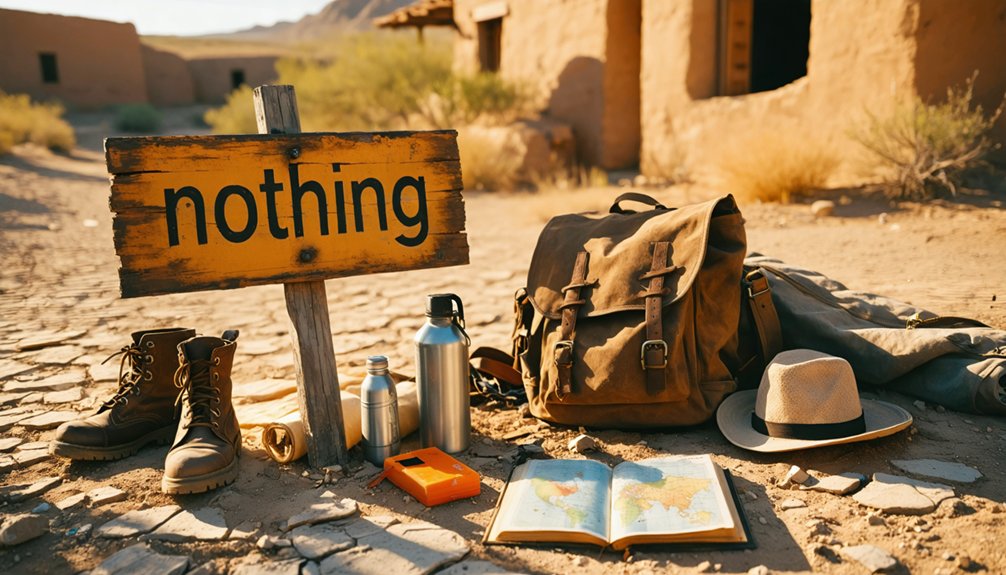
Because Vernetta sits deep in the Mojave’s backcountry with zero services, what you pack isn’t just a matter of comfort—it’s a matter of survival.
In Vernetta’s remote Mojave wilderness, your packing list isn’t about luxury—it’s about making it back alive.
Carry at least two gallons of water per person, a spare tire, recovery gear, and basic camping essentials like a first-aid kit and emergency blanket. BLM land offers no ranger station, so you’re entirely self-reliant out there.
For photography tips, arrive at sunrise or sunset when golden light transforms the crumbling adobe and weathered stamp mill into dramatic, shadow-rich compositions.
Pack a wide-angle lens for panoramic Panamint Range shots and a macro lens for rusted equipment details. Don’t forget extra batteries—cold desert nights drain them fast, and you won’t find an outlet for miles.
Inside the Vernetta Ruins: What’s Still Standing
Stepping into Vernetta feels like interrupting a moment frozen in 1900—the miners left so abruptly that the ruins tell the whole story without a single interpretive sign.
Your ruin exploration begins at the stamp mill, where weathered timber frames and rusted machinery still outline the ore-crushing operation that once drove the entire camp.
Collapsed adits dot the hillside above, and wooden shack foundations anchor the desert floor. Adobe walls from the saloon and boarding houses remain partially upright, their historical significance impossible to overstate—these structures survived over a century of brutal desert conditions completely untouched.
Tailings dumps fan outward from the mill like frozen waves.
You’ll also spot scattered pioneer grave markers, each one quietly deepening the site’s sense of raw, unfiltered history that no museum can replicate.
The Best Time to Visit Vernetta
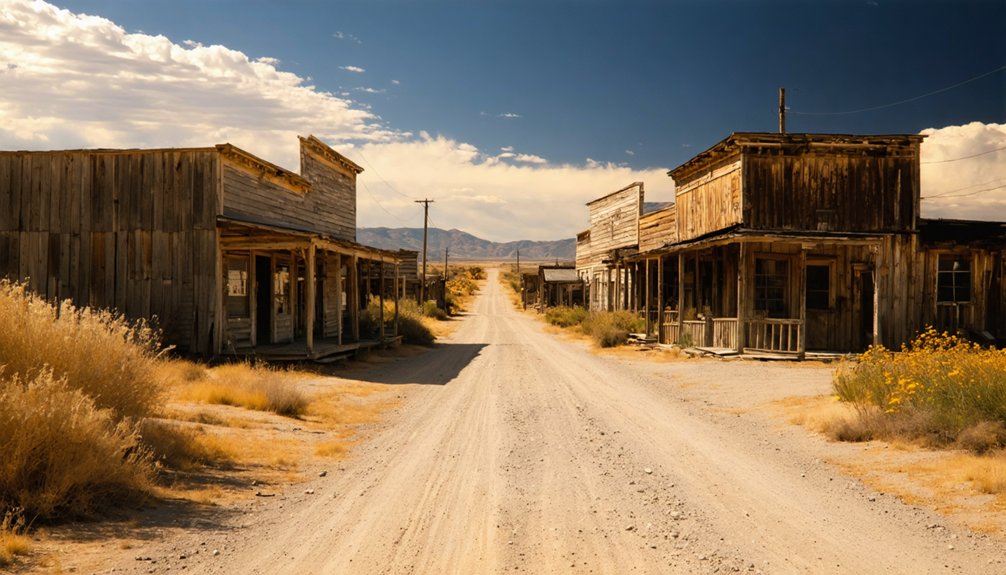
When you visit Vernetta matters almost as much as how you get there. Summer temperatures regularly exceed 100°F, turning the desert into a dangerous furnace. Your best season runs from October through April, when cooler temperatures make exploring ruins genuinely enjoyable.
Weather considerations should drive your planning around these three windows:
- Fall (October–November): Mild temperatures, golden light perfect for photography, and dry trail conditions.
- Winter (December–February): Cool, crisp air ideal for hiking; occasional road mud after rain.
- Spring (March–April): Wildflowers occasionally bloom nearby, and comfortable daytime highs reward early risers.
Sunrise and sunset visits amplify the atmosphere dramatically.
Whatever season you choose, always check forecasts beforehand — desert weather shifts fast, and you’re completely on your own out there.
Ghost Towns Near Vernetta Worth the Detour
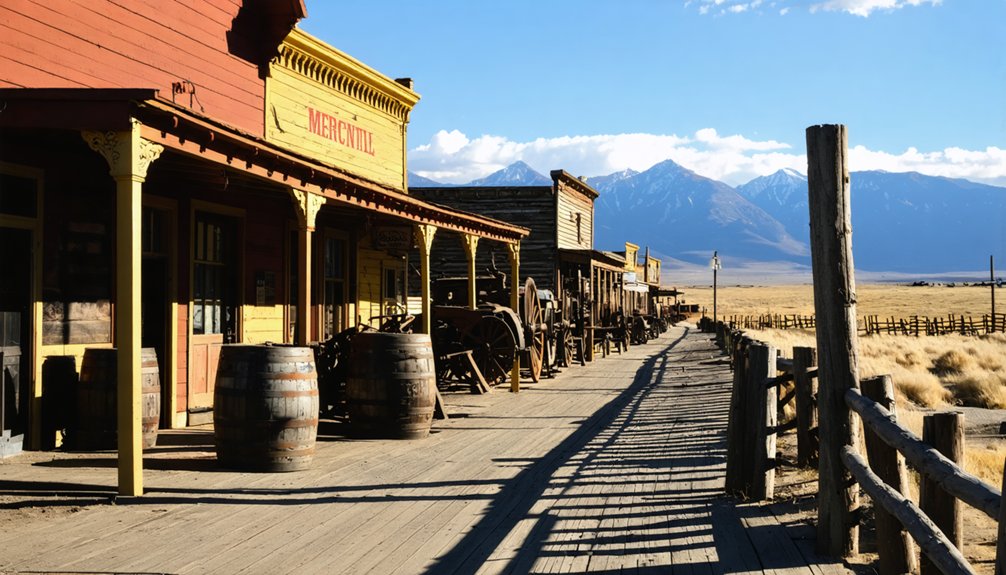
While you’re exploring Vernetta, you’d be remiss not to swing by Ballarat, a once-thriving desert outpost of 500 residents that now hosts a single caretaker and a weathered general store just 20 minutes away.
Push further out and Rhyolite rewards the detour with over 200 ruins, including a roofless bank and crumbling train depot that hint at its peak population of 10,000.
If you’ve got a capable 4WD rig and an appetite for the obscure, Chloride City’s 1905 mill remains and the rugged ruins of Panamint City round out a ghost town loop that turns a single-site visit into a full-day expedition through California’s vanished mining past.
Ballarat And Rhyolite
Nestled just 20 minutes from Vernetta, Ballarat and Rhyolite stand as two of the Mojave Desert’s most compelling ghost town detours, each offering a dramatically different window into California’s mining past.
Ballarat history reveals a once-thriving settlement of 500 residents, now home to a single caretaker surrounded by weathered relics.
Rhyolite ruins tell an even grander story, where 10,000 souls once filled banks, brothels, and a functioning train depot.
Plan your detour strategically:
- Stop at Ballarat’s general store for artifacts and local lore
- Photograph Rhyolite’s iconic bottle house and crumbling bank facade
- Time your visit at sunrise for dramatic desert lighting
Together, these stops transform your Vernetta trip into an unforgettable full-day exploration of California’s untamed frontier heritage.
Chloride City And Beyond
Beyond Ballarat and Rhyolite, Chloride City beckons with its own rugged charm—a short-lived 1905 mining camp tucked into the Panamint Range, accessible only by 4WD and rewarding those who make the effort with weathered mill remains and raw desert solitude.
Its historic significance lies not in grand ruins but in authentic, unpolished remnants that tell an honest story of ambition and hardship.
For serious desert exploration, push further to Panamint City, an outlaw-founded silver settlement requiring a rugged hike-in but delivering unmatched isolation and mining legacy visible in its scattered structural bones.
Greenwater rounds out the circuit, though you’ll find no visible ruins—just open desert and a humbling reminder that boom towns vanish completely.
Each stop deepens your understanding of California’s untamed frontier past.
Frequently Asked Questions
Was Vernetta Ever Considered for Historic Landmark Designation Beyond BLM Management?
The available records don’t confirm Vernetta’s historic landmark designation beyond BLM management. You’ll find its ghost town significance honored through historic preservation via BLM’s “arrested decay” policy, keeping its raw, untouched freedom intact.
Are Guided Tours or Ranger-Led Programs Ever Offered at Vernetta?
You’ll find absolutely zero guided exploration or ranger experiences at Vernetta — it’s gloriously untamed BLM land with no facilities whatsoever! You’re completely on your own, giving you total freedom to explore these haunting ruins independently.
Did Vernetta Have Any Notable Historical Figures or Infamous Residents?
The records don’t highlight notable residents or specific historical figures tied to Vernetta’s historical significance, but you’ll discover a community of nameless prospectors, outlaws, and drifters whose collective spirit shaped this wild, forgotten silver mining settlement.
Can Visitors Legally Collect Artifacts or Ore Samples Found at Vernetta?
You can’t collect artifacts or ore samples at Vernetta. BLM’s artifact preservation rules and legal regulations protect everything on-site. Respect the “arrested decay” policy — you’re free to explore, photograph, and soak in history without taking a piece home.
Has Vernetta Appeared in Any Films, Documentaries, or Published Photography Books?
You won’t find confirmed film appearances or major photography features documenting Vernetta specifically, but its haunting ruins and dramatic Panamint Range backdrop make it a compelling subject you’d love capturing independently.
References
- https://dornsife.usc.edu/magazine/echoes-in-the-dust/
- https://www.youtube.com/watch?v=ElbXVNDurPc
- https://www.flyingdawnmarie.com/new-blog/california-ghost-towns
- https://parks.sbcounty.gov/opinion-beyers-byways-a-brief-history-of-calico-ghost-town/
- https://dvnha.org/info-trip-planning/ghost-towns/
- https://www.youtube.com/shorts/xpNGm1VT0iE
- https://www.visitcalifornia.com/road-trips/ghost-towns/
- https://roamingtogether.com/bennettville-ghost-town/