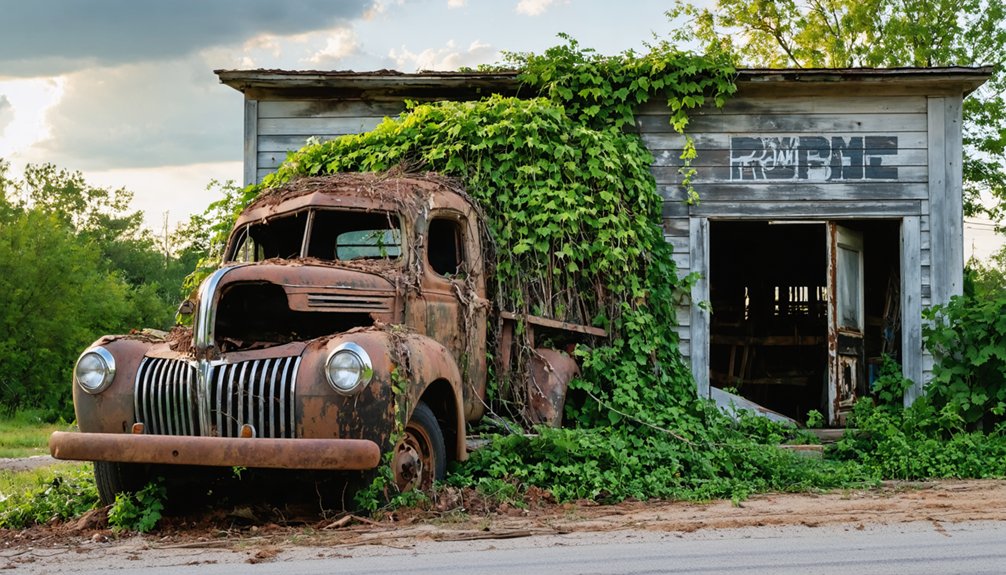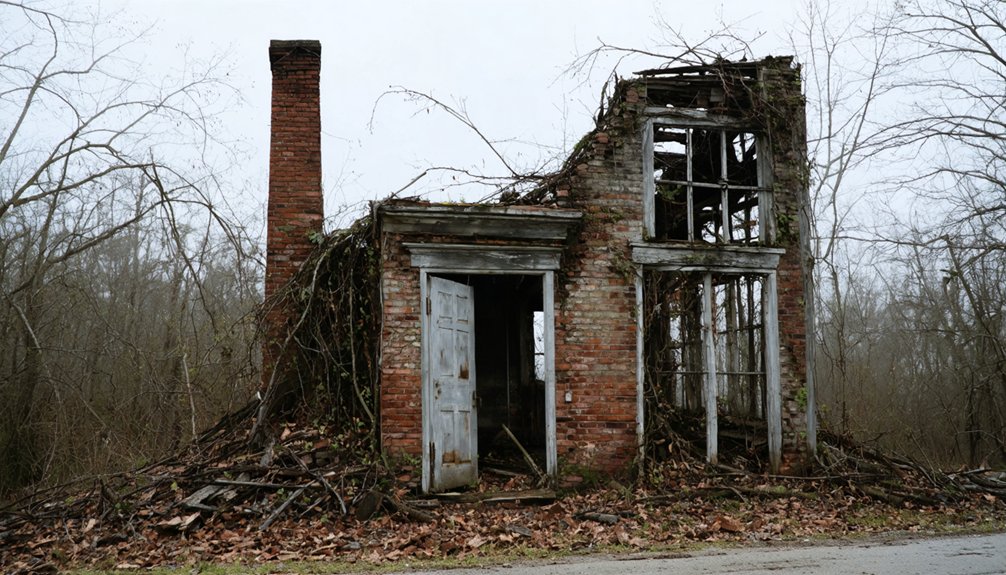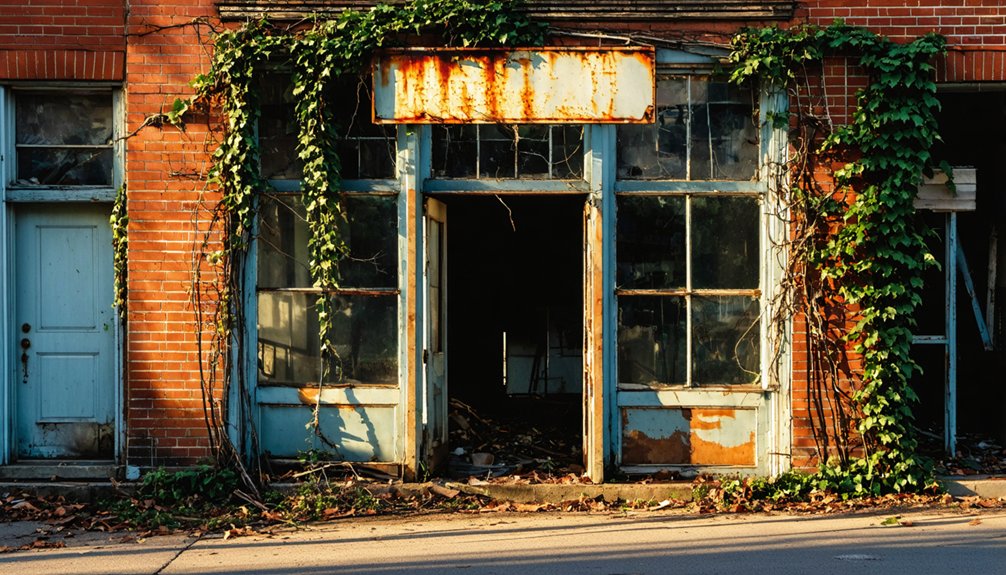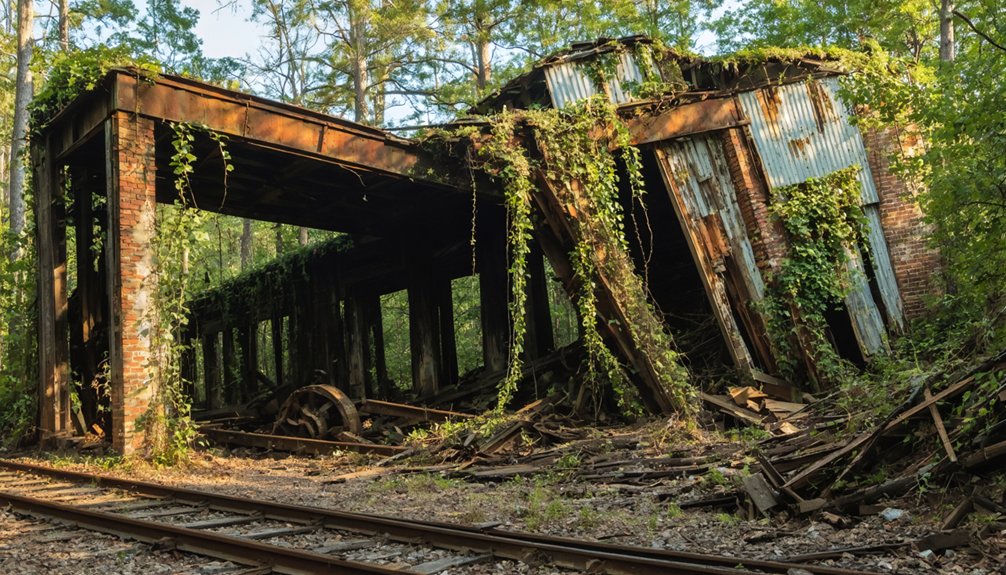
Alabama’s mining ghost towns are scattered across regions where coal, iron ore, and marble once fueled rapid industrial growth. You’ll find remnants of self-contained communities in places like West Blocton, Battelle, Aldrich, and Sylacauga—each reflecting a distinct extraction economy that collapsed under resource depletion and market pressures. Immigrant labor, infrastructure ruins, and preserved museums document these communities’ brief but significant histories. The full story of their rise and fall runs deeper than most explorers expect.
Key Takeaways
- Alabama’s mining ghost towns were built around coal, iron ore, and marble extraction, declining due to resource depletion and economic competition.
- Battelle, an iron mining town near Valley Head, ceased operations by 1905 due to inferior mineral quality, leaving scattered brick ruins.
- West Blocton, tied to the Cahaba Coal Field in Bibb County, preserves significant coal infrastructure from Alabama’s industrial expansion era.
- Aldrich, near Montevallo, hosts Alabama’s official coal mining museum, preserving regional labor history since 1984 at the original mine site.
- Sylacauga remains historically significant for its world-renowned pure white marble deposits, with active quarries and walking trails still accessible today.
What Are Alabama’s Mining Ghost Towns?
Alabama’s mining ghost towns are abandoned communities that once thrived on the extraction of coal, iron ore, marble, and limestone, only to decline when resources depleted or economic competition rendered them unviable.
You’ll find these sites scattered across the state, from Bibb County’s Cahaba Coal Field to Talladega County’s marble deposits. Operators deployed evolving mining techniques to extract raw materials fueling Alabama’s industrial expansion.
Immigrant labor, particularly Italian workers in towns like West Blocton, formed the backbone of these operations. When Birmingham’s more competitive mines emerged or demand collapsed, communities dissolved rapidly.
What remain are ruins, cemeteries, and occasional museums preserving collective memory. Understanding these towns reveals how resource extraction shaped Alabama’s regional identity, infrastructure, and demographic composition throughout the late nineteenth and early twentieth centuries.
Alabama’s Mining Ghost Towns: 6 Sites Worth Exploring
Alabama’s abandoned mining towns offer you a direct window into the state’s industrial past, where iron, coal, and marble extraction once drove regional economies before resource depletion and market competition rendered communities obsolete.
You’ll find six sites worth examining, each preserving distinct remnants — from scattered bricks and rotted timber at Battelle to museum collections at Aldrich — that document the full arc of Alabama’s mining era.
As you explore these locations, you’re tracing a regional history shaped by speculative capital, immigrant labor, and geological opportunity, all of which collapsed under pressures that Birmingham’s more competitive mines ultimately made irreversible.
Notable Ghost Town Sites
Six mining ghost towns scattered across Alabama offer a rare window into the state’s industrial past, each preserving distinct remnants of the extraction economy that once defined central and northeastern Alabama.
These forgotten legacies span iron, coal, and marble operations, collectively representing Alabama’s industrial heritage across multiple counties and eras.
You’ll encounter Battelle’s scattered bricks near Valley Head, West Blocton’s coal infrastructure in Bibb County, and Aldrich’s preserved structures outside Montevallo.
Sylacauga’s marble quarrying legacy anchors Talladega County, while Old Cahawba’s surrounding valley documents Alabama’s coal country origins.
Each site reflects specific resource exploitation patterns, workforce demographics, and economic collapse timelines.
Exploring these locations lets you reconstruct the operational logic behind Alabama’s 19th and early 20th-century extraction industries through physical evidence rather than abstraction.
Mining History And Remnants
Each of Alabama’s six mining ghost towns carries physical and documentary evidence that reveals how extraction industries shaped the state’s economic geography from the late 19th century through the mid-20th century.
You’ll find that mining techniques and community impact intersect across these sites in three critical ways:
- Resource extraction methods — from iron ore processing at Battelle to deep coal shaft mining at West Blocton — directly determined settlement size and longevity.
- Infrastructure remnants — scattered bricks, company-built structures, and cemeteries — document how self-contained communities functioned economically.
- Institutional preservation — the Aldrich Coal Mine Museum and Library of Congress documentation — protect records that commercial development would otherwise erase.
These tangible remnants aren’t merely historical curiosities; they’re evidence of Alabama’s industrial foundation that you can physically examine and independently interpret.
Exploring Alabama’s Abandoned Towns
Whether you’re tracing industrial archaeology or regional economic history, Alabama’s six mining ghost towns offer a geographically diverse itinerary of extraction-era sites spanning iron, coal, and marble industries across the state’s northern and central counties.
You’ll encounter Battelle’s scattered brick ruins near Valley Head, West Blocton’s coal infrastructure remnants in Bibb County, and Aldrich’s preserved structures outside Montevallo.
Sylacauga’s active marble district retains its historical significance alongside Alabama’s oldest covered bridge.
Old Cahawba anchors Dallas County’s coal heritage as the state’s designated coal mining museum.
Across these sites, abandoned buildings range from total forest reclamation to partially intact company structures.
Each location rewards independent exploration, connecting you directly to extraction economies that defined Alabama’s industrial development between the 1870s and mid-twentieth century.
Why These Towns Rose Fast and Collapsed Faster
Alabama’s mining ghost towns didn’t emerge gradually—they erupted almost overnight wherever speculators identified viable deposits of coal, iron ore, or marble. Economic factors drove rapid infrastructure investment, pulling workers from across the U.S. and Europe before fundamentals were fully validated.
Community dynamics formed quickly—churches, commissaries, and company housing appeared within years. Yet collapse proved equally swift once conditions shifted.
Three forces consistently dismantled these communities:
- Resource quality failures — Battelle’s iron ore couldn’t compete with Birmingham’s superior deposits.
- Market demand collapse — West Blocton and Aldrich lost viability as coal demand declined regionally.
- Economic competition — Larger, better-positioned operations absorbed available capital and labor.
You’re left with ruins, scattered bricks, and reclaimed forests where entire economies once operated independently.
Battelle: Valley Head’s Forgotten Iron Mining Town
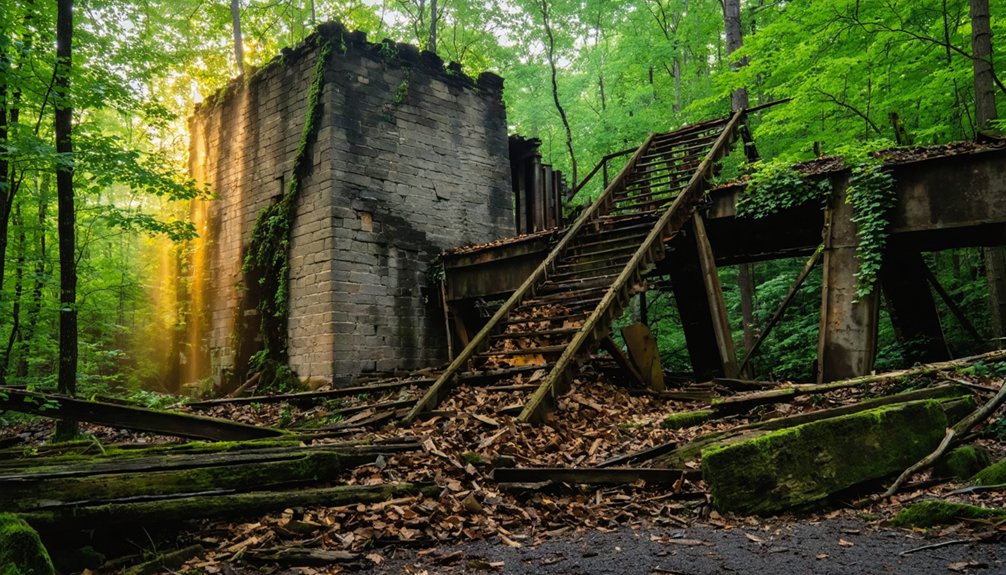
Five miles north of Valley Head, at the foot of Lookout Mountain, Ohio speculators once bet heavily on iron ore, coal, and limestone deposits they believed could rival Birmingham’s industrial output.
Colonel John Gordon Battelle led that charge, forming the Lookout Mountain Iron Company to pursue full-scale iron production. Battelle history tells a familiar story: optimism outpaced reality. By 1905, operations ceased because mineral quality and quantity couldn’t compete with Birmingham’s superior deposits.
You’ll find no standing structures today — only scattered bricks, rotted lumber, and metal fragments reclaimed by forest. The Belcher Lumber Company briefly worked the site in the 1940s, but even that left little trace.
Walk the area now, and you’re moving through near-total erasure.
West Blocton and the Cahaba Coal Field Story
Nestled in Bibb County, West Blocton emerged as one of Alabama’s more consequential coal towns, drawing its identity directly from the Cahaba Coal Field — a geological formation that positioned central Alabama as a primary fuel supplier during the region’s late nineteenth and early twentieth century industrial expansion.
Its economic impact extended beyond extraction, attracting diverse labor forces:
- American workers seeking industrial wages
- Italian immigrants establishing distinct cultural heritage within the community
- Supporting businesses sustaining commercial infrastructure around active mines
You’ll find that West Blocton’s trajectory mirrors broader Appalachian coal narratives — rapid boomtown growth followed by contraction once demand softened.
Its decline wasn’t merely economic; it represented the erosion of an entire community’s identity, leaving behind fragmented evidence of a once-thriving industrial settlement.
Aldrich, Sylacauga, and Alabama’s Other Mining Remnants
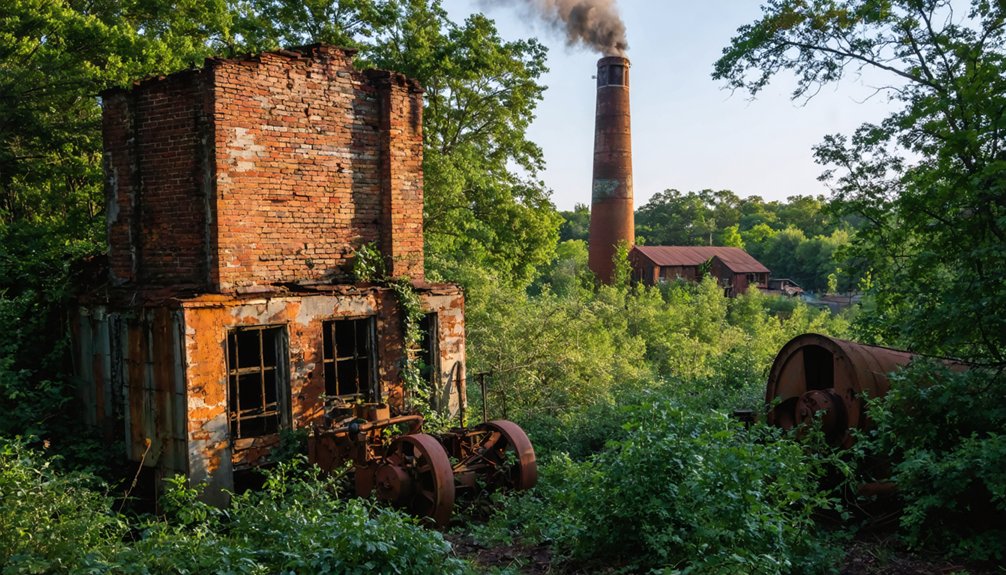
Beyond West Blocton, two distinct mining remnants — Aldrich and Sylacauga — illustrate how Alabama’s extractive industries shaped community identity across different resource types and geographies.
The Aldrich Remnants reflect a self-contained coal community that declining demand gradually absorbed into Montevallo. You can still visit the Aldrich Coal Mine Museum, located 1.5 miles from Montevallo at the original site, where preserved structures document regional labor history authentically.
Sylacauga Quarries represent a different extractive legacy entirely. Positioned atop the world’s purest white marble deposits in Talladega County, Sylacauga earned its “Marble City” designation through late 19th-century quarrying operations that made it one of Alabama’s most economically significant mining centers.
Together, these sites demonstrate how resource type fundamentally determined community character, architectural form, and long-term historical survival across Alabama’s diverse mining landscape.
Ruins, Cemeteries, and Preserved Structures Still Standing
What distinguishes Alabama’s mining ghost towns from mere historical abstractions is the physical evidence still scattered across their former sites.
When you explore these landscapes, you’ll encounter ghostly artifacts that anchor the region’s mining heritage to tangible reality.
Three key remnants define these spaces:
- Battelle ruins — scattered bricks, rotted lumber, and metal fragments reclaimed by forest along Lookout Mountain’s base.
- Aldrich Coal Mine Museum — preserved 1.5 miles from Montevallo at the original operational site, designated Alabama’s official coal mining museum in 1984.
- Coldwater Covered Bridge — Alabama’s oldest covered bridge, standing near Sylacauga’s marble quarrying district in Talladega County.
You can walk directly through these sites, reading the land itself as a primary historical document.
Can You Still Visit These Alabama Ghost Towns?
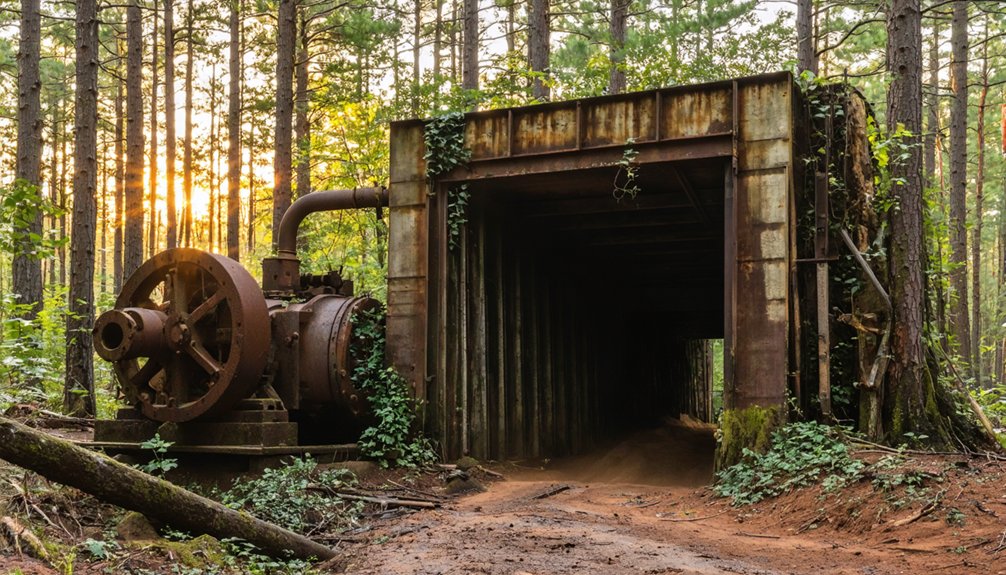
Yes, you can still visit most of Alabama’s mining ghost towns, though accessibility and preservation vary considerably by site.
For ghost town explorations, Battelle offers hiking through forest reclaiming scattered brick and metal remnants five miles north of Valley Head.
Sylacauga welcomes visitors to active marble quarry surroundings, the Coldwater Covered Bridge, and walking trails.
The Aldrich Coal Mine Museum, 1.5 miles from Montevallo, delivers structured mining heritage experiences at the original operational site.
West Blocton’s Cahaba Coal Field remnants remain accessible within Bibb County’s landscape.
Old Cahawba, Alabama’s designated coal mining museum since 1984, provides the most formalized visitor experience.
Old Cahawba has served as Alabama’s official coal mining museum since 1984, offering visitors the region’s most structured heritage experience.
Each site demands different preparation — some require rugged hiking, others offer maintained facilities — so research each destination before you go.
Alabama Mining Museums That Preserved the History
Museums scattered across Alabama’s mining regions have stepped in where crumbling ruins and overgrown lots can’t fully tell the story.
You’ll find dedicated institutions safeguarding mining artifacts and championing historical preservation across the state.
Three institutions stand out:
- Aldrich Coal Mine Museum — Positioned 1.5 miles from Montevallo at the original site, it anchors the region’s coal legacy with authentic on-site remnants.
- Old Cahawba Archaeological Park — Designated Alabama’s official coal mining museum by the state senate in 1984, it documents the valley’s industrial past.
- West Blocton Heritage Collections — Capturing immigrant worker culture tied to the Cahaba Coal Field, preserving labor and community records.
These sites let you engage directly with Alabama’s industrial backbone on your own terms.
Why Alabama’s Mining Ghost Towns Still Captivate Explorers
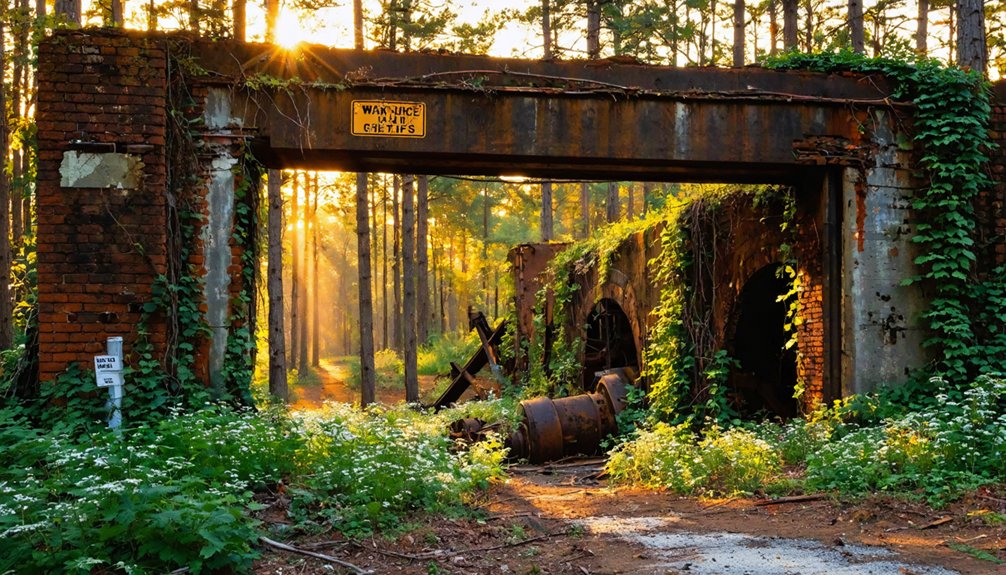
Alabama’s mining ghost towns captivate explorers because they compress industrial history into tangible, navigable landscapes where you can read economic collapse directly in scattered brick, rotted timber, and reclaimed forest.
When you hike toward Battelle’s ruins or trace Aldrich’s company-town footprint, you’re decoding regional industrial ambition that Birmingham’s dominance ultimately extinguished.
These sites aren’t curated exhibits — they’re unfiltered records you interpret independently. Their historical significance lies precisely in that rawness; no interpretive barrier exists between you and the evidence.
You’ll uncover hidden treasures not as artifacts behind glass but as geological formations, structural remnants, and cemetery markers embedded in Alabama’s landscape.
That autonomy — reaching conclusions through direct observation rather than mediated narrative — explains why these declining communities continue drawing historically literate, freedom-seeking explorers across generations.
Frequently Asked Questions
Were Any Alabama Mining Ghost Towns Ever Considered for National Landmark Status?
You’ll find that Old Cahawba’s historical significance earned it official state recognition in 1984, meeting landmark criteria as Alabama’s coal mining museum, though definitive national landmark designation records for these mining ghost towns aren’t explicitly confirmed here.
Did Any Mining Families Remain After Towns Were Abandoned in Alabama?
Yes, some mining families did stay behind, preserving family legacies tied to mining heritage. You’ll find descendants who maintained regional roots, sustaining cultural memory even as towns dissolved, keeping Appalachian Alabama’s independent spirit alive through generations.
Are There Guided Ghost Town Tours Available in Alabama Currently?
Coincidentally, as interest in Alabama’s past surges, you’ll find guided experiences emerging at sites like Aldrich Coal Mine Museum, where you can actively explore historical significance without constraints, uncovering forgotten mining communities on your own terms.
What Wildlife Now Inhabits Alabama’s Reclaimed Former Mining Ghost Towns?
You’ll find remarkable wildlife diversity thriving in Alabama’s reclaimed mining ghost towns, where the ecological impact of forest succession actively supports white-tailed deer, wild turkey, various raptor species, and diverse reptilian communities reclaiming industrially-scarred landscapes.
Did Any Alabama Mining Ghost Towns Experience Revivals After Initial Closure?
You’d wait a million years for full revivals! Aldrich’s revival efforts succeeded partially—it’s absorbed into Montevallo, preserving economic impacts through the Coal Mine Museum, while Sylacauga’s marble industry sustained long-term regional revitalization beyond initial closure.
References
- https://thebamabuzz.com/5-alabama-ghost-towns-to-put-on-your-bucket-list/
- https://www.landmarksdekalbal.org/the-ruins-of-battelle/
- https://www.ezhomesearch.com/blog/11-ghost-towns-in-alabama-that-bridge-the-distance-between-yesterday-and-today/
- https://www.youtube.com/watch?v=ms6onL3rEO4
- https://www.worldatlas.com/cities/5-old-timey-mining-towns-in-alabama.html