If you’re searching for Florida’s mining ghost towns, head to Polk County’s Bone Valley, where phosphate once fueled entire company towns that collapsed almost overnight. Places like Nichols thrived on fertilizer production before depleted deposits and economic shifts forced everyone out. Today, you’ll find smokestack ruins, weed-covered foundations, and eerie silence where thousands once lived. The history, legends, and what’s left of these forgotten communities run much deeper than you’d expect.
Key Takeaways
- Florida’s mining ghost towns are concentrated in Polk County’s Bone Valley, where phosphate deposits once fueled thriving company towns like Nichols.
- Towns collapsed due to depleted phosphate deposits, economic downturns, and natural disasters, leaving behind foundations, smokestacks, and silence.
- Company town life revolved around industrial work, company-owned housing, and company stores that created financial dependency among workers.
- Local folklore includes tales of miner spirits, unexplained lights, and voices from flooded excavations, preserving cultural memory of these towns.
- Visitors can explore accessible remnants, though some sites are privately owned; the Mulberry Phosphate Museum offers a safer alternative.
Florida’s Most Haunting Mining Ghost Towns
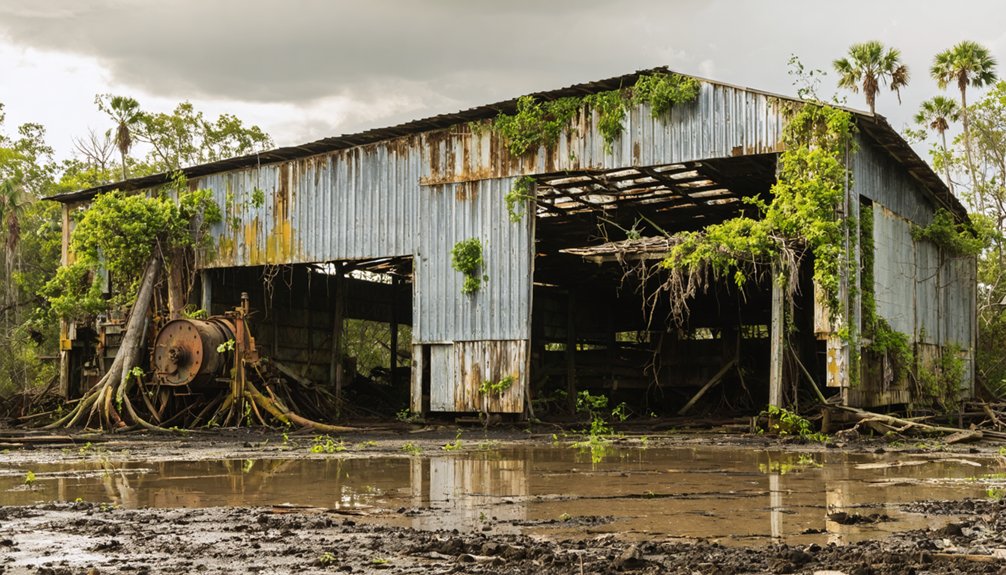
Where the phosphate deposits once ran deep and the company towns rose fast, Florida hides some of the most atmospheric mining ghost towns in the American South.
You’ll find them scattered across Polk County’s Bone Valley, where phosphate history shaped entire communities that vanished once the ore ran out. Towns like Nichols thrived under a mining economy built on fertilizer production, then collapsed when markets shifted and deposits dried up.
Bone Valley built towns on phosphate and buried them just as fast when the ore gave out.
Ruby, farther north, followed clay and kaolin extraction until floods and resource exhaustion finished it off.
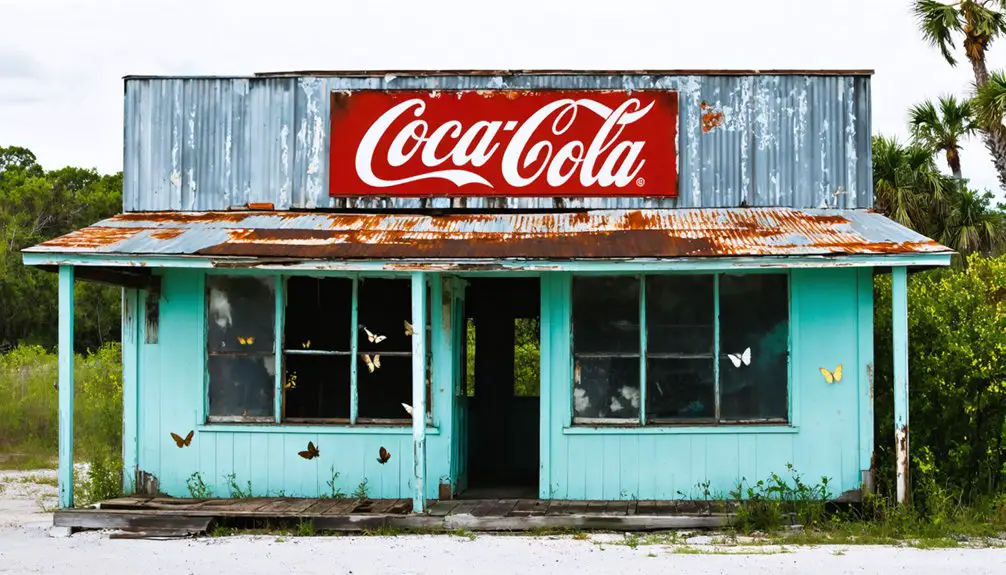
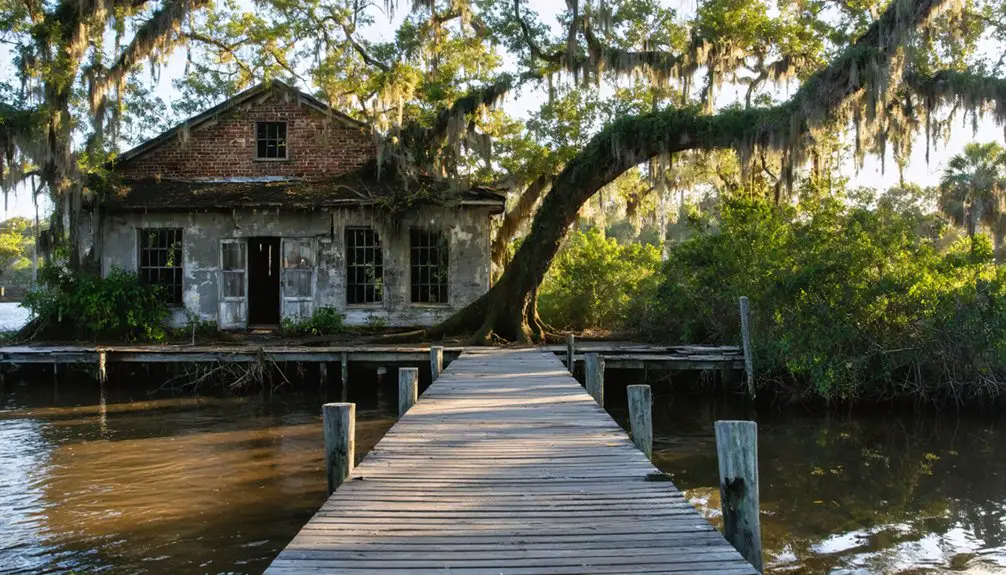
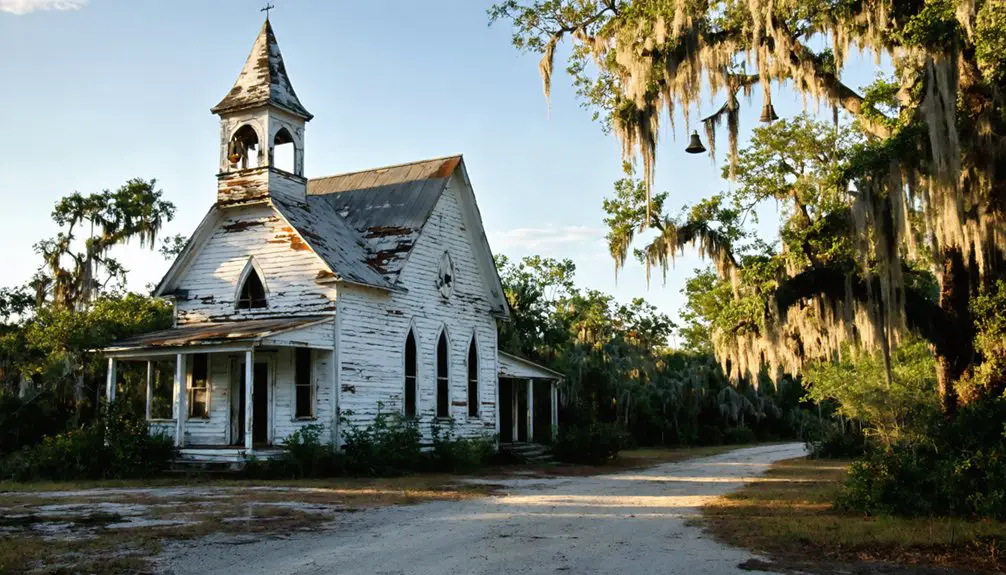
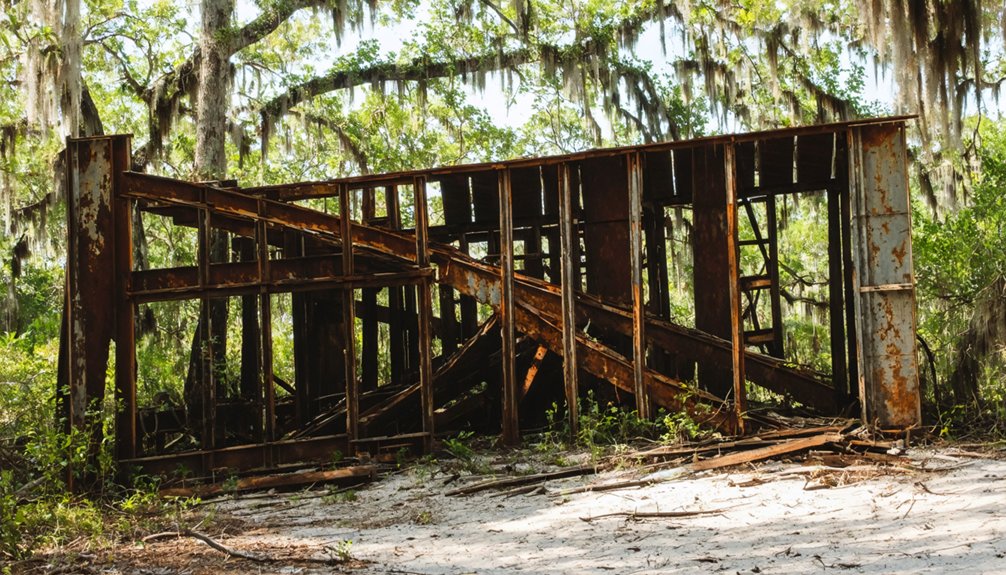
What you encounter today are smokestack ruins, weed-covered foundations, and folklore about miner spirits.
These sites aren’t preserved or polished — they’re raw landscape fragments that remind you exactly how quickly extraction-based freedom turns into abandonment.
What Caused These Mining Towns to Vanish?
Once the ore ran out, everything else followed. Florida’s mining towns weren’t built to last — they were built to extract. When resources disappeared, so did livelihoods, families, and entire communities. Resource depletion and economic fluctuations worked together to erase these settlements from the map.
Three core factors drove the collapse:
- Depleted deposits — Phosphate and kaolin reserves exhausted faster than anticipated, eliminating the sole employment base overnight.
- Market downturns — Economic fluctuations in national fertilizer and mineral demand left operations financially unviable.
- Natural disasters — Devastating floods, particularly in low-lying towns like Ruby, prevented rebuilding efforts entirely.
Company towns had no economic diversity to fall back on. Once the industrial purpose vanished, you’d find nothing left but foundations, folklore, and silence.
What It Was Actually Like Living in a Florida Mining Company Town
Before those towns emptied out, they were fully functioning settlements built around a single industrial purpose — and life inside them reflected that design at every level.
Your daily life revolved around the company’s schedule, its housing, its commissary, and its rules. You didn’t own your home — the company did. You often spent your wages at the company store, keeping your finances tightly bound to your employer.
Community dynamics formed quickly under those conditions, as workers built strong social bonds while remaining economically dependent on a single operator.
In Polk County’s phosphate towns like Nichols, you’d have lived among hundreds of laborers producing fertilizer for national agriculture. That shared purpose created cohesion, but it also meant that when the phosphate ran out, everything you’d built together disappeared almost overnight.
Legends and Ghost Stories From Bone Valley’s Mining Past
The same company towns that shaped daily life in Bone Valley left behind something less tangible than smokestack ruins — a layered body of folklore that still circulates among Polk County locals and urban explorers.
Haunted landscapes here carry three recurring legends:
- Miner spirits wandering abandoned rail lines where phosphate cars once rolled through midnight shifts.
- Voices rising from flooded pit excavations after heavy rains reclaim former extraction zones.
- Unexplained lights near collapsed power plant foundations that locals attribute to workers never accounted for after closures.
Local folklore treats these stories as cultural memory rather than pure entertainment.
You’ll find them preserved in oral histories, regional YouTube explorations, and community narratives that frame Bone Valley’s ghost towns as warnings about resource dependence and impermanent settlement.
Can You Still Visit Florida’s Abandoned Mining Ghost Towns?
Whether you’re a heritage traveler, urban explorer, or local history enthusiast, Florida’s abandoned mining ghost towns remain accessible — though rarely in the way you might expect.
Florida’s abandoned mining ghost towns beckon heritage travelers and urban explorers — though access rarely unfolds as expected.
Most sites lack formal historical preservation status, so you won’t find maintained trails or interpretive signage. Instead, you’ll encounter weed-covered foundations, isolated smokestacks, and scattered ruins embedded in open fields or conservation land.
In Polk County’s Bone Valley, some former phosphate sites are now privately owned by companies like Mosaic, restricting direct access.
Ruby’s remnants sit near river bottomland, requiring careful navigation. Urban exploration of these sites demands research, respect for property boundaries, and awareness of environmental hazards like sinkholes.
Local museums, such as the Mulberry Phosphate Museum, offer safer, context-rich alternatives for understanding Florida’s mining heritage.
Frequently Asked Questions
How Many Ghost Towns Have Existed in Florida Due to Mining?
You’ll find over two hundred abandoned settlements have existed in Florida, many tied to mining relics from phosphate, kaolin, and mineral extraction booms that swept through the state during the late 19th and early 20th centuries.
Which Museums Preserve the History of Florida’s Phosphate Mining Industry?
Like a time capsule frozen in earth, you’ll find Phosphate Heritage preserved at the Mulberry Phosphate Museum in Polk County, where Mining Artifacts connect you directly to Florida’s industrial past and the freedom of discovery.
How Did Phosphate Mining Impact Agricultural Expansion Across the United States?
Phosphate production from Florida’s mines fueled agricultural practices nationwide, driving economic growth by supplying fertilizers that boosted crop yields. You’d find that land reclamation efforts later transformed depleted mining sites, balancing industrial extraction with renewed agricultural and conservation opportunities.
Are Any Florida Mining Ghost Towns Formally Designated as Historical Sites?
You won’t find most Florida mining ghost towns formally designated as historical sites. They largely lack official historic preservation status, leaving their mining heritage recognized mainly through local lore, landscape fragments, and occasional archival records.
What Environmental Damage Did Phosphate Mining Leave Behind in Florida?
You’ll find phosphate pollution reshaped Florida’s landscape dramatically — it’s left sinkholes, disturbed soils, and altered terrain across Polk County. Land reclamation efforts have since converted many former mining sites into open fields and conservation areas.
References
- https://fdc.com/blog/ghost-towns-in-florida/
- https://patchproflorida.com/blog/the-fascinating-history-of-floridas-ghost-towns/
- https://floridatrailblazer.com/tag/ghost-towns/
- https://www.youtube.com/watch?v=zKzjDvVjvHc
- https://en.wikipedia.org/wiki/List_of_ghost_towns_in_Florida
- https://www.journaloffloridastudies.org/0102ghosttowns.html
- http://freepages.rootsweb.com/~gtusa/history/usa/fl/pierce.htm
- https://www.facebook.com/GhostTownLiving/videos/a-florida-ghost-town-with-a-nuclear-secret/916778927790559/
- https://www.reddit.com/r/Paranormal/comments/1dkfu12/abandoned_town_in_florida/
- https://www.tampabayheritage.com/post/florida-s-ghost-towns