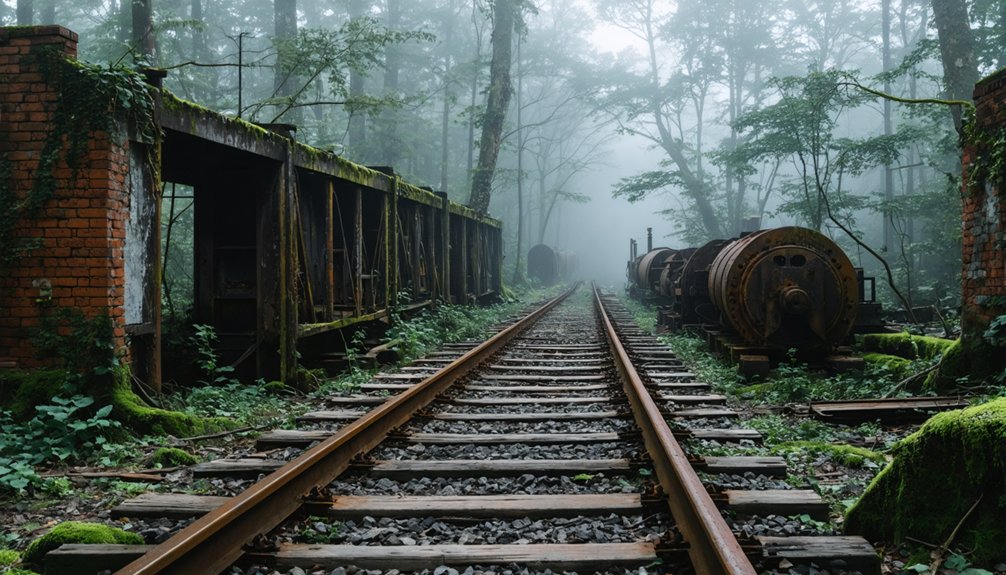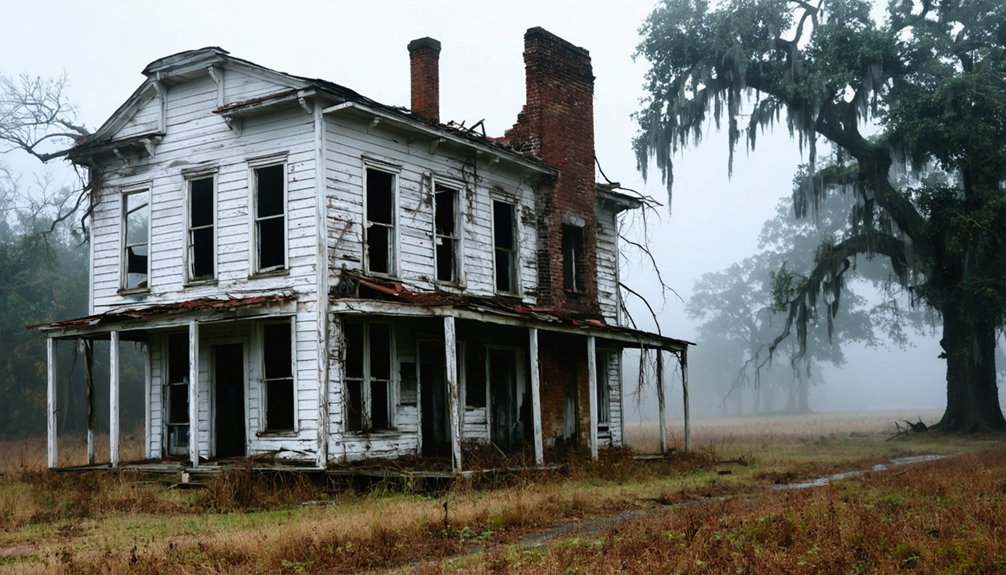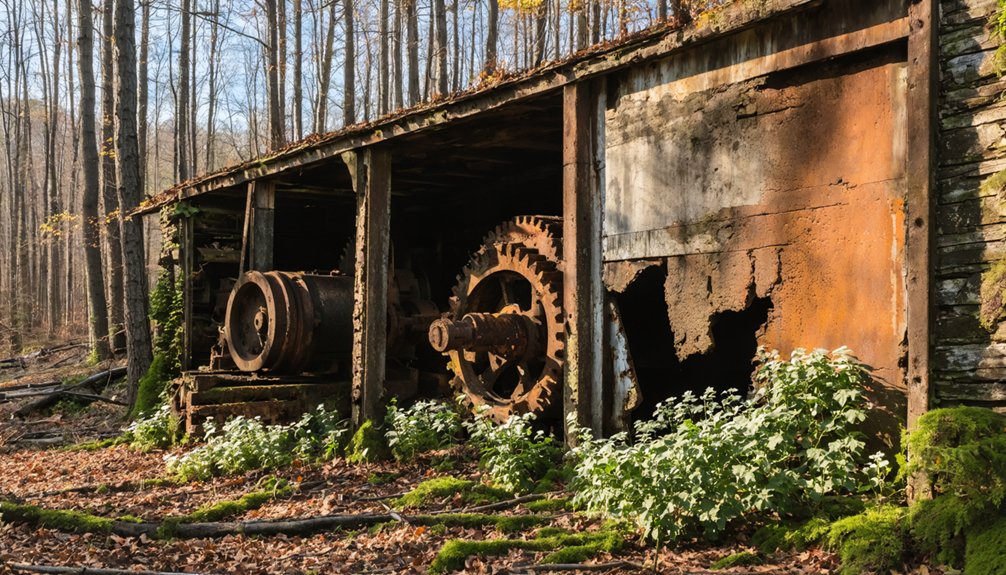
You’ll find Georgia’s mining ghost towns scattered across the northern highlands, remnants of a gold rush that preceded California’s by nearly two decades. Towns like Auraria and Shackelton followed a familiar boom-and-bust cycle, driven by ore depletion, economic shifts, and absent regulatory frameworks. What remains today includes cemeteries, scattered foundations, historical markers, and archival records that collectively reconstruct these vanished communities. There’s far more to uncover about these overlooked settlements than their quiet ruins suggest.
Key Takeaways
- Georgia’s gold rush began in the late 1820s, predating California’s by nearly two decades, centered in North Georgia’s Lumpkin County.
- Auraria was a prominent early mining ghost town, yielding an estimated $20 million in gold before declining after Dahlonega’s mint opened.
- Shackelton, founded in 1909 in Chattooga County, exemplifies the typical boom-and-bust cycle, abandoned within a decade due to ore depletion.
- Physical remnants include cemeteries, ruins, foundations, and historical markers, though many sites are overgrown or located on private land.
- Reconstructing these towns’ histories requires combining land records, Sanborn maps, digitized newspapers, and archival sources alongside physical site visits.
Georgia’s Gold Rush and the Mining Towns It Created
Before California ever became synonymous with gold fever, Georgia had already lived through its own boom. In the late 1820s, prospectors flooded Lumpkin County, founding communities like Auraria and extracting roughly $20 million in gold from the surrounding hills.
Georgia’s gold rush predates California’s by decades — and the hills of Lumpkin County still hold the proof.
You can trace the cultural heritage of this era through standing structures, historic markers, and archival records that document what was once a thriving regional economy.
The environmental impact was equally significant. Hydraulic mining and placer operations reshaped streambeds, cleared timber, and altered drainage patterns that persisted long after the rush ended.
When the federal mint opened in nearby Dahlonega, commerce migrated, and Auraria began its slow decline.
What you’re left with today is a partial town — part ruin, part record, entirely irreplaceable.
Auraria: Georgia’s Most Famous Mining Ghost Town
When you trace Georgia’s gold rush to its roots, you’ll find Auraria in Lumpkin County standing as the state’s most prominent mining ghost town. It was founded in the late 1820s and early 1830s — decades before California’s 1849 rush.
The region yielded an estimated $20 million in gold, drawing prospectors and commerce that briefly made Auraria a thriving settlement.
Yet the establishment of a federal mint in nearby Dahlonega gradually pulled businesses and residents away, sealing Auraria’s decline into the partial abandonment you can still observe through its remaining structures today.
Gold Rush Origins
Few places in Georgia carry the historical weight of Auraria, a mining ghost town in Lumpkin County that predates California’s gold rush by decades. Founded in the late 1820s, it became ground zero for gold prospecting in the American South. Early settlers applied evolving mining technology to extract what historians estimate reached $20 million in gold.
Here’s what shaped Auraria’s remarkable rise:
- Discovery — Prospectors identified rich placer deposits before federal oversight arrived.
- Settlement — Miners, merchants, and laborers built a functioning economy rapidly.
- Extraction — Advancing mining technology accelerated production profoundly.
- Decline — Dahlonega’s establishment drew commerce away, gutting Auraria’s foundation.
You’re looking at a settlement that embodied genuine economic independence before institutional forces redirected its momentum elsewhere.
Auraria’s Decline And Legacy
Dahlonega’s emergence as a regional commercial hub directly accelerated Auraria’s unraveling. Once the federal mint anchored Dahlonega’s economy, merchants, miners, and institutions followed, pulling essential resources away from Auraria’s streets. What had once generated roughly $20 million in gold quietly faded into partial abandonment.
Yet Auraria didn’t vanish entirely — several structures still stand, offering you tangible evidence of Georgia’s earliest gold-rush era.
That physical remnance makes mining preservation critically important here. You can walk among surviving buildings that predate California’s 1849 rush, connecting directly with a chapter of American economic history that’s rarely documented this thoroughly.
Heritage tourism gives Auraria renewed purpose, transforming a declining settlement into an accessible historical site. Auraria’s legacy isn’t just Georgia’s — it reflects how extraction economies rise, collapse, and leave permanent marks on landscapes.
Why Georgia’s Mining Towns Boomed and Collapsed
Georgia’s mining towns rose and fell on the logic of extraction: once the ore ran out, so did the reason to stay. You’ll find that cultural influences shaped these communities quickly, but environmental impacts stripped them just as fast. Four core forces drove the cycle:
Georgia’s mining towns lived and died by extraction — when the ore vanished, so did everything else.
- Ore depletion rendered operations economically unviable overnight.
- Transportation shifts redirected commerce toward growing regional centers like Dahlonega.
- Environmental degradation left landscapes unable to sustain agricultural alternatives.
- Cultural displacement scattered workers who’d no institutional reason to remain.
When mines closed, merchants followed. Schools emptied. Roads fell quiet. The settlements didn’t fade gradually — they collapsed structurally. Understanding this pattern helps you recognize why Georgia’s gold-rush legacy produced ghost towns rather than lasting industrial cities.
Shackelton and Other Forgotten Georgia Mining Towns
When you examine Georgia’s forgotten mining settlements, Shackelton in Chattooga County stands as a precise case study in rapid community formation and collapse—founded in 1909, abandoned by the 1920s once nearby mines shuttered.
You’ll find this pattern repeated across the state’s historical record: extraction ends, economic rationale dissolves, and the population disperses, leaving behind little more than names, scattered ruins, or overgrown foundations.
Beyond Shackelton, Georgia’s broader ghost-town inventory documents numerous other mining settlements that followed the same arc, their histories preserved now primarily through local archives, heritage directories, and incomplete but essential catalogues like the state’s Wikipedia ghost-town list.
Shackelton’s Brief Mining Existence
Though Auraria dominates Georgia’s mining ghost-town narrative, Shackelton in Chattooga County represents an equally instructive, if far less celebrated, chapter in the state’s extractive history. Founded in 1909, its settlement patterns reflected classic resource-extraction logic: establish, extract, abandon.
Consider what Shackelton’s brief existence reveals:
- Mining techniques dictated the town’s lifespan — once methods couldn’t sustain profitability, closure followed swiftly.
- Settlement patterns mirrored boom-and-bust cycles common across Georgia’s extractive communities.
- Mine closure in the 1920s left no institutional anchor to retain residents.
- Today, Shackelton survives only as a name in historical records, stripped of physical presence.
You’re witnessing how resource dependency, without diversification, guarantees a community’s erasure from the living landscape.
Mines Close, Towns Vanish
Shackelton’s story isn’t singular — dozens of Georgia mining settlements followed the same arc: extraction peaks, ore thins, operations shutter, and residents scatter within a generation.
When mines closed, towns didn’t linger. Populations dispersed, structures collapsed, and landscapes reverted to field or forest. You’ll find no municipal record, no functioning institution — only a name on an archival map.
Mining regulations, largely absent in early Georgia operations, failed to require remediation or orderly closure, leaving environmental impact unchecked and communities without *handover* support.
Streams carried sediment, soils remained disturbed, and former residents bore the economic consequences alone. These settlements didn’t fade gradually — they collapsed abruptly, erased by the same market logic that built them.
Shackelton simply documented what dozens of nameless Georgia mining camps experienced without historical record.
Other Forgotten Georgia Settlements
Shackelton, founded in 1909 and abandoned by the 1920s, represents one of the more documented entries on Georgia’s incomplete ghost-town inventory — but it’s far from isolated. Across the state, you’ll find former mining settlements reduced to:
- Cemeteries standing as the sole markers of vanished communities
- Scattered ruins where environmental impact reshaped the surrounding landscape over decades
- Pasture land that swallowed entire town footprints after abandonment
- Historical markers serving as cultural preservation tools where no structures survive
These remnants aren’t accidents — they’re records. Each site reflects a community that extracted resources, exhausted them, and dissolved.
Georgia’s ghost-town inventory remains incomplete by its own admission, meaning undocumented settlements still await identification. You’re looking at a historical landscape that rewards serious, independent investigation.
Buildings, Cemeteries, and Markers Still Visible at Mine Sites
While full erasure marks many of Georgia’s abandoned mining settlements, sites like Auraria still retain physical remnants—standing structures, cemeteries, and historical markers—that document the community’s former presence. You’ll find that these surviving elements serve as primary sources for industrial archaeology, offering tangible evidence of labor, commerce, and daily life that written records alone can’t fully capture.
Preservation efforts have kept select buildings and burial grounds accessible, allowing researchers and independent explorers to examine what Georgia’s gold-rush era actually produced at ground level. Cemeteries, in particular, preserve demographic data—names, dates, and origins—that reveal who built these communities and who didn’t survive them.
Historical markers supplement physical remains by contextualizing site-specific events. Together, these layers give you direct access to a documented past that resists complete disappearance.
Why Georgia’s Gold Rush Ghost Towns Have a Different Story
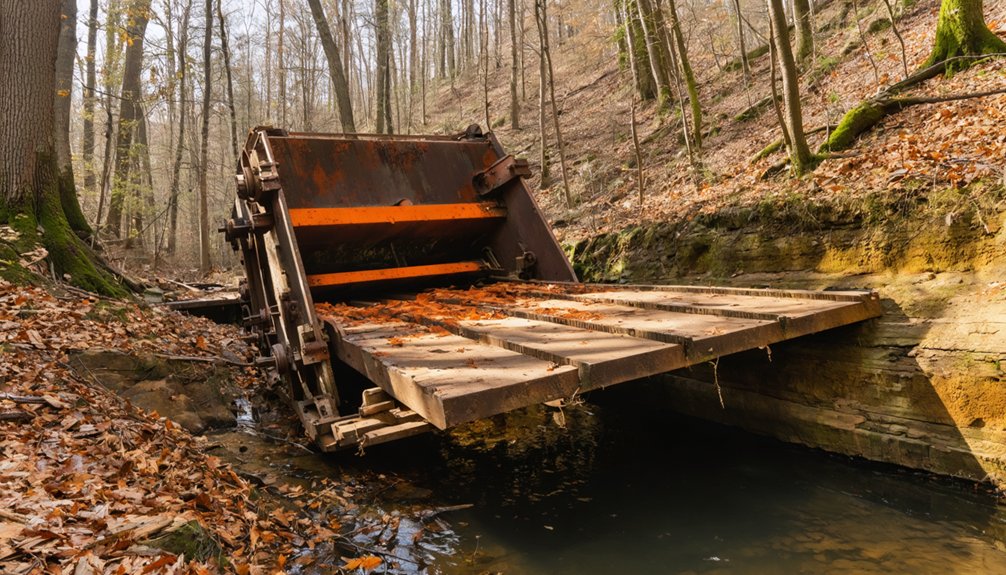
Georgia’s gold-rush ghost towns carry a historical weight that separates them from the more familiar western narratives you’ll find dominating most abandonment literature. Georgia’s boom preceded California’s by decades, giving these sites a distinct cultural impact rooted in early American economic ambition and federal intervention.
Four distinctions set Georgia’s gold-rush ghost towns apart:
- They predate the 1849 California rush by roughly two decades
- Federal infrastructure, including a U.S. Mint in Dahlonega, shaped their rise and decline
- Their cultural impact reflects Indigenous displacement alongside settler expansion
- Environmental effects from early hydraulic and placer mining remain embedded in the regional landscape
You’re engaging with ghost towns that document a largely overlooked chapter of American resource history, one built on decisions that permanently altered both communities and land.
Where Georgia’s Mining Ghost Towns Are Located by Region
When you trace Georgia’s mining ghost towns on a map, you’ll find that North Georgia commands the most significant concentration, with Lumpkin and Chattooga counties anchoring sites like Auraria and Shackelton within the state’s gold-bearing geological corridor.
You can, however, identify scattered mining remnants beyond the northern highlands, as resource extraction once pulled communities into existence across varied Georgia landscapes before economic exhaustion erased them.
Recognizing this regional distribution helps you understand that Georgia’s mining ghost-town record isn’t a single-county phenomenon but a statewide pattern shaped by geology, capital, and abandonment.
North Georgia Mining Regions
Tucked into the Blue Ridge Mountains and the surrounding Piedmont foothills, North Georgia served as the geographic core of the state’s gold-rush era and remains the primary region where mining ghost towns are concentrated today. The mining legends forged here shaped the cultural impact felt across Appalachian communities for generations.
Four counties define this historic corridor:
- Lumpkin County – Home to Auraria and the Dahlonega Mint site
- Union County – Contains scattered placer-mining remnants
- White County – Features creek-bed extraction sites along the Chattahoochee headwaters
- Chattooga County – Includes Shackelton, abandoned after its mines closed in the 1920s
You’ll find that exploring this region means tracing a documented boom-and-bust arc written directly into the land itself.
Scattered Statewide Mining Sites
While North Georgia’s mining corridor draws the most attention, you’ll find that the state’s abandoned mining settlements extend well beyond the Blue Ridge foothills into a broader, less-documented statewide distribution.
Chattooga County’s Shackelton, founded in 1909 and abandoned by the 1920s after nearby mines closed, illustrates how resource exhaustion scattered ghost towns across Georgia’s western counties. You’ll encounter varied states of town preservation across these sites — some retain structural remnants and cemeteries, while others reverted entirely to pasture.
Mining artifacts surface at locations far removed from Dahlonega’s well-catalogued district, signaling extraction histories that regional records have underrepresented. Georgia’s ghost-town inventory remains explicitly incomplete, meaning your independent research into county archives and local-history projects will likely uncover additional abandoned mining communities still awaiting formal documentation.
Can You Visit These Georgia Mining Ghost Town Sites?
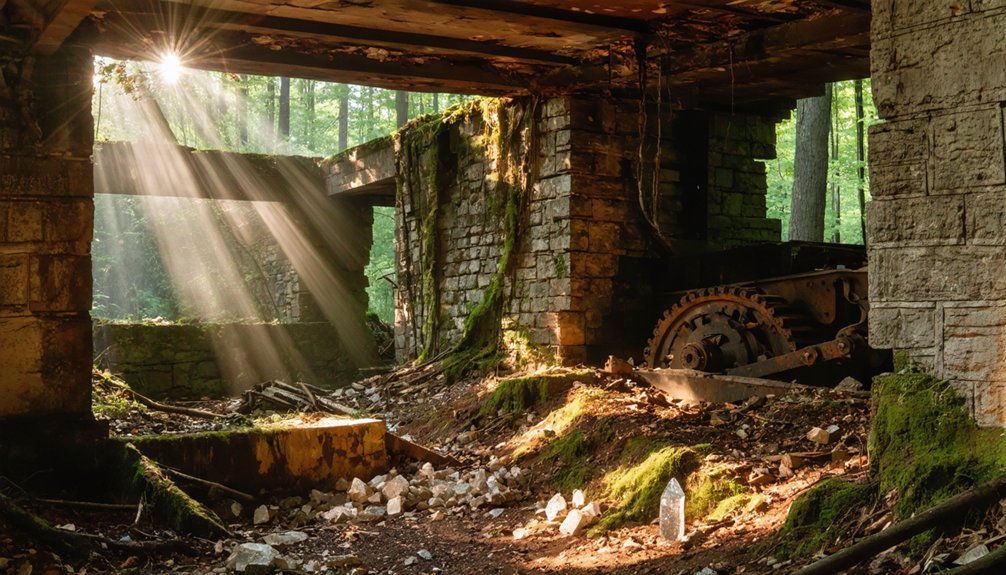
Visiting Georgia’s mining ghost towns is possible, though the experience varies considerably depending on the site. Auraria, tied to local legends of Georgia’s earliest gold rush, retains standing structures you can explore. Shackelton offers little beyond scattered remnants after its 1920s abandonment.
Before you go, consider these practical realities:
- Access varies — some sites sit on private land requiring permission.
- Preservation efforts differ widely, leaving certain locations stabilized while others deteriorate freely.
- Documentation helps — carry historical references, as markers are often absent.
- Respect boundaries — federal and state regulations protect many heritage sites from disturbance.
You’ll find Georgia’s mining ghost towns reward careful research before visiting, ensuring you arrive informed and prepared for what each site actually offers.
What You’ll Actually Find When You Show Up
Expectations shape every visit, so knowing what physically remains at Georgia’s mining ghost towns matters before you commit to the trip. At Auraria, you’ll encounter standing structures, historical markers, and evidence tied directly to early mining technology—stamp mills, sluice remnants, and excavated hillsides that document extraction methods from the 1830s.
Shackelton offers considerably less; you’ll find scattered foundations and overgrown lots where a functioning community once operated. Cultural preservation efforts vary sharply between sites. Some locations maintain interpretive signage and managed access, while others sit on private land with restricted entry.
Cemeteries frequently outlast every other structure, giving you a tangible but sobering measure of what survives. Adjust your expectations accordingly—you’re reading a fragmented archive, not touring a reconstructed museum.
How to Dig Into Georgia’s Lost Mining Community History
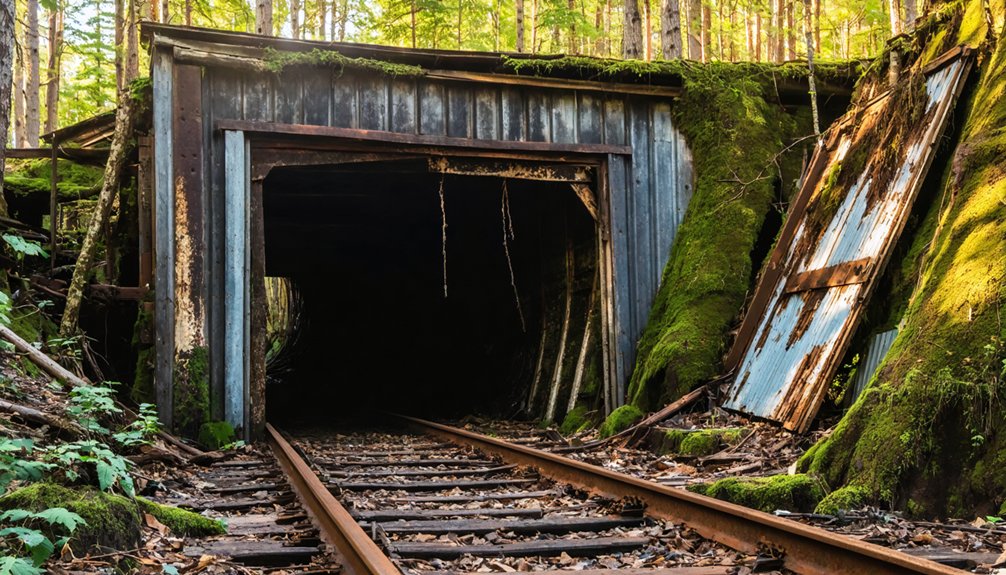
Because the physical record at these sites is fragmentary, you’ll need to cross-reference documentary sources to build a complete picture of any mining community’s rise and collapse. Scattered ruins rarely tell you who financed the mining equipment, who built the community infrastructure, or why operations ceased. Independent research closes those gaps.
The physical record is fragmentary. Documentary sources close the gaps ruins can never fill.
- Consult Georgia’s county deed and probate records to trace land ownership shifts tied to mine closures.
- Review digitized Atlanta Constitution archives for contemporary reporting on mining output and town decline.
- Cross-reference Wikipedia’s explicitly incomplete Georgia ghost-town list against local historical society inventories.
- Examine Sanborn fire insurance maps, which document community infrastructure layouts for many small Georgia settlements before abandonment.
These sources, combined, let you reconstruct timelines that physical visits alone can’t provide.
Frequently Asked Questions
How Many Ghost Towns Does Georgia Have in Total?
You don’t have an exact total, but Georgia’s inventory remains incomplete, encompassing numerous abandoned mining sites across counties. Historic preservation efforts continue documenting these lost communities, with national trackers like Geotab recording over 3,800 ghost towns nationwide.
What Other States Had Gold Rushes Before California’s?
You’ll find that North Carolina and Georgia both experienced historical gold rushes before California’s 1849 rush, where miners refined early mining techniques in placer and hard-rock extraction across Appalachian deposits during the 1820s–1830s.
Are Georgia Mining Ghost Towns Protected Under Any Preservation Laws?
You’ll find that preservation laws like the National Historic Preservation Act can protect sites of historical significance, but coverage varies—you’d need to verify each Georgia mining ghost town’s individual status through state heritage registries.
Did Any Georgia Mining Towns Get Relocated Rather Than Abandoned?
You’d think entire towns sprouted legs and marched away! The knowledge base doesn’t document town relocation cases — it shows mining equipment exhaustion drove abandonment, not relocation. You’ll need specialized archival sources for definitive town relocation records.
How Much Gold Remains Unmined Beneath Georgia’s Ghost Town Sites?
You can’t find a definitive figure for hidden mineral deposits or unexploited gold reserves beneath Georgia’s ghost town sites, as current geological surveys haven’t fully quantified what undisturbed extraction potential remains beneath these historically significant grounds.
References
- https://en.wikipedia.org/wiki/List_of_ghost_towns_in_Georgia_(U.S._state)
- https://www.reddit.com/r/Georgia/comments/1gi0aak/is_there_any_abandoned_townsvillagescities_i_can/
- https://vanishinggeorgia.com/tag/georgia-ghost-towns/
- https://www.ghosttowns.com/states/ga/ga.html
- https://patch.com/georgia/across-ga/gold-mining-haunted-spirits-heart-gas-most-eccentric-towns
- https://www.axios.com/local/atlanta/2023/11/21/georgia-ghost-towns-auraria-gold
- https://en.wikipedia.org/wiki/Shackelton
- https://en.wikipedia.org/wiki/Auraria