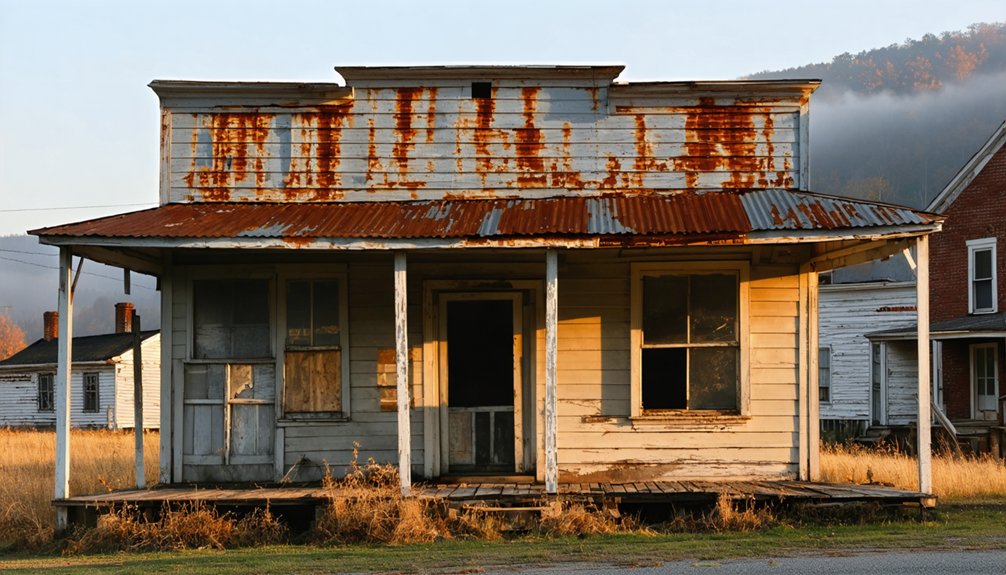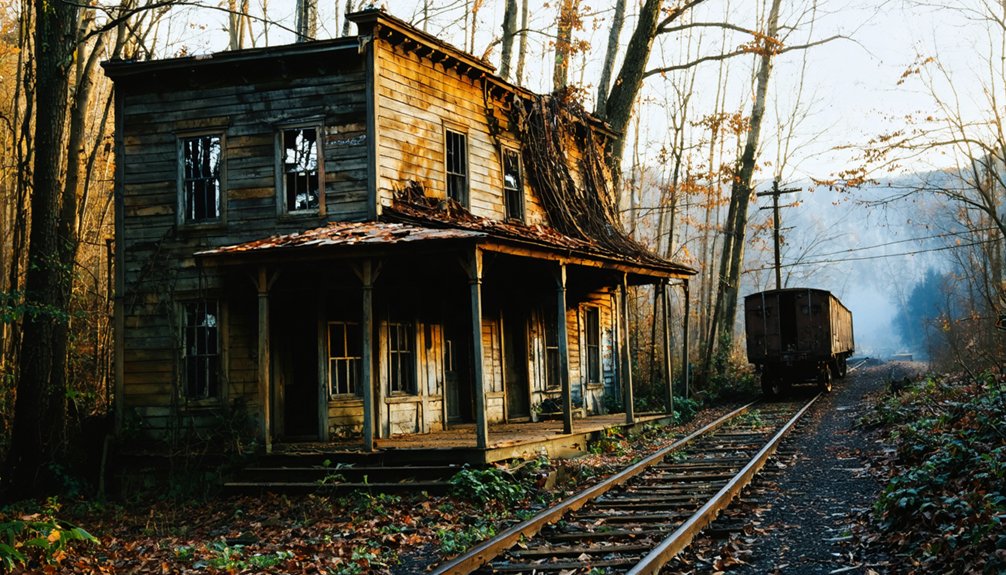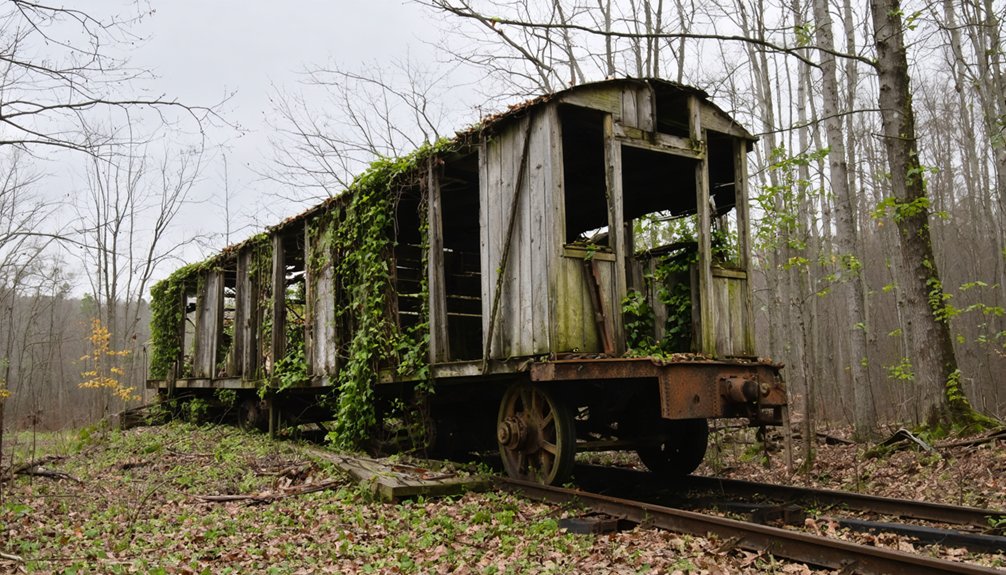
Kentucky’s mining ghost towns tell a story you can’t ignore. You’ll find them scattered across the eastern coalfields, where coal depletion, environmental damage, and company withdrawal erased entire communities almost overnight. Towns like Lynch once housed nearly 10,000 residents, while others like Paradise were completely swallowed by extraction activities. Some were even submerged beneath reservoirs. The full history behind these vanished settlements is far more complex than it first appears.
Key Takeaways
- Lynch once housed nearly 10,000 residents and now stands as a historic site with surviving industrial ruins and structures.
- Blue Heron operated from 1937 to 1962 and is now preserved as an outdoor museum within Big South Fork.
- Barthell is a surviving mining camp that offers overnight stays, allowing visitors to experience ghost town history firsthand.
- Harlan County towns like Oz and Tin Can Alley collapsed entirely after coal seams were exhausted, leaving no physical trace.
- Paradise was completely erased by coal extraction activities, representing the most extreme outcome of mining town abandonment.
What Turned Kentucky Coal Towns Into Ghost Towns?
When the coal ran out or the profits dried up, company withdrawal often followed swiftly, stripping these settlements of both employment and housing stability in a single blow.
When the coal ran out, companies left fast — and they took the jobs and the homes with them.
You’ll find that advancing mining techniques, while initially extending a seam’s productive life, ultimately accelerated exhaustion by extracting coal more efficiently and completely. Once operators relocated, residents had little reason to stay.
Environmental impacts compounded abandonment — scarred landscapes, contaminated water sources, and subsidence made continued habitation both impractical and unsafe. Flood control projects and federal land acquisitions erased other communities entirely, offering residents no choice but departure.
Railroad shifts and agricultural decline reinforced these pressures across broader regions. Together, these forces didn’t just empty buildings; they dismantled the economic logic that had justified these communities’ existence in the first place.
Which Kentucky Coal Towns Are the Most Famous?
Among Kentucky’s roughly 41 ghost towns, a handful stand out for their scale, documented history, or transformation into heritage sites. Lynch, once home to nearly 10,000 residents, reflects mining industry innovations that made it among the world’s most prosperous coal towns. Its surviving structures still tell that story.
Blue Heron, operating under Stearns Coal & Lumber Company from 1937 to 1962, now functions as an outdoor museum within Big South Fork, embodying cultural preservation efforts that keep vanished communities accessible.
Paradise in Muhlenberg County represents a starker outcome—completely erased by extraction.
Harlan County’s cluster of nine ghost towns, including Oz and Tin Can Alley, documents coal dependency at its most concentrated. These towns collectively define Kentucky’s complicated relationship with resource-driven settlement and abandonment.
Why Did Nine Harlan County Towns Completely Disappear?
Nine Harlan County towns—Bear Wallow, Dog Trot, Hell for Certain, Oz, Pee Vee, Slick Lizard, Tin Can Alley, Upper Squabble, and Uz—didn’t fade gradually; they collapsed when coal’s economic foundation gave out entirely. Once the mines exhausted their seams or companies withdrew operations, residents lost employment, housing, and purpose simultaneously.
When coal’s foundation gave out, nine Harlan County towns didn’t fade—they collapsed entirely, erasing employment, housing, and purpose at once.
No diversified economy existed to absorb the shock, so people left rather than rebuild around nothing.
You won’t find standing structures or managed heritage sites commemorating these nine communities. Their cultural significance survives primarily in records, place names, and oral histories—fragile vessels for communities that once sustained real lives.
The absence of historic preservation efforts means their stories risk disappearing entirely. Harlan County’s pattern demonstrates how completely coal dependency could erase a settlement when industry collapsed without warning or shift.
Which Kentucky Ghost Towns Were Flooded by Reservoirs?
While coal extraction erased many Kentucky communities from the inside out, federal water projects wiped others off the map entirely through inundation. You’ll find these losses represent a distinct category of disappearance, where government authority overrode local permanence.
Three submerged or displaced communities stand as clear examples:
- Birmingham, Marshall County — swallowed beneath Kentucky Lake, leaving historical preservation possible only through archival records.
- Golden Pond, Trigg County — removed entirely for a national recreation area, sacrificing a living community for managed public land.
- Mammoth Cave towns, Edmonson County — cleared through federal land acquisition, where environmental restoration priorities permanently displaced established residents.
These erasures weren’t accidental. They reflected deliberate policy choices that traded community continuity for flood control, recreation, and conservation goals you’d no vote in making.
Which Kentucky Mining Ghost Towns Can You Still Visit?
Unlike the communities swallowed by reservoirs or stripped of every trace by industrial withdrawal, several Kentucky mining ghost towns left enough standing that you can visit them today and read their histories directly from the landscape.
Some Kentucky mining ghost towns still stand, letting history speak for itself through ruins rather than reconstruction.
Blue Heron in McCreary County operates as an outdoor museum within the Big South Fork area, where preservation efforts transformed a closed 1962 mining site into an interpretive landmark.
Lynch retains mine support structures and industrial ruins that fuel both scholarly study and urban legends about its vanished prosperity.
Barthell, also in McCreary County, still offers overnight stays inside a surviving mining camp.
Each site lets you move freely through physical evidence of coal’s rise and collapse, engaging history without intermediaries filtering what you see or how you interpret it.
What Ruins and Structures Still Stand at Abandoned Coal Sites?
When you walk through a site like Lynch, the physical record of coal extraction surrounds you in layers: mine support structures, industrial foundations, and the skeletal remains of company-built housing all hold their ground decades after the workforce left. These industrial relics and settlement remnants tell a history no document fully captures.
Three categories of standing evidence define most abandoned coal sites:
- Mine infrastructure — tipples, shaft entrances, and ventilation systems anchoring the industrial footprint
- Company housing foundations — grid-patterned lots revealing how operators controlled domestic life
- Civic ruins — remnants of schools, churches, and commissaries that once sustained entire communities
Blue Heron preserves these layers as an outdoor museum, letting you read the town’s collapse without guesswork.
Frequently Asked Questions
How Many Total Ghost Towns Does Kentucky Have Statewide?
You’ll find Kentucky has approximately 41 ghost towns statewide, many offering historic preservation efforts and tourist attractions that let you explore the state’s rich, contextual past of coal-dependent communities and their remarkable, freedom-evoking remnants.
What Was Lynch’s Population at Its Peak Prosperity?
At its peak, Lynch’s historical population trends reached roughly 10,000 people, showcasing massive economic impacts on the region. You’d find it was once considered among the world’s most prosperous coal mining towns.
How Long Did Blue Heron Operate as an Active Mining Town?
Blue Heron operated for 25 years, from 1937 to 1962, under Stearns Coal & Lumber Company. You’ll find its mining equipment and history of miners preserved today as an outdoor museum in Big South Fork.
What County in Kentucky Has the Most Mining Ghost Towns?
You’ll find Harlan County holds Kentucky’s highest concentration of mining ghost towns, with nine vanished settlements reflecting historical mining techniques’ boom-bust cycle. Ghost town preservation efforts there document communities like Uz, Oz, and Slick Lizard that coal’s collapse erased.
Did Any Kentucky Mining Ghost Towns Survive as Places to Stay Overnight?
You can actually stay overnight at Barthell in McCreary County, one of Kentucky’s abandoned mining communities that’s been preserved for overnight ghost town stays, letting you experience authentic coal camp history firsthand.
References
- https://www.youtube.com/watch?v=D9gOmfCuKLs
- https://www.youtube.com/watch?v=RRS9TL_PLsA
- https://www.youtube.com/watch?v=rcyyCKbvcaM
- https://www.youtube.com/watch?v=gELufUoh_CQ
- https://www.islands.com/1842805/hidden-blue-heron-kentucky-abandoned-mining-town-river-gorge-ghostly-tours-scenic-hikes/
- https://www.youtube.com/watch?v=sI-FgXqY-aY
- https://wbkr.com/visit-these-20-creepy-kentucky-ghost-towns-for-a-halloween-road-trip/
- https://everafterinthewoods.com/abandoned-ghost-towns-in-kentucky-that-still-hold-echoes-of-the-past/