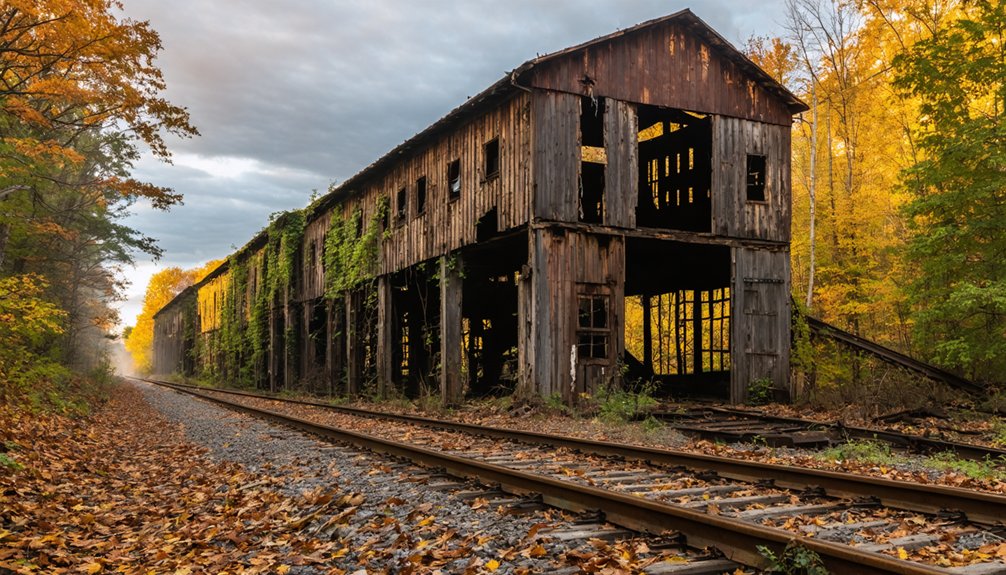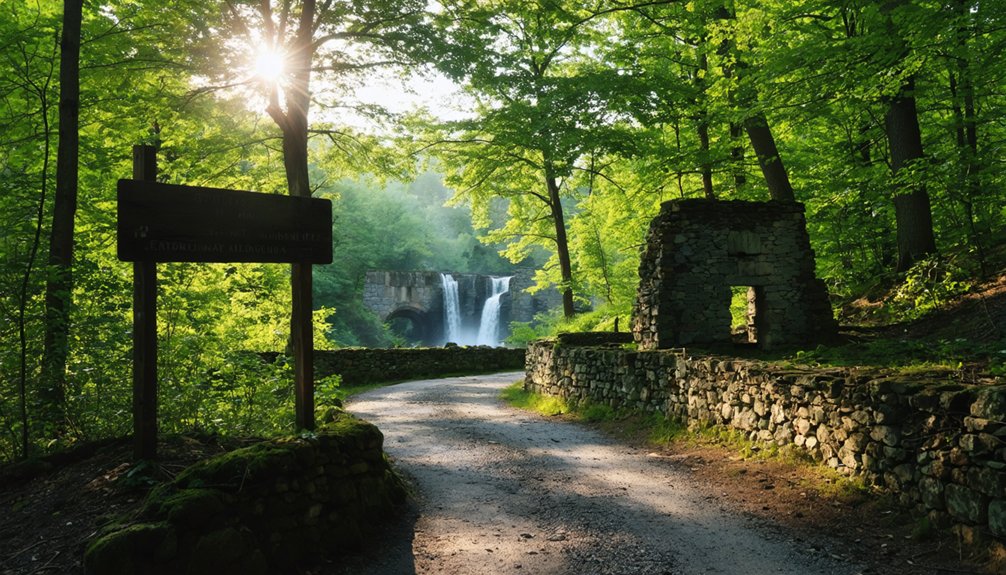
If you’re planning a ghost town road trip, Hindostan Falls in Indiana is worth every mile. Once home to 1,200 frontier residents, cholera wiped the town out by the 1820s, leaving behind an eerie flat rock with 128 square anchor holes near the East Fork of the White River. You can fish, hike, and explore pioneer cemeteries nearby. Visit in late September for Hindostan Days — and there’s much more to this haunting story.
Key Takeaways
- Hindostan Falls in Martin County, Indiana, was once a thriving frontier town of 1,200 residents before collapsing by 1830.
- A cholera outbreak caused 138 deaths within three months, prompting survivors to abandon the town entirely.
- Visit the flat rock with 128 square anchor holes along the East Fork of the White River.
- Plan your trip around Hindostan Days, held annually on the last Saturday of September, featuring guided historical interpretations.
- Enhance your visit by exploring nearby pioneer cemeteries and the Martin County Historical Society & Museum.
What’s Left of Hindostan Falls Today?
Although little remains of Hindostan Falls, what you’ll find is genuinely worth the trip. The most striking historical artifact is a flat rock embedded near the riverbank, carved with 128 square holes — each measuring 18 by 18 inches — once used to anchor the town’s mills. It’s a raw, tangible connection to a community that briefly thrived here.
Beyond that, the natural scenery takes over completely. The East Fork of the White River frames the site beautifully, and the surrounding recreation area invites fishing, hiking, and camping on your own terms.
Pioneer cemeteries dot the landscape nearby, adding quiet historical weight to your visit. A 1966 historical marker also stands at the site, giving context to everything you’re seeing.
How Cholera Destroyed Hindostan Falls in the 1820s
By 1820, Hindostan Falls had grown into a thriving frontier town of roughly 1,200 residents — then cholera arrived and dismantled everything within a decade. This historical outbreak reshaped the entire region almost overnight.
Hindostan Falls flourished with 1,200 residents — until disease arrived and erased an entire thriving frontier town almost overnight.
The epidemic impact hit fast and without mercy:
- 138 people died within just three months during the outbreak
- Historians also identify the event as possibly yellow fever, calling it the “Great Sickness”
- Survivors abandoned homes, businesses, and infrastructure to escape the spread
- By 1830, the town had fundamentally collapsed into silence
When you walk the site today, you’re standing where an entire community simply ceased to exist. No war, no flood — just disease. That reality makes Hindostan Falls one of Indiana’s most haunting and unforgettable ghost town stories.
What Can You See and Do at the Site?
The haunting history of Hindostan Falls doesn’t stay buried — it shows up in the landscape itself when you visit the site today. Walk to the riverbank and you’ll find a flat rock etched with 128 square holes, once anchor points for the town’s mills. It’s a quiet but powerful reminder of what thrived here.
Beyond that stone relic, the natural scenery invites you to linger. Fish the East Fork of the White River, hike the trails, or camp under open skies. Pioneer cemeteries dot the area for those drawn to deeper history.
Local legends of buried treasure add an extra layer of intrigue. A 1966 historical marker grounds it all, giving you context before you explore freely on your own terms.
Plan Your Visit Around Hindostan Days in September
If you want to time your visit perfectly, plan around Hindostan Days, held annually on the last Saturday of September. This community celebration blends local history with natural beauty, giving you a richer experience than a solo exploration would offer.
You’ll find opportunities to dig into:
- Local legends surrounding buried treasure and the town’s mysterious collapse
- Guided interpretations of the site’s frontier-era history
- Connections with the Martin County Historical Society & Museum for deeper research
- Hidden treasures found in the writings of local author Bill Whorrall
Attending Hindostan Days lets you move beyond simply walking the grounds. You’ll hear stories, meet people who know this land intimately, and leave with a fuller picture of why this forgotten river town still captures imaginations today.
Nearby History Sites Worth Adding to Your Trip
While Hindostan Falls anchors your road trip, Martin County holds more history worth exploring. Stop by the Martin County Historical Society & Museum to dig into local legends, buried treasure lore, and the region’s frontier past. The museum’s collections give context that the quiet riverbank simply can’t tell you alone.
Pick up books by local author Bill Whorrall, who writes about Martin County’s hidden treasures and natural wonders — perfect reading for the drive home. While you’re out, keep an eye out for pioneer cemeteries scattered near the Hindostan site. These overlooked burial grounds carry quiet stories of early settlers who shaped and then fled the once-thriving town.
Combining these stops turns a single ghost town visit into a full, rewarding historical journey through Indiana’s frontier heritage.
Frequently Asked Questions
Who Founded Hindostan Falls and When Was It Established?
Frederick Schultz founded Hindostan Falls in 1808, and you’ll find it fascinating that his journey from Vincennes birthed one of Indiana’s most enchanting ghost town legends, now preserved through remarkable historical landmarks waiting for your exploration.
How Large Did the Population of Hindostan Falls Grow?
You’d be amazed — by 1820, Hindostan Falls’ population soared to around 1,200 residents! Today, ghost town tourism lets you explore what remains after devastating population decline tragically erased this once-thriving frontier community from existence.
What Were the Main Businesses and Industries in Hindostan Falls?
You’d have swiped right on Hindostan Falls’ frontier economy! Mills, a hotel, a button factory, and a post office drove this boomtown’s pulse. Today, ghost town tourism reveals that abandoned infrastructure etched into flat rock.
Are There Any Books Written About Hindostan Falls History?
You’ll find books on Hindostan Falls by local author Bill Whorrall, who captures the town’s local legends and historic landmarks. His works on Martin County’s history give you a fascinating, freedom-fueling glimpse into this lost frontier world.
Is There Buried Treasure Rumored to Exist at Hindostan Falls?
Like whispers carried on the river’s current, local legends keep hidden treasure tales alive at Hindostan Falls. You’ll find ghost stories swirling around this abandoned settlement, fueling your sense of adventure and freedom as you explore.
References
- https://www.discoversouthernindiana.com/blog/post/the-ghost-town-of-hindostan-falls-indianas-lost-jewel/
- https://en.wikipedia.org/wiki/Hindostan_Falls
- https://www.onlyinyourstate.com/state-pride/indiana/untold-story-hindostan-falls-in
- https://www.onlyinyourstate.com/experiences/indiana/vacant-ghost-town-rural-indiana
- https://myfamilytravels.com/this-indiana-ghost-town-site-was-once-a-small-settlement-and-now-exists-as-faint-remains-hidden-in-the-landscape/