Texas mining ghost towns like Terlingua, Shafter, and Thurber reveal a pattern you’ll recognize quickly: mineral discovery triggers an overnight population surge, companies build entire infrastructure systems within weeks, and communities collapse just as fast when ore depletes or markets crash. You’re looking at settlements shaped entirely by single-resource dependency, where economic withdrawal left behind adobe ruins, capped mine shafts, and weathered cemeteries. Keep exploring, and you’ll uncover the full industrial and human story these landscapes preserve.
Key Takeaways
- Texas mining ghost towns like Terlingua, Shafter, and Thurber rose rapidly after mineral discoveries, sometimes reaching populations of thousands within months.
- Mining companies built entire towns, including housing, churches, and schools, prioritizing speed over long-term planning or community sustainability.
- Ore depletion, falling commodity prices, and the rise of petroleum caused rapid economic collapse and mass abandonment of these communities.
- Physical remnants include crumbling adobe structures, capped mine shafts, abandoned cemeteries, and industrial ruins scattered across desert landscapes.
- Visiting these sites typically requires high-clearance vehicles, offline maps, and respectful boundaries to preserve their historical and cultural significance.
What Makes a Town a Mining Ghost Town in Texas?
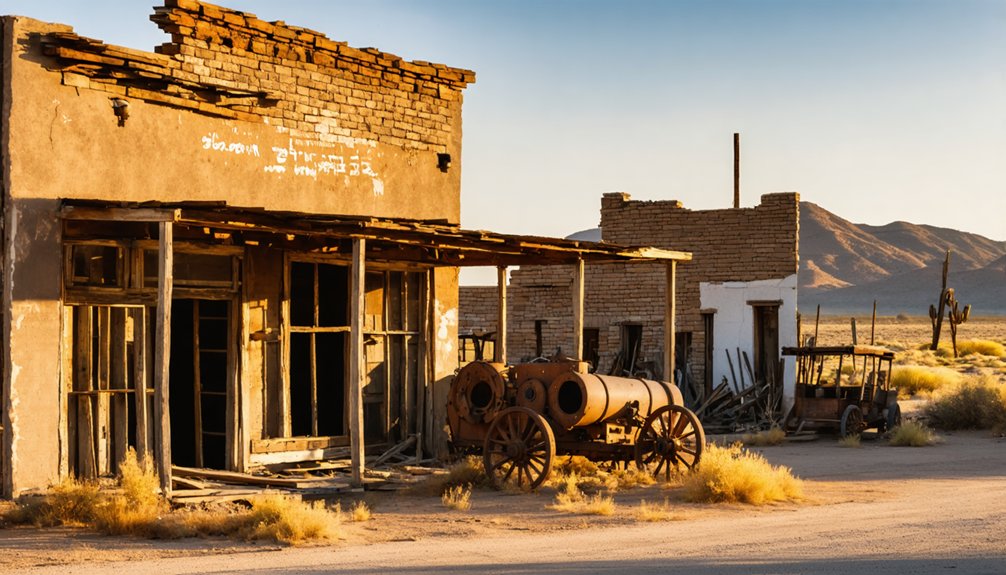
When a Texas mining town exhausted its ore, lost access to viable transportation routes, or faced a collapse in commodity prices, its population typically scattered within years—sometimes months—leaving behind foundations, cemeteries, and industrial ruins as the primary evidence of settlement.
You’ll recognize a mining ghost town by what it retains: abandoned mining equipment, deteriorating town architecture, and structural remnants that collectively document an economic cycle rather than a sustained community. Texas examples range from fully barren sites to semi-abandoned settlements where a handful of residents remain.
The classification isn’t purely about population absence—it’s about economic irrelevance. Once extraction ceased driving settlement, commerce collapsed, families relocated, and physical decay accelerated, particularly in West Texas desert conditions where heat and wind erode adobe and stone with unrelenting efficiency.
How Texas Mining Booms Built Entire Communities Overnight
When you examine Texas mining booms, you’ll find that ore discoveries triggered population surges so rapid that entire communities materialized within months rather than years.
Mining companies constructed company towns with deliberate efficiency, erecting housing, commercial buildings, churches, and administrative structures to attract and retain a labor force as quickly as extraction operations demanded.
You can see this pattern clearly in towns like Terlingua and Shafter, where populations climbed into the thousands almost overnight, with infrastructure scaling upward in direct proportion to commodity demand.
Rapid Population Growth Patterns
Once a significant mineral strike occurred in Texas, entire communities materialized within months rather than decades. You’d witness populations surging from near-zero to thousands almost overnight, as workers, merchants, and opportunists converged on extraction sites with minimal mining regulations governing their settlement patterns.
Terlingua swelled beyond 2,000 residents during its mercury peak; Shafter approached 4,000 during its silver boom. These weren’t gradual urban developments—they were economic detonations.
Entrepreneurs constructed housing, supply depots, and social institutions simultaneously, prioritizing extraction speed over sustainable planning.
Environmental impacts accumulated rapidly as land was stripped, water sources were compromised, and industrial waste spread unchecked.
This compressed growth model created communities structurally dependent on a single commodity, making their eventual collapse as swift and decisive as their founding.
Company Towns Rise Quickly
Thurber exemplifies how Texas mining booms didn’t just attract workers—they manufactured entire social ecosystems almost instantaneously. Coal companies controlled every structure, service, and street, binding mining labor to corporate authority with remarkable efficiency.
You’d recognize these company towns by their deliberate uniformity:
- Rows of identical worker housing stretching across stripped landscapes
- Company-owned stores where miners spent wages before leaving the premises
- Churches and schools built to project stability and retain workforce loyalty
- Industrial ruins now scarring terrain, marking environmental impact that outlasted the boom
These communities rose because corporations needed dependable labor concentrated near extraction sites. Speed mattered more than permanence.
Once resources thinned or markets shifted, that same corporate efficiency dissolved entire populations, leaving foundations, debris, and environmental damage as the only testimony to what briefly thrived.
Infrastructure Built Overnight
How rapidly could a barren West Texas landscape transform into a functioning settlement? Faster than most historical accounts suggest. Once cinnabar or silver strikes confirmed viable deposits, mining technology dictated the pace of construction. Companies erected housing, processing facilities, and supply structures within weeks, not years.
Population migration accelerated this transformation dramatically. Workers, merchants, and families arrived before permanent roads existed, building communities through necessity rather than planning. Terlingua and Shafter both demonstrate this pattern — thousands of residents occupied formally desolate terrain almost immediately after extraction operations commenced.
You can recognize this infrastructure not by its sophistication but by its urgency. Every adobe wall, every capped mine shaft, and every cemetery marker reflects decisions made under economic pressure, where speed consistently outprioritized durability or long-term civic design.
Terlingua: The Mercury Town That Time Forgot
Tucked into the rugged Chihuahuan Desert of West Texas, Terlingua rose from near obscurity after cinnabar deposits were discovered in the late 19th century, transforming a barren stretch of land into a mercury-producing hub that attracted more than 2,000 residents at its peak. Advanced mining technology drove resource extraction at scale, supplying mercury critical to detonators and precious metal processing.
When postwar prices collapsed, the town emptied fast.
Walking through Terlingua today, you’ll encounter:
Walking through Terlingua today, the desert doesn’t greet you — it confronts you with what was left behind.
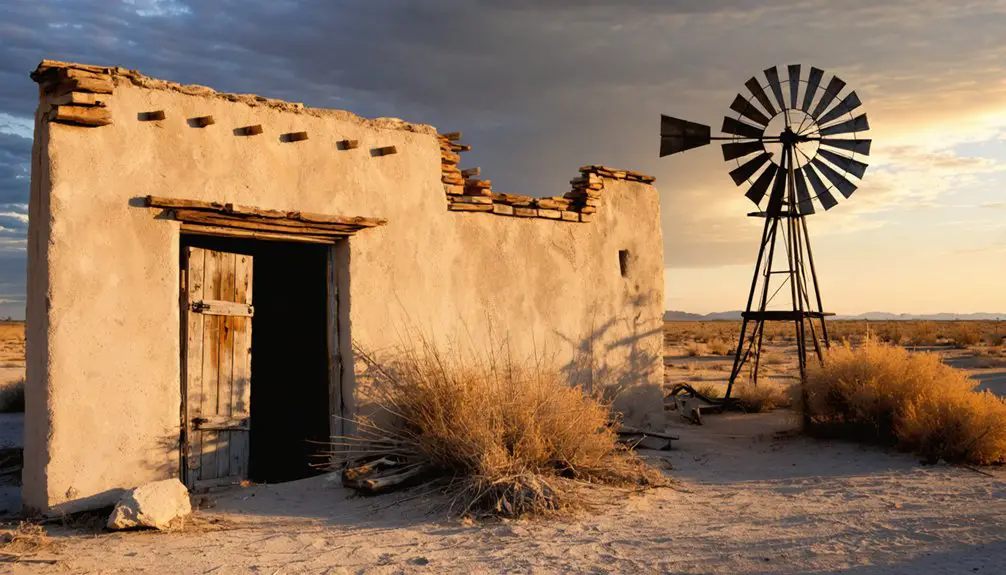
- Crumbling adobe walls bleached by relentless desert sun
- Capped mine shafts scattered across eroded terrain
- A weathered cemetery holding miners lost to toxic exposure
- Stone ruins of company structures reclaimed by wind and dust
That silence you feel isn’t emptiness — it’s documented collapse.
Shafter: Texas’s Silver Capital Turned Ghost Town
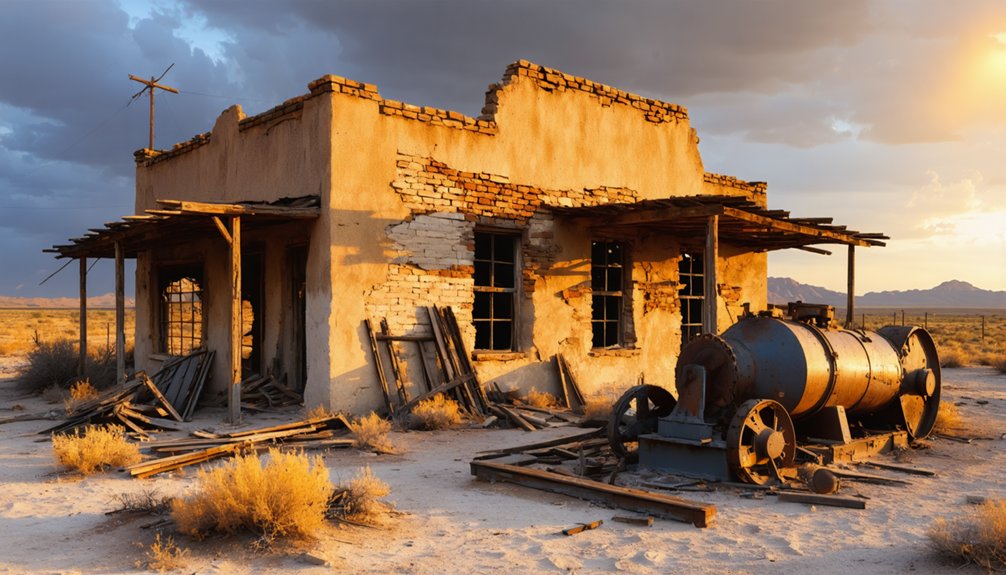
Nestled in the Chinati Mountains of Presidio County, Shafter earned its reputation as the “Silver Capital of Texas” through a rapid boom that drew an estimated 4,000 residents during peak production — a population density remarkable for such isolated terrain.
Established in the 1880s, the town built substantial mining infrastructure to support large-scale silver extraction before the mine’s 1942 closure triggered swift depopulation.
What you’ll find today reflects both loss and resilience. Ghost town preservation efforts have kept portions of Shafter’s structural remnants — ruins, abandoned mine frameworks, and scattered foundations — accessible for historical study.
Only a handful of families remain. The site stands as direct evidence of how commodity-driven settlement collapses when extraction ends, leaving behind a landscape that documents industrial ambition and inevitable decline.
Thurber: The Rise and Fall of a Texas Coal Town
When you examine Thurber’s history, you’ll find a coal town that rose rapidly near the Palo Pinto–Erath county line in the late 19th century, fueled by strong regional demand for coal during an era of industrial expansion.
At its peak, Thurber functioned as a company town, meaning a single corporate entity controlled housing, commerce, and labor—a model that created both economic efficiency and profound social dependency.
You can trace its collapse to the convergence of ore depletion, shifting energy markets, and the obsolescence of the company-town structure itself, forces that stripped the settlement of its population and left behind only brick structures and industrial ruins.
Thurber’s Coal Mining Rise
Though it lacks the mercury mystique of Terlingua or the silver legacy of Shafter, Thurber stands as one of Texas’s most compelling examples of a coal-driven company town that rose and collapsed within a single lifetime. Mining techniques here centered on shaft extraction, fueling rapid industrial expansion near the Palo Pinto–Erath county line.
The town infrastructure emerged almost overnight:
- Brick streets and company-owned housing lined orderly rows
- A church, school, and general store served thousands of workers
- Rail lines connected Thurber’s coal directly to regional markets
- Underground shafts extended beneath the rolling Cross Timbers landscape
You can see how concentrated corporate control shaped every structure and routine. Workers traded independence for wages, and Thurber’s brief dominance depended entirely on coal demand holding firm.
Economic Decline And Abandonment
Thurber’s collapse arrived as swiftly as its construction, driven by two compounding forces that the corporate model couldn’t absorb: the rise of petroleum as a competing fuel source and the mechanization that rendered mass labor workforces obsolete.
Texas Mineral & Chemical Company couldn’t adapt its rigid company-town structure to absorb the economic impact of these simultaneous disruptions. When the railroad switched to oil-burning locomotives, Thurber’s primary customer vanished overnight.
Workers scattered, businesses shuttered, and the infrastructure that once housed thousands became economically indefensible. Community resilience proved impossible within a model where the corporation owned everything — residents held no property stakes that could anchor them through hardship.
You see Thurber’s lesson clearly: concentrated corporate ownership eliminates the individual agency that allows communities to survive industrial shifts.
Boquillas, Indianola, and Other Forgotten Texas Mining Ghost Towns
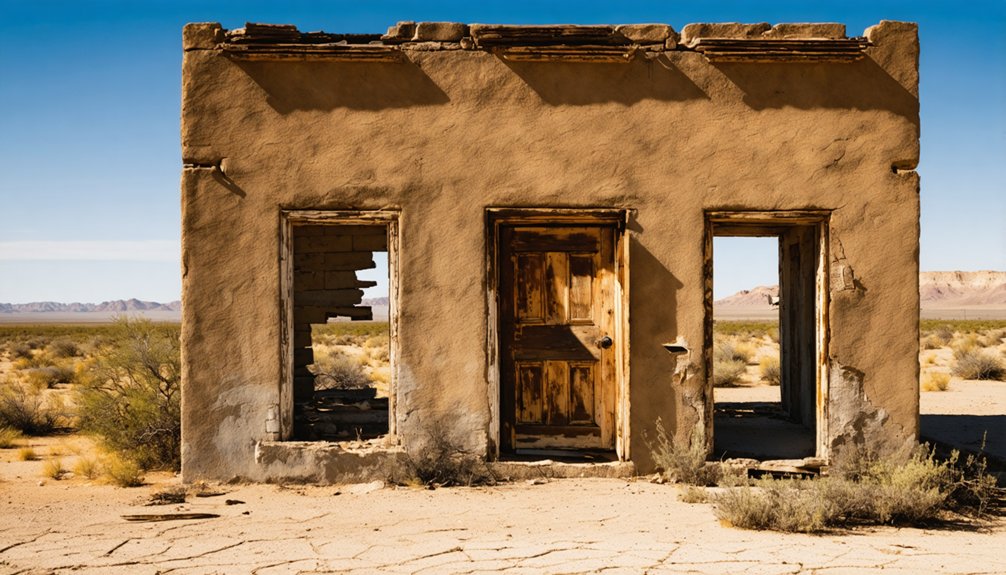
Beyond Terlingua and Shafter, Texas harbors a broader collection of forgotten mining ghost towns that reveal how extraction economies could take root and collapse across dramatically different landscapes. Shifting mining technology and population demographics shaped each community’s rise and fall differently.
Consider what these sites preserve:
- Boquillas: A border settlement where ore transport across the Rio Grande defined daily survival
- Indianola: A coastal entry point where imported mining equipment arrived before storms erased the town entirely
- Presidio: A district where ancient smelting traditions met industrial-era ambition
- Llano County sites: Granite and mineral workings that attracted diverse labor populations before markets contracted
You can read these landscapes as economic autopsies — each ruin marking where capital withdrew, workers scattered, and extraction’s promises dissolved into desert silence.
What Killed These Texas Mining Ghost Towns for Good
When you examine the collapse of Texas mining ghost towns, two forces consistently emerge as the decisive killers: ore depletion and commodity price crashes. Once a mine’s productive seams ran thin, operators couldn’t justify the extraction costs, and closures followed swiftly, pulling the economic foundation out from under entire communities.
You can trace this pattern directly through towns like Terlingua, where postwar mercury price collapses accelerated an already declining output and effectively ended the town’s viability almost overnight.
Ore Depletion And Closures
Though commodity price collapses and transportation failures accelerated decline, ore depletion and mine closures delivered the final, irreversible blow to Texas’s mining towns. When ore veins ran dry, no amount of improved mining techniques or adjusted labor conditions could sustain operations. You’re looking at communities that vanished almost overnight once extraction became economically inviable.
The physical evidence left behind tells that story clearly:
- Capped mine shafts sealed over exhausted cinnabar deposits in Terlingua
- Abandoned silver tunnels collapsing into the Chinati Mountains near Shafter
- Empty company housing stripped of materials by departing workers
- Crumbling adobe walls slowly reclaimed by West Texas desert winds
Each closure triggered an immediate chain reaction — businesses shuttered, families relocated, and infrastructure decayed without anyone left to maintain it.
Price Collapses Triggered Abandonment
Ore depletion sealed mines, but commodity price collapses are what emptied the towns. When mercury prices crashed after World War II, Terlingua’s remaining residents had no economic reason to stay. The market didn’t care about mining regulations or community survival — it simply moved on.
You’ll notice that price-driven abandonment hits faster than gradual ore exhaustion because it eliminates financial return overnight. Workers relocated, businesses shuttered, and infrastructure decayed under desert conditions.
The environmental impacts of sudden abandonment compounded the loss — capped mines, toxic residue, and eroding adobe structures became permanent features of the landscape.
These collapses weren’t failures of individual effort; they were structural consequences of commodity dependence. Understanding that distinction helps you recognize why so many Texas mining towns couldn’t survive market volatility.
Ruins, Cemeteries, and Artifacts Still Standing in Texas Mining Ghost Towns
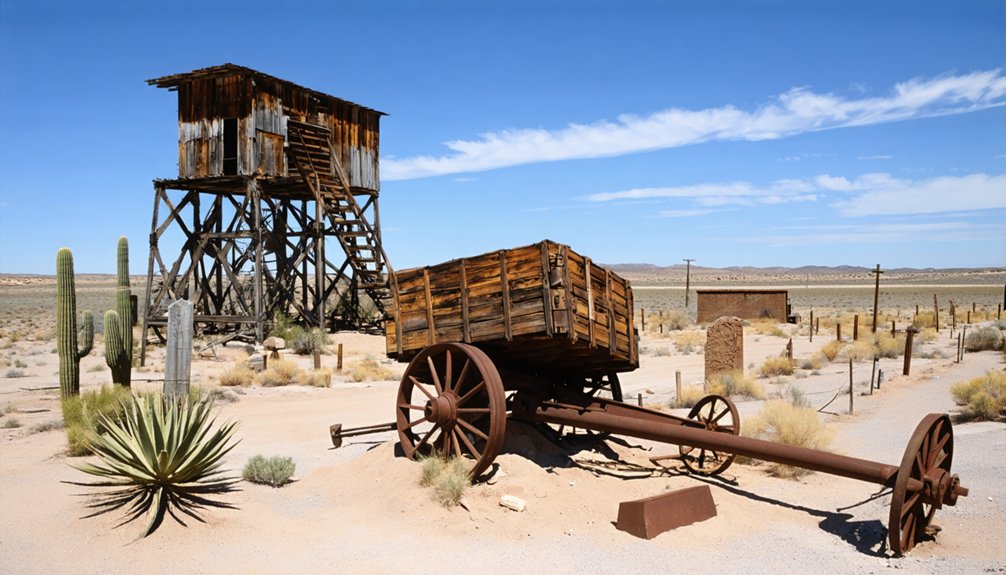
Even as the miners departed and the economies collapsed, the physical remnants of Texas’s mining ghost towns endured, offering researchers and visitors a tangible record of boom-and-bust extraction cycles. You’ll find that cultural preservation efforts have documented surviving structures tied to mining technology, revealing how laborers lived and worked under resource-extraction pressures.
Across sites like Terlingua and Shafter, these remnants persist:
- Adobe and stone ruins slowly eroding under desert heat and wind
- Capped mine shafts marking where mercury and silver extraction once operated
- Cemeteries holding workers claimed by dangerous conditions and mercury exposure
- Abandoned company housing and church foundations outlining former community layouts
These artifacts don’t simply decay—they communicate independent histories of labor, industry, and resilience that no centralized narrative can fully erase.
How to Visit Texas Mining Ghost Towns Today
Visiting Texas mining ghost towns requires logistical preparation, since sites like Terlingua and Shafter sit in remote West Texas terrain where services, paved roads, and cell coverage are limited or absent. You’ll want high-clearance vehicles, sufficient water, and downloaded offline maps before departing.
Terlingua functions partially as a tourist attraction, offering guided tours, a historic district, and nearby Big Bend National Park access.
Shafter remains less developed, demanding greater self-sufficiency but rewarding visitors with largely undisturbed ruins.
Both sites participate in broader cultural preservation efforts, so you should respect posted boundaries, avoid disturbing artifacts, and consult land-ownership records beforehand, since private, state, and federal jurisdictions frequently overlap.
Contacting local historical societies before visiting provides access restrictions, seasonal road conditions, and interpretive resources that considerably improve your experience.
Why Texas Mining Ghost Towns Still Matter
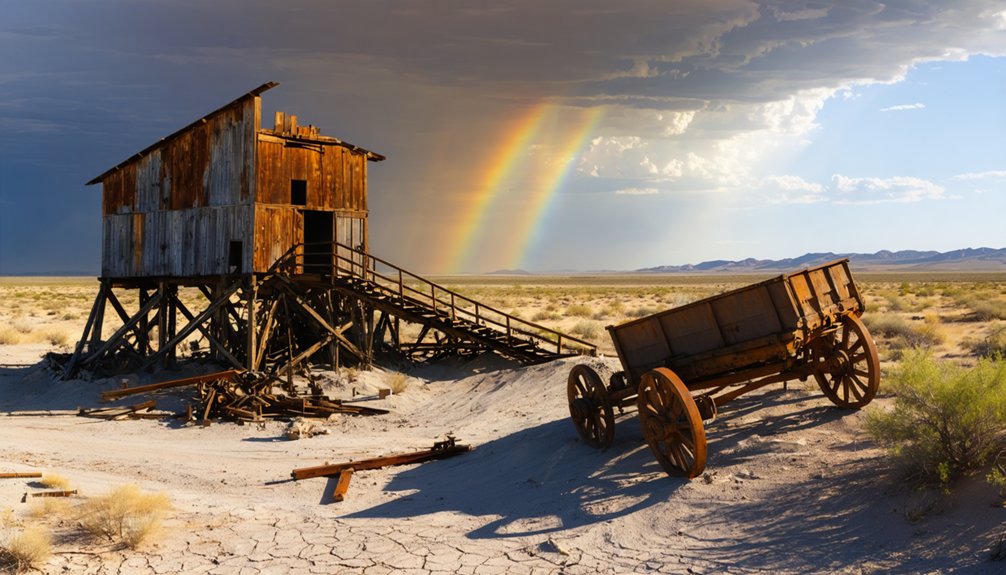
Planning a visit to these sites is worthwhile, but understanding why they matter extends well beyond tourism. Texas mining ghost towns represent documented evidence of independent labor, resource-driven economies, and communities that built lives outside institutional centers. Cultural preservation here isn’t abstract — it’s tangible.
Visiting Texas mining ghost towns matters beyond tourism — they’re tangible proof of independent labor and lives built outside institutional centers.
These sites remind you that:
- Ruined adobe walls hold the history of mercury miners who built Terlingua from raw desert terrain
- Collapsed silver-mine structures in Shafter mark where thousands once exercised economic autonomy
- Abandoned cemeteries record human costs that official histories frequently minimize
- Industrial ruins in Thurber show how corporate control eventually surrendered to broader economic forces
As tourist attractions, these towns generate awareness. As preserved landscapes, they demand accountability to an honest, unfiltered American past.
Frequently Asked Questions
Were Children Allowed to Work in Texas Mining Ghost Town Operations?
Yes, you’d find children working in these operations before child labor laws and mining safety regulations restricted the practice, as families depended on every available worker to survive the harsh economic demands of extraction communities.
What Languages Were Commonly Spoken in Texas Mining Ghost Town Communities?
You’d hear a real melting pot of tongues — Spanish, English, and indigenous languages dominated. Language diversity reflected Cultural influences from Mexican workers, Anglo miners, and Native communities shaping these vibrant, freedom-seeking Texas mining ghost town settlements.
Did Any Texas Mining Ghost Towns Have Their Own Currencies or Payment Systems?
You’ll find that Thurber and similar settlements used company scrip, a hallmark of historical currency systems that controlled mining town economies, restricting your spending to company stores and effectively limiting workers’ financial freedom.
How Did Miners in Texas Ghost Towns Receive Medical Care During Emergencies?
You’d have relied on company doctors and rudimentary first aid in historical medical practices, as emergency response systems barely existed—mine operators often provided basic care, leaving you vulnerable to fatal delays in isolated West Texas camps.
Are Any Texas Mining Ghost Towns Currently Privately Owned or Restricted?
Yes, you’ll find that private ownership controls several Texas mining ghost towns, where restricted access limits your exploration. Shafter, for instance, remains privately held, meaning you can’t freely roam its silver-mining ruins without permission.
References
- https://authentictexas.com/texas-ghost-towns/
- https://en.wikipedia.org/wiki/List_of_ghost_towns_in_Texas
- https://www.facebook.com/TexasHistoricalCommission/posts/the-tiny-west-texas-ghost-town-of-terlingua-began-at-the-turn-of-the-20th-centur/1142971624590454/
- https://www.ghostsandgetaways.com/blog-1/27-fascinating-ghost-towns-in-texas
- https://www.youtube.com/watch?v=phjUE19A8HM
- https://www.youtube.com/watch?v=qpLoI0H_4Iw
- https://medium.com/picturethis/the-ghost-towns-of-big-bend-7b2653f0c5d8
- https://www.youtube.com/watch?v=n82okde31YY
- https://en.wikipedia.org/wiki/Terlingua
- https://en.wikipedia.org/wiki/Shafter