Vermont’s abandoned mining settlements—remnants of copper booms, slate rushes, and iron extraction dating back to the 1850s—offer you a direct encounter with the state’s forgotten industrial past. You’ll find cellar holes at West Castleton, toxic ruins at Copperfield, and asbestos contamination at Belvidere Mountain. These sites reflect geology, technological ambition, and brutal market cycles that built towns overnight and erased them just as swiftly. There’s far more to uncover about what remains—and what still poses active hazards.
Key Takeaways
- West Castleton thrived as a slate quarrying hub in the 1850s, now preserving cellar holes and quarry walls along Bomoseen State Park’s Slate History Trail.
- Copperfield once housed 1,800 residents during Vermont’s copper boom; today only toxic ruins remain under EPA environmental oversight.
- Vermont’s mining towns collapsed rapidly due to market fluctuations, falling ore prices, and depleted deposits, leaving communities with little institutional support.
- Belvidere Mountain Asbestos Mine is a designated Superfund site, presenting ongoing asbestos contamination hazards beyond its historical significance.
- Before visiting, consult USGS topographic maps, Vermont Historical Society archives, and EPA records to verify site access, ownership, and safety conditions.
Why Vermont Became a Mining Hotspot
Vermont’s geology made industrial-scale extraction almost inevitable. Beneath its ridgelines and valleys lay copper, iron, slate, asbestos, and trace gold — resources that drew capital and labor throughout the 19th century.
Vermont’s geology practically invited extraction — copper, iron, slate, and gold pulling capital and labor into its ridgelines for generations.
As mining technology advanced, operators could reach deeper ore deposits and process materials at greater volume, amplifying the economic impact on local communities almost overnight. Towns formed around extraction sites, company housing went up, and commerce followed.
You can trace this pattern across Plymouth, Vershire, and Castleton — each settlement built not around civic planning but around resource access. That dependency defined everything.
When ore prices fell or deposits thinned, the economic impact reversed just as sharply. Mining technology couldn’t solve market collapse. What it built quickly, economic pressure dismantled completely, leaving only stone and silence behind.
Vermont’s Mining Ghost Towns Worth Knowing About
If you’re tracing Vermont’s mining past through its abandoned landscapes, three sites stand out for their historical depth and physical remains: West Castleton, Copperfield, and Tyson Furnace.
West Castleton rose in the 1850s around the slate industry, eventually supporting 43 houses, two sawmills, and multiple quarries before economic collapse hollowed it out.
You’ll find similarly sharp boom-bust trajectories at Copperfield, where the Ely Copper Mine drove the population to roughly 1,800 before market failure and bankruptcy ended the settlement.
At Tyson Furnace, founded in 1835 by Isaac Tyson around iron ore deposits in the Black River Valley.
West Castleton Slate Village
Among Vermont’s slate-era settlements, West Castleton stands as one of the more thoroughly documented examples of a company-driven industrial village that rose and collapsed with a single extractive economy. Slate quarrying drove its growth through the 1850s, when the village supported 43 houses, two sawmills, a school, and several active quarries.
Company control over housing and commerce concentrated both labor and economic risk in a single industrial framework. When industrial decline eroded the slate market, that concentration became a liability.
Workers who’d built livelihoods around the quarries had little institutional buffer against collapse. Today, you can access the site through the three-quarter-mile Slate History Trail in Bomoseen State Park, where stone foundations and quarry remnants preserve a legible record of what market dependency ultimately cost this community.
Copperfield Copper Boom Town
Slate wasn’t Vermont’s only extractive economy to build and then abandon a community. Copperfield, tied to the Ely Copper Mine in South Vershire, reached a peak population of roughly 1,800 during the late 1800s copper boom.
Mining technology at the time enabled aggressive extraction, drawing workers and commerce into a settlement that functioned entirely around the mine’s output. When copper markets collapsed and the company went bankrupt, the town collapsed with it.
You’ll find no municipal infrastructure remaining today — only stone walls, cellar holes, and an environmental impact severe enough to draw EPA oversight. Toxic mining ruins continue polluting local streams and wetlands.
Copperfield illustrates precisely how resource extraction creates communities with no independent foundation, leaving behind both human absence and ecological consequence.
Tyson Furnace Iron Settlement
Iron extraction shaped Vermont’s industrial geography just as forcefully as copper or slate, and Tyson Furnace stands as one of its more instructive casualties. Isaac Tyson founded the settlement in 1835 following the discovery of rich iron ore deposits in the Black River Valley.
The operation demanded substantial town infrastructure — worker housing, supply routes, and functional mining equipment to sustain continuous extraction. You’ll find that when the iron market weakened, that dependency became fatal.
Unlike communities with diversified economies, Tyson Furnace existed solely to serve the mine. Once production ceased, residents departed and the settlement dissolved. Today, almost nothing of the original town remains visible.
Tyson Furnace illustrates precisely how resource-dependent settlements surrendered their autonomy to industrial cycles they couldn’t outlast or redirect.
The Boom-Bust Cycle That Emptied These Towns
What emptied these Vermont towns wasn’t simple neglect—it was the violent rhythm of extraction economies, where rapid industrial growth collapsed just as quickly as it had risen. When copper prices fell, Copperfield’s 1,800 residents had nowhere to turn.
The violent rhythm of extraction economies built these towns overnight—and erased them just as fast.
When slate demand weakened, West Castleton’s company-controlled housing and commerce left workers completely exposed. You’ll notice a consistent pattern: industrial capital built these communities, then abandoned them entirely when profits disappeared.
The economic decline wasn’t the only consequence you should understand. Environmental impact persisted long after the workers left. Copperfield’s toxic ruins remain EPA-monitored.
Belvidere Mountain’s asbestos waste still contaminates local streams. These sites remind you that extraction economies extracted more than ore—they extracted stability, safety, and ecological integrity from the landscape itself.
What Physically Remains at Vermont’s Abandoned Mine Sites
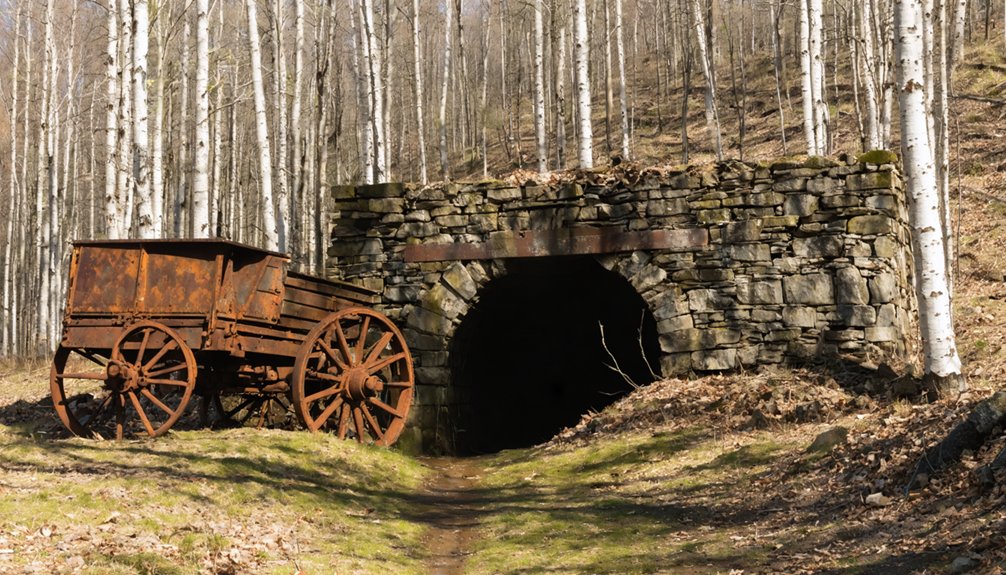
Beyond the economic collapse and its environmental aftermath, you’re left with a physical record—partial, scattered, and often hidden beneath decades of forest regrowth.
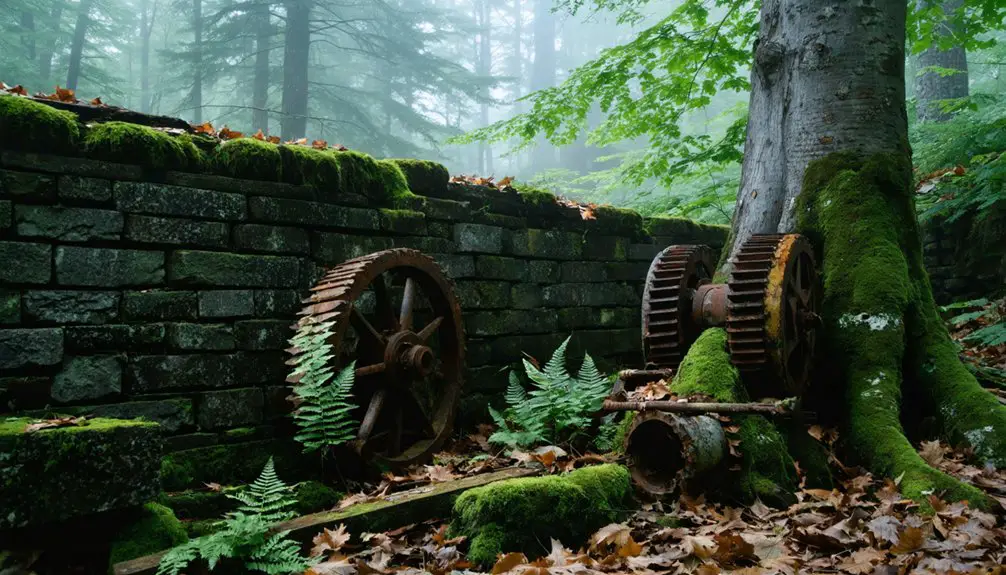
At West Castleton, you’ll find structural remnants along the Slate History Trail: cellar holes, quarry walls, and foundation pits marking where 43 houses once stood.
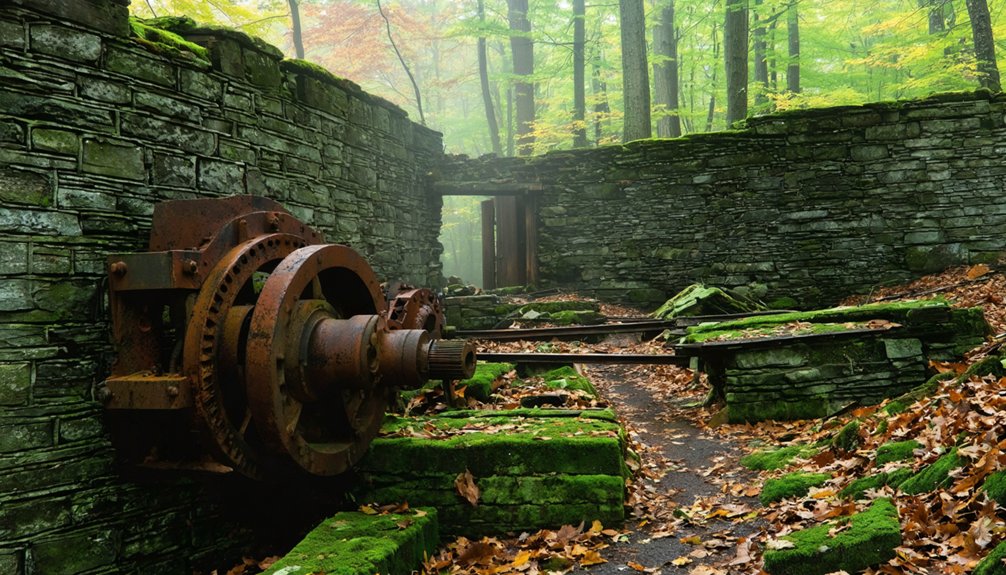
Vershire holds stone walls tied to Copperfield’s copper boom.
Tyson Furnace leaves almost nothing visible.
What survives across these sites reflects mineral preservation only where stone resisted weathering and root intrusion.
Overgrown roads, abandoned quarry faces, and railroad-related infrastructure offer the clearest navigational evidence.
Many locations demand hiking through remote terrain, and some require landowner permission.
You’re reading a fragmented archive—one that rewards careful attention and independent inquiry over passive observation.
Toxic Legacies Left Behind by Vermont’s Mining Ghost Towns
The physical remnants at these sites carry a second record—one measured not in stone walls but in contamination. At Copperfield, EPA monitoring continues because copper extraction left behind toxic legacy deposits that leach into surrounding watersheds.
You’ll find similar conditions at the Belvidere Mountain Asbestos Mine, classified as a Superfund site where asbestos fibers and industrial waste created severe environmental pollution affecting local streams and wetlands. These aren’t passive historical curiosities—they’re active chemical threats requiring regulatory oversight.
Understanding this reality matters if you value the freedom to responsibly access and interpret these landscapes. The boom-bust cycle didn’t simply erase communities; it embedded long-term ecological damage into Vermont’s terrain, binding resource extraction’s consequences directly to the land long after the last worker left.
Which Vermont Mining Ghost Towns Can You Visit?
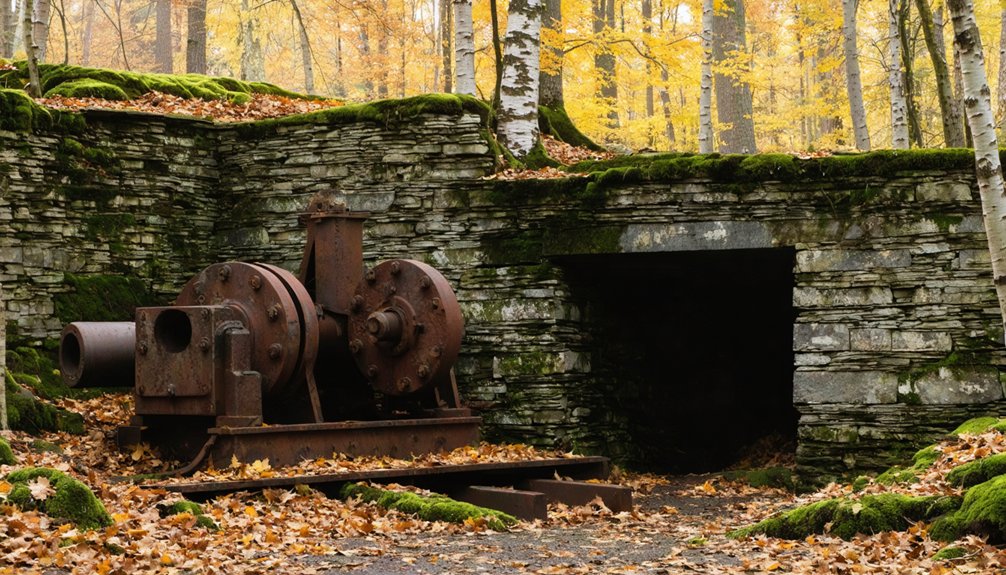
Despite those contamination risks, several of Vermont’s mining ghost towns remain accessible—and some are worth planning a trip around. West Castleton offers the clearest entry point: a 3/4-mile Slate History Trail inside Bomoseen State Park leads you directly to foundation ruins, cellar holes, and quarry remnants from its 1850s industrial peak.
Historical preservation efforts here have made visitor accessibility straightforward and self-guided.
Vershire’s stone walls and cellar holes from the Ely Copper Mine era remain visible on the landscape, though you’ll want to verify land access before exploring.
Ricker Basin draws hikers through forested terrain where abandoned road traces mark former settlement patterns.
Not every site is open—some require landowner permission—so research access conditions before you go.
How to Research Vermont’s Mining Ghost Towns Before You Visit
Before heading into the field, you’ll want to build a documentary foundation that distinguishes verified historical sites from folklore. Start with historical maps—USGS topographic sheets from the late 1800s and early 1900s routinely show settlement names, road traces, and industrial features that modern maps omit entirely.
Cross-reference those against local archives held by the Vermont Historical Society, county courthouses, and town clerk offices, where deed records, tax inventories, and census schedules confirm occupancy dates and population figures. The Vermont Division for Historic Preservation maintains survey files on many abandoned sites.
EPA records are essential for toxic locations like the Belvidere Mountain Asbestos Mine and Copperfield. Academic theses on Vermont’s extractive industries often synthesize these scattered primary sources, saving you considerable archival labor before you ever lace your boots.
Frequently Asked Questions
Are There Guided Tours Available at Any Vermont Mining Ghost Town Sites?
Like a map with missing roads, guided tours aren’t widely documented for Vermont’s mining history sites, but you’ll find structured access at West Castleton’s Slate History Trail, where you can independently explore preserved remnants.
How Many People Lived in Vermont’s Mining Towns at Their Peak Populations?
Peak populations varied markedly across sites. You’ll find Copperfield’s demographic changes reached roughly 1,800 residents during copper’s boom, while Belvidere Mountain’s population history peaked around 300 workers — reflecting each town’s resource-driven rise and fall.
Were Children Allowed to Work in Vermont’s Historic Slate and Copper Mines?
Sadly, yes — it’s a bitter pill to swallow, but child labor was commonplace in Vermont’s slate and copper mines before mining regulations emerged to protect young workers from these hazardous, exploitative industrial conditions you’d find historically documented.
Did Any Vermont Mining Ghost Towns Ever Attempt a Successful Economic Revival?
You won’t find verified successful economic revival strategies among Vermont’s mining ghost towns—historical mining techniques left toxic, depleted landscapes that couldn’t sustain reinvention, and most sites surrendered permanently to forest, Superfund designation, or preserved abandonment.
Are Artifacts Found at Vermont Ghost Town Sites Legally Protected From Removal?
With 177 vanished Vermont sites at stake, yes—legal protections actively shield artifacts from removal. You can’t pocket finds without violating artifact preservation laws, as state and federal statutes criminalize unauthorized collection from protected historical properties.
References
- https://www.youtube.com/watch?v=2fvPo9iQC-w
- https://raregoldnuggets.com/?p=4332
- https://www.youtube.com/watch?v=gxePk0rsBx4
- https://ghosttowntrails.com/vermont
- https://newenglandwithlove.com/ghost-towns-in-vermont/
- https://www.youtube.com/watch?v=Yy85eB_ZBh8
- https://www.vermonter.com/abandoned-places-in-vermont/
- http://vermontdeadline.blogspot.com/2013/12/
- https://urbexunderground.com/ghost-towns-in-vermont/