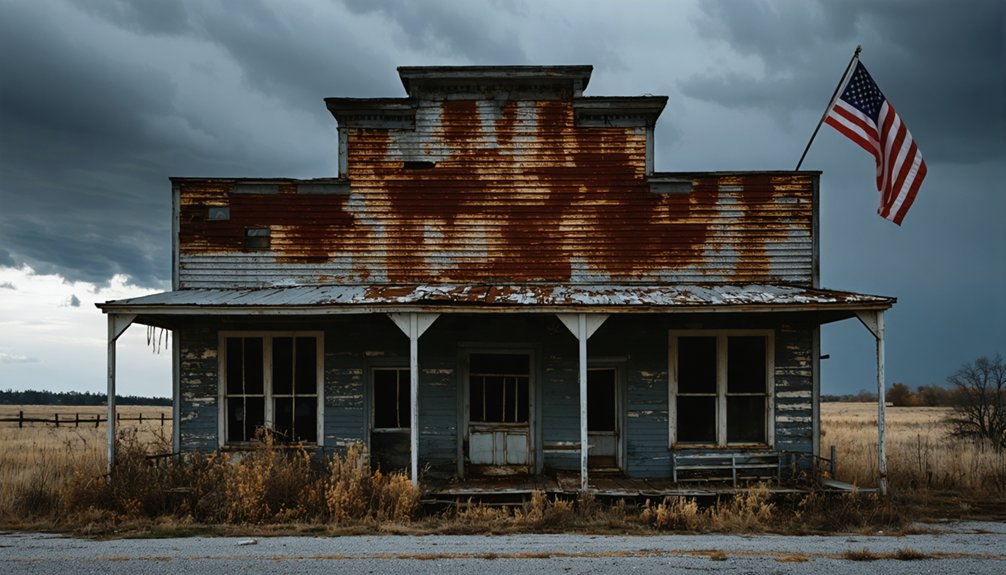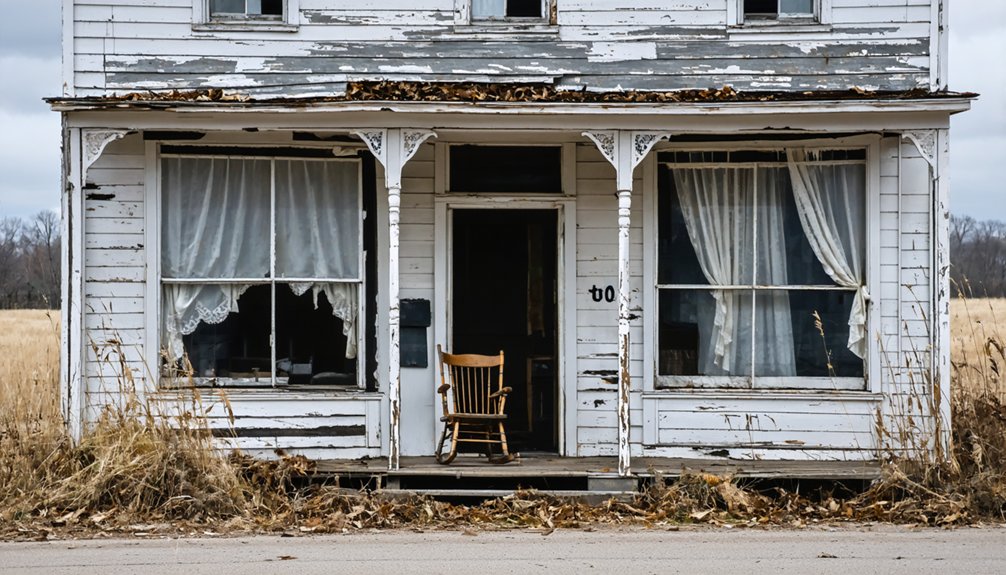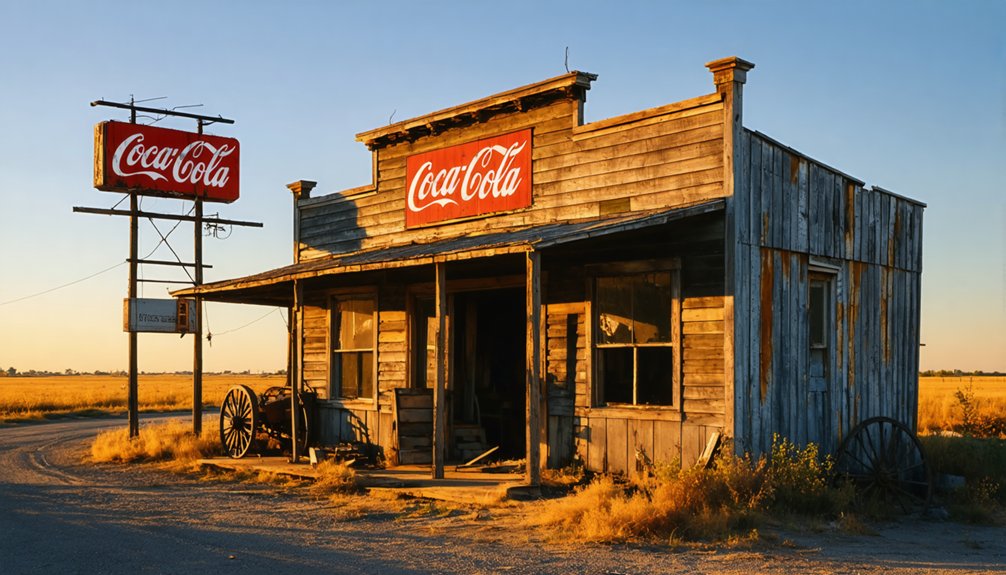
Explore Midwest ghost towns by researching their origins and locations through historical society archives and digital mapping tools. Pack safety essentials like sturdy boots, first aid kits, and navigation equipment. Always check land ownership status and obtain proper permissions before visiting. Document your findings with photographs while leaving artifacts untouched. Respect these silent witnesses to history by practicing ethical exploration. The silent structures of America’s heartland await your respectful discovery.
Key Takeaways
- Research Midwest ghost towns through interactive maps and historical society archives that document abandoned settlements across the region.
- Pack essential safety gear including sturdy boots, first aid kits, and navigation tools when exploring remote abandoned locations.
- Verify land ownership status before visiting, as many Midwest ghost towns may be on private property requiring permission.
- Look for surviving structures like red-brick schoolhouses, log cabins, and stone foundations that reveal the town’s original layout.
- Respect historical integrity by leaving artifacts undisturbed and supporting local preservation efforts in Midwest ghost towns.
The Vanishing Heartland: Most Common Ghost Towns
The American Midwest harbors a surprising number of ghost towns, each silently telling stories of boom-and-bust cycles that once defined the region’s development.
You’ll find these abandoned settlements typically share common ghost town origins—mining operations that dried up, railroad stops rendered obsolete, or farming communities devastated by the Dust Bowl.
As you explore places like Ardmore, South Dakota, you’ll witness the skeletal remains of a once-thriving railroad stop, abandoned after locomotives no longer needed water stations.
Economic decline transformed vibrant communities like Bonnell and Mt. Lawn, Indiana into “Level 3” ghost towns where homes still stand but businesses have disappeared.
Throughout Kansas, Oklahoma, and the Dakotas, countless rural communities succumbed to agricultural collapse during the 1930s, leaving behind empty buildings as silent monuments to vanished ways of life.
Visitors to Missouri may encounter the chilling remnants of penitentiary towns, where the Missouri State Penitentiary once stood as the bloodiest 47 acres in America before closing in 2004.
Atchison, Kansas, which claims to be the most haunted city in the state, features abandoned structures alongside actively haunted locations like the Sallie House and McInteer Villa.
What Remains: Identifying Ghost Town Features
When you explore abandoned settlements, you’ll discover surviving architectural elements that range from red-brick schoolhouses to deteriorating log cabins and Beaux-Arts railway stations.
You can trace property boundaries by locating fence posts and map the settlement’s original layout by identifying stone foundations that reveal building footprints beneath years of soil accumulation.
These physical remains offer significant evidence about construction techniques, community priorities, and adaptation strategies to local environments, particularly visible in water management systems and agricultural infrastructure designed for harsh desert conditions. The Grafton Ghost Town near Zion National Park showcases well-preserved adobe and wood homes that demonstrate how pioneers adapted building materials to their environment. In Midwest ghost towns specifically, remnants of hand-hewn logs and stone foundations reveal the resourcefulness of early settlers who utilized locally available materials.
Surviving Structures
Crumbling brick facades and weathered wooden storefronts stand as silent witnesses to once-thriving communities, offering ghost town explorers tangible connections to the past.
Religious structures often remain most intact, with churches from the 1800s preserving architectural styles through decades of abandonment. You’ll find log cabins and blacksmith shops revealing the historical significance of frontier commerce and pioneer craftsmanship. Michigan’s Upper Peninsula ghost towns showcase the dramatic impact of copper mining decline on community infrastructure. In some locations like Blakeley, you might only find ghost structures, rough frames that help visitors visualize the original buildings’ size and shape.
- Look for 19th-century homes arranged in grid patterns, indicating planned communities from mining or milling boom periods.
- Identify preserved commercial establishments like general stores with original fixtures, cash registers, and merchandise displays.
- Examine basement tunnels connecting neighboring structures, revealing hidden Prohibition-era speakeasy networks.
Post offices and town halls often remain as solitary civic markers, their weathered frames standing defiant against nature’s reclamation.
Mapping Forgotten Foundations
Beneath overgrown vegetation and years of accumulated soil, ghost town foundations reveal critical clues about settlement patterns and community functions that once thrived in now-abandoned locations.
You’ll find forgotten landmarks like stone foundations extending into waterways, remnants of copper mining operations that dominated regional economies over a century ago.
Look for rectangular outlines indicating homes, larger footprints of factories, and the distinctive foundations of churches built between 1850-1870.
These ghostly remnants tell stories through their placement and construction methods. Brick structures like Fort Jefferson contrast with deteriorating log cabins, showcasing evolving building techniques.
Cemetery markers, though weathered and often smothered by myrtle and thimbleberry, provide precise documentation of former residents.
German lettering on tombstones reveals immigrant settlement patterns that shaped these once-bustling communities you’re now exploring.
Some ghost towns like Bodie, California maintain approximately 110 structures that offer remarkable architectural insights into 19th-century mining settlements.
The ghostly legends of Colorado mining towns provide a glimpse into the hardships faced by miners and their families. Tales of lost treasures and mysterious disappearances continue to captivate those who explore these once-thriving communities. Each abandoned building whispers stories of ambition, despair, and a relentless pursuit of fortune.
When visiting sites like Forestville, explore the preserved Meighen General Store from the 1890s that offers a glimpse into the daily life of past residents.
Finding Hidden History: Maps and Resources
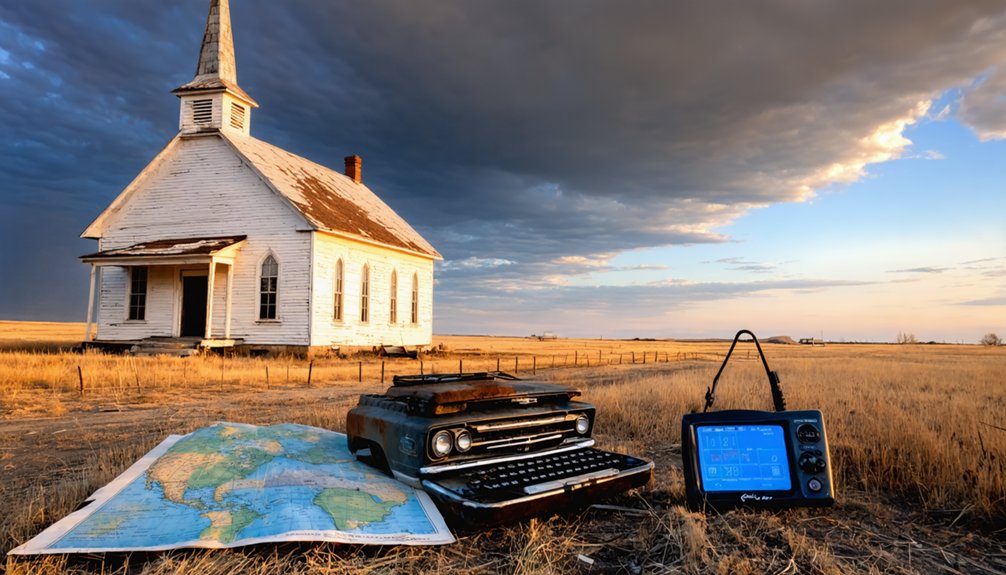
You’ll discover a wealth of ghost town locations through digital map resources like the Ghost Towns Map and state-specific databases at Ghosttowns.com, which provide searchable interfaces with historical details and photographs.
Historical society archives, such as Wisconsin’s collection of pre-1969 maps by Victor Bates, offer irreplaceable primary sources documenting abandoned settlements, mining operations, and transportation routes. The Wisconsin Historical Society’s map highlights ghost towns numbered with a corresponding index, making it easier to locate these historical sites. Michigan’s Upper Peninsula contains numerous ghost towns resulting from the boom-and-bust cycles of mining and logging industries.
Crowdsourced location databases continue to expand our knowledge of forgotten places, with platforms allowing enthusiasts to contribute site coordinates, historical information, and contemporary photographs of these vanishing historical landmarks.
Digital Map Resources
Numerous digital map resources have transformed the process of ghost town exploration, offering unprecedented access to hidden historical sites across the country.
Modern mapping platforms consolidate data from Wikipedia, historical archives, and user contributions, allowing you to pinpoint over 125 documented ghost towns with precision. These interactive tools reveal Texas as the epicenter with 550 abandoned settlements, while states like Oklahoma and Michigan offer hundreds more waiting to be discovered.
- Search for ghost towns by entering your location to find the nearest historical ruins
- Use Heat View visualizations to identify regions with high concentrations of abandoned settlements
- Access embedded Wikipedia links for detailed historical context about each location’s rise and fall
Digital maps provide the freedom to explore forgotten places on your own terms.
Historical Society Archives
Historical Society Archives serve as the backbone of ghost town exploration, offering meticulous documentation that digital resources often lack. Wisconsin Historical Society’s Map Collection provides invaluable indices of vanished mining and logging towns, with archival materials measuring 46 x 43 cm that detail ghost communities across Northern regions.
When conducting archival research, you’ll discover Keweenaw County’s Central Mine documentation, including records of the 52 million pounds of copper produced before its 1898 closure.
Minnesota’s Forestville collection reveals how the Meighen family’s foreclosure records document the town’s shift after being bypassed by railroads in 1880.
For thorough historical preservation, visit these archives in person—Wisconsin Historical Society’s 4th floor in Madison houses physical records that classification systems use to categorize ghost towns from Level 1 to Level 4.
Crowdsourced Location Databases
While Historical Society Archives offer traditional documentation, crowdsourced location databases have revolutionized ghost town exploration through collective knowledge sharing.
Platforms like BatchGeo and EagleEyeExplorer harness user contributions to map thousands of forgotten settlements, complete with coordinates, histories, and photographs that might otherwise remain undocumented.
- Access interactive maps showing over 4,500 U.S. ghost towns with density heatmaps highlighting exploration hotspots
- Contribute your own discoveries and photographs to platforms like Forgotten Lands, enhancing collective knowledge
- Utilize mobile apps like Michigan Tech’s Keweenaw Time Traveler to navigate directly to sites while accessing historical context on-the-go
These crowdsourced platforms overcome official record limitations by incorporating personal histories and real-time verification, though data quality can vary between well-documented and newly-discovered locations.
Before You Explore: Safety and Preparation Tips
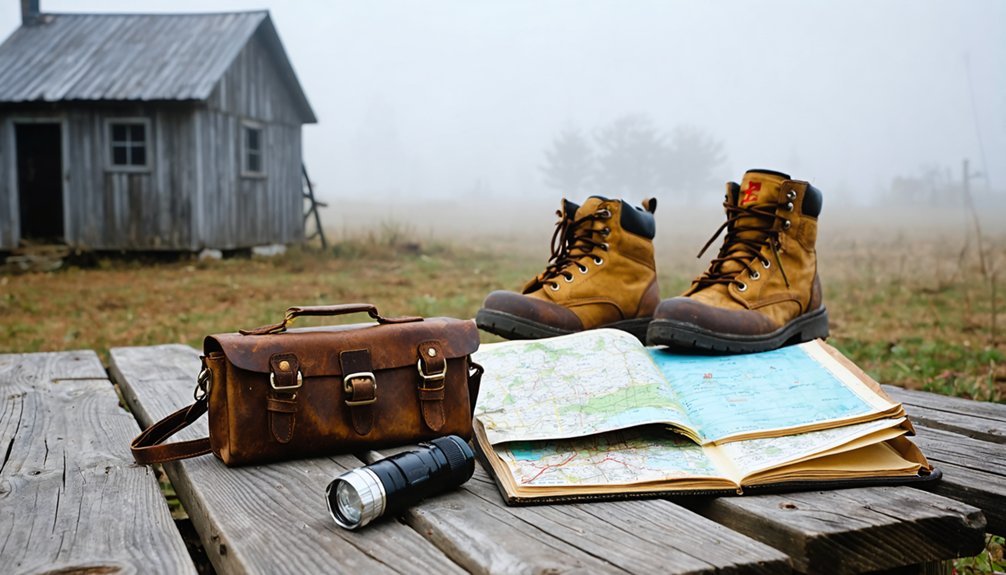
As you plan your journey into the spectral remains of forgotten towns, thorough preparation becomes your first defense against the very real dangers that lurk in these abandoned places.
Research whether your target site sits on public or private land, and check for legal protections that might restrict access.
Your safety gear should include sturdy boots, long pants, gloves, and a dust mask to protect against hazardous materials like asbestos.
Don’t forget a flashlight, first aid kit, and navigation tools for remote locations. Legal considerations extend beyond trespassing—removing artifacts from protected sites can result in significant fines.
Before departing, share your route plan with someone trustworthy, noting your destination and expected return time.
Remember that cell service often disappears in these isolated locations, so prepare alternative communication methods for emergencies.
Preservation vs. Exploration: Ethical Ghost Town Visits
The ethical explorer treads lightly through forgotten doorways, balancing curiosity against preservation in every step. When visiting ghost towns, you’re traversing spaces rich with history that demand respect. Your footprint affects both physical structures and the communities connected to these places.
- Always obtain proper permission before entering sites, respecting private property and regulatory frameworks that protect these historical treasures.
- Leave everything as you found it—artifact removal disrupts the historical record and accelerates site degradation.
- Consider community impact by supporting local preservation efforts and respecting the cultural significance these places hold for nearby residents.
Ethical considerations extend beyond legal compliance—they encompass your responsibility to preserve these fragile windows into the past for future generations while honoring the stories they contain.
Beyond Ruins: Photographing and Documenting Your Discoveries

Capturing the ephemeral nature of abandoned settlements requires specialized equipment and techniques that extend far beyond casual snapshot photography.
Arm yourself with a sturdy tripod, wide-angle lens (20-24mm), and reliable flashlight—these aren’t optional for serious ghost town documentation.
Switch your camera to manual mode for complete control in challenging light conditions. Set aperture between f/4-f/8, extend shutter speeds to 15-30 seconds, and adjust ISO to 800-1600 depending on darkness.
These photography techniques form your technical foundation.
For creative lighting, try light painting with flashlights or LED panels. EL-wire swept near ground level creates ethereal fog effects, while colored gels establish mood.
Capture a base exposure first, then blend multiple light-painted frames in post-processing to control intensity and coverage throughout your composition.
Frequently Asked Questions
Are Ghost Towns Legally Accessible During Hunting Seasons?
Yes, you can legally access ghost towns during hunting seasons if they’re on public lands, but you’ll need to follow hunting regulations and prioritize ghost town safety throughout your visit.
Can Metal Detectors Be Used at Abandoned Midwest Town Sites?
You’ll need permits for metal detecting at most abandoned Midwest town sites. Check state metal detector regulations and practice proper abandoned site etiquette by obtaining permission and avoiding protected archaeological areas.
How Reliable Are Ghost Town GPS Coordinates From Social Media?
Like footprints in shifting sand, social media GPS coordinates for ghost towns often lead you astray. They’re notoriously unreliable, with significant GPS discrepancies and limited social media accuracy, typically off by several kilometers.
Do Any Midwest Ghost Towns Offer Guided Historical Tours?
Yes, you’ll find guided tours at Fayette Historic State Park in Michigan, Keweenaw ghost towns, and cities like Omaha and Kansas City, all highlighting their historical significance through expert narration.
Which Seasons Offer the Best Ghost Town Photography Lighting?
Fall offers the best lighting with warm golden hour tones highlighting textures and fall foliage adding vibrant contrast. Spring provides soft diffused light, while winter creates dramatic shadows with snow reflection.
References
- https://devblog.batchgeo.com/ghost-towns/
- https://wgrd.com/michigan-ghost-town-map/
- https://www.wisconsinhistory.org/Records/Image/IM116137
- https://www.frrandp.com/p/ghost-towns-map.html
- https://www.geotab.com/ghost-towns/
- https://en.wikipedia.org/wiki/Lists_of_ghost_towns_in_the_United_States
- https://www.youtube.com/watch?v=lfj6aeZEVJY
- https://www.atlasobscura.com/lists/abandoned-places-midwest
- https://gandernewsroom.com/2023/06/28/7-michigan-ghost-towns-you-might-not-find-on-your-map-2/
- https://www.travelawaits.com/2702819/most-haunted-places-midwest/