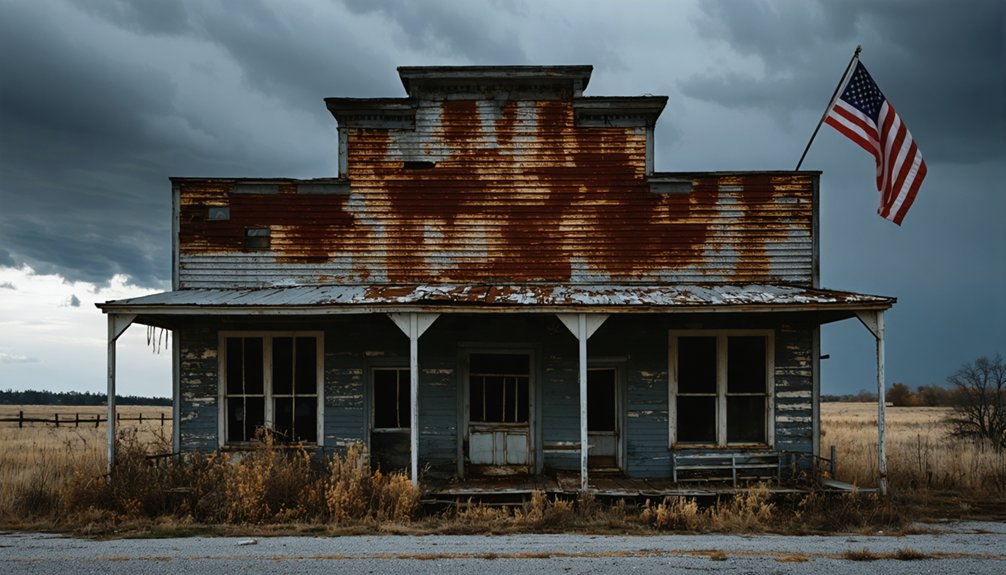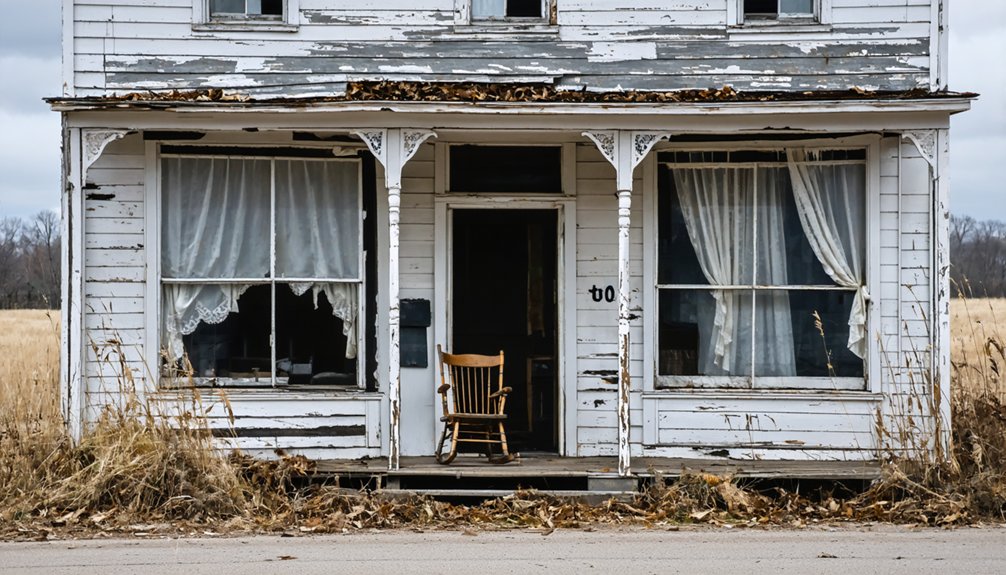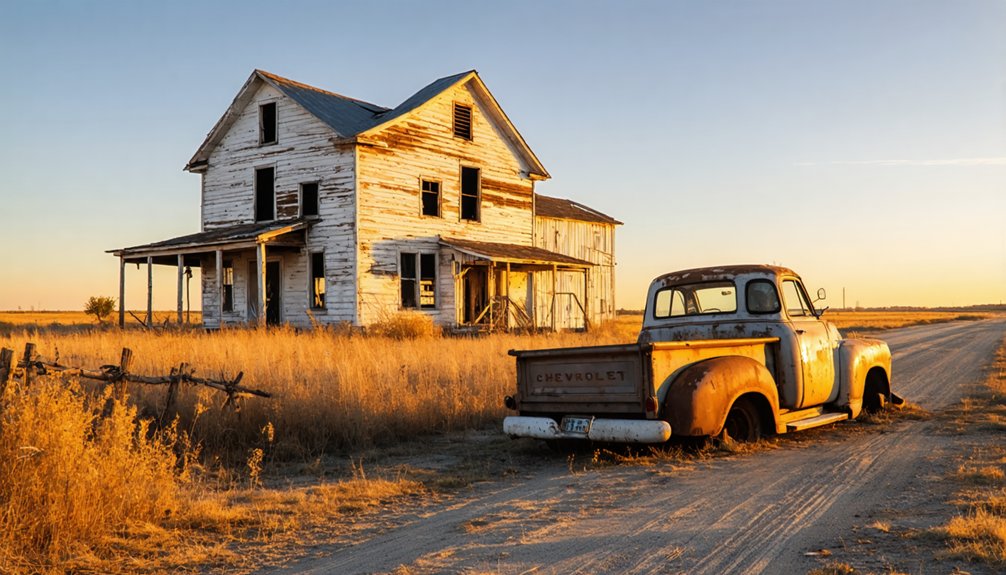
When exploring the Midwest’s ghost towns, you’ll encounter abandoned mining communities that tell stories of industrial booms, immigrant contributions, and economic collapse. These sites, from Michigan’s copper kingdom to coal camps along forgotten railroads, require proper gear and seasonal awareness for safe navigation. Indigenous mining history adds depth to these atmospheric ruins, where preserved architecture stands as testimony to bygone prosperity. The silent streets whisper tales that await your discovery beyond the decaying façades.
Key Takeaways
- Essential exploration gear includes a backpack, multi-functional tools, hands-free illumination, protective equipment, and navigation tools.
- Late fall provides ideal exploration conditions with reduced vegetation revealing architectural details and minimal insect presence.
- Michigan’s Upper Peninsula contains nearly 100 ghost towns from the copper boom between the 1840s and 1920s.
- Seasonal hazards include spring’s destabilized foundations, summer’s structural deterioration, autumn’s concealed ground hazards, and winter’s obscured trails.
- Photography opportunities are enhanced by visiting during autumn’s peak foliage or early morning mist for atmospheric shots.
The Rise and Fall of Midwest Mining Communities

As the industrial revolution swept across America in the mid-nineteenth century, the Midwest’s rich mineral deposits became a focal point for rapid development and settlement.
You’ll find the remnants of these communities scattered across the region, where lead, copper, iron, and coal once drew waves of European immigrants—Cornish, Finnish, and Slavic workers who brought specialized mining expertise to the frontier.
These boomtowns emerged almost overnight as federal policies opened indigenous lands to extraction. In Sheridan County, the arrival of the Burlington Railroad in 1892 transformed the area into a hub of coal camp development along the Tongue River.
Federal policies transformed indigenous territories into industrial frontiers, birthing instant communities where mineral wealth dictated settlement patterns.
When you explore these abandoned landscapes today, you’re witnessing the physical testimony of community resilience that once thrived despite dangerous conditions and economic volatility. Following the crash of 1888, many smaller mining companies were completely eliminated, leaving once-thriving towns to deteriorate.
Mining legacies remain visible in architectural contrasts—ornate company buildings alongside modest worker housing—silent monuments to the boom-and-bust cycles that eventually left these once-vibrant communities empty and forgotten.
Upper Peninsula’s Abandoned Copper Kingdom
You’ll find the Keweenaw Peninsula dotted with nearly 100 ghost towns that once thrived during the copper boom between the 1840s and 1920s, when mining operations extracted over 90 million pounds of pure copper from settlements like Cliff and Central Mines.
The rapid collapse of these communities mirrors the boom-bust economics of resource extraction, with populations plummeting from over a thousand residents to mere dozens within decades as mining operations ceased. The Calumet and Hecla mining company’s operations on the Calumet conglomerate became one of the region’s most productive sites after opening in 1865.
Today, restored buildings at sites like Central Mine and the preserved infrastructure at Quincy Smelter offer glimpses into the peninsula’s copper kingdom, where hand-hewn log cabins and abandoned mining shafts stand as monuments to Michigan’s industrial heritage. The copper from this region was uniquely valuable as it was pure native copper, free of adulterants and ready for immediate use without extensive processing.
Keweenaw’s Forgotten Mining Heritage
Deep beneath the rugged terrain of Michigan’s Upper Peninsula lies an extraordinary archaeological treasure that predates European settlement by millennia.
You’re walking through the living remnants of America’s first copper mining industry—a sophisticated indigenous heritage spanning 8,000 years. When you explore these ancient sites, you’ll witness where native peoples extracted 500,000 tons of exceptionally pure copper without smelting technology.
Walking these forgotten paths, you’ll discover:
- Ancient pit mines spanning 5-30 feet deep across Keweenaw and Isle Royale
- Tools crafted from hammerstones that broke copper from bedrock
- Evidence of extensive trade networks stretching across North America
- Archaeological sites where 19th-century European miners followed indigenous footprints
These ghost towns tell dual stories of indigenous ingenuity and later industrial ambition—both ultimately surrendered to wilderness. Copper was formed into distinctive oxhide ingots weighing 20-30 kilograms to facilitate easier transportation across these historical routes. The region’s unique geological formation, known as the Mid-continent rift, created rare deposits of native copper that could be used without complex processing.
Boom-Bust Copper Economics
While indigenous peoples had harvested copper for millennia, the true economic transformation of Michigan’s Upper Peninsula began in 1845 when industrial-scale mining operations released unprecedented wealth from the region’s copper veins.
For nearly four decades, this remote wilderness dominated America’s copper production, generating fortunes equivalent to hundreds of millions in today’s currency.
You’ll find the region’s history marked by dramatic copper fluctuations—booming during wartime demand and collapsing during the Great Depression. The mining legacies remain visible in abandoned company towns that once thrived on metal prices. Today, companies like Talon Metals Corp. are exploring the area again for resources critical to the energy transition.
After World War II, operations gradually declined until White Pine, the last major mine, closed in 1995. Despite extracting billions of pounds of copper, these ghost towns stand as monuments to an economy that rose and fell with global metal markets.
Preserved Historical Buildings
Monuments to a vanished era, the preserved historical buildings of Michigan’s Upper Peninsula stand as silent witnesses to the copper kingdom‘s former glory.
You’ll find architectural significance in every corner—from Calumet Theatre’s ornate interiors to Quincy Mine’s imposing shaft house. These structures once served a thriving community with a population of 40,000 during the mining boom. Restoration efforts by local historical societies have saved these structures from oblivion, allowing you to step through portals to the past. The region’s first copper boom began in 1843 when thousands of prospectors flocked to the Upper Peninsula seeking fortune.
Four remarkable preserved sites include:
- Laurium Manor, a 45-room representation of mining wealth
- The Central Mine village with its 1868 church
- Calumet’s historic downtown with its copper-influenced structures
- Delaware Mine, with 1,700 feet of original workings
These aren’t merely old buildings; they’re physical manifestations of the boom-bust cycle that shaped the region’s identity and cultural landscape.
Paranormal Hotspots and Haunted Destinations
Scattered across the abandoned landscapes of the Midwest’s ghost towns, paranormal hotspots beckon the brave and curious with their unsettling histories and unexplained phenomena.
Among the famous haunted towns in the Midwest, each location has its own chilling tales of encounters and lingering spirits. Visitors often share spine-tingling experiences that add to the mystique of these abandoned places. As the sun sets, the echoes of the past seem to resonate through the streets, inviting a deeper exploration into their eerie glorification.
From the blood-soaked floors of Villisca Axe Murder House to the notorious “Gateway to Hell” at Stull Cemetery, these locations offer more than mere ghostly encounters—they provide windows into regional tragedy and folklore tales that persist through generations. Visitors to Stull Cemetery risk steep financial penalties if caught trespassing on these hallowed grounds.
The “Bloodiest 40 Acres” of Missouri State Prison draws investigators with its dungeon cells and gas chamber, while Michigan’s Upper Peninsula ghost towns harbor the restless spirits of miners in their crumbling structures.
You’ll find paranormal activity particularly concentrated in former battle sites and abandoned hospitals, where trauma remains imprinted in the very walls.
These destinations challenge your rational mind while connecting you to the complex, often violent histories that shaped the Midwest’s identity.
Essential Ghost Town Exploration Gear and Safety Tips

Preparing for your ghost town expedition requires thoughtful consideration of both standard exploration equipment and specialized tools designed to document potential paranormal encounters.
Midwestern ghost towns present unique seasonal hazards—summer explorations risk exposure to heat and insects, while winter visits demand protection against freezing temperatures and potentially dangerous ice formations.
Your photography kit should include a weatherproof DSLR camera with wide-angle lens capabilities, a sturdy tripod for low-light conditions, and extra memory cards to capture the haunting architectural remains that silently narrate the region’s boom-and-bust narrative.
Essential Exploration Equipment
A well-stocked backpack serves as your lifeline when venturing into the forgotten landscapes of Midwestern ghost towns.
Prioritize multi-functional tools like Swiss Army knives and compact pry bars that facilitate both exploration tactics and emergency responses. When selecting equipment, consider the dual imperatives of self-reliance and gear maintenance.
Your essential exploration arsenal should include:
- Hands-free illumination (headlamp plus backup flashlights) to navigate deteriorating structures while maintaining awareness of structural hazards
- Protective equipment (respirator, gloves, safety glasses, helmet) to shield against historic contaminants like asbestos and lead paint
- Navigation tools (compass and offline maps) for traversing complex sites where GPS signals falter
- First aid supplies with bandages, antiseptic, and pain relievers to address inevitable minor injuries amid rusting infrastructure
Seasonal Safety Concerns
While ghost towns hold their haunting appeal year-round, each season introduces distinct hazards that demand specialized preparation and awareness.
Spring thaws destabilize foundations and trigger flash floods in low-lying areas, while summer heat accelerates structural deterioration and increases dehydration risk.
Autumn’s fallen leaves conceal treacherous ground hazards, and winter’s snow obscures trails and weakens roofs.
Your safety gear should adapt accordingly—waterproof boots and rain gear for spring explorations, sun protection and extra water during summer, hiking poles for traversing leaf-covered terrain in fall, and insulated clothing with traction devices in winter.
Weather preparedness becomes paramount as seasonal storms can wash out access roads and disrupt communication, potentially leaving you stranded in these remote locations where cell service remains unreliable.
Photography Gear Recommendations
Ghost town photography demands specialized equipment beyond the casual smartphone snapshot. The deteriorating structures and atmospheric conditions of Midwest ghost towns require manual camera settings and deliberate lens choices to capture their haunting essence.
For ideal ghost town documentation, prepare:
- A camera with manual controls and focus capabilities for adapting to varying light conditions in abandoned structures.
- A versatile lens kit including wide-angle (14-35mm) for interiors, standard zoom (24-70mm) for general use, and telephoto (70-200mm) for isolating distant details.
- A sturdy tripod and remote shutter release for stabilizing long exposures up to 30 seconds.
- Protective gear including lens hoods, filters, and cleaning supplies to shield equipment from omnipresent dust and debris.
Remember to pack extra batteries and memory cards—remote locations offer no recharging opportunities when documenting these vanishing American cultural artifacts.
Preserved Historical Sites Worth Visiting

Across the rusting industrial landscapes and abandoned corridors of the Midwest lie remarkably preserved historical sites that offer visitors tangible connections to America’s past.
Michigan’s Quincy Mine and Keweenaw ghost towns showcase a century of copper mining heritage, while Fayette Historic State Park’s iron smelting ruins illuminate 19th-century industrial might.
Ohio’s State Reformatory in Mansfield stands as both architectural marvel and cinematic landmark, its imposing structure carrying the weight of penal history.
Iowa’s unique Squirrel Cage Jail and Edinburgh Manor reveal institutional approaches to confinement and care, their walls echoing with forgotten voices.
Missouri’s Ha Ha Tonka Castle ruins, now reclaimed by nature within a state park, exemplify the region’s commitment to historical preservation.
These sites transcend mere ghost town legends—they’re portals where America’s industrial, institutional, and architectural heritage remains tangible and accessible.
Hidden Gems Off the Beaten Path
Beyond the well-trodden paths of popular tourist destinations lie the true treasures of Midwestern abandonment—forgotten settlements that reveal untold chapters of American expansion.
These hidden treasures demand adventurous spirits willing to traverse less-charted territories.
For the intrepid explorer, these forgotten landscapes offer silent testimony to America’s restless journey through time.
You’ll discover forgotten stories in these remarkable locations:
- Matt’s Farmstead in Missouri, where 160-year-old pioneer stone ruins perch dramatically on a bluff.
- Nelsonia in Lincoln County, a timber-industry settlement established in 1890, now vanished into historical obscurity.
- Ardmore, South Dakota, where steam locomotives once stopped for water before technological progress rendered it obsolete.
- Kansas City Workhouse Castle, an architectural anomaly whose crumbling façade bears witness to evolving carceral practices.
These sites offer profound connections to America’s industrial evolution, revealing how transportation, resource extraction, and agriculture shaped—then abandoned—entire communities.
Photography Guide for Capturing Forgotten Places

How can one truly preserve the haunting beauty of the Midwest’s abandoned settlements? The answer lies in mastering ghost town aesthetics through deliberate technique and respectful documentation.
Arm yourself with a mirrorless camera or DSLR to capture subtle light variations, paired with wide-angle lenses for sweeping vistas and primes for textural details. A tripod becomes essential for long exposures that transform ordinary ruins into ethereal landscapes.
Effective storytelling techniques emerge when you shoot during golden hours, utilizing window reflections and shadow play to evoke mystery. Research each town’s unique history beforehand to highlight distinctive architectural elements and artifacts that speak to its past.
Always prioritize safety and ethical practices—respect property boundaries, watch for structural hazards, and minimize your impact to preserve these fragile historical treasures for future explorers.
Economic Forces Behind Midwestern Abandonment
The economic unraveling of once-thriving Midwestern communities reveals a complex tapestry of market forces and industrial evolution that transformed vibrant towns into silent monuments.
You’re witnessing the aftermath of economic dependency on singular industries—mining operations that extracted until nothing remained, manufacturing centers that relocated abroad, agricultural towns hollowed by mechanization.
Resource scarcity and market evolution created four distinct abandonment patterns:
- Mining communities collapsed when copper, coal, or salt deposits became exhausted.
- Manufacturing centers emptied as global competition shuttered steel mills and factories.
- Transportation route changes isolated towns from crucial commercial traffic.
- Agricultural consolidation eliminated the need for robust rural populations.
These ghost towns stand as stark reminders of capitalism’s creative destruction—where communities that couldn’t adapt to changing economic realities simply ceased to exist.
Seasonal Considerations for Ghost Town Adventures

When planning your exploration of Midwest ghost towns, timing can dramatically influence both your experience and access to these haunting historical sites. Late fall offers ideal conditions—reduced vegetation reveals architectural details while cooler temperatures minimize insects and heat-related risks.
The ghost town ecology transforms dramatically with seasonal changes; mid-May through October provides fullest access to historic buildings, campsites, and interpretive programs.
Winter adventurers can experience snow-blanketed ruins via cross-country ski trails, though facilities are limited. Spring brings muddy terrain requiring sturdy footwear.
For photography enthusiasts, autumn’s golden light and peak foliage (late September to mid-October) create stunning backdrops, while early morning mist adds atmosphere.
Consider timing your visit around fall festivals or paranormal events that breathe new life into these abandoned places, enhancing your connection to their storied past.
Frequently Asked Questions
Are Permits Required to Explore Abandoned Midwest Ghost Towns?
Like maneuvering through legal quicksand, you’ll need permits for most ghost town explorations. Exploration guidelines vary—federal and state lands require official permission, while private property demands owner consent. Legal restrictions protect historical artifacts.
What Indigenous Communities Previously Inhabited These Ghost Town Areas?
You’ll find former territories of Mississippian, Ho-Chunk, Menominee, and Ojibwe peoples across these abandoned settlements. Their rich Native Tribes’ Cultural Heritage remains embedded in landscapes now defined by absence rather than presence.
Can I Legally Collect Artifacts From Midwest Ghost Towns?
No, you can’t legally collect artifacts without proper authorization. Federal lands prohibit it entirely; state lands require permits; private lands demand written permission. Artifact preservation demands these legal guidelines protect our shared heritage.
How Accessible Are These Locations for Visitors With Mobility Limitations?
Accessibility varies widely. You’ll encounter challenging trail conditions with uneven terrain limiting wheelchair access, though some sites offer accessible parking and modified entrances while preserving their haunting historical authenticity.
Are There Guided Tours Specifically Focused on Geological Features?
You’ll find extraordinarily illuminating guided excursions emphasizing geological formations throughout the Midwest, particularly in Michigan’s copper-rich Upper Peninsula and Colorado’s mineral districts where industrial heritage intersects dramatically with natural history.
References
- https://thetravelingwildflower.com/hauntedplacestovisit/
- https://www.visitkeweenaw.com/things-to-do/museums-history/ghost-towns/
- https://twifc.substack.com/p/what-are-the-midwests-coolest-ghost
- https://www.frrandp.com/p/ghost-towns-map.html
- https://boingboing.net/2024/03/10/discover-the-midwests-mysterious-abandoned-spots-from-spooky-silos-to-deserted-airports.html
- https://www.geotab.com/ghost-towns/
- https://en.wikipedia.org/wiki/Lists_of_ghost_towns_in_the_United_States
- https://www.youtube.com/watch?v=lfj6aeZEVJY
- https://www.atlasobscura.com/lists/abandoned-places-midwest
- https://www.wyohistory.org/encyclopedia/coal-camps-sheridan-county