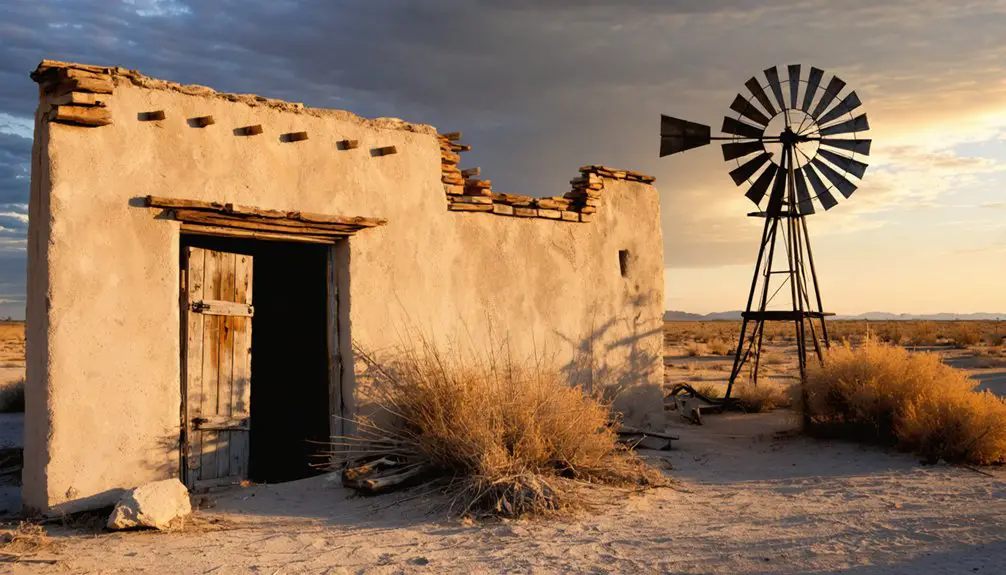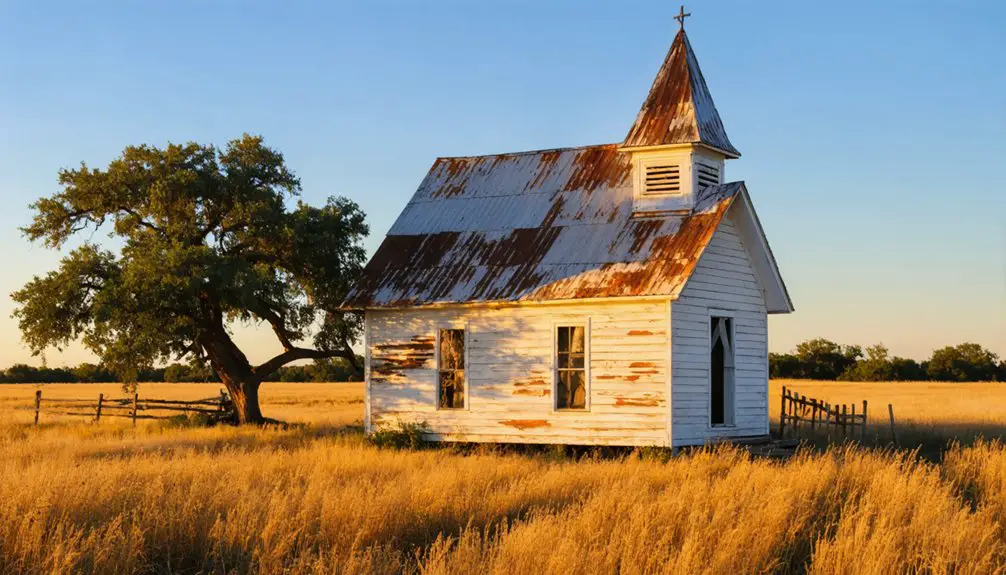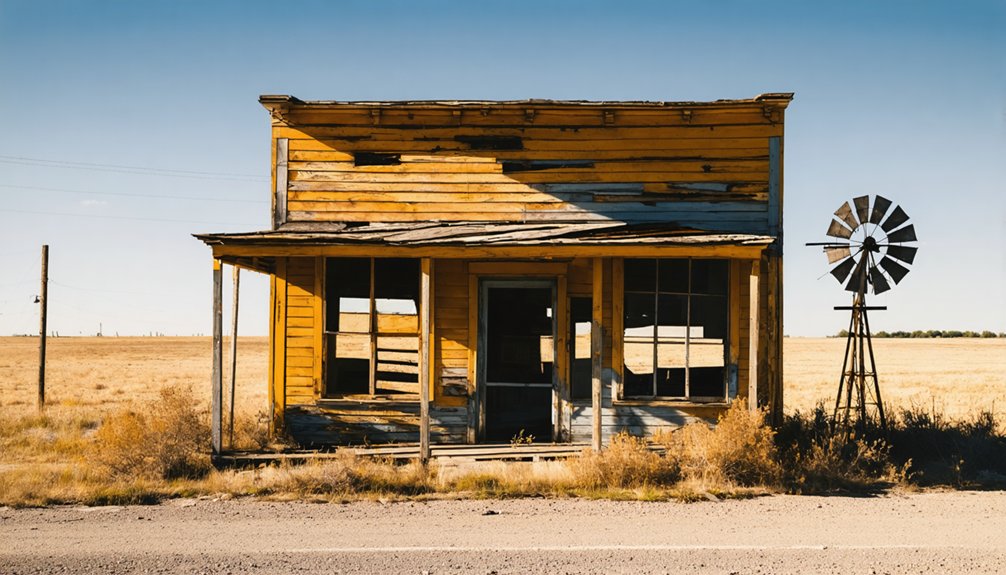
You’ll find North Texas ghost towns scattered across the landscape as silent remnants of 19th-century frontier settlements that once thrived before railroads rerouted, trade shifted, and larger towns pulled away their populations and purpose. They range from completely erased sites to places still marked by crumbling foundations, overgrown cemeteries, and faint landscape footprints. Denton County alone holds several worth exploring. If you’re ready to uncover what’s left, there’s far more to discover ahead.
Key Takeaways
- North Texas ghost towns originated as 19th-century frontier settlements that declined around 1900 due to economic shifts and railroad rerouting.
- Physical remnants like cemeteries, crumbling foundations, and overgrown lots serve as visible markers of these abandoned communities.
- Denton County sites such as Elizabethtown and Stony offer accessible ghost town remnants for exploration and historical discovery.
- Larger trade centers and redirected rail routes drew away residents and businesses, leaving smaller settlements economically marginalized.
- Verify site conditions through county records and historical societies, as preservation levels and accessibility vary considerably across locations.
What Makes a Town a North Texas Ghost Town?
What exactly qualifies a settlement as a North Texas ghost town isn’t always straightforward. You’re dealing with a spectrum ranging from completely abandoned sites to named places that simply lost municipal function over time.
Most originated as 19th-century frontier settlements that declined around 1900 due to economic shifts, changing trade routes, or proximity to stronger competing towns.
You’ll find that cultural preservation often determines what survives — cemeteries, road names, scattered structures, and local memory frequently outlast the towns themselves.
Modern development has absorbed some sites entirely, erasing physical evidence while preserving only the place name on a map.
Distinguishing between a fully vanished community and one with partial remnants is essential when you’re researching or visiting these locations across Denton County and the broader North Texas region.
How North Texas Ghost Towns Died Out
When you trace the decline of North Texas ghost towns, two forces emerge as decisive: economic displacement and the redirection of transportation routes.
You’ll find that once a nearby town captured regional trade or became the dominant shipping point, smaller settlements lost their commercial reason to exist.
The gradual withdrawal of residents and businesses followed almost predictably, leaving little behind but place names and scattered physical remnants.
Economic Shifts Drove Decline
How does a town simply cease to exist? In North Texas, economic decline rarely arrived overnight. Instead, it crept in gradually as population shifts pulled residents toward stronger trade centers and more profitable opportunities.
When nearby communities developed better shipping infrastructure or attracted larger industries, smaller settlements lost their competitive edge. You can see this pattern clearly across Denton County, where towns like Stony never exceeded 50 residents partly because Justin emerged as a dominant shipping point.
Once businesses followed the money elsewhere, tax bases collapsed and municipal functions became unsustainable. Residents who valued economic freedom and self-sufficiency had no choice but to relocate.
What remained were scattered structures, named roads, and cemeteries — quiet evidence that ambition once thrived there before larger forces redirected it entirely.
Transportation Routes Redirected Growth
Few forces reshaped North Texas settlement patterns more decisively than transportation infrastructure. When railroad lines bypassed existing communities, those towns lost their commercial lifelines almost immediately. Merchants, residents, and investors followed the tracks, relocating to whichever depot town offered better access to regional markets.
You can trace this pattern clearly across Denton County, where settlements that once served frontier needs simply couldn’t compete once rail corridors shifted economic gravity elsewhere. Justin’s emergence as a stronger shipping point effectively marginalized smaller nearby communities like Stony.
Recognizing this history carries real cultural significance for understanding how modern North Texas developed. Historical preservation efforts at surviving sites help you connect present-day landscapes to these decisive 19th-century turning points, grounding regional identity in something more substantive than nostalgia alone.
North Texas Ghost Towns That Are Actually Worth Visiting
If you’re ready to explore North Texas ghost towns firsthand, you’ll find that several sites reward careful planning with genuinely compelling historical remnants. Denton County locations like Elizabethtown and Stony offer scattered structural traces, old cemeteries, and road names that anchor you directly to 19th-century settlement patterns.
Before you visit, research county maps, local history archives, and statewide ghost-town listings so you can locate hidden sites that don’t advertise themselves.
Hidden Historical Sites Nearby
What remains of North Texas’s ghost towns won’t appear on most travel itineraries, yet these sites offer something more textured than conventional historical attractions. You’ll find cultural preservation embedded in the landscape itself—through old cemeteries, faded road names, and scattered foundations that local legends keep alive.
When exploring nearby hidden sites, prioritize these three:
- Abandoned cemeteries – They document original settler populations with remarkable specificity.
- Named roads and crossroads – These preserve the geographic footprint of vanished communities like Stony and Drop in Denton County.
- Remnant structures – Even partial buildings reveal construction methods and settlement patterns from the 1850s–1900s period.
You’re not touring ruins—you’re reading a landscape that official history often overlooks.
Remnants Worth Exploring
Some North Texas ghost towns reward a visit more than others, and knowing which sites still hold visible remnants saves you from driving out to a field with nothing but a county road sign. Elizabethtown in Denton County offers tangible connections to frontier settlement, where historical preservation efforts have kept traces of its 19th-century origins accessible. You’ll find that abandoned cemeteries, weathered structures, and named roads often tell more than any museum exhibit could.
Modern tourism around these sites remains low-key, which suits independent explorers who prefer authenticity over curated experiences. Stony, once capped at roughly 50 residents, leaves behind a landscape footprint worth examining. Prioritize locations where physical evidence still exists—structures, grave markers, or original road alignments—rather than places preserved only in local memory.
Planning Your Ghost Town Visit
Planning a ghost town visit in North Texas requires more than a general interest in abandoned places—you need precise coordinates, a reliable vehicle, and a realistic sense of what each site actually offers before you leave the pavement. Denton County sites like Stony and Elizabethtown reward preparation, not impulse.
Before you go, prioritize these three steps:
- Verify access rights — many sites sit on private land, so confirm legal entry beforehand.
- Research historical architecture — knowing what structures originally stood helps you identify surviving remnants accurately.
- Document local legends — county historical societies preserve oral accounts that clarify what’s myth and what’s documented fact.
You’ll navigate these sites more effectively when you’ve replaced curiosity with knowledge and spontaneity with deliberate planning.
North Texas Ghost Towns in Denton County You Should Know
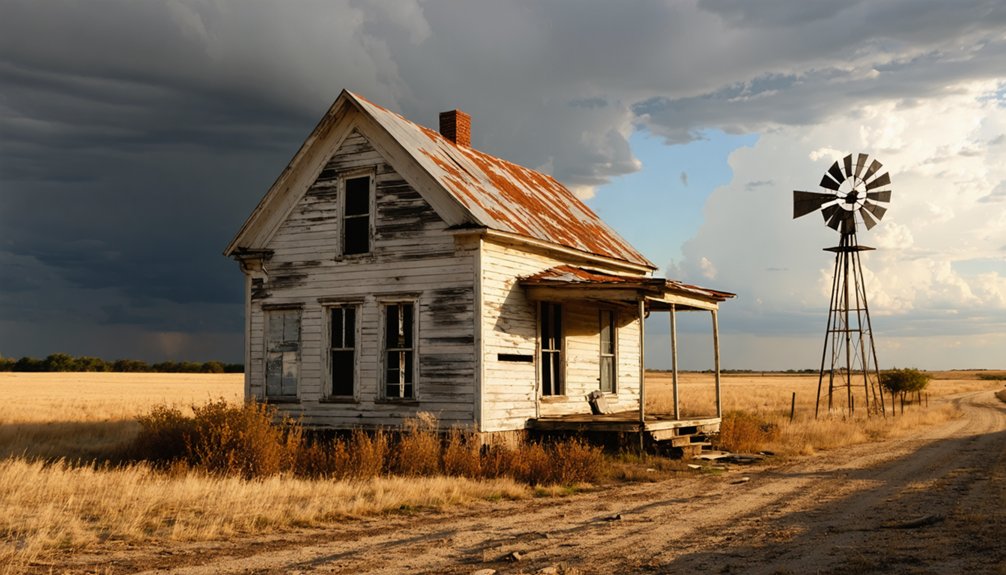
Denton County preserves some of North Texas’s most compelling ghost town remnants, and if you’re drawn to regional history, these sites are worth your attention. Elizabethtown stands as a former frontier settlement whose abandoned structures hint at 19th-century ambitions that never fully materialized.
Denton County’s ghost town remnants, like Elizabethtown, reveal 19th-century frontier ambitions that history quietly left behind.
Drop, now functioning as little more than a named place, reflects how municipal status quietly dissolves when economic momentum shifts elsewhere.
Stony, settled in the late 1850s in far west Denton County, never exceeded roughly 50 residents, partly because Justin emerged as the dominant nearby shipping point.
Local legends surrounding these communities add interpretive texture to what the physical record alone can’t fully explain.
Each site rewards careful research before you visit, since remnants vary considerably in accessibility and preservation.
Completely Gone vs. Still Standing: How to Tell the Difference
When you visit a North Texas ghost town, the first distinction you’ll need to make is whether you’re looking at a site that’s completely vanished or one that still holds physical remnants.
You can identify standing traces through abandoned structures, old cemeteries, and landscape footprints that preserve the town’s original outline.
Where nothing physical survives, you’ll rely on road names, historical maps, and local memory to confirm a settlement ever existed at all.
Defining “Gone” Versus “Standing”
Not every ghost town looks the same once you find it. Some sites show clear urban decay — crumbling foundations, collapsed structures, overgrown lots. Others have undergone land reuse, leaving almost no visible trace. Knowing the difference sharpens your research and sets accurate expectations before you visit.
Use these distinctions when evaluating a site:
- Completely gone — No structures remain; the location survives only through maps, road names, or cemetery records.
- Partially standing — At least one original structure, ruin, or landscape feature remains identifiable on-site.
- Repurposed — Land reuse has transformed the original footprint into farmland, subdivisions, or commercial property, obscuring historical evidence.
Applying these categories helps you interpret what you’re seeing — and what North Texas history has quietly erased.
Physical Clues Left Behind
Even when a settlement has technically vanished, it rarely disappears without leaving physical evidence behind. You’ll find clues embedded in the landscape itself — overgrown cemetery plots, crumbling foundations, and road alignments that once served wagons and commerce. These remnants let you distinguish a completely erased site from one still holding structural traces.
In North Texas, preservation efforts have helped document several such locations before natural decay erases them entirely. Some sites carry reputations shaped by urban legends, blending local folklore with documented history. That mix can obscure what’s actually standing versus what’s simply rumored to exist.
When you visit, look for soil disturbances, fence lines, and named roads that reference forgotten communities. These physical markers tell a more honest story than any legend ever could.
Maps, Names, And Memory
Physical remnants tell part of the story, but maps and place names often carry the rest. When a settlement disappears entirely, cultural memory becomes your primary archive. Urban decay leaves structural evidence, but names outlast buildings by generations.
To distinguish completely gone sites from partially surviving ones, examine three layers:
- Historical maps — Compare 19th-century county plats against current GIS data to identify erasure patterns.
- Road and place names — Surviving designations signal former settlement boundaries even without standing structures.
- Local oral traditions — Community accounts preserve details no official record captures.
You’ll find that named places like Drop in Denton County exist somewhere between memory and geography — neither fully present nor entirely lost. That ambiguity defines North Texas ghost towns most honestly.
What You’ll Actually See at North Texas Ghost Town Sites
When you visit a North Texas ghost town site, don’t expect dramatic ruins or preserved streetscapes — what you’ll find is far more subtle. Most sites offer scattered foundation stones, overgrown lots, or a solitary structure slowly surrendering to weather.
Abandoned cemeteries frequently serve as the most legible markers of former settlement, their weathered headstones anchoring cultural significance to otherwise unremarkable ground. Road names and county maps often preserve the only official trace of what once existed.
Preservation efforts remain limited at many locations, meaning you’ll navigate these spaces largely on your own terms, without interpretive signage or managed access. That rawness is precisely the appeal — you’re reading a landscape rather than consuming a curated exhibit, piecing together a community from what little remains.
How to Find North Texas Ghost Towns on a Road Trip

Knowing what to look for at these sites is only half the equation — you also need to know how to reach them. North Texas ghost towns don’t advertise themselves, so independent research is essential before you hit the road.
- Cross-reference county maps with statewide ghost-town listings to pinpoint Denton County locations like Elizabethtown or Stony.
- Search local history archives and travel features for documented traces of historical architecture, abandoned cemeteries, or surviving road names.
- Collect local legends beforehand — oral traditions often reveal access points and contextual detail that no map provides.
You’ll navigate more confidently when you’ve layered digital tools with firsthand historical sources.
That preparation transforms a casual drive into a deliberate, rewarding exploration of North Texas’s forgotten settlements.
How North Texas Ghost Towns Shaped Frontier-Era Texas History
These forgotten settlements did more than simply fade from the map — they actively shaped the economic, social, and logistical framework of frontier-era Texas. Early North Texas communities established trade corridors, defined county boundaries, and anchored regional identity long before larger cities absorbed their populations.
When towns like Elizabethtown and Stony declined, their abandoned structures didn’t erase history — they preserved it in physical form. You’ll find that legendary ghost stories surrounding these sites often carry fragments of real historical conflict, migration pressure, and economic struggle.
Each collapsing building represents a deliberate choice someone once made to build, settle, and survive on open frontier land. Understanding these towns means understanding how individual freedom, geographic isolation, and economic ambition collectively forged the character of North Texas itself.
Where to Learn More Before You Visit North Texas Ghost Towns

Before heading out to explore North Texas ghost towns, you’ll want to ground your visit in reliable local history sources that go beyond surface-level travel guides. Economic nostalgia drives much of the public interest, but preservation efforts depend on informed visitors who treat these sites responsibly.
Start your research using these three focused approaches:
- Denton County historical archives — county-level records document settlement timelines, land transfers, and population data for towns like Elizabethtown and Stony.
- Texas State Historical Association’s Handbook of Texas — offers peer-reviewed entries on abandoned communities statewide.
- Local library collections and oral history projects — preserve firsthand accounts that institutional sources often miss.
Each resource sharpens your understanding before you arrive, turning a casual trip into a historically grounded exploration.
Are Any North Texas Ghost Towns Still Functioning Communities?
Once your research points you toward specific sites, a practical question follows: do any of these so-called ghost towns still function as living communities? The answer is nuanced. Some locations, like Drop in Denton County, retain a named-place designation without operating as municipalities. Residents may still occupy scattered properties, and local legends surrounding these sites persist through oral tradition and county histories.
Others are genuinely abandoned, surviving only through cemeteries, road names, or faint structural remnants. Preservation efforts vary considerably — some sites receive documented attention while others deteriorate without intervention.
You should expect a spectrum rather than a binary. Treating every listed ghost town as completely vacant will mislead your visit. Verify current conditions through county records, regional historical societies, and updated travel sources before drawing conclusions.
Frequently Asked Questions
Are North Texas Ghost Towns Protected Under Any Historical Preservation Laws?
Protection isn’t guaranteed—you’ll find historical preservation laws vary by land ownership. If you own or access these sites, you’re responsible for understanding local, state, and federal regulations that may apply.
Can You Legally Purchase Land Where a Ghost Town Once Stood?
Over 90% of ghost town sites are privately owned — you can pursue ghost town ownership through standard land purchase regulations, meaning you’d buy the land just like any other private or county-listed property.
Have Any North Texas Ghost Towns Been Featured in Films or Documentaries?
You won’t find major film credits tied to these sites, but documentaries exploring haunted legends and abandoned structures have occasionally spotlighted North Texas ghost towns, giving freedom-seeking history enthusiasts compelling visual access to forgotten communities.
Do Any Ghost Towns in North Texas Have Active Paranormal Tourism Communities?
You won’t find well-documented, active paranormal tourism communities tied specifically to North Texas ghost towns, though haunted legends and spirit sightings circulate through local oral traditions, drawing independent enthusiasts who explore these historically rich, abandoned sites independently.
Are There Guided Group Tours Specifically Focused on North Texas Ghost Towns?
“Seek and you shall find” — you’ll discover that dedicated guided group tours focusing on ghost town legends and abandoned architecture in North Texas remain scarce, but regional historical societies and travel groups occasionally organize excursions worth exploring.
References
- https://en.wikipedia.org/wiki/List_of_ghost_towns_in_Texas
- https://couriertexas.com/dfw/2024/04/30/north-texas-ghost-towns/
- https://dfwurbanwildlife.com/2011/05/29/chris-jacksons-dfw-urban-wildlife/march-28-2005-ghost-towns-in-north-texas/
- https://www.youtube.com/watch?v=IzXH6Gk8-MA