If you’re exploring Iowa’s mining ghost towns, you’ll find them scattered across the state’s southern and central counties, where vast bituminous coal deposits formed during the Carboniferous period sparked rapid industrial settlement. Towns like Flagler and Fairmount emerged quickly near active mine shafts, only to collapse once resources were exhausted. Their physical remnants—overgrown foundations, rusted machinery, and cellar holes—still mark the landscape, and there’s considerably more to uncover about their documentation, location, and legacy.
Key Takeaways
- Iowa’s southern and central counties contain extensive bituminous coal deposits that fueled rapid mining town development during the Carboniferous period.
- Mining towns like Flagler and Fairmount emerged quickly near active mine shafts, supported by post offices, stores, and rail spurs.
- These communities followed a boom-and-bust cycle, collapsing once coal resources were exhausted due to single-industry dependence.
- Physical remnants including overgrown foundations, rusted machinery, and cellar holes still mark many former Iowa mining town sites.
- County histories, plat maps, post office records, and USGS databases are essential tools for researching Iowa’s mining ghost towns.
What Turned Iowa Into Coal Country?
Iowa’s transformation into coal country began beneath its surface, where vast bituminous coal deposits stretched across the southern and central counties, embedded in geological formations laid down during the Carboniferous period. These reserves drew industrial investment, railroad expansion, and migrant labor into previously agrarian communities.
You can trace the pattern clearly: extraction fueled rapid settlement, then exhaustion triggered economic decline. When seams ran dry, population shifts followed swiftly, leaving behind post offices, abandoned storefronts, and displaced workers with no local industry to sustain them.
Coal didn’t just reshape Iowa’s economy temporarily — it restructured where people lived, how towns formed, and ultimately, why so many of those towns vanished. Understanding that geological foundation helps you grasp why Iowa’s ghost-town history is inseparable from its coal-mining past.
How Iowa’s Mining Ghost Towns Were Born
When coal seams were discovered and deemed commercially viable, operators moved fast — laying out town plats, establishing post offices, and recruiting workers before the broader public had any clear sense of what was being built or how long it would last. Labor migration drove rapid population surges into otherwise rural Iowa townships.
Mining equipment arrived alongside transient workers, and overnight, functional communities materialized from open farmland.
These settlements shared recognizable features:
- Post offices established to legitimize the settlement
- Company stores supplying workers and families
- Housing clusters built near active mine shafts
- Rail spurs connecting mining equipment and coal output to broader markets
Once a seam exhausted, the infrastructure that built these towns offered no reason to stay — and most didn’t.
The Boom-and-Bust Cycle Behind Iowa Mining Ghost Towns
The coal seams that sparked Iowa’s mining settlements didn’t last, and neither did the towns built around them. You’ll find a consistent pattern in county histories: mining labor flooded a site when extraction began, stores opened, post offices were established, and housing went up fast.
Then resource depletion hit. Once a seam ran out, operators closed the mine, workers relocated to active sites, and commercial activity collapsed almost immediately. The settlement had no secondary economic function to fall back on.
You’re looking at communities that existed entirely in service of extraction, not agriculture or regional trade. When the coal was gone, the rationale for the town vanished with it.
That cycle repeated across Iowa’s southern and central counties throughout the late nineteenth and early twentieth centuries.
Iowa’s Most Notable Mining Ghost Towns
Among the clearest examples of Iowa’s boom-and-bust mining pattern, Flagler and Fairmount stand out in archival records as settlements whose entire existence tied directly to coal extraction. Both towns formed quickly, established post offices, and vanished once coal resources depleted. You’ll find their stories preserved in county histories and ghost-town inventories rather than on modern maps.
Flagler and Fairmount rose with coal, vanished with it, and survive today only in archives and ghost-town records.
Key archival details worth noting:
- Flagler was laid out in 1877, with its post office operating from 1876 to 1914
- Fairmount operated near Knoxville as a short-lived mining-era community
- Mining artifacts recovered from both sites confirm rapid commercial development
- Town layouts typically included stores, housing, and postal facilities before swift decline
These documented settlements give you concrete, verifiable anchors for understanding Iowa’s broader mining ghost-town record.
How Railroads Determined Which Iowa Mining Towns Disappeared
Railroad access often decided a mining town’s fate more decisively than the coal seam beneath it. When rail lines bypassed a settlement, residents frequently relocated their buildings and businesses closer to the nearest station. Mining infrastructure alone couldn’t sustain a community if hauling coal became too costly or logistically impractical without direct rail connection.
Railroad influence cut both ways. Construction camps created temporary boomtowns that vanished once track-laying crews moved forward.
Conversely, towns positioned along active lines gained commercial staying power even after local mines depleted. When railroads transitioned from coal to diesel fuel, water stops and coal-refilling stations lost their entire economic purpose overnight.
You can trace these patterns through post office records and county histories, which document precisely when commerce collapsed following railroad abandonment or route changes.
Physical Traces Still Visible at Iowa’s Mining Ghost Town Sites
Where railroads shaped a town’s economic fate, the ground itself often preserves what documents can’t fully capture. When you visit former Iowa mining settlements, you’ll find physical traces that archival records alone can’t convey.
The ground remembers what documents forget—physical traces outlasting every archive, ledger, and county history combined.
Look for these common remnants:
- Town foundations emerging through overgrowth, marking where homes and storefronts once stood
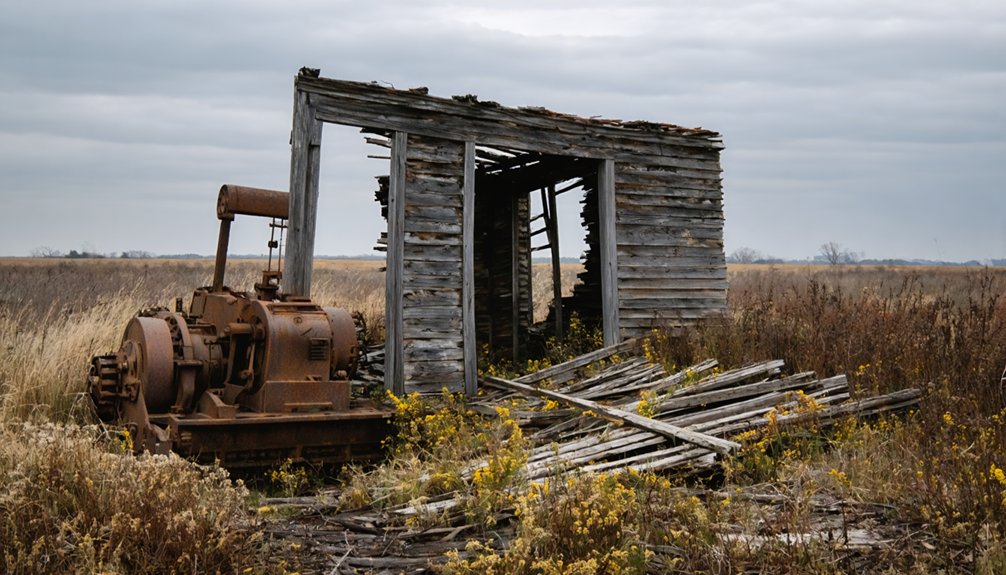
- Mining equipment fragments, including rusted machinery components partially buried near former shaft sites
- Depressions and earthworks indicating collapsed mine entries or waste spoil areas
- Cellar holes and stone footings revealing residential and commercial building layouts
These features let you read the landscape as a primary source. Iowa’s southern coal counties contain numerous such sites where extraction, settlement, and abandonment compressed into decades.
You’re fundamentally walking through stratigraphy that county histories only partially document.
Can You Still Visit Iowa’s Mining Ghost Towns?
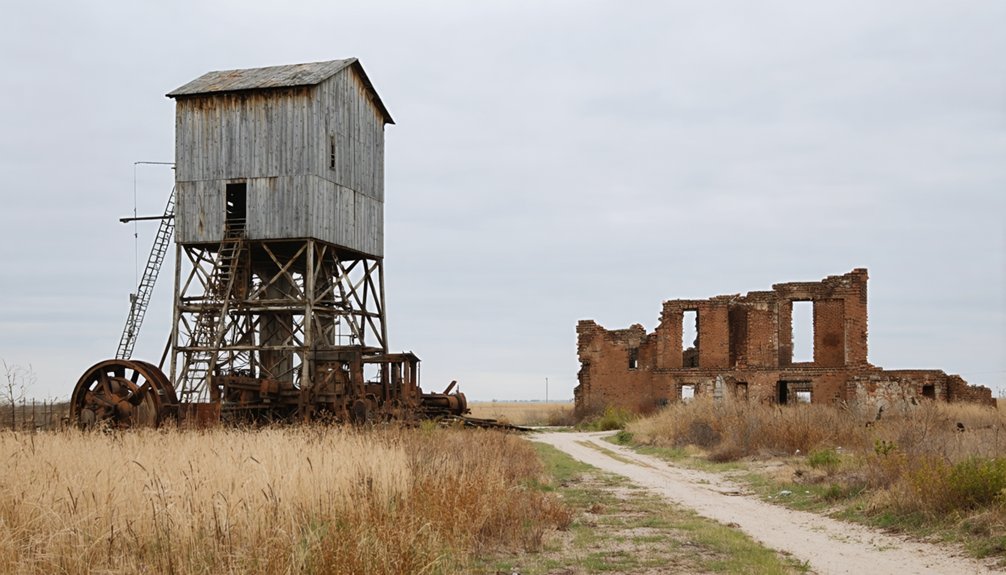
If you’re drawn to Iowa’s coal-mining past, you can still visit several accessible remnants of these vanished communities scattered across the state’s southern counties.
You’ll find that former town sites near Knoxville and within Mahaska County occasionally preserve structural fragments, earthworks, or overgrown foundations that archival maps can help you locate and interpret.
Accessible Remnants Today
Though Iowa’s mining ghost towns rarely announce themselves with dramatic ruins or heritage signage, you can still find traces of these vanished communities if you know where to look. Visitor access remains informal across most sites, but preserved artifacts and landscape features reward careful exploration.
Practical starting points include:
- County historical societies holding maps, photographs, and deeds tied to former coal settlements
- Rural cemeteries marking where mining communities once stood near Mahaska and Marion Counties
- Earthwork depressions indicating former mine shafts or building foundations in agricultural fields
- Local archives and post office records documenting towns like Flagler and Fairmount
You’re fundamentally doing fieldwork when you explore these places. Bring historical maps, cross-reference county records, and treat each remnant as primary evidence of Iowa’s extractive past.
Visiting Historical Mining Sites
Visiting Iowa’s mining ghost towns demands preparation, patience, and a tolerance for ambiguity—most sites exist not as designated landmarks but as unmarked agricultural land where a town once functioned. You’ll rarely encounter interpretive signage or preserved mining equipment.
Instead, you’re reading topographic shifts, consulting plat maps, and cross-referencing county histories to reconstruct former town layouts. Flagler and Fairmount, for instance, require archival homework before you set foot on-site.
You should contact local historical societies in Marion and Mahaska counties before visiting—they hold deed records, photographs, and survey documents that orient your search. Trespassing laws apply to privately held parcels, so secure landowner permission in advance.
Treat each visit as field research, not tourism, and you’ll extract far more meaning from what little remains visible.
Where to Find Iowa Mining Ghost Town Records
If you’re tracing Iowa’s mining ghost towns, you’ll find your most reliable evidence in three core source types: county history archives, post office historical records, and compiled ghost town inventories.
County archives hold granular details—plat maps, local histories, and settlement accounts—that national databases consistently overlook.
Cross-referencing these with postal records, which document when communities gained and lost mail service, lets you reconstruct a town’s rise and decline with surprising precision.
County History Archives
Where do you begin when official maps have erased the towns you’re trying to find? County history archives offer a direct path into Iowa’s mining past, documenting settlement relocation, mining labor patterns, and communities that vanished before federal records caught up. These archives preserve what standardized databases overlook.
Dig into these primary sources:
- County histories — narrative records identifying coal towns by name, founding date, and decline
- Plat maps — visual evidence of platted towns that never survived past one generation
- Township records — granular documentation of mining labor settlements and population shifts
- Local newspaper archives — firsthand accounts of mine closures and community exodus
You’ll find specificity here that no ghost-town index provides. County archives remain your most reliable tool for reconstructing Iowa’s erased mining settlements.
Post Office Historical Records
Post office historical records offer a precise and underutilized entry point into Iowa’s mining ghost towns. You’ll find establishment and discontinuation dates that map directly onto mining activity, labor movements, and shifts caused by mining legislation.
When a coal seam exhausted, postal service typically ended within months, leaving a dateable record of abandonment. The USPS Historical Post Offices database and the National Archives both hold these records.
Cross-reference them against county plat maps to locate exact settlement sites. Flagler’s post office operated from 1876 to 1914, documenting its rise and decline as a coal town with unusual precision.
You can replicate this method across dozens of similar Iowa communities, building a documented record that commercial ghost-town lists consistently overlook.
Ghost Town Inventories
Ghost town inventories vary widely in quality and coverage, so you’ll need to evaluate each source critically before relying on it.
For Iowa mining ghost towns, cross-referencing multiple inventories reveals settlement patterns that no single list captures completely.
Mining infrastructure like shaft locations and rail spurs often appears in county atlases rather than compiled ghost-town databases.
Key inventory sources worth consulting:
- Iowa county histories — document coal-town origins and abandonment timelines
- USGS geographic name databases — preserve discontinued place names tied to mining camps
- State Historical Society of Iowa archives — hold plat maps showing vanished settlement patterns
- Ghost-town enthusiast compilations — useful starting points but require verification against primary records
Cross-checking these sources gives you the most accurate picture of Iowa’s abandoned mining communities.
Frequently Asked Questions
What Types of Workers Typically Lived in Iowa Mining Ghost Towns?
In Flagler, you’d find miners, storekeepers, and laborers shaping the labor demographics of these camps. They endured harsh living conditions, extracting coal until the seam ran dry, then relocating when opportunity demanded freedom elsewhere.
Did Any Iowa Mining Ghost Towns Ever Get Officially Recognized Historically?
You’ll find that county histories and post office records have officially acknowledged sites like Flagler, preserving ghost town legends tied to specific mining techniques, giving you archival proof these coal communities earned documented historical recognition.
How Many Iowa Ghost Towns Are Directly Linked to Coal Mining?
You’ll find no exact count, but you’re looking at dozens of coal mining ghost towns across Iowa’s southern counties — sites where ghost town preservation efforts rely on post office records, county histories, and archival inventories to track them.
Were Iowa Mining Towns Ever Depicted in Historical Photographs or Artwork?
You’ll find artwork depictions and photographic archives documenting Iowa’s coal mining towns across county historical societies and state repositories, where you can actively explore visual records capturing these vanished communities before abandonment erased their physical presence entirely.
Did Any Iowa Mining Ghost Towns Later Become Protected Heritage Sites?
Like embers refusing to die, some sites survived industrial decline. You’ll find preservation efforts have shielded select Iowa mining ghost towns, transforming forgotten coal communities into protected heritage sites where archival history breathes freely again.
References
- https://en.wikipedia.org/wiki/List_of_ghost_towns_in_Iowa
- https://freepages.history.rootsweb.com/~gtusa/usa/ia.htm
- https://pubs.lib.uiowa.edu/annals-of-iowa/article/id/13329/download/pdf/
- https://ghost-towns.close-to-me.com/states/iowa/
- https://www.youtube.com/watch?v=CdF9cW6ikmU