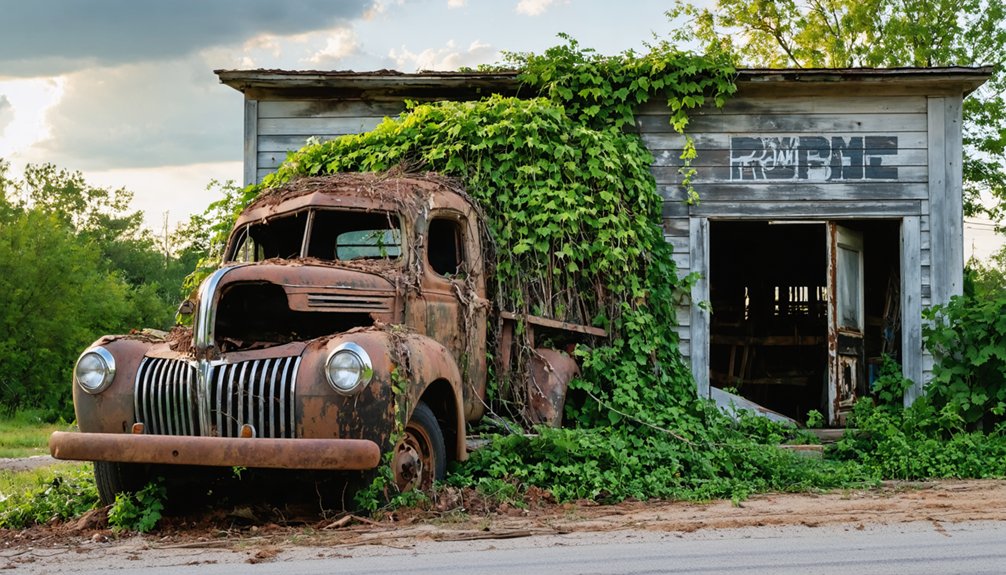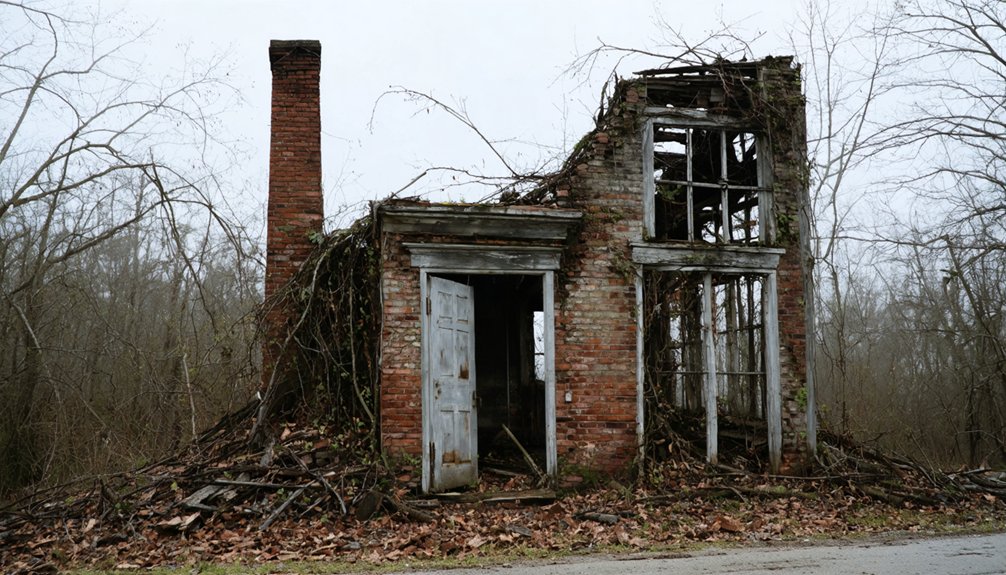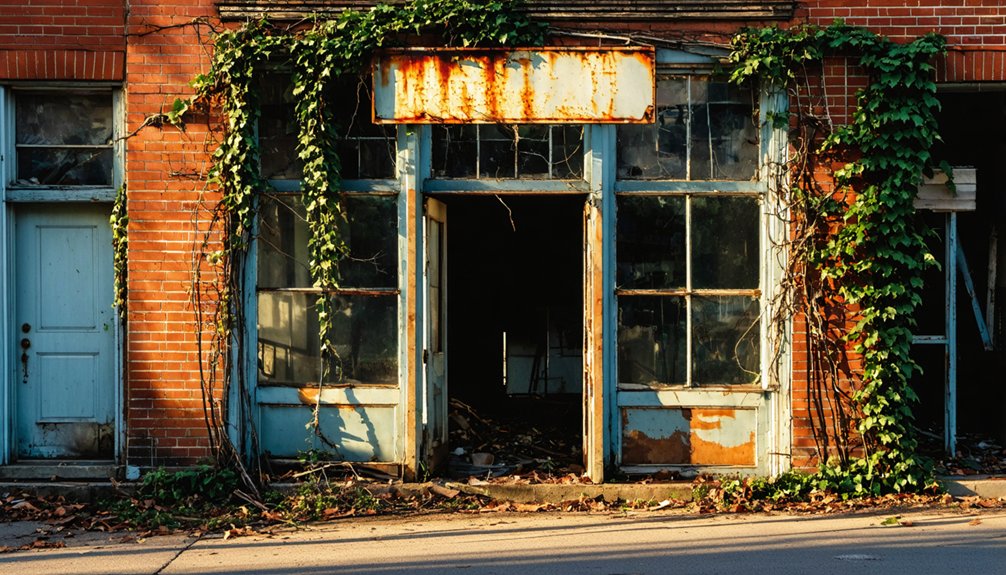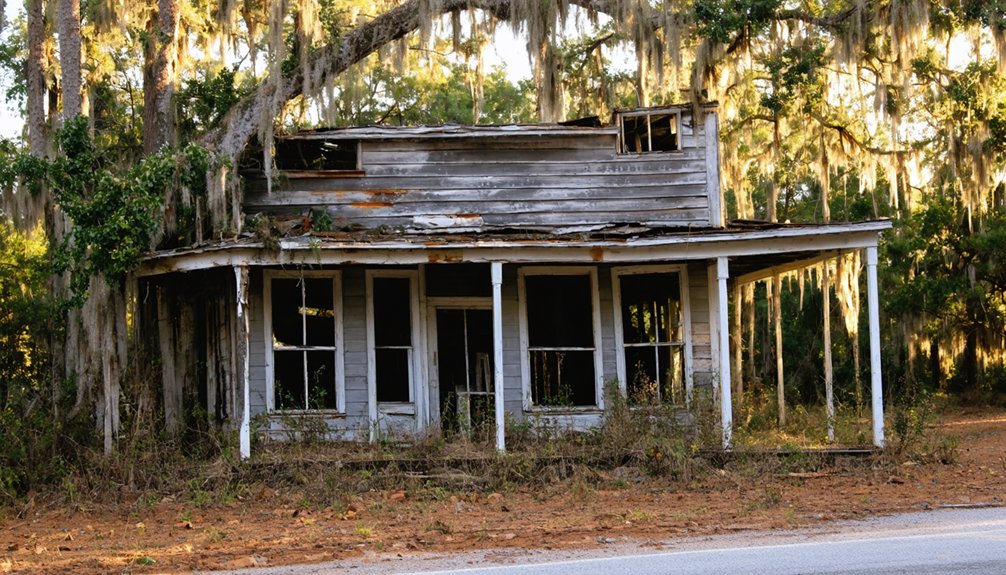
Alabama’s ghost towns range from sunken river settlements to abandoned coal camps and forgotten county seats. You’ll find Old Cahawba, the state’s first capital, partially preserved with brick foundations and cemetery markers. Towns like Bainbridge disappeared entirely beneath reservoir waters, while industrial camps like Bluffton vanished once the iron ore ran out. Each site reflects a distinct collapse — economic, environmental, or political. Keep exploring, and you’ll uncover stories most Alabamians have never heard.
Key Takeaways
- Old Cahawba, Alabama’s first state capital, was abandoned due to flooding and malaria, making it the state’s most famous ghost town.
- Blakeley and Bellefonte were once thriving county seats that rapidly declined after losing their administrative and economic importance.
- Bainbridge was a river trade town established in 1819 that was completely submerged under Wilson Lake by the 1840s.
- Industrial towns like Bluffton and Brownville were abandoned after iron ore depletion and lumber company closures left them without purpose.
- Alabama ghost towns survive through urban legends, preservation efforts, archaeological remains, cemeteries, and foundations rather than standing structures.
What Qualifies as an Alabama Ghost Town
When most people picture a ghost town, they imagine a dusty, deserted main street with tumbleweeds rolling past crumbling storefronts—but Alabama’s ghost towns don’t fit neatly into that Western image. Here, you’ll find communities that are submerged under reservoirs, demolished by industrial collapse, or reduced to a single cemetery.
Compiled statewide lists categorize these sites using labels like abandoned, neglected, barren, historic, and gone completely. Some locations survive only through urban legends passed down across generations, while others benefit from active preservation efforts that protect what little remains.
Alabama researchers typically focus on former capitals, river towns, mining camps, and company towns. If you’re defining an Alabama ghost town, think broadly—loss of function, population, and purpose matters more than visible ruins.
Old Cahawba: Alabama’s Most Famous Ghost Town
Among all of Alabama’s ghost towns, Old Cahawba stands out as the most recognized and historically significant. It served as Alabama’s first state capital from 1820 to 1826 before repeated flooding and malaria forced its abandonment. Today, preservation efforts protect what remains on this Dallas County site.
You’ll find several documented remnants still visible:
- Brick walls and old home site foundations
- Cemetery markers from early residents
- Relocated St. Luke’s Episcopal Church
- Archaeological evidence of the former capital layout
Urban legends surrounding Cahawba have grown alongside scholarly interest, adding cultural weight to an already documented history. Preservation efforts through state and local organizations keep the site accessible and studied.
Cahawba represents what happens when geography and disease override political ambition, leaving freedom-seekers with a clear historical lesson in impermanence.
Alabama Ghost Towns That Were Once County Seats
Several Alabama ghost towns carry the added historical weight of having once served as official county seats, a status that makes their decline even more striking. Blakeley in Baldwin County held that role before its disestablishment in 1865, and compiled records now classify it as neglected.
Bellefonte in Jackson County served as Jackson County’s seat until cholera and economic collapse pushed residents out by the 1920s, leaving it similarly neglected today. Both sites represent gaps in historical preservation efforts that deserve your attention.
You’ll find that their former administrative importance makes them compelling tourist attractions, offering tangible evidence of how quickly civic infrastructure can collapse when trade, population, and economic conditions shift. Visiting these sites connects you directly to Alabama’s documented but often overlooked governmental history.
Alabama River Towns Now Underwater
If you trace Alabama’s ghost towns, you’ll find that some didn’t simply empty out — they disappeared beneath water entirely. Bainbridge, established in 1819 in Colbert and Lauderdale counties, is now submerged under Wilson Lake, swallowed by the 1840s.
Alabama’s rivers didn’t just shape trade routes; they ultimately reclaimed several of the towns built along their banks.
Bainbridge Beneath Wilson Lake
Beneath the surface of Wilson Lake in northern Alabama lies what was once the town of Bainbridge, a settlement established in 1819 that straddled Colbert and Lauderdale counties before submersion in the 1840s rendered it one of the state’s most literally buried ghost towns.
Unlike abandoned structures slowly reclaimed by vegetation, Bainbridge disappeared entirely beneath rising waters. Haunted legends surrounding submerged towns carry particular weight here, where nothing remains accessible.
Key documented facts:
- Bainbridge was established in 1819 along strategic river trade routes
- Submersion occurred in the 1840s following waterway development
- Wilson Lake now permanently covers the original townsite
- No surface ruins remain visible to researchers or visitors
You can’t walk these streets or examine foundations — the water erased that freedom entirely.
Rivers That Swallowed Towns
Bainbridge isn’t the only Alabama town the water claimed. Rivers shaped Alabama’s early settlement patterns, and they erased settlements just as decisively. Communities built along trade routes depended on river access for commerce, but flooding, dam construction, and shifting river ecosystems made those same waterways lethal to long-term town preservation.
Bainbridge disappeared beneath Wilson Lake in the 1840s, but Arcola in Hale County faced a similar fate when river-dependent trade collapsed by the 1850s. You can trace a clear pattern: towns positioned for river commerce became vulnerable the moment water levels, infrastructure, or trade routes changed.
The rivers didn’t just damage these communities — they consumed them entirely. What remains exists underwater or in historical records, not on any modern map you’d recognize.
Alabama Mining and Lumber Ghost Towns
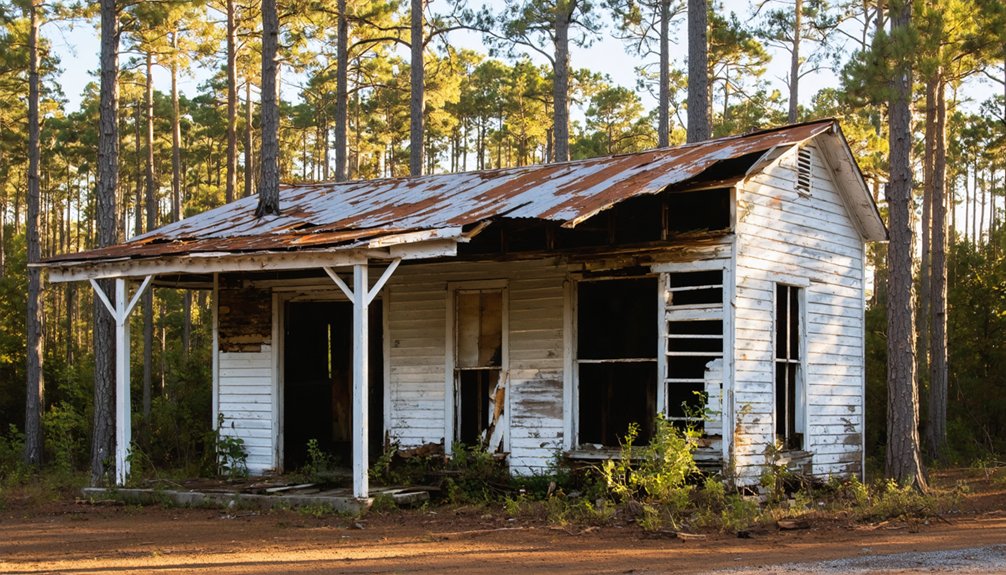
When Alabama’s mining booms and lumber operations collapsed, they left behind entire communities that simply ceased to function. Industrial decline and railroad abandonment stripped these towns of every reason to exist.
Consider these documented examples:
Consider these documented examples of Alabama’s forgotten towns — communities erased by industrial collapse, their existence confirmed only in compiled records.
- Bluffton (Cherokee County) — iron ore mining town, established 1888, abandoned 1934
- Brownville (Tuscaloosa County) — W.P. Brown and Sons Lumber Co. company town, demolished around 1989
- Beaver Mills (Mobile County) — Civil War-era uniform depot, later abandoned
- Blanche (Cherokee County) — listed as completely gone in compiled records
Once the ore ran out or the lumber contracts ended, you’d find workers relocating and infrastructure crumbling fast. No industry meant no population.
These sites confirm a consistent Alabama pattern: when corporate operations ceased, towns vanished without passage or recovery.
Alabama Ghost Towns Most Visitors Overlook
While most visitors gravitate toward Old Cahawba, Alabama’s ghost-town landscape includes lesser-known sites that don’t make typical travel itineraries. Manasco in Walker County leaves only a cemetery behind, yet its haunting legends draw curious researchers willing to explore beyond marked trails.
Battelle in DeKalb County offers neglected abandoned structures with little interpretive signage, demanding independent investigation.
Aigleville in Marengo County faded by the 1830s, leaving almost no physical trace.
Blanche in Cherokee County has disappeared entirely from the landscape.
These overlooked sites reward travelers who value firsthand discovery over curated tourism. You’ll find fewer crowds, rawer conditions, and more direct encounters with Alabama’s layered past.
Cross-referencing compiled ghost-town lists with county records gives you the clearest picture of what actually remains at each location.
Frequently Asked Questions
Are Any Alabama Ghost Towns Protected as Official State Historic Sites?
Yes, you’ll find Old Cahawba’s a documented state historic site, where haunted legends and local legends thrive. Alabama actively protects it, preserving ruins, cemeteries, and analytical records for freedom-seeking history enthusiasts.
Can Visitors Legally Explore or Enter Abandoned Alabama Ghost Town Properties?
Over 60% of Alabama’s ghost towns sit on private land — you can’t freely roam them. Respect trespassing laws; entering without permission violates private property rights. Always research ownership and secure legal access before exploring.
Have Any Alabama Ghost Towns Ever Been Successfully Restored or Repopulated?
Yes, you’ll find Old Cahawba’s partial restoration stands as Alabama’s best example—preservationists have tackled urban decay and preservation challenges there, though full repopulation hasn’t occurred; most sites remain abandoned despite documented conservation efforts.
Are There Guided Tours Available Specifically for Alabama Ghost Towns?
You’ll find guided tour options at Old Cahawba through Cahaba River Society, but many sites require private ghost town access via landowner permission or local historical society arrangements before you can explore them.
How Many Total Ghost Towns Are Estimated to Exist Across Alabama?
Dozens of documented destinations dot Alabama’s landscape—you’ll find incomplete statewide lists revealing abandoned communities shaped by urban decay. Ghost town legends suggest the count’s constantly growing as researchers uncover forgotten places lost to flooding, mining, and shifting trade routes.
References
- https://en.wikipedia.org/wiki/List_of_ghost_towns_in_Alabama
- https://www.facebook.com/61573972532206/posts/one-of-alabamas-most-well-preserved-and-historic-ghost-townsold-cahawba-also-kno/122174329250799084/
- https://kids.kiddle.co/List_of_ghost_towns_in_Alabama
- https://www.youtube.com/watch?v=8HslRR8tJdA
- https://www.youtube.com/watch?v=ms6onL3rEO4
- https://www.al.com/living/2014/10/7_alabama_ghost_towns_a_photo.html
- https://www.youtube.com/watch?v=1Qy5Sq51SbA
- https://www.youtube.com/watch?v=EdIGphQum-Q