Greenbanks Hollow, also known as Buck Hollow, is one of Vermont’s most fascinating ghost towns tucked into the Green Mountains of Caledonia County. You’ll find crumbling stone foundations, moss-covered cellar holes, and remnants of a Civil War-era wool mill village that forest has slowly reclaimed. No entrance fee is required, making it an easy road trip stop. Stick around to uncover everything you need to plan your visit the right way.
Key Takeaways
- Buck Hollow, also called Greenbanks Hollow, is a Vermont ghost town in Caledonia County, accessible via GPS using “Greenbanks Hollow, Vermont.”
- The site features stone foundations, root cellars, and a restored covered bridge, offering visitors a glimpse into 1800s mill village life.
- No entrance fee or reservation is required, making it an easy, budget-friendly stop on any road trip.
- Visit in late September to mid-October for peak foliage or spring to spot cellar holes hidden by summer vegetation.
- Wear sturdy footwear and bring water, as the terrain is uneven; nearby St. Johnsbury offers dining and additional attractions.
What Is Greenbanks Hollow, Vermont?
Although it goes by the name Buck Hollow in some travel circles, the ghost town you’re actually looking for is Greenbanks Hollow, a former mill village tucked into the Green Mountains of Caledonia County, Vermont. Built around a thriving mid-1800s wool mill, this tight-knit community once supplied woolen uniforms to Union soldiers during the Civil War.
When fire destroyed the mill, the town’s purpose vanished with it, and the forest slowly reclaimed what residents left behind.
Today, preservation efforts dating back to 2004 have transformed the site into an accessible slice of Vermont heritage. You’ll find stone foundations, root cellars, and a restored covered bridge waiting to be explored.
Local legends and interpretive signage bring the vanished community back to life as you walk the grounds.
The Wool Mill That Built and Destroyed Greenbanks Hollow
When you visit Greenbanks Hollow, you’re walking through the ghost of an industrial powerhouse that once supplied woolen uniforms to Union soldiers during the Civil War.
At its peak, the five-story wool mill standing over Joe’s Brook ranked among the largest in the country, making this quiet Vermont hollow a surprisingly significant wartime supplier.
Then, on a bitter December night, fire tore through the mill and stripped the community of its only reason to exist, setting the town on an irreversible path toward abandonment.
Mill’s Civil War Production
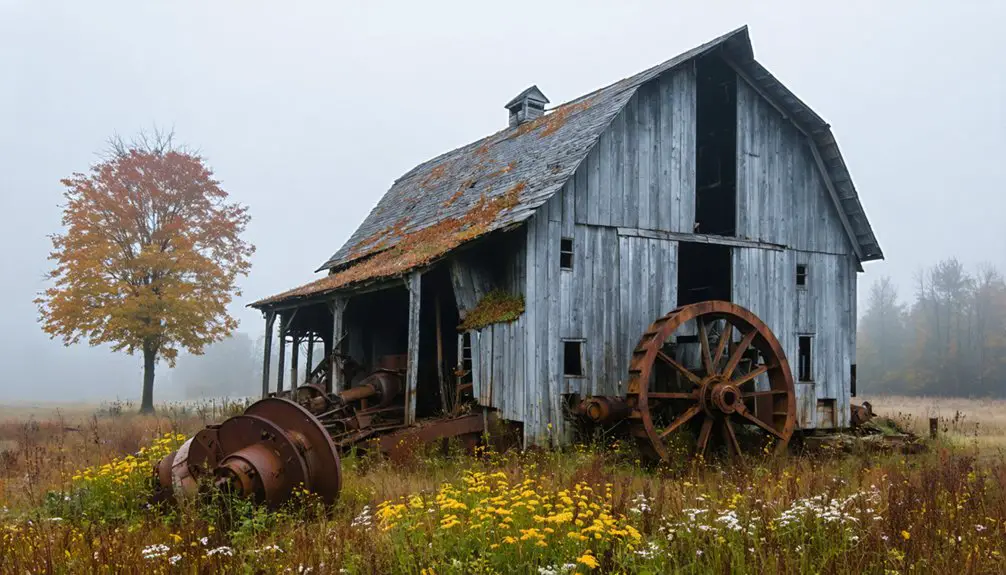
The five-story wool mill at Greenbanks Hollow didn’t just define the community — it was the community. At its peak, it ranked among the largest wool mills in the country, and when the Civil War created an urgent demand for woolen uniforms, this mill answered the call.
You’re standing at a site that directly supplied the Union Army, making Greenbanks Hollow part of something far larger than a Vermont village. That wartime production brought prosperity and purpose.
But industrial decline followed when fire consumed the mill on a bitter December night, stripping away the town’s entire reason for existing. Forest reclamation did the rest.
What once hummed with machinery quietly surrendered to trees, roots, and silence — leaving only the foundations you’ll walk past today.
Fire’s Lasting Consequences
Fire didn’t just destroy a building — it erased a community’s entire reason for existing. When the five-story wool mill burned on that cold December night, it took every job, every wage, and every future plan along with it.
Industrial decline followed swiftly and without mercy. Families had no reason to stay, so they left. Businesses shuttered. Roads grew quiet.
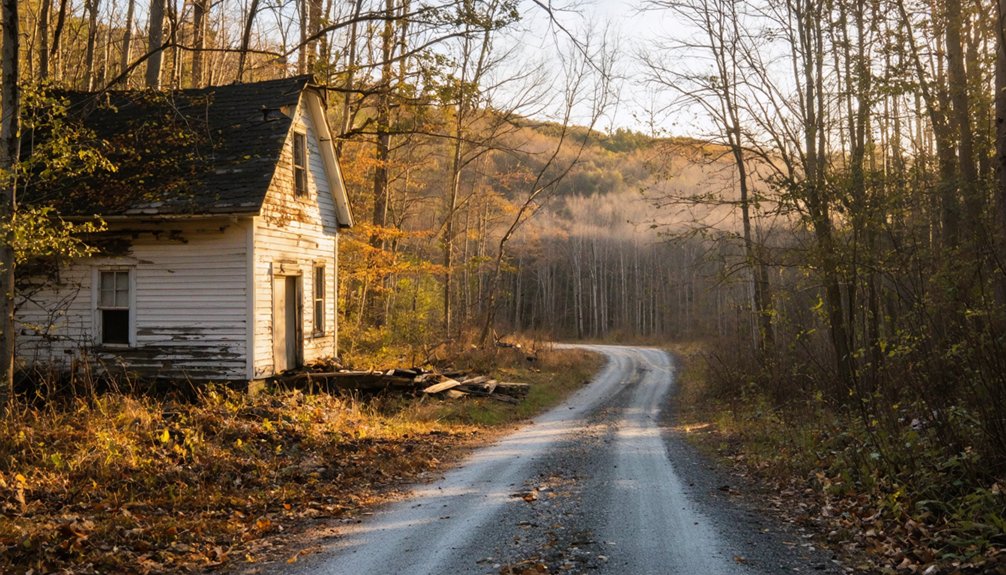
What was once a thriving mill village became a memory dissolving into the trees.
That’s the part that hits hardest when you walk the site today. Forest reclamation has done its patient work, pulling stone walls and root cellars back into the earth.
You’re not just visiting ruins — you’re standing inside a cautionary tale about how quickly one catastrophic night can silence an entire way of life.
What Remains at Greenbanks Hollow Today
Though the forest has quietly swallowed most of what once stood here, Greenbanks Hollow still holds enough to make the trip worthwhile. You’ll find historical artifacts and visible preservation efforts woven throughout the site, giving you real context for what life here once looked like.
Look for these three highlights when you arrive:
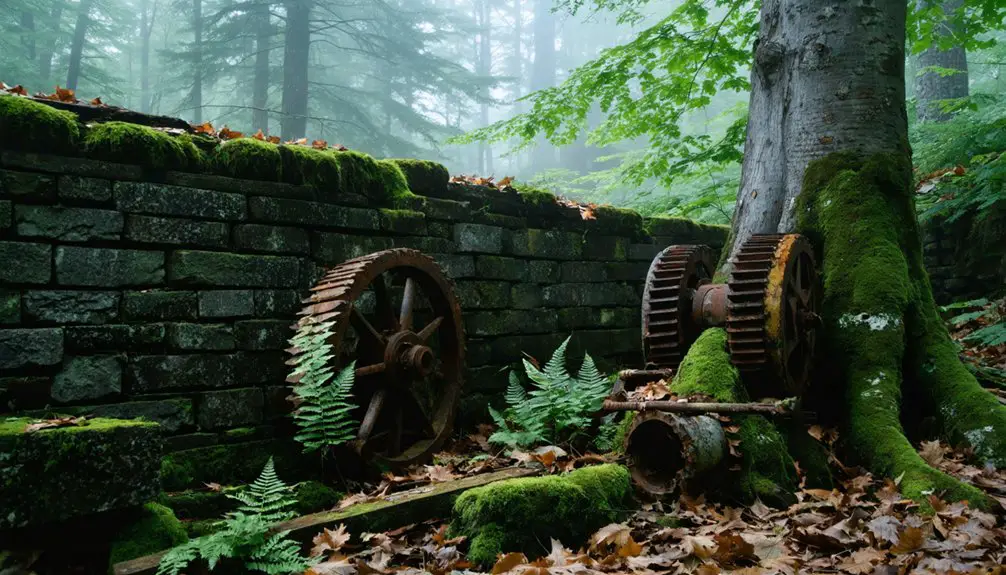
- Stone foundations — the mill’s footprint still outlines the scale of its five-story structure
- Root cellars and wandering walls — remnants of homes reclaimed by trees and moss
- A restored covered bridge — a tangible link to the village’s working past
Informational signs installed in 2004 help you piece the story together. You won’t need a guide — just your curiosity and a willingness to look closely.
When to Visit for the Best Trail and Foliage Conditions
Timing your visit to Greenbanks Hollow can make a significant difference in what you experience on the trail. Late September through mid-October brings peak seasonal foliage, wrapping the stone foundations and forest paths in deep reds, oranges, and golds. The ruins feel more dramatic against that backdrop, and the scenic viewpoints along the surrounding hills reward the short walk in ways a summer visit simply can’t match.
Spring works well too — snowmelt reveals cellar holes and walls that heavy vegetation hides by July. Avoid midsummer if you prefer clear sightlines through the tree cover.
Winter visits are possible but require careful footing on ungroomed paths. Whatever season you choose, arrive early to enjoy the stillness that makes this hollow feel genuinely removed from the modern world.
How to Find Greenbanks Hollow and Where to Park
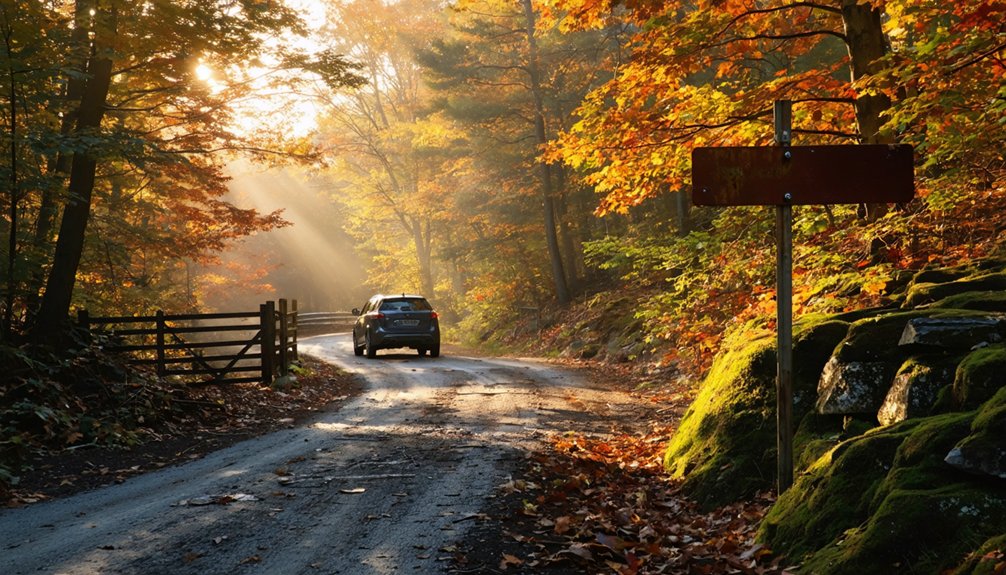
For smooth trail access and local parking, keep these three points in mind:
- Search correctly — Use “Greenbanks Hollow, Vermont” in your GPS or mapping app for accurate routing.
- Local parking — A small roadside pull-off near the covered bridge serves as your starting point; space is limited, so arrive early.
- Trail access — The ruins spread across a walkable forested area, so wear sturdy footwear and expect uneven terrain.
No entrance fee or reservation is currently required.
What to Bring to Greenbanks Hollow
Because Greenbanks Hollow is a preserved outdoor ruin site rather than a developed park, you’ll want to pack a few essentials before you head out. Wear sturdy shoes since you’ll be walking uneven, root-crossed terrain near stone foundations and cellar holes. Bring water, as there are no facilities on-site.
For photography tips, arrive in morning light when shadows add depth to the moss-covered walls and covered bridge. A wide-angle lens captures the full scale of the foundations, while a macro setting reveals the fine texture of historical preservation work done on the stonework.
Pack layers if you’re visiting in cooler months, since the tree canopy holds cold air. A printed map helps too, because cell service in Vermont’s Green Mountains can be unreliable.
What Else Near Greenbanks Hollow Is Worth the Stop?
Once you’ve walked the ruins at Greenbanks Hollow, the surrounding stretch of Caledonia County rewards a slower pace. You’re already deep in the Green Mountains, so use that momentum to explore what’s nearby.
- Scenic overlooks along Route 2 — Pull over where the ridgelines open up and let Vermont do the talking. The views shift beautifully with the season.
- Danbury and nearby villages — A few miles north, small towns offer a genuine feel without the tourist polish. Stretch your legs and look around.
- Local dining in St. Johnsbury — Drive east and you’ll find real kitchens serving Vermont-sourced food. It’s a worthy reward after a morning spent in the woods.
None of these stops demand much time, but each one adds weight to the day.
Before You Go: Safety at Abandoned Sites
Ghost town structures have stood without maintenance for decades. Floors, stairs and roof timbers fail without warning, and a building that looks solid from outside may not hold your weight. Stay out of standing structures unless the site is actively maintained and open to visitors.
Mine workings are the more serious hazard. Vertical shafts can be hundreds of feet deep, are often unfenced, and may be hidden by brush or capped with rotted boards. Never enter an adit, tunnel or shaft: abandoned workings can hold oxygen-poor or toxic air that gives no warning before you lose consciousness.
Enclosed spaces with rodent droppings carry a risk of hantavirus, which is contracted by breathing contaminated dust. Do not sweep or stir up dust inside old cabins and outbuildings.
Cell coverage at these sites is usually poor or absent. Tell someone your route and expected return time, and carry more water than you think you need.
Frequently Asked Questions
Is Greenbanks Hollow the Same Place as Buck Hollow, Vermont?
They’re likely the same place! You’ll find Greenbanks Hollow’s historical preservation efforts showcase stunning stone ruins perfect for wildlife observation. It’s Vermont’s forgotten mill village where freedom-seekers like you can explore authentically, so search “Greenbanks Hollow” for accurate directions.
Are Dogs Allowed at the Greenbanks Hollow Historic Site?
Better safe than sorry — the knowledge base doesn’t confirm specific dog safety or leash rules for Greenbanks Hollow. You’d want to contact local Vermont authorities directly before bringing your pup along.
Is There an Entrance Fee to Visit Greenbanks Hollow?
No entrance fee stands between you and Greenbanks Hollow’s rich historical preservation! You’ll freely explore stone foundations, ruins, and a restored covered bridge—all accessible visitor amenities welcoming curious adventurers ready to uncover Vermont’s fascinating, forgotten past.
How Long Does a Typical Visit to Greenbanks Hollow Take?
Like Thoreau wandering Walden, you’ll spend one to two hours exploring Greenbanks Hollow’s scenic viewpoints, wildflower blooms, and stone ruins — roaming freely at your own unhurried pace through Vermont’s quietly mesmerizing, history-rich forest landscape.
Is Greenbanks Hollow Accessible for Visitors With Mobility Limitations?
Greenbanks Hollow’s uneven terrain and forested paths limit wheelchair access and accessibility features. You’ll navigate root cellars, stone foundations, and natural ground, so it’s best suited for visitors who’re comfortable with rugged, unpaved outdoor exploration.
References
- https://www.youtube.com/watch?v=YrQNbrIrNT8
- https://jeff-foliage.com/2019/01/18/the-inn-at-buck-hollow-farm/
- https://en.wikipedia.org/wiki/List_of_ghost_towns_in_Vermont
- https://www.youtube.com/watch?v=2fvPo9iQC-w
- https://www.youtube.com/watch?v=gxePk0rsBx4
- https://kids.kiddle.co/List_of_ghost_towns_in_Vermont
- https://www.youtube.com/watch?v=TlGqCZdEdb4