Alaska’s ghost towns aren’t just abandoned — they’re being actively erased by permafrost, aggressive vegetation, and brutal Arctic winters. You’ll find copper empire ruins at Kennicott, gold rush remnants at Treadwell and Dyea, cliffside dwellings at Ukivok, industrial dredges at Chatanika, and an earthquake-obliterated Native village at Afognak. Each site tells a story of human ambition swallowed by wilderness. Stick around, and you’ll uncover the full haunting history behind every forgotten settlement.
Key Takeaways
- Kennicott, a copper mining town operational from 1903–1938, features a 14-story concentration mill and is designated a National Historic Landmark.
- Treadwell, near Juneau, operated from 1883–1917 and once housed five mills, stores, and Alaska’s first indoor swimming pool.
- Dyea served as a Klondike Gold Rush gateway in 1897–1898, rapidly abandoned after the gold rush collapsed.
- Chatanika, established in 1904, contains preserved gold dredges and is associated with ghost stories about spectral miners.
- Afognak, an ancient Alutiiq settlement, was abandoned after the devastating 1964 Good Friday earthquake destroyed the community.
Why Alaska’s Ghost Towns Feel More Abandoned Than Anywhere Else
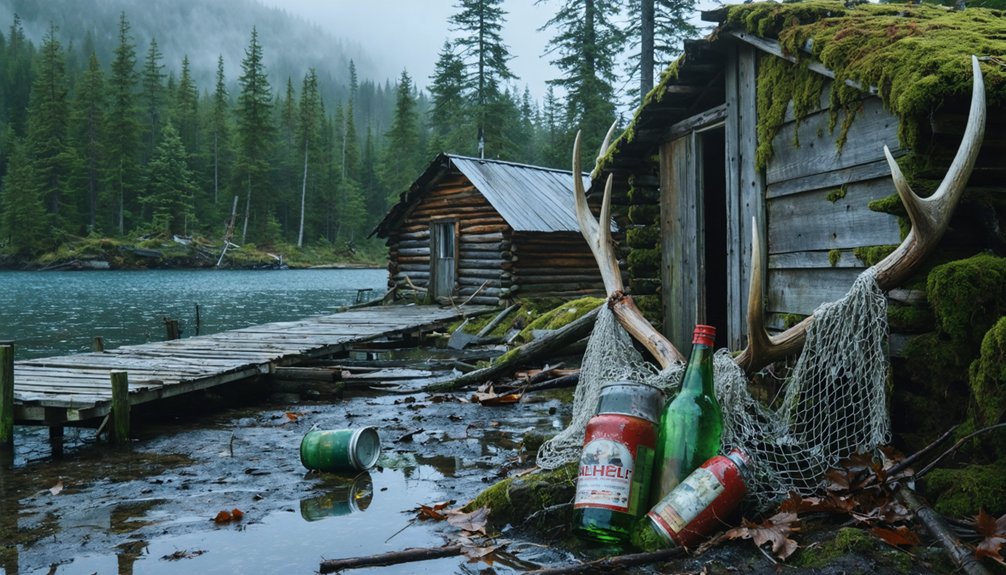
Alaska’s ghost towns don’t just feel abandoned — they feel *erased*. Unlike their counterparts in the American Southwest, these sites face brutal Arctic winters, seismic activity, and aggressive vegetation that accelerate decay beyond human intervention.
You’re not walking through preserved history — you’re witnessing active erasure.
Abandonment psychology hits differently here. When you stand in Ukivok or Dyea, the isolation amplifies your awareness of how completely civilization can vanish.
There’s no romantic decay — just raw, indifferent nature reclaiming what humans briefly claimed.
Historical preservation becomes nearly impossible against these forces. Remote locations, extreme weather, and limited funding mean most sites receive minimal protection.
What you experience isn’t curated nostalgia — it’s genuine impermanence, reminding you that freedom and wilderness ultimately answer to no one’s agenda.
Kennicott: The Copper Empire Frozen in Time
Not every ghost town surrenders quietly to erasure — Kennicott stands apart as a copper empire so thoroughly built that even a century of abandonment hasn’t fully swallowed it.
Prospectors Clarence Warren and Jack Smith discovered the richest copper mine on Kennecott Glacier in 1900, igniting an industrial operation that would define Alaska’s interior. The Kennecott Mining Corporation ran five mines from 1903 to 1938, constructing a 14-story concentration mill, power plants, hospitals, and bunkhouses.
Copper mining here wasn’t modest — it was an empire carved from wilderness. When operations ceased in 1938, workers simply walked away, leaving structures frozen mid-function.
Kennicott’s legacy endures through its National Historic Landmark designation, and you can still walk those grounds today, reading history directly from its weathered bones.
Treadwell: Juneau’s Forgotten Gold Mining City
If you’re exploring Alaska’s gold mining history, you can’t overlook Treadwell, a thriving settlement near Juneau that operated five mills, stores, mess halls, bunkhouses, and even Alaska’s first indoor swimming pool from 1833 to 1917.
You’ll find that the town’s remarkable industrial infrastructure once supported a robust community complete with a marching band, reflecting the scale and ambition of its mining operations.
Today, you can walk through Treadwell’s hauntingly beautiful ruins, which form one of the most visually striking ghost towns in the Juneau area, offering a tangible connection to Alaska’s pre-statehood economic history.
Treadwell’s Gold Mining Legacy
Tucked just outside Juneau, Treadwell stands as one of the most compelling relics of Alaska’s gold mining era, thriving from 1883 to 1917 before succumbing to the forces that ultimately claimed it.
Treadwell’s impact extended far beyond simple extraction — it built an entire civilization around gold, featuring five operational mills, stores, mess halls, and bunkhouses that supported a bustling workforce.
Your legacy exploration of this site reveals something remarkable: Alaska’s first indoor swimming pool, a natatorium, existed here long before modern conveniences reached most frontier settlements.
The community functioned as a self-sustaining enterprise, complete even with a marching band.
When mining operations ceased, nature reclaimed the infrastructure, transforming Treadwell into hauntingly beautiful ruins that you can still wander through today near Juneau.
Treadwell’s Abandoned Ruins Today
What remains of Treadwell today forms one of Southeast Alaska’s most evocative archaeological landscapes, where collapsing structures, overgrown foundations, and flooded mine shafts tell a story that the historical record alone can’t fully convey.
When you walk through these ruins, you’re encountering Treadwell history in its rawest form—nature aggressively reclaiming what industry once dominated.
The site’s Treadwell architecture, though heavily deteriorated, still reveals traces of the town’s remarkable scale: remnants of mill buildings, compressed-air pipe systems, and subterranean cavities where cave-ins swallowed entire structures after the 1917 flooding disaster.
You’ll find no reconstructed facades here, no sanitized museum experience—just authentic wreckage that demands your own interpretation.
Douglas Island preserves these ruins as a designated historic site, accessible via trail from Juneau.
Dyea: The Klondike Boomtown Nature Swallowed Whole
During the height of the Klondike Gold Rush in 1897–1898, Dyea served as a critical gateway for prospectors flooding into the Yukon, transforming almost overnight from a quiet Tlingit trade staging area and seasonal fishing camp into a bustling boomtown outside present-day Skagway.
At its peak, thousands chased fortune through its muddy streets, fueling one of the most dramatic chapters in Klondike history.
Once the gold rush collapsed, Dyea’s population evaporated just as rapidly as it had surged.
Nature reclamation moved swiftly and decisively — forests, grasses, and tidal flats quietly consumed what ambition had built.
Today, you’ll find little more than scattered foundations and overgrown remnants pressing through the soil, a sobering reminder that the wilderness always reclaims what humans abandon.
Ukivok: The Cliffside Village That Defied Gravity
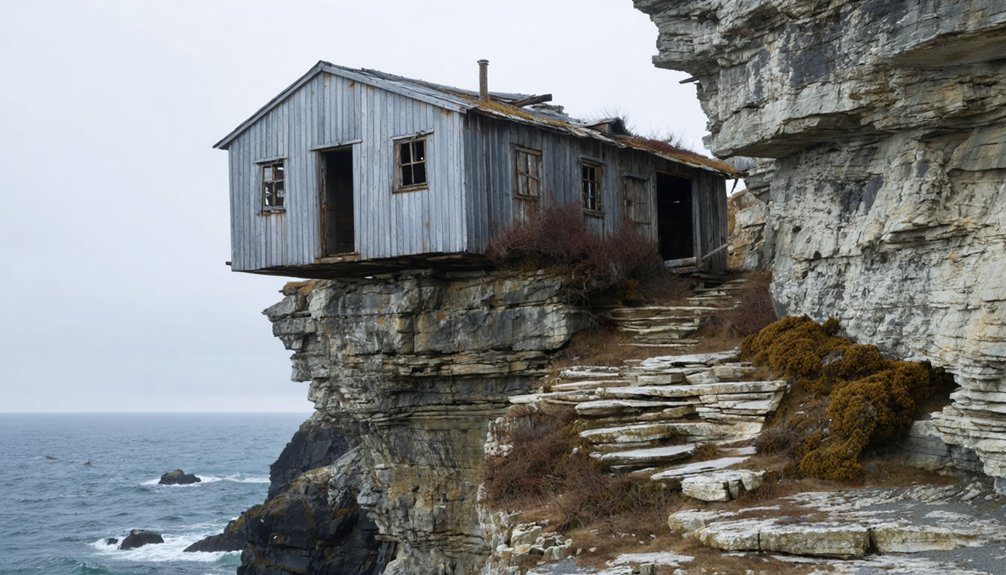
Perched on the near-vertical ocean cliffs of King Island in the Bering Sea, Ukivok stands as one of Alaska’s most visually arresting ghost towns — a settlement that seems to defy the basic physics of human habitation.
Built by the Aseuluk seafarers, Ukivok history reveals a community of extraordinary resilience and ingenuity. The cliffside architecture — wooden homes anchored against brutal Arctic winds and storms — represents a masterclass in adaptive construction.
Three defining features make Ukivok unforgettable:
- Homes literally clinging to nearly vertical slopes
- A dramatic silhouette visible against the Bering Sea skyline
- Abandonment completed between the 1950s and 1960s
You won’t find another ghost town anywhere that so powerfully captures humanity’s determination to carve freedom from an unforgiving landscape.
Chatanika: Gold Dredges and Ghost Stories Near Fairbanks
When you visit Chatanika, you’re stepping into a gold rush boom town that took root in the Fairbanks North Star Borough in 1904, drawing prospectors keen to extract the region’s rich mineral wealth.
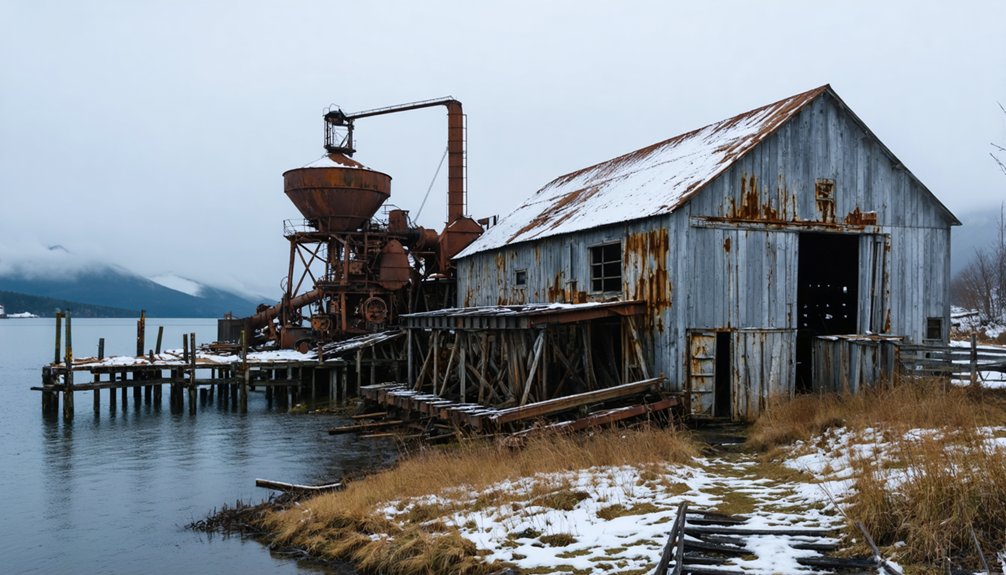
You’ll find the most striking remnants of that era in the giant dredges left scattered across the landscape, massive mechanical witnesses to an industry that once defined Interior Alaska.
Today, you can also explore Chatanika’s ghostly reputation, as locals and visitors alike report eerie encounters among the rusting equipment and weathered structures that time has refused to fully erase.
Chatanika’s Gold Rush Origins
Nestled in the Fairbanks North Star Borough, Chatanika emerged as a gold rush boom town in 1904, fueled by the discovery of placer gold deposits in the region’s river valleys.
Chatanika’s history reflects the rugged independence that defined Alaska’s frontier spirit. Miners employed evolving gold mining techniques to extract wealth from the frozen earth:
- Hydraulic sluicing — directing pressurized water to expose buried gold deposits
- Drift mining — tunneling through permafrost to reach gold-bearing gravel layers
- Mechanical dredging — deploying giant dredges to systematically process riverbeds
You can still see remnants of these methods scattered across the landscape today. Each technique represents a chapter in humanity’s relentless pursuit of freedom through self-determination, carving opportunity directly from Alaska’s unforgiving but rewarding wilderness.
Giant Dredges Left Behind
As Chatanika’s mining boom faded, it left behind some of the most striking industrial relics in Alaska’s interior: massive gold dredges that still sit frozen in time along the valley floor.
You’ll find these monuments to dredge technology standing largely intact, their bucket lines and machinery preserved by the cold, dry climate.
These mining artifacts offer you a rare, unfiltered look at how industrialized gold extraction reshaped Alaska’s interior landscape.
The Eldorado Gold Mine, operating nearby, keeps one dredge accessible for tours, letting you walk through history hands-on.
Unlike sanitized museum exhibits, Chatanika’s dredges remain raw and unrestored, demanding your respect for the brutal efficiency they once represented.
They’re not just relics — they’re honest evidence of an industry that transformed an entire region.
Ghostly Tales Today
Three narratives define Chatanika’s ghostly identity today:
- Spectral miners reportedly wander the dredge fields at dusk, still chasing veins that played out a century ago.
- Unexplained sounds — mechanical groaning, distant voices — echo through the Interior’s frigid nights.
- Shadow figures near the historic roadhouse fuel persistent speculation among independent researchers.
You don’t need to believe in ghosts to feel Chatanika’s weight.
Its silence speaks loudly enough.
Afognak: The Native Village an Earthquake Erased
Afognak’s roots stretch back to around 5500 B.C.E., when the Native Alutiiq people first established a settlement that would endure for millennia.
Russia colonized this resilient community in 1784, weaving European influence into its rich Afognak history. For centuries, the village thrived against Alaska’s harsh conditions, preserving a culture that predated Western civilization by thousands of years.
Then, on March 27, 1964, everything changed. The catastrophic Good Friday earthquake, one of the most powerful ever recorded, delivered a devastating earthquake impact that the community couldn’t survive.
Located in the Kodiak Island Borough, Afognak suffered irreparable destruction, forcing residents to permanently abandon their ancestral homeland. You’ll find no rebuilding effort followed — the village simply ceased to exist, leaving behind a haunting silence that nature has since reclaimed entirely.
Which Alaska Ghost Towns Are Open to Visitors?
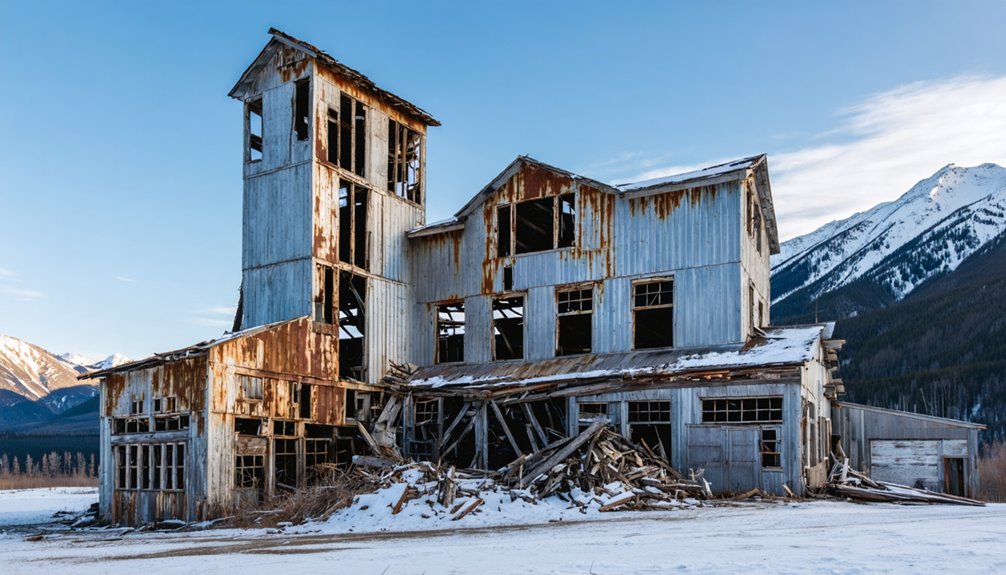
Whether you’re planning a trip through Alaska’s storied past or simply curious about what remains accessible, several of these ghost towns welcome visitors today.
Alaska’s ghost towns still welcome visitors, offering rare glimpses into a storied past waiting to be explored.
- Kennicott offers guided tours through its 14-story concentration mill, giving you direct access to one of Alaska’s most compelling National Historic Landmarks.
- Treadwell, near Juneau, lets you explore hauntingly beautiful ruins where visitor experiences reveal the industrial scale of early gold mining operations.
- Dyea, outside Skagway, remains open to hikers and history enthusiasts enthusiastic to walk terrain tied directly to the Klondike Gold Rush’s historical significance.
You’ll find each site rewards careful exploration.
Access conditions vary seasonally, so check current trail and tour availability before visiting to maximize your experience at these irreplaceable locations.
How to Explore Alaska Ghost Towns Without Getting Into Trouble
Knowing where you can go is only half the equation—how you conduct yourself once you’re there determines whether your visit enriches your understanding or creates problems for you and future explorers.
Respect the historical significance of each site by leaving artifacts undisturbed; federal law prohibits removing objects from protected landmarks like Kennicott.
Take standard safety precautions before entering any structure—deteriorating floors, unstable walls, and exposed nails are genuine hazards in places like Ukivok and Treadwell.
Tell someone your itinerary, carry emergency supplies, and understand that remote sites like Dyea offer no cell coverage.
Photograph freely, document thoroughly, and share what you learn. Your responsible behavior preserves access for everyone who values these irreplaceable windows into Alaska’s past.
Frequently Asked Questions
Are Any Alaska Ghost Towns Haunted by Reported Paranormal Activity?
You’ll find that Alaska’s ghost towns carry a haunted history, though documented paranormal reports remain scarce. Visitors to Ukivok and Kennicott often describe eerie encounters, sensing lingering presences amid abandoned structures battered by Alaska’s unforgiving elements.
Can Visitors Legally Take Artifacts or Souvenirs From Alaska Ghost Towns?
Like sacred relics frozen in time, you can’t legally remove artifacts from Alaska’s ghost towns. Strict legal regulations govern artifact preservation, protecting these historic sites. Respect these laws—they’re your duty as a freedom-loving, responsible visitor.
What Wildlife Commonly Inhabits Abandoned Alaska Ghost Town Buildings Today?
When you explore Alaska’s ghost towns through urban exploration, you’ll encounter remarkable wildlife adaptations: bears, foxes, ravens, owls, and rodents commonly inhabit abandoned structures, utilizing decayed buildings as dens, nesting sites, and shelter from harsh elements.
Are There Guided Photography Tours Specifically Focused on Alaska Ghost Towns?
You’ll find guided tours at Kennicott and Skagway’s Dyea that cater specifically to photographers. These experiences offer invaluable photography tips, letting you capture hauntingly beautiful ruins while exploring Alaska’s remarkable abandoned history independently.
Do Any Alaska Ghost Towns Appear in Films or Television Productions?
Yes, you’ll find Alaska’s ghost towns serving as film locations and inspiring television adaptations. Kennecott and Skagway’s Dyea have captivated producers seeking authentic, haunting backdrops that powerfully convey frontier freedom, historical drama, and America’s untamed wilderness spirit.
References
- https://en.wikipedia.org/wiki/List_of_ghost_towns_in_Alaska
- https://thealaskafrontier.com/ghost-towns-in-alaska/
- https://www.youtube.com/watch?v=TC_KPrhDByY
- https://www.atlasobscura.com/things-to-do/alaska/ghost-towns
- https://www.alaska.org/detail/kennicott-mine-ghost-town-walking-tour
- https://motorcyclemojo.com/2015/09/alaska-ghost-towns/
- https://www.gi.alaska.edu/alaska-science-forum/ghost-towns-scattered-across-alaska-map
- https://www.youtube.com/watch?v=Cz0IGc2Uy0E