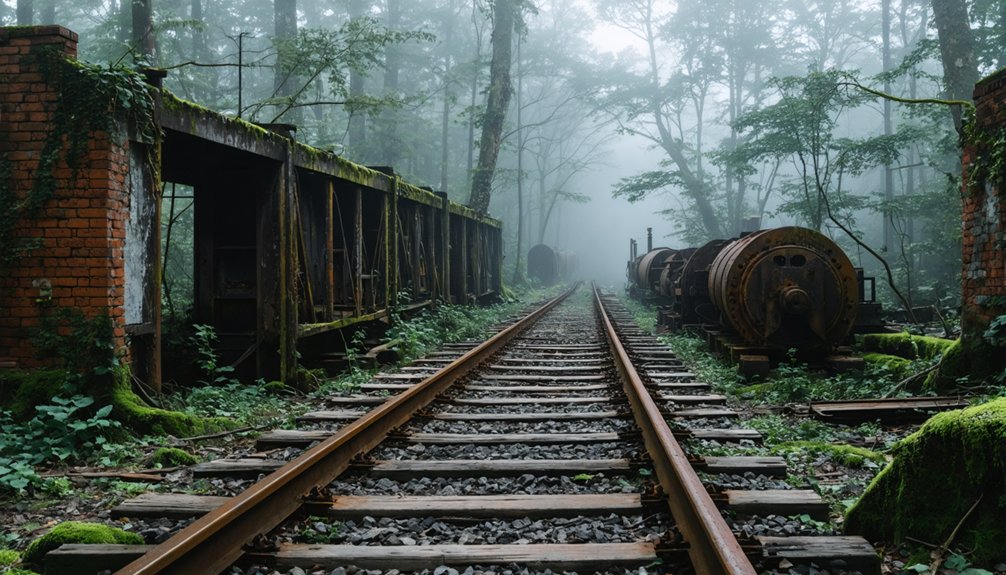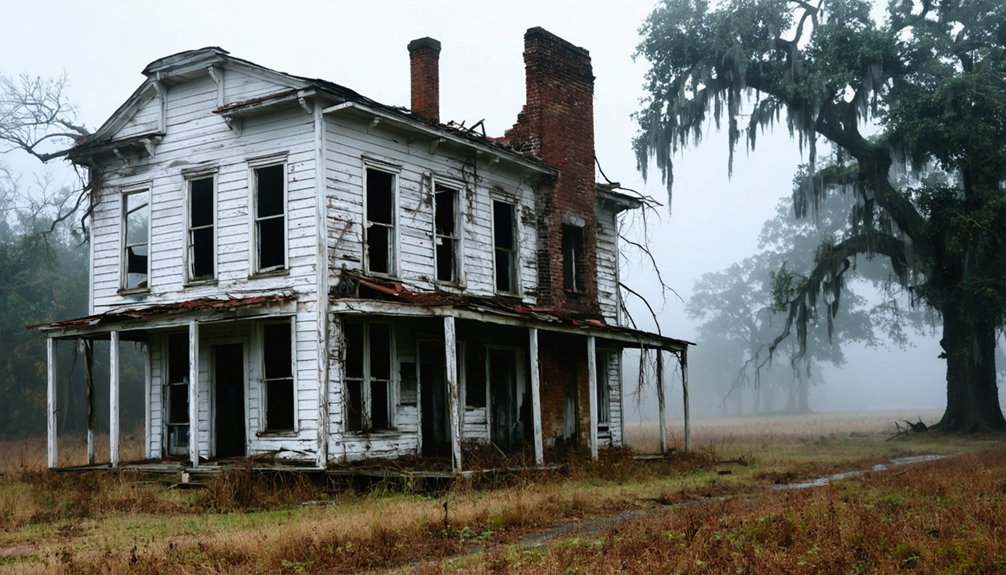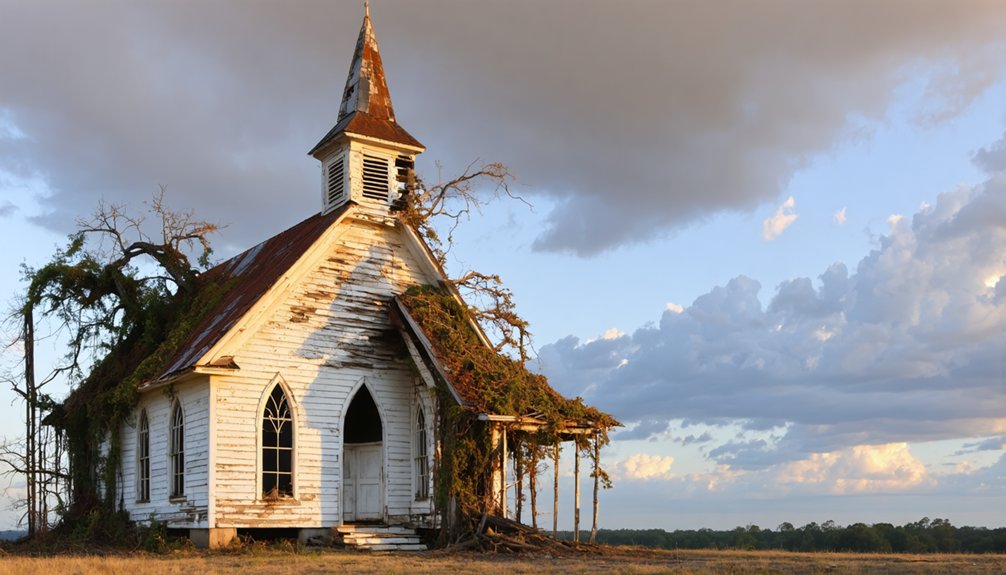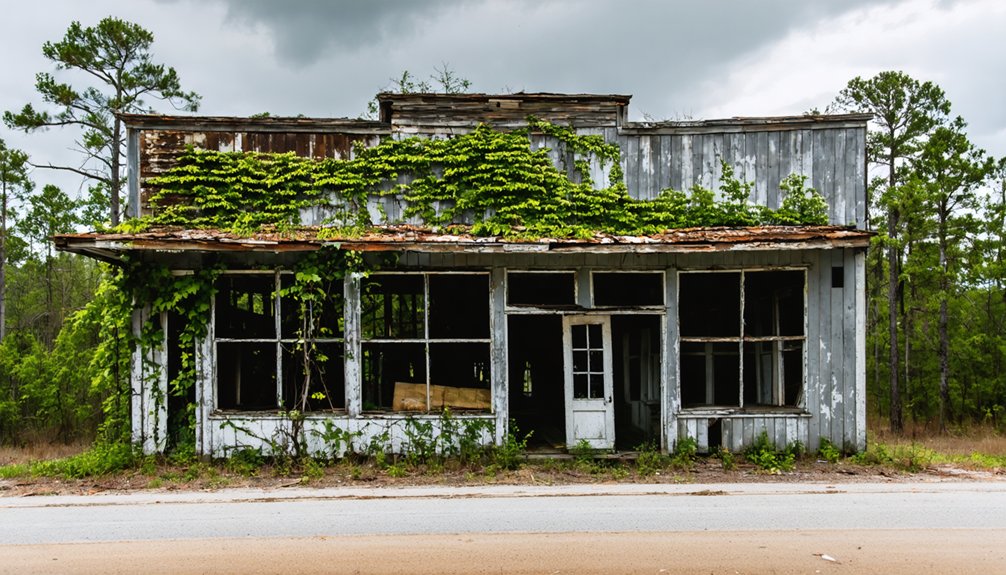
Georgia’s ghost towns tell stories you won’t find in most history books. You’ll discover nearly 1,800 vanished communities scattered across the state—abandoned after gold rushes collapsed, mills closed, railroads bypassed, and government dams swallowed entire towns underwater. Sites like Auraria, Scull Shoals, and Allatoona each reflect distinct forces that erased once-thriving communities. Some retain ruins and cemeteries; others have reverted to forest or sunk beneath reservoirs. Each site reveals far more than it first appears.
Key Takeaways
- Auraria thrived during Georgia’s 1820s gold rush but collapsed after richer strikes elsewhere, leaving overgrown foundations behind.
- Scull Shoals was abandoned after its mills closed, leaving industrial ruins that reflect Georgia’s economic decline.
- Allatoona was submerged beneath Lake Allatoona after a government dam project, leaving no visible structures today.
- Archival surveys have documented approximately 1,796 vanished or historical sites across Georgia, illustrating the broad scope of ghost towns.
- Sunbury is among Georgia’s oldest colonial ghost towns, with preserved ruins and cemeteries dating back to the 1700s.
Georgia Ghost Towns: Gold Rushes, Mill Closures, and Flooded Cities
Georgia’s ghost towns didn’t fade for a single reason—they collapsed under the weight of gold-rush busts, mill closures, railroad bypasses, agricultural decline, and government flood projects.
When California’s gold fields opened, Auraria emptied fast. When mills shut down, Scull Shoals went silent. When the Army Corps of Engineers dammed the Etowah River, Allatoona disappeared beneath Lake Allatoona entirely.
You’re looking at a pattern of economic and political forces that repeatedly erased communities across the state.
One archival survey documented 1,796 vanished or historical Georgia sites, confirming how widespread this loss runs.
Today, several of these locations function as tourist attractions drawing visitors interested in ruins, cemeteries, and forgotten history.
Historic preservation efforts at select sites work to document what remains before it disappears completely.
Why Georgia Has So Many Abandoned Towns
Few states match Georgia’s density of abandoned communities, and the reasons stack up fast. Urban decay didn’t happen overnight here — it accumulated through specific, documentable events that stripped towns of their economic purpose and left cultural heritage behind in ruins.
Few states match Georgia’s density of abandoned communities — decay that accumulated through specific, documentable events.
Three forces drove most of the abandonment you’ll find across Georgia:
- Gold ran out — North Georgia mining camps emptied once California and Colorado offered richer strikes, taking entire populations with them.
- Railroads rerouted — Towns built around rail access collapsed when lines shifted, cutting off commerce permanently.
- Government projects displaced residents — Allatoona disappeared beneath a reservoir in the 1940s by deliberate design.
One archival survey documents 1,796 vanished or historical sites statewide. That number tells you everything about how thoroughly Georgia’s landscape changed.
The Most-Visited Georgia Ghost Towns and What Happened to Them
Among Georgia’s hundreds of abandoned places, a handful draw consistent attention from historians, photographers, and curious travelers — and each one collapsed for a distinct, documentable reason. Auraria emptied after gold seekers chased richer strikes in California and Colorado.
Scull Shoals lost its economic foundation when its mills closed, leaving ruins and hidden artifacts scattered across the Greene County landscape.
Allatoona disappeared entirely beneath Lake Allatoona in the mid-1940s, a government-driven erasure.
Oscarville and Sunbury round out the most-referenced list, both carrying haunted legends tied to displacement and colonial-era decline.
You’ll find that each site represents a different mechanism of collapse — economic, industrial, hydrological, or social.
Understanding what killed each town gives you a clearer framework for reading Georgia’s broader pattern of abandonment.
North Georgia’s Lost Gold Rush Settlements
If you trace Georgia’s ghost-town history back to its roots, you’ll find that North Georgia’s gold rush—predating California’s 1849 rush by more than two decades—sparked the rapid rise of mining settlements like Auraria in Lumpkin County.
Auraria flourished as prospectors flooded the region, but when richer strikes drew them west, the town’s population collapsed and its economy never recovered.
The same pattern erased dozens of smaller camps and supply towns across the North Georgia hills, leaving behind little more than overgrown foundations and scattered cemeteries.
Georgia Gold Rush Origins
Before California’s gold rush captured the national imagination, Georgia had already experienced its own mineral frenzy in the North Georgia hills. Discoveries near Dahlonega and Auraria drew thousands of fortune-seekers, fundamentally reshaping the region’s landscape and communities.
Consider what that era left behind:
- Entire towns rose and collapsed within decades, stripping families of their livelihoods overnight.
- Cherokee communities were violently displaced to make room for prospectors hungry for wealth and freedom.
- Historical preservation efforts now protect what little remains, transforming former boomtowns into tourist attractions you can actually visit today.
You’re looking at a defining American pattern: rapid extraction, sudden abandonment, and silence. Georgia’s gold rush origins explain why so many North Georgia communities exist today only as ruins and memories.
Auraria’s Rise And Fall
Auraria stands as one of the clearest examples of what the Georgia Gold Rush built—and then erased. Located in Lumpkin County, it emerged as a thriving settlement in the 1820s, drawing miners, merchants, and speculators to North Georgia’s gold-rich hills.
You can trace its peak to the early rush years, when commerce moved fast and fortunes seemed certain. Then California called in 1849, and Colorado followed. People left, businesses folded, and Auraria hollowed out.
Today, it functions less as a bustling community and more as a marker of historical preservation efforts in a region that once shaped Georgia’s economy. While it doesn’t rank among the state’s major tourist attractions, Auraria still draws those who want to see where America’s first significant gold rush began and collapsed.
Mining Towns Left Behind
Though Auraria draws the most attention, it wasn’t the only North Georgia settlement that gold built and abandonment swallowed. Dozens of camps rose fast, drew desperate men, then emptied just as quickly when richer strikes pulled everyone west.
What these towns left behind still speaks:
- Rusted mining equipment scattered across creek beds — silent proof that real people bet everything here and lost.
- Town legends passed through generations, keeping names alive that no map currently honors.
- Overgrown foundations where families once built ordinary lives around extraordinary hope.
You can walk these ridgelines today and feel the weight of that departure. North Georgia’s gold country doesn’t just hold history — it holds the evidence of what happens when economic foundations collapse without warning.
Central Georgia’s Mill Towns That Industry Left Behind
While North Georgia’s ghost towns often trace their origins to gold fever, Central Georgia’s abandoned settlements tell a different story—one driven by industrial collapse and agricultural decline.
Mill towns like Scull Shoals in Greene County once anchored regional economies through textile and paper production. When those industries failed, communities collapsed with them.
When the mills went silent, so did the towns that existed because of them.
Economic shifts stripped these towns of their purpose. The boll weevil devastated cotton-dependent local economies, and mill closures eliminated the jobs holding residents in place.
You can still find ruins, overgrown foundations, and isolated cemeteries marking where these communities once stood.
Industrial decline didn’t happen overnight—it unfolded across decades, leaving behind a landscape that reflects both human ambition and economic vulnerability.
Central Georgia’s ghost towns stand as documented evidence of what happens when an industry disappears.
Coastal Georgia’s Forgotten Colonial Settlements
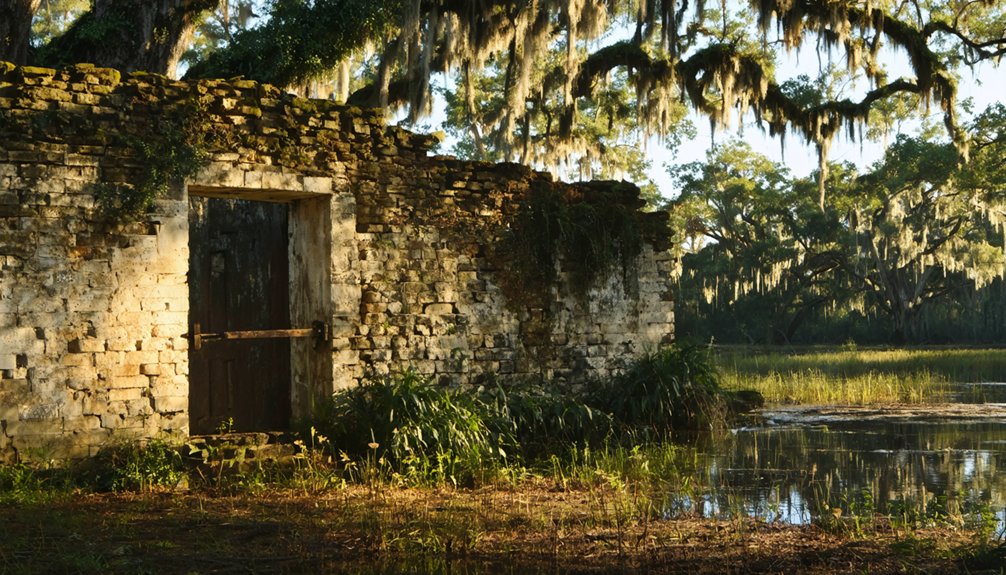
Coastal Georgia’s ghost towns carry a distinct historical weight—several trace their origins to the colonial era, making them among the oldest abandoned settlements in the state. Sunbury and New Ebenezer represent communities that once held real political and economic power before time, coastal erosion, and shifting trade routes erased them from relevance.
When you walk these sites, you’re standing inside documented history:
- Sunbury once rivaled Savannah as a port—now it’s silence and cemetery stones.
- New Ebenezer preserves rare colonial-era ruins that marine archaeology continues to inform.
- Coastal erosion has permanently destroyed physical evidence that no archive can recover.
These aren’t romanticized ruins. They’re tangible proof that prosperity is never permanently guaranteed, and freedom requires actively preserving what remains.
What Physical Evidence Survives at Georgia Ghost Town Sites Today?
Depending on the site, what survives at Georgia ghost towns ranges from standing structures to nothing visible at all. You’ll find historical architecture at some locations — churches, mills, schools, and general stores in varying states of decay. Others preserve cemeteries with graves dating to the 1700s, functioning as cultural landmarks even when every building has collapsed.
Scull Shoals retains industrial ruins, while Allatoona exists entirely underwater, visible only during low water levels. Some sites have reverted to forest or pasture with no structural evidence remaining.
One archival survey documents 1,796 vanished or historical places across Georgia, confirming how broad this landscape actually is. What you encounter depends entirely on which site you’re visiting and how much time and neglect have shaped it.
Frequently Asked Questions
Are Any Georgia Ghost Towns Located on Private Property?
Yes, many Georgia ghost towns sit on private land. You’ll need to respect private property laws and trespassing regulations before exploring. Always research ownership and secure permission to preserve your freedom while staying legally protected.
Can You Legally Take Artifacts Found at Georgia Ghost Town Sites?
Think twice before pocketing that relic — artifact laws impose strict legal restrictions on you. You can’t legally remove artifacts from public lands, and private property sites require explicit owner permission first.
Are Georgia Ghost Towns Dangerous to Visit?
You’ll face real risks at abandoned structures, from unstable floors to collapsing roofs. Haunted legends draw curious visitors, but physical hazards pose documented dangers. You’re responsible for evaluating conditions and making informed, independent decisions before entering any site.
Do Any Georgia Ghost Towns Appear on Official State Historic Registers?
Yes, you’ll find several carry the torch of historical preservation—Sunbury and Scull Shoals hold official recognition, making them documented tourist attractions where Georgia’s past isn’t just remembered; it’s formally protected and freely yours to explore.
Are Guided Tours Available at Any Georgia Ghost Town Locations?
You’ll find guided tours at select sites like Scull Shoals, where you can explore haunted stories and seize photography opportunities. Rangers and local historians actively lead documented walks through these fascinating, freedom-rich abandoned landscapes.
References
- https://en.wikipedia.org/wiki/List_of_ghost_towns_in_Georgia_(U.S._state)
- https://en.wikipedia.org/wiki/Category:Ghost_towns_in_Georgia_(U.S._state)
- https://www.youtube.com/watch?v=U5v5DrrV82s
- https://roughdraftatlanta.com/2021/05/23/travels-with-charlie-georgias-ghost-towns-slideshow/
- https://www.youtube.com/watch?v=a7pU0FYaO9I
- https://www.youtube.com/watch?v=thL6kv4p4-g&vl=en-US
- https://www.youtube.com/watch?v=lzP7R2kmjII
- https://ghosttowntrails.com/georgia
- https://en.wikipedia.org/wiki/Lists_of_ghost_towns_in_the_United_States
- https://www.youtube.com/watch?v=E4dYqKefiNg