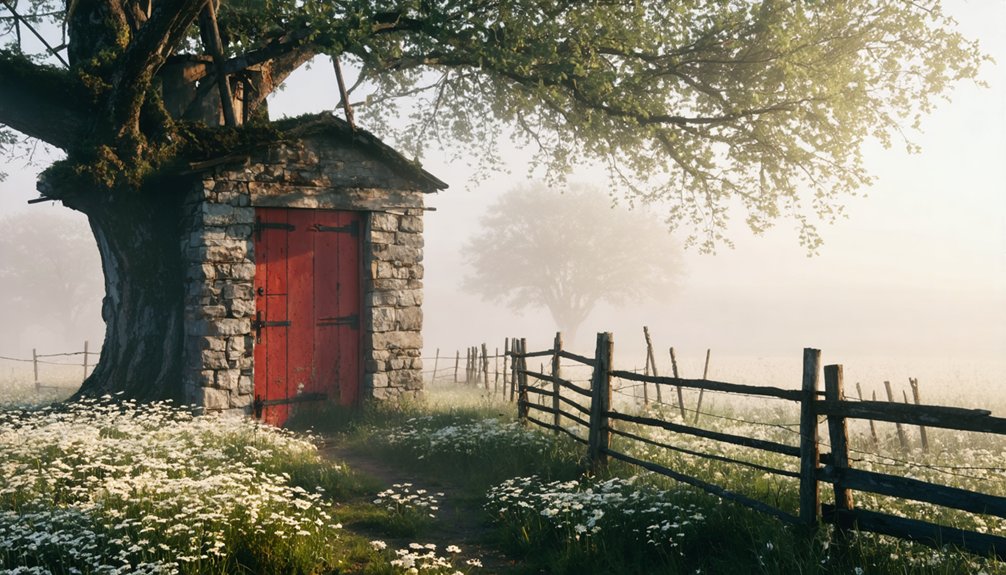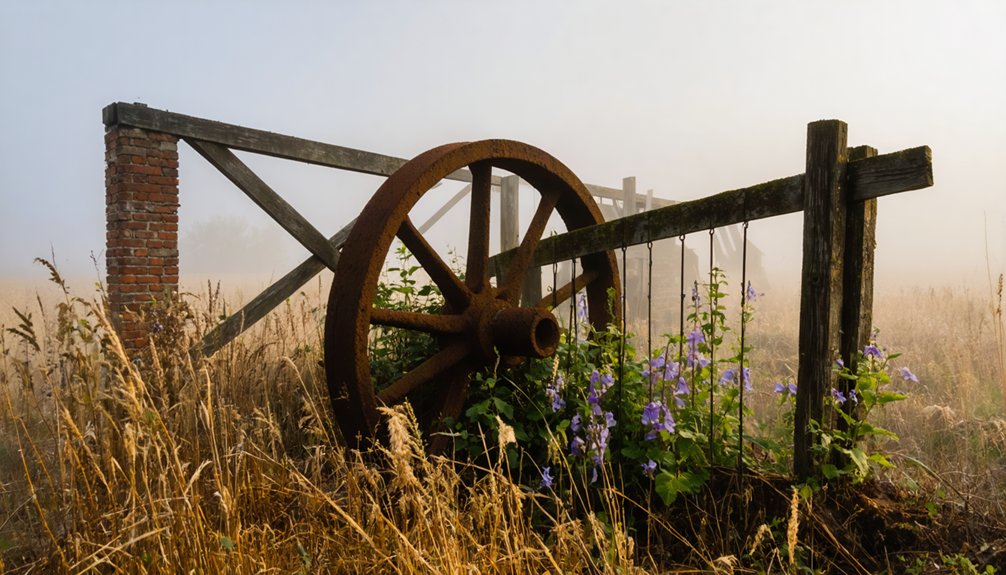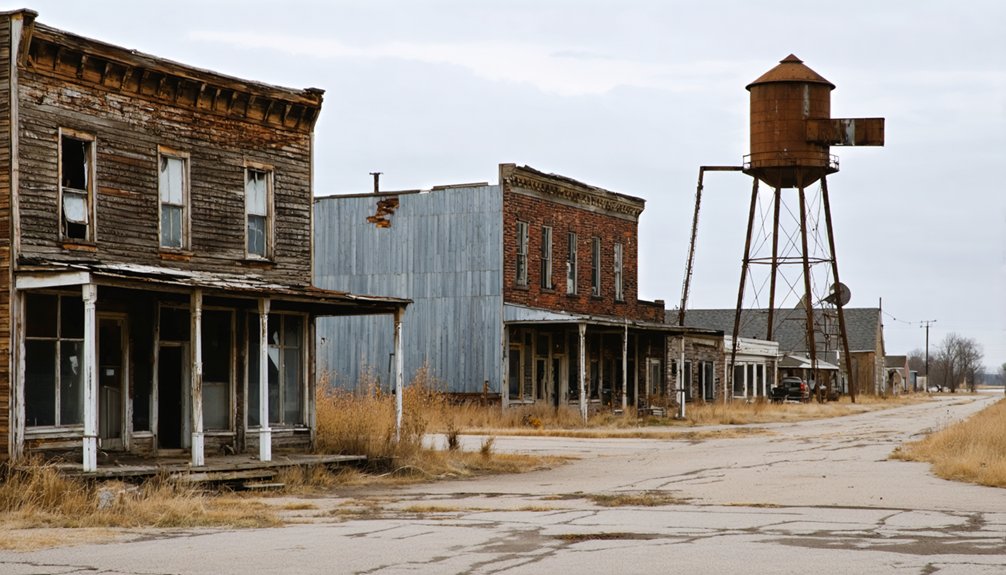
You’ll discover over 100 abandoned settlements across Iowa’s 99 counties, where thousands once lived before vanishing between the 1850s and 1960s. Railroad towns like Vinton emerged in 1869 but declined when air travel dominated by the 1950s. Coal mining communities like Buxton peaked at 10,000 residents before disappearing post-WWI. Eight towns now rest beneath Lake Red Rock’s waters since 1969, while architectural remnants from stagecoach stops like Buckhorn’s 1836 church still stand as haunting markers of these forgotten communities’ complex histories.
Key Takeaways
- Railroad expansion in the 1850s-1870s created towns like Vinton and Knowlton that declined when air travel replaced trains.
- Coal mining boom produced towns like Buxton with 10,000 residents that vanished after mines closed in the 1920s.
- Eight communities, including Red Rock and Coalport, were submerged beneath Lake Red Rock between 1960-1969.
- Preserved remnants like Buckhorn’s church and Edinburgh Manor’s 1910 mental institution mark former settlements.
- Stagecoach stops like Dalmanutha disappeared as railroads expanded, leaving only cemeteries and scattered ruins.
How Railroads Created and Destroyed Iowa Communities
When Iowa’s first railroad, the Mississippi & Missouri, completed its initial 12 miles between Davenport and Walcott in June 1855, it sparked a transformation that would reshape the state’s landscape for the next century. You’ll find towns like Vinton and Knowlton that sprang to life when rails arrived in 1869, with residents building freight storehouses, grain elevators, hotels, and banks around depot areas.
The Wabash Railroad expanded to over 2,000 miles across the Midwest during the 1870s, making Iowa epitomize railroading in America’s breadbasket.
But air travel swiftly overtook trains by the 1950s, transforming these communities into fly-over country. You can still trace abandoned railroad infrastructure where the Wabash began its 1983 abandonment and Vinton’s depot closed in 1967, marking changing economic landscapes that turned thriving railroad towns into ghost towns.
Coal Mining Towns That Vanished Beneath the Surface
While railroads determined which Iowa towns survived by their proximity to tracks, coal mining communities faced an even more precarious existence—they literally depended on what lay beneath their feet. By 1895, over 6,000 miners worked Iowa’s 342 coal mines, with numbers doubling by the industry’s 1920s peak.
Buxton exemplified both triumph and tragedy:
- Founded around 1900, it became America’s most successful integrated community with 5,000 residents
- The Consolidation Coal Company built complete infrastructure including recreational activities in coal mining regions
- By mid-1920s, it vanished entirely when coal deposits depleted
Moran, Angus, Scandia, and Phildia followed similar paths—booming then disappearing by 1940. Today, farmland covers these sites. Yet the cultural legacies of mining towns endure through preserved records, proving communities built on freedom and opportunity transcend physical existence.
Lake Red Rock: Eight Towns Lost to Progress
Unlike mining towns that disappeared gradually as coal veins ran dry, eight Iowa communities vanished abruptly beneath Lake Red Rock‘s waters between 1960 and 1969. You’ll find Red Rock, established by John Bedell in 1845, was the longest-lasting settlement—its school operated over a century before the Corps of Engineers arrived.
Coalport, platted in 1857, shipped Marion County‘s first coal via Des Moines River steamboats until the waterway shifted course in 1903.
The government selected this location in 1948 over Howell Station, purchasing properties in the early 1960s with fair compensation. Most residents built life after relocation elsewhere, though Red Rock Cemetery remains on the north bluff.
Today, commemorative plaques mark what’s submerged, while rare low-water conditions occasionally reveal rooftops and old street foundations.
Remnants Still Standing in Iowa’s Abandoned Settlements
Five distinct sites preserve tangible evidence of Iowa’s vanished communities, where structures still stand against decay. You’ll discover spooky architectural remnants that reveal Iowa’s forgotten past through three remarkable locations:
Iowa’s abandoned structures stand as haunting sentinels, preserving fragments of forgotten communities through weathered stone, rusted iron, and crumbling architectural remnants.
- Buckhorn’s Trinity – The church, creamery, and cemetery stand since 1836, where the creamery once produced 34 million pounds of butter (1899-1952) and hosted legendary picnics drawing 5,000 attendees.
- Terra Haute’s Schoolhouse – This Decatur County relic persists amid overgrown general store ruins, offering peaceful yet eerie exploration.
- Edinburgh Manor – Built in 1910, this Scotch Grove mental institution now provides paranormal exploration experiences with crumbling walls and decaying interiors attracting ghost hunters.
Elkport’s stone ruins and Banwell Bridge’s abandoned iron truss structure complete your journey through Iowa’s accessible, haunting landmarks.
From Bustling Commerce to Complete Disappearance
Iowa’s ghost towns emerged from thriving commercial centers that anchored regional economies through the mid-1800s. You’ll find Buckhorn’s antler themed hospitality defined its identity as a Dubuque County stage coach stop, while Dalmanutha operated as a strategic hub along Western Coach routes after 1855.
The stage coach era adaptation couldn’t withstand railroad expansion—Dalmanutha declined when tracks bypassed southern Guthrie County, and Morrisburg collapsed after losing its transportation relevance. Buxton exemplified this pattern dramatically, peaking at 10,000 residents as the Mississippi’s largest coal-mining city before post-WWI mine closures erased everything.
Today, Coalport sits submerged under Lake Red Rock, Morrisburg’s buildings were relocated, and Buxton left no remnants—complete disappearances from landscapes that once sustained thousands through commerce and industry.
Frequently Asked Questions
Are Iowa’s Ghost Towns Safe to Visit and Explore Today?
You’ll find Iowa’s ghost towns generally safe to explore, with crime rates below national averages. Potential safety concerns include unstable structures in abandoned buildings. Local preservation efforts vary by site, so you’d better stick to public roads and daytime visits.
One particularly intriguing area is the abandoned buildings in Motor, Iowa, where remnants of past commerce linger among the cracked facades. It’s a haunting glimpse into the area’s history, offering a unique backdrop for photographers and urban explorers alike. Just be sure to take caution, as some structures may be more unstable than they appear.
Can You Legally Remove Artifacts or Items From Abandoned Iowa Towns?
Ironically, abandoned doesn’t mean free-for-all. You can’t legally remove artifacts without obtaining permits on public lands or respecting private property rights. Most Iowa ghost towns sit on regulated land where collection requires explicit landowner permission or official authorization.
What’s the Oldest Documented Ghost Town in Iowa’s History?
Indianapolis, founded in 1844 by Willis Baker in Mahaska County, is Iowa’s earliest documented settlement turned ghost town. Abandoned town records show it thrived as a trading hub before decline, leaving only its cemetery as proof of existence.
Do Any Ghost Towns in Iowa Have Reported Paranormal Activity?
You’ll find Iowa’s “ghost” towns earn their name twice over—reported sightings of apparitions and claimed supernatural occurrences plague several abandoned settlements. Freedom-seekers document unexplained phenomena in decaying structures, though skeptics argue isolation breeds imagination more than spirits.
Which Iowa Ghost Town Had the Largest Population Before Abandonment?
Buxton had Iowa’s largest ghost town population at 10,000 residents before abandonment. You’ll find historical economic factors—exhausted coal seams and post-WWI demand collapse—caused this integrated mining community’s complete shutdown, scattering its once-thriving population across America.