If you’re exploring Kansas’s old ghost towns, you’ll find over 6,000 abandoned or semi-abandoned communities shaped by railroad bypasses, agricultural mechanization, economic collapse, and environmental disasters. Towns like Diamond Springs, Elmdale, and Dunlap each tell a distinct story through crumbling storefronts, limestone foundations, and shuttered post offices. They’re not always fully deserted — some still have remaining residents. Understanding what drove these communities to collapse reveals a deeper pattern across Kansas’s 105 counties that’s worth uncovering.
Key Takeaways
- Kansas has over 6,000 ghost towns ranging from fully abandoned settlements to semi-ghost towns still housing a few remaining residents.
- Railroads heavily influenced town survival; communities bypassed by rail routes quickly lost businesses, post offices, and populations.
- Notable ghost towns include Dunlap, LeHunt, Elmdale, and Diamond Springs, each reflecting unique histories of decline and abandonment.
- Physical remnants like limestone foundations, collapsed storefronts, and cellar depressions help document and interpret Kansas’s ghost town histories.
- Causes of abandonment include railroad shifts, agricultural mechanization, the Great Depression, and environmental disasters like severe flooding.
What Makes a Town a Kansas Ghost Town?
Before you can appreciate the sheer scale of Kansas’s ghost town phenomenon, you’ve got to understand what actually qualifies a settlement for that designation. A ghost town isn’t strictly an abandoned place. It’s any settlement that’s lost its commercial, civic, or population center, even if a few residents remain.
You’ll find that urban decay and population decline are the defining markers, whether you’re looking at crumbling storefronts, shuttered post offices, or vacant lots where businesses once operated. Kansas ghost towns include both incorporated places and fully extinct, unincorporated settlements.
The Kansas Historical Society estimates the state holds more than 6,000 such towns, a figure so vast that researchers acknowledge the list remains incomplete. Recognizing this spectrum helps you accurately distinguish a semi-ghost town from a fully abandoned one.
The Reasons Kansas Has Over 6,000 Ghost Towns
Several converging forces drove Kansas to accumulate such a staggering number of ghost towns, and understanding each one clarifies why the phenomenon scaled so dramatically across the state. Railroad route shifts bypassed dozens of settlements overnight, triggering immediate economic decline.
Several converging forces drove Kansas’s ghost towns, with railroad route shifts bypassing settlements overnight and triggering immediate economic collapse.
Agricultural mechanization eliminated labor demands that had originally justified small rural communities. When post offices and rail stations closed, population migration accelerated, stripping towns of their commercial and civic cores.
The Great Depression compounded existing vulnerabilities, collapsing local economies that were already fragile. Environmental shocks, including severe flooding, pushed remaining residents out permanently.
You’ll find that no single cause explains the full count; instead, these pressures compounded across generations, systematically dismantling thousands of communities and leaving behind the vast ghost-town landscape Kansas carries today.
Ghost Towns the Railroads Left Behind
Railroad expansion and contraction shaped Kansas settlement more decisively than almost any other single force, and the towns it erased tell that story with particular clarity. When rail routes shifted or bypassed communities entirely, commercial life collapsed almost overnight. Post offices closed, merchants relocated, and populations followed the tracks elsewhere.
You can trace this pattern across dozens of Kansas counties, where foundations and cellar depressions mark where ambition once stood. Some of these sites carry mining history and cultural legends that complicate the simple narrative of abandonment — LeHunt, for instance, blended industrial cement production with enduring haunting stories.
Understanding railroad-driven decline gives you analytical leverage over the broader Kansas ghost town phenomenon, revealing how infrastructure decisions made in distant boardrooms permanently erased communities from the living map.
Small Kansas Towns the Great Depression Erased
The Great Depression didn’t just impoverish Kansas communities — it erased them. Economic decline struck with compounding force: crop prices collapsed, banks failed, and drought stripped the land bare. Towns that had survived railroad bypasses and agricultural downturns couldn’t absorb this final blow.
Population shifts accelerated as families abandoned homes, businesses shuttered permanently, and post offices closed — the clearest administrative signal that a town had ceased to function.
Dunlap illustrates this pattern precisely. Founded in 1869, it sustained itself for decades before Depression-era pressures reduced it to a handful of residents surrounded by abandoned structures. You can still visit and observe what economic collapse looks like fossilized in architecture.
These towns weren’t simply forgotten — they were systematically hollowed out by forces that rewarded consolidation and punished isolation.
Communities Destroyed by Flooding and Environmental Loss
Where economic decline unfolded gradually, flooding struck Kansas communities with sudden, irreversible force. You can study Elmdale as a clear example of how flooding aftermaths permanently altered settlement patterns. After major floods in the early 1950s, Elmdale’s population collapsed, leaving only a handful of residents behind.
Environmental impacts didn’t simply damage infrastructure — they dismantled the economic and civic foundations that gave small towns their reason to exist.
When you examine these losses analytically, you’ll recognize a pattern: flooding removed what gradual decline hadn’t yet touched. Residents couldn’t rebuild what the water repeatedly threatened.
Unlike railroad-driven decline, which offered communities time to adapt, environmental destruction forced immediate abandonment. Understanding this distinction helps you appreciate why Kansas carries thousands of ghost towns across its landscape today.
The Most Visited Kansas Ghost Towns and What Remains
Among Kansas ghost towns, a few attract consistent visitor interest because they offer tangible remnants — standing structures, documented histories, and accessible sites — rather than just a named location on an aging county map.
LeHunt draws curiosity through its ghost town legends tied to the cement industry’s collapse, leaving behind abandoned landscapes that still reflect industrial ambition.
Dunlap preserves Depression-era architecture alongside a documented founding narrative dating to 1869.
Diamond Springs offers Santa Fe Trail context, grounding its ruins in frontier commerce.
When you visit these sites, you’re engaging with physical evidence that resists erasure. Each location rewards analytical attention — examining what structures survived, why populations left, and how geography shaped abandonment.
These towns aren’t merely curiosities; they’re interpretive landscapes demanding serious historical engagement.
Abandoned Buildings and Ruins Still Standing Across Kansas
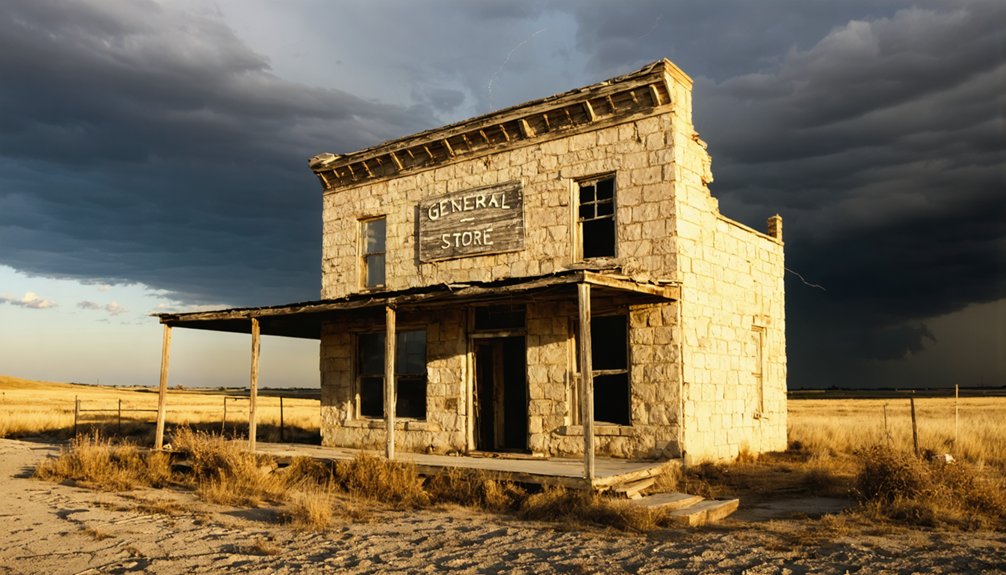
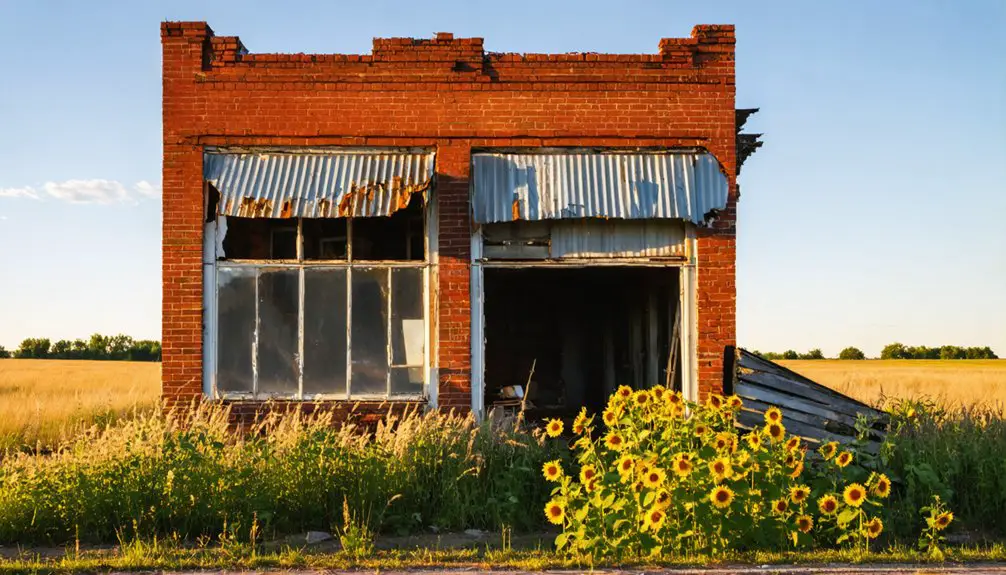
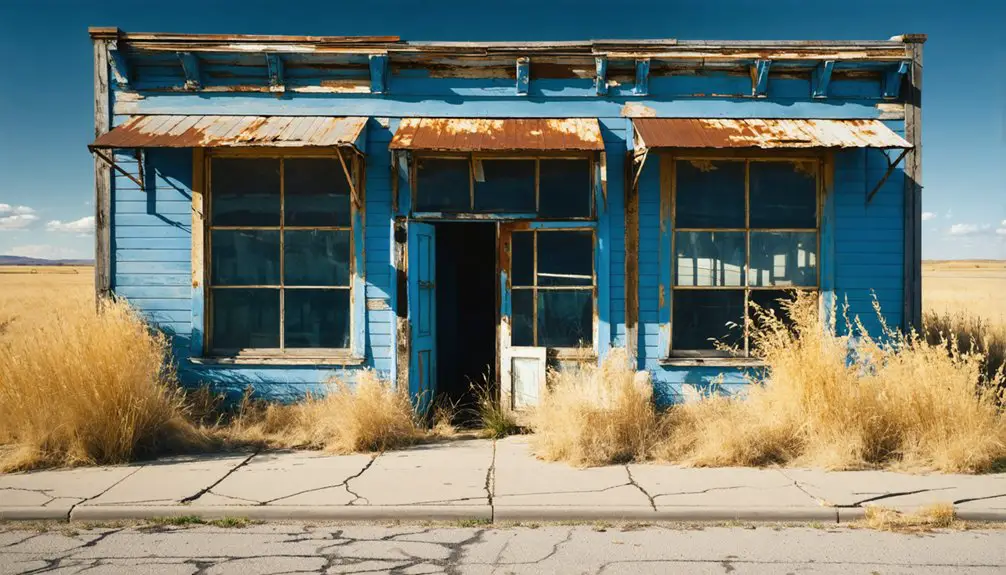
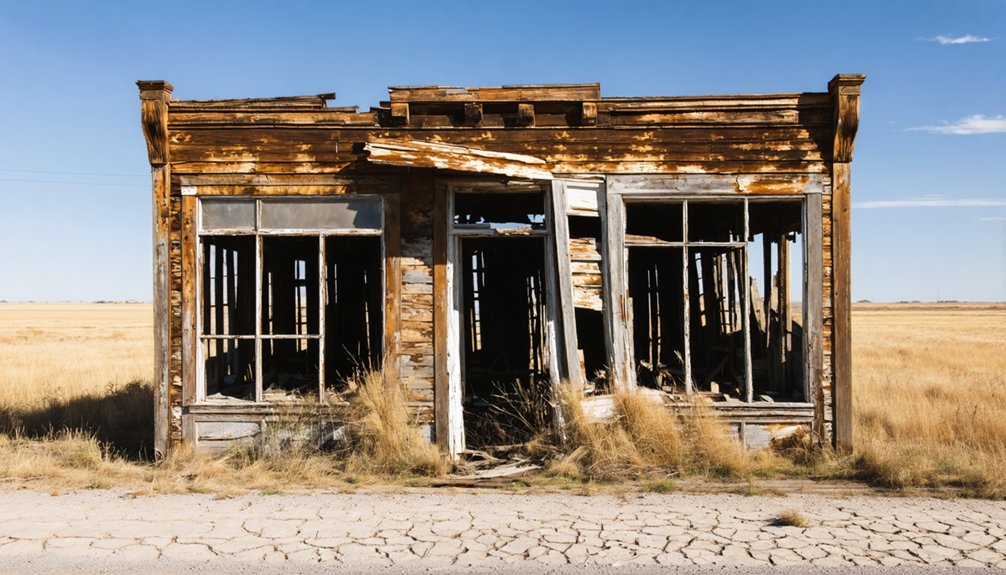
When you travel through Kansas ghost towns, you’ll encounter a striking range of structural remnants, from crumbling limestone foundations to standing storefronts frozen in mid-century decay.
Along historic corridors like the Santa Fe Trail, ruins such as those near Diamond Springs serve as physical markers of frontier-era commerce and migration patterns.
Recognizing these ghost town remains requires you to look beyond obvious abandonment signals, since even a single derelict structure or an overgrown lot where a post office once operated can confirm a settlement’s extinction.
Notable Abandoned Kansas Structures
Scattered across Kansas, abandoned structures serve as tangible evidence of the state’s cycles of settlement, economic ambition, and decline. You’ll find crumbling storefronts that once anchored Wild West commerce, cement plant ruins tied to industrial ventures like LeHunt’s United Kansas Portland Cement Company, and weathered farmsteads that mechanized agriculture rendered obsolete.
Mining towns left behind structural footprints that document extractive economies now completely exhausted. In Dunlap, Depression-era abandonment produced visible architectural decay still readable today.
Elmdale’s flood-damaged remnants illustrate environmental vulnerability‘s permanent toll on built environments. These structures aren’t merely picturesque decay; they’re analytical documents encoding migration patterns, economic failures, and infrastructural decisions.
When you examine them critically, you’re engaging directly with the forces that shaped—and ultimately unmade—Kansas’s frontier settlements.
Ruins Along Historic Trails
Historic trails didn’t just move people across Kansas—they anchored settlements whose ruins now mark those same corridors. Along the Santa Fe Trail, Diamond Springs once earned the title “Diamond of the Plains,” offering travelers water and commerce.
Today, its remnants signal how trail-dependent economies collapsed once traffic patterns shifted. You’ll find similar stories scattered across counties where railroads and wagon routes once intersected.
These sites carry real weight for historic preservation efforts, since their physical evidence ties modern visitors to frontier-era decision-making and settlement logic. They also represent untapped tourism development opportunities—travelers seeking authentic frontier landscapes will follow documented ruins if you give them reliable maps and historical context.
Kansas’s trail corridors aren’t empty; they’re structured arguments for why settlement happened exactly where it did.
Recognizing Ghost Town Remains
Abandoned buildings and ruins serve as the most legible evidence of Kansas’s ghost towns, letting you read a settlement’s history directly from its surviving structures. Collapsed storefronts, roofless homesteads, and fractured foundations each mark distinct phases of decline—railroad withdrawal, agricultural mechanization, or Depression-era collapse.
You can distinguish fully abandoned sites from semi-ghost towns by noting whether any commercial activity or residency persists alongside the ruins. Post office closure dates further sharpen that distinction analytically.
Preservation efforts vary considerably; some counties actively protect structures that now function as tourist attractions, while others leave buildings to deteriorate without intervention. Recognizing these physical markers—standing walls, earthwork depressions, isolated chimneys—trains your eye to interpret Kansas’s broader settlement history rather than simply observing decay.
A County-by-County Guide to Kansas Ghost Towns
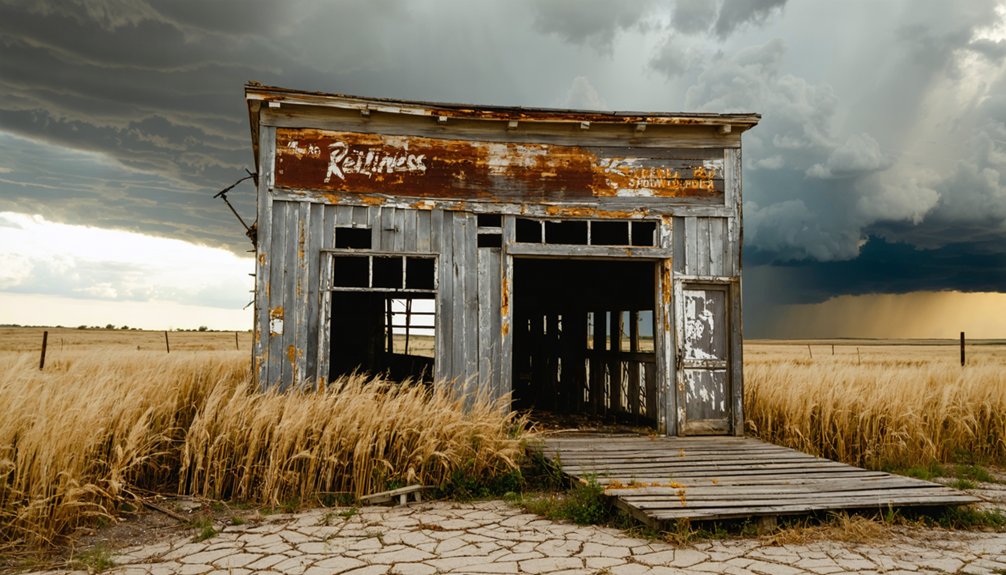
Because Kansas ghost towns are distributed across the state’s 105 counties, a county-based organizational framework offers the most practical and analytically coherent way to navigate their scope and variety.
When you examine Sumner County, you’ll find extinct settlements like Hunnewell and Dalton, each carrying distinct ghost town legends tied to railroad decline.
Graham County yields places like Fargo and Wild Horse, where preservation efforts remain minimal and structural evidence is rapidly deteriorating.
Douglas and Franklin counties reveal frontier-era settlements abandoned after post offices closed and commercial cores collapsed.
By moving county to county, you’re able to identify regional patterns—railroad displacement, agricultural mechanization, Depression-era collapse—rather than treating each town as an isolated anomaly.
This geographic structure transforms a fragmented list into a coherent, navigable record of Kansas settlement and abandonment.
Where to Find Kansas Ghost Towns by County
Tracking Kansas ghost towns by county becomes considerably more manageable once you recognize that the Kansas Historical Society has documented more than 6,000 such settlements across the state’s 105 counties—a figure that underscores both the density and the distributional complexity of abandonment patterns statewide.
The Kansas Historical Society has documented more than 6,000 ghost towns across the state’s 105 counties.
Counties like Sumner, Graham, Douglas, Franklin, and Lincoln each contain dozens of extinct settlements, many tied to railroad realignments or agricultural collapse.
You’ll find that mining history shaped southeastern Kansas counties particularly, where resource depletion accelerated decline.
Native American sites further complicate classification, as some abandoned locations predate Euro-American settlement entirely.
Organizing your research by county lets you cross-reference post office records, remaining structures, and population data systematically, giving you a precise, freedom-oriented framework for independently exploring Kansas’s remarkably layered landscape of abandonment.
The Kansas Ghost Towns Still Worth the Drive
Even with thousands of Kansas ghost towns on record, a handful stand out as particularly worthwhile destinations because they combine accessible ruins, documented history, and distinctive character. If ghost town tourism draws you toward authentic urban decay rather than curated exhibitions, these sites reward the effort.
Dunlap offers Depression-era architectural remnants alongside documented settlement history dating to 1869.
LeHunt presents industrial ruins tied to the United Kansas Portland Cement Company, adding structural complexity to your visit.
Elmdale demonstrates how environmental catastrophe accelerated abandonment, giving you a readable landscape shaped by 1950s flooding.
Diamond Springs connects directly to Santa Fe Trail history, grounding the site within frontier geography.
Each location lets you analyze decline on your own terms, without barriers or gatekeeping filtering your experience.
Frequently Asked Questions
Can You Legally Visit or Enter Abandoned Kansas Ghost Town Buildings?
You can’t legally enter privately owned abandoned buildings without permission. Respect historical preservation laws and property rights when chasing haunted legends—trespassing risks fines. Always research ownership beforehand to explore Kansas ghost towns responsibly and freely.
Are Any Kansas Ghost Towns Privately Owned or Restricted From Public Access?
Yes, countless Kansas ghost towns sit on private land, so you’ll find land ownership blocks your access entirely. Always research historical preservation records and contact landowners before you visit, or you’re trespassing.
Do Kansas Ghost Towns Appear on Standard GPS or Mapping Applications?
Some appear on GPS apps, but you’ll find many omitted. Cross-reference historical preservation records and ghost town photography guides to accurately locate these sites, as standard mapping tools often exclude extinct or semi-abandoned Kansas settlements.
Have Any Kansas Ghost Towns Ever Been Successfully Revived or Repopulated?
Like seeds in dry soil, some towns have revived. You’ll find preservation efforts and haunted legends actually attract tourists and investors, successfully breathing new life into select Kansas ghost towns that once faced total abandonment.
Are Guided Tours Available for Exploring Kansas Ghost Towns Safely?
You’ll find guided tours at select sites emphasizing historical preservation, transforming these tourist attractions into analytically rich experiences. Independent exploration demands caution, as structural hazards persist, so you should research county historical societies for organized, safety-conscious excursions beforehand.
References
- https://en.wikipedia.org/wiki/List_of_ghost_towns_in_Kansas
- https://legendsofkansas.com/kansas-ghost-town-list/
- https://www.legendsofamerica.com/ks-ghosttowns/
- https://www.youtube.com/watch?v=KBXINX0xqnU
- https://www.reddit.com/r/kansas/comments/102hrmy/looking_for_ghost_towns_to_document/
- https://www.youtube.com/watch?v=dF7vGl5xasI
- https://www.onlyinyourstate.com/experiences/kansas/kansas-ghost-towns
- https://www.youtube.com/watch?v=wocJ7F-jdrs
- https://legendsofkansas.com/sumner-county-kansas-extinct-towns/
- https://en.wikipedia.org/wiki/Category:Former_populated_places_in_Kansas