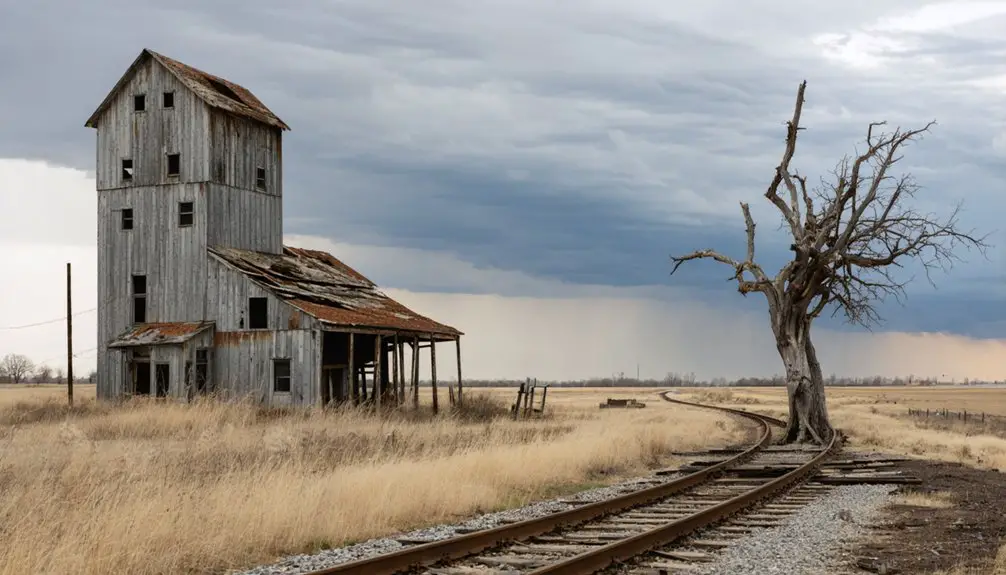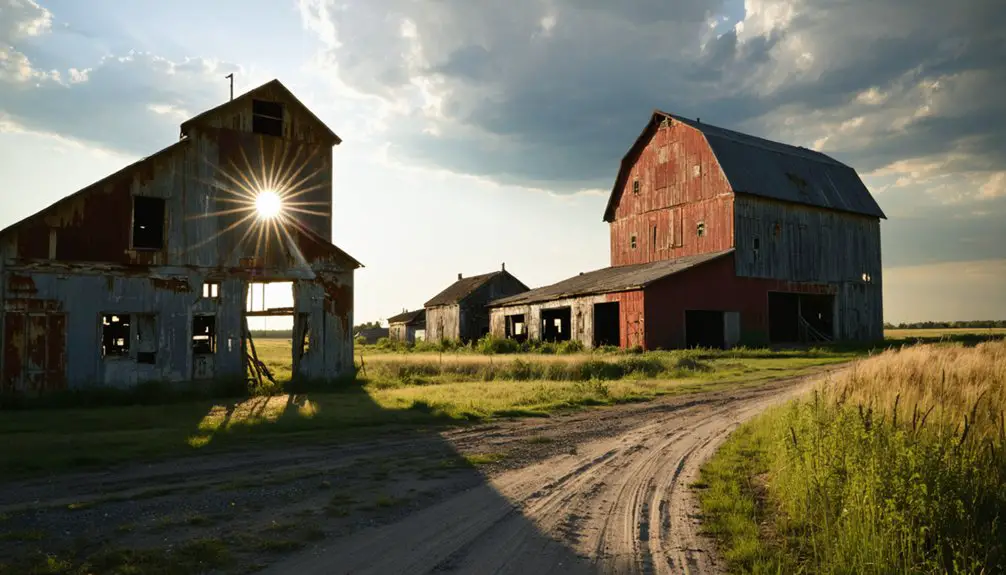
Minnesota’s ghost towns reveal how quickly a single economic blow could erase a thriving community. You’ll find towns like Nininger, which collapsed after the Panic of 1857, and Forestville, abandoned after a railroad bypass in 1868. Elcor vanished within two years of its mine closing, while Old Crow Wing faded as trade routes shifted. These forgotten places reflect commerce’s fragile hold on early settlements, and there’s far more to uncover about each town’s dramatic rise and fall.
Key Takeaways
- Forestville became a ghost town after an 1868 railroad bypass, reducing its population to 55 residents and is now a Minnesota state park.
- Nininger was founded by Ignatius Donnelly but collapsed after the Panic of 1857 devastated investments, leaving behind only historical markers today.
- Elcor was completely abandoned by 1956 after the Corsica mine closed, leaving only foundations now covered by the Minorca Mine.
- Old Crow Wing was a thriving trading hub that declined due to economic shifts, with only one white house remaining today.
- Wasioja’s decline followed the Civil War, which decimated its young male population, leaving seminary ruins as its most recognizable landmark.
What Makes a Minnesota Town a Ghost Town?
A Minnesota town earns the “ghost town” label when its population collapses to near-zero following the loss of its primary economic driver.
You’ll find that economic factors like railroad bypasses, mine closures, and failed commercial ventures consistently triggered irreversible population shifts across the state.
When railroads bypassed towns like Forestville and Old Wadena, residents simply relocated where opportunity existed.
When the Corsica mine closed in 1954, Elcor’s entire population vacated within two years.
Some towns, like Nininger, never achieved critical mass before collapsing entirely.
What distinguishes a true ghost town from a struggling community is permanence — the economic engine doesn’t just slow down, it stops completely.
You’re left with foundations, historical markers, and structures that document what once existed.
Nininger: The Boom Town That Never Boomed
If you’re exploring Minnesota’s ghost towns, Nininger stands out as a cautionary tale of ambition outpacing reality.
Ignatius Donnelly, later known as “The Sage of Nininger,” founded the town in the mid-19th century with grand visions of transforming it into a thriving metropolis.
Donnelly’s Failed Vision
Nininger’s story begins with one man’s outsized ambition: Ignatius Donnelly, a Philadelphia-born lawyer and politician who believed he could build a thriving metropolis on the banks of the Mississippi River.
Donnelly’s dreams were bold — he promoted Nininger aggressively, attracting settlers and investors throughout the mid-1850s. You can imagine the excitement surrounding this frontier settlement, where opportunity seemed limitless.
But economic challenges quickly dismantled his vision. The Panic of 1857 devastated frontier investments, collapsing real estate values and halting growth across Minnesota’s developing communities.
Settlers abandoned Nininger almost as fast as they’d arrived. Donnelly himself stubbornly remained, earning the title “The Sage of Nininger,” but the town never recovered.
His metropolitan dream dissolved into farmland, leaving behind historical markers where a city was supposed to stand.
Nininger’s Rapid Decline
What Donnelly’s ambition built in months, the Panic of 1857 dismantled almost overnight. The financial crisis gutted Nininger’s economic foundation, driving settlers away faster than they’d arrived. You can trace this collapse through Nininger history — a cautionary tale of speculative overreach meeting brutal economic reality.
Residents abandoned their lots, businesses shuttered, and Donnelly’s printed newspaper eventually fell silent. The population evaporated, leaving behind structures that nature steadily reclaimed. Unlike towns bypassed by railroads, Nininger’s death came from pure financial contagion.
Today, the town legacy survives through historical markers at the township city hall, roughly 40 minutes from Minneapolis. You’ll find farmland where ambition once promised a thriving city.
Donnelly stayed, earning his “Sage of Nininger” title amid the ruins of his own creation.
Forestville: The Minnesota Ghost Town a Railroad Abandoned
If you’re exploring Minnesota’s ghost towns, Forestville offers a striking case study in how a single infrastructural decision can doom a thriving community.
Founded in 1852 in Fillmore County, Forestville watched its economic prospects collapse when the railroad bypassed it in 1868, shrinking its population to just 55 residents by 1880.
The Meighen family then purchased the entire town and its surroundings by 1889, an acquisition that paradoxically preserved Forestville’s remaining structures as a state park you can visit today.
Forestville’s Railroad Bypass
Forestville, founded in 1852 in Fillmore County near Wykoff and Preston, was a thriving Minnesota settlement until the railroad bypassed it in 1868. That single decision destroyed any chance of town revitalization.
The railroad impact proved devastating — businesses closed, residents left, and the population collapsed to just 55 by 1880. You can see how quickly a community unravels when economic infrastructure disappears overnight.
By 1889, the Meighen family had purchased the entire town and surrounding land. Rather than rebuilding, they simply absorbed it.
What’s remarkable is that Forestville’s abandonment ultimately preserved it. Today, you can walk through its original buildings as a state park, experiencing a rare, intact snapshot of 19th-century Minnesota life that active towns inevitably lose through modernization and development.
The Meighen Family’s Legacy
When the Meighen family purchased the entire town of Forestville and its surrounding land in 1889, they made a decision that would inadvertently shape Minnesota’s historical preservation for generations.
Rather than demolishing or redeveloping the structures, the Meighen family maintained the property largely intact. Their stewardship prevented commercial development from erasing Forestville’s original architecture and layout.
You can see the direct result of their legacy today — Forestville exists as a state park featuring original buildings that authentically reflect mid-19th-century Minnesota life.
Town preservation efforts benefited enormously from the family’s continued ownership, which kept outside interests at bay. Without their intervention, Forestville’s historical record would’ve likely disappeared entirely.
Their choice fundamentally transformed an abandoned settlement into a living document of Minnesota’s frontier history.
Old Crow Wing: The Trading Hub That the Mississippi Forgot
Once a thriving 19th-century trading center positioned at the confluence of the Crow Wing and Mississippi Rivers, Old Crow Wing has since dwindled to little more than a single white house.
Its trading dynamics once fueled regional commerce, connecting Native American networks with European settlers pushing westward. You can still walk the loop trail today, reading plaques that document the site’s historical significance at every turn.
Economic shifts ultimately unraveled the town’s foundation, leaving behind only scattered remnants of what was once a bustling hub. That lone white house stands as a quiet symbol of ambition overtaken by changing times.
If you value understanding how communities rise and fall freely, Old Crow Wing offers an unfiltered, honest look at Minnesota’s commercial and cultural past.
Elcor and Wasioja: Two Minnesota Ghost Towns the Iron Range Erased
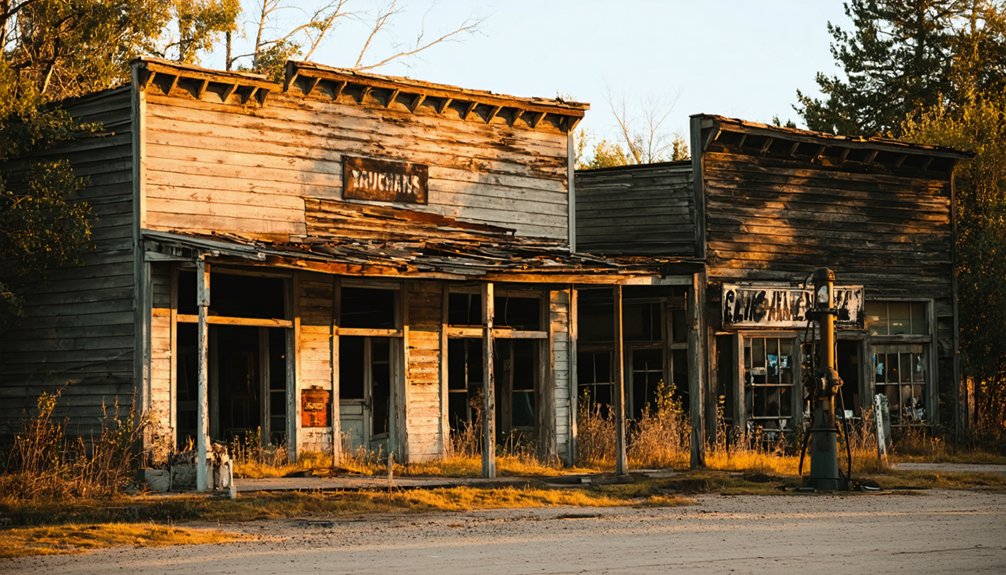
Elcor and Wasioja represent two distinct chapters in Minnesota’s ghost town history, each erased by forces beyond their residents’ control.
Elcor history traces back to 1897, when a mining company built the town for iron range workers near Gilbert. After the Corsica mine closed in 1954, residents vacated, and by 1956, Elcor sat completely abandoned.
The Minorca mine eventually swallowed it whole, leaving only foundations and scattered artifacts beneath the earth.
Wasioja’s legacy follows a different but equally sobering arc. The Civil War claimed so many of its young men that the town never recovered.
You’ll find the seminary ruins still standing as a stark reminder of a community that ambition built and war dismantled.
Both towns demand your reflection on how quickly prosperity can collapse.
Old Wadena: The Ghost Town That Started as a Trading Post
While Elcor and Wasioja fell to industry and war, Old Wadena‘s story begins much earlier, rooted in commerce rather than conflict. As an early trading post along the Crow Wing River, Old Wadena carried real historical significance as a hub connecting traders and settlers throughout mid-19th-century Minnesota.
You’ll find that its economic decline followed a familiar pattern — the railroad bypassed it, stripping away the commercial traffic that kept it alive. Once that happened, the town couldn’t sustain itself.
Today, it’s preserved as a historical park, complete with reconstructed buildings and informational markers.
If you value understanding how free enterprise shaped and abandoned early American settlements, Old Wadena offers you a direct, documented look at how commerce built communities — and how its absence just as quickly dismantled them.
Which Minnesota Ghost Towns Are Open to the Public?

How many of these ghost towns can you actually visit? Most of them welcome you freely.
Forestville operates as a state park with preserved original buildings, making it ideal for ghost town tourism.
Forestville’s preserved original buildings make it a standout ghost town destination, now protected as a Minnesota state park.
Old Crow Wing features walking trails and historical plaques you can explore independently.
Old Wadena functions as a historical park with reconstructed buildings and informational markers.
Nininger offers historical markers at the township city hall, though little else remains.
Wasioja’s seminary ruins stand accessible for those interested in Civil War history.
Elcor, however, isn’t publicly accessible since Minorca Mine now covers the site completely.
Historical preservation efforts have kept most of these locations open and documented.
You’ll find that Minnesota actively maintains these sites, giving you direct access to the state’s forgotten past.
Frequently Asked Questions
Are There Any Guided Tours Available at Minnesota’s Ghost Towns?
You’ll find ghost town history comes alive at places like Forestville State Park, where guided tour options are available. Old Crow Wing also offers walkable trails with plaques, letting you explore freely at your own pace.
What Is the Best Time of Year to Visit Minnesota Ghost Towns?
Summer’s your best bet for visiting Minnesota’s ghost towns, offering ideal conditions for photography tips and seasonal events. You’ll capture vivid details of sites like Forestville and Old Crow Wing with longer daylight hours and accessible trails.
Can Visitors Legally Take Artifacts Found at Abandoned Minnesota Town Sites?
You shouldn’t take artifacts from Minnesota’s ghost town sites. Artifact preservation laws carry serious legal implications—removing items from historical locations violates state and federal regulations, stripping future generations of irreplaceable cultural heritage you’d otherwise help protect.
Are Minnesota Ghost Towns Accessible for Visitors With Mobility Limitations?
Ironically, history’s forgotten towns aren’t forgotten by all — you’ll find accessibility features vary widely. Forestville’s state park offers better transportation options and paved paths, while sites like Old Crow Wing’s loop trail may challenge mobility-limited visitors.
Do Any Minnesota Ghost Towns Offer Overnight Camping or Lodging Nearby?
You’ll find camping options near Forestville State Park, where you can stay overnight and explore nearby attractions. Old Crow Wing’s loop trail area also offers accessible camping, letting you freely discover Minnesota’s fascinating ghost town history.
References
- https://www.youtube.com/watch?v=5bCG6B2rzZY
- https://thievesriver.com/blogs/articles/ghost-towns-in-minnesota
- https://quickcountry.com/minnesotas-abandoned-ghost-towns/
- https://en.wikipedia.org/wiki/List_of_ghost_towns_in_Minnesota
- https://www.youtube.com/watch?v=btvFiKT3Quw
- https://exploringnorthshore.com/north-shore-ghost-towns/
- https://goodhuecountyhistory.org/learn/county-history/ghost-towns/
- https://maplewoodmn.gov/1522/The-Ghost-town-of-Gladstone