Pennsylvania’s ghost towns tell the story of industries that built communities overnight and abandoned them just as fast. You’ll find coal towns buried by Blacklick Creek, oil boomtowns like Pithole that vanished within two years, and Centralia, where an underground fire has burned since 1962. Floods, corporate buyouts, and resource depletion all erased once-thriving neighborhoods. Each site carries its own distinct history — and there’s far more to uncover about what shaped these forgotten places.
Key Takeaways
- Centralia, PA became a ghost town after an underground coal fire ignited in 1962, causing toxic gases and near-complete evacuation.
- Pithole emerged during the 1865 oil boom, reached 15,000 residents, then vanished within two years after oil wells dried up.
- Pennsylvania ghost towns were commonly caused by resource depletion, industrial collapse, floods, fires, or deliberate submersion beneath reservoirs.
- The Pennsylvania Ghost Town Trail spans 30 miles through Indiana and Cambria counties, showcasing ruins of former coal mining communities.
- Sites like Eckley Miners’ Village and Fricks Locks are preserved as historic landmarks, offering safe, guided access for visitors.
What Makes a Pennsylvania Town a Ghost Town?
A Pennsylvania town earns the “ghost town” label when economic collapse, environmental disaster, or infrastructure obsolescence strips it of its permanent population and functional purpose.
You’ll find that most cases follow a predictable pattern: a single industry drives growth, that industry fails, and urban decay accelerates rapidly.
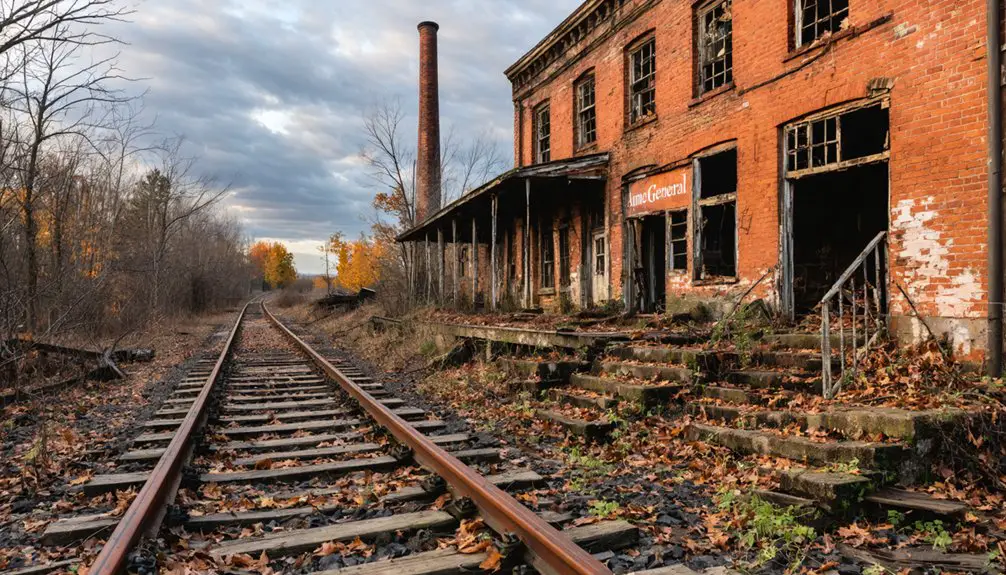
Industrial relics — collapsed tipples, crumbling furnaces, abandoned company houses — mark what remains.
Centralia lost residents to an underground coal fire burning since 1962.
Pithole collapsed within years of its oil boom ending.
Canal towns became obsolete once rail replaced waterway transport.
What distinguishes a true ghost town from a declining one is the near-total absence of functioning civic life.
No schools, no commerce, no permanent residents — just structures reclaimed by time and vegetation.
The Most Famous Ghost Towns in Pennsylvania
When you explore Pennsylvania’s most recognized ghost towns, two stand out for dramatically different reasons: Centralia and Pithole.
Centralia’s story begins with a 1962 coal seam fire that never extinguished, forcing near-total evacuation and leaving streets cracked by heat and smoke still rising from the ground today.
Pithole presents an equally striking contrast, having surged to a population of thousands during the 1865 oil boom near Oil Creek before collapsing almost overnight once the petroleum dried up.
Centralia’s Underground Fire
Centralia stands as Pennsylvania’s most infamous ghost town, largely because an underground coal seam fire ignited in 1962 and has never been extinguished. The fire history traces back to a landfill burn that spread into exposed coal seams beneath the borough, triggering decades of toxic gas emissions and ground subsidence.
State and federal authorities eventually condemned nearly every structure, relocating most residents by the 1980s. Today, you’ll find cracked roadways, overgrown lots, and scattered mining relics marking where a thriving community once stood.
A handful of residents legally retained the right to remain. Route 61 buckled so severely that officials permanently closed a segment.
Centralia’s story documents how industrial extraction, when left unchecked, can permanently erase a community from the map.
Pithole’s Rapid Collapse
Pithole emerged in May 1865 as one of the most dramatic petroleum boomtowns in American history, drawing thousands of speculators to a remote creek valley in Venango County within weeks of its first oil strike.
At its peak, Pithole held nearly 15,000 residents, hotels, newspapers, and a post office ranking third busiest in Pennsylvania. When the wells dried up, the collapse was equally swift — the population vanished within two years.
Today, you’ll find abandoned landmarks scattered across an open field, where interpretive signs mark where streets once stood. Haunted legends persist among visitors who walk the empty terrain, sensing the weight of ambition that evaporated almost overnight.
The state preserves the site, giving you a rare, unfiltered glimpse into extraction economy‘s brutal cycles.
Why Pennsylvania Ghost Towns Were Abandoned
Pennsylvania’s ghost towns didn’t die by accident—specific economic and environmental forces drove each abandonment. You’ll find that coal mine fires forced Centralia’s near-total evacuation, while oil busts collapsed Pithole almost overnight after extraction ended.
Canal abandonment rendered Schuylkill Canal villages obsolete, and flood control projects condemned communities like Livermore entirely.
Each cause left distinct marks on abandoned architecture—collapsed tipples, flooded foundations, concrete shells reclaimed by vegetation. Some sites carry haunted legends tied to violent histories, like Whiskey Run’s unsolved murders. Others disappeared beneath reservoirs or regulatory condemnation.
Understanding why these towns failed gives you clearer insight into how dependent they were on single industries. When those industries collapsed, no economic alternative existed, and residents had no choice but to leave permanently.
Pennsylvania Ghost Towns Destroyed by Floods, Fires, and Submersion
When you explore Pennsylvania’s ghost towns, you’ll find that natural disasters and industrial catastrophes erased entire communities through fire, flooding, and deliberate submersion.
Centralia’s 1962 underground coal seam fire remains the most dramatic example, forcing near-total evacuation of residents over several decades as the fire continues burning today.
Beyond Centralia, you’ll encounter flood-condemned towns like Livermore, swallowed by river expansion projects, and submerged communities like Cokeville, which now lies beneath Conemaugh River Lake.
Centralia’s Underground Coal Fire
Among Pennsylvania’s ghost towns, Centralia stands out as a community destroyed not by floodwaters or deliberate demolition, but by an underground coal seam fire that ignited in 1962 and never went out. Located in Columbia County, Centralia’s abandoned structures and mining relics now mark a landscape swallowed by an unstoppable geological event.
The fire produced four cascading consequences:
- Toxic gases forced near-total resident relocation within decades.
- Sinkholes destabilized roads and properties permanently.
- Pennsylvania condemned and demolished most homes by the 1990s.
- A few residents legally fought to remain, and some still do today.
You can visit Centralia and walk cracked, steam-venting roads, but you won’t find a functioning town. The fire continues burning underground, with no viable extinguishing solution identified.
Flood-Condemned Pennsylvania Communities
While Centralia’s fate came from below ground, other Pennsylvania communities met their end through water. Flood control projects condemned towns like Livermore, swallowing them entirely through river expansion.
Fricks Locks in Chester County faced a different pressure — nuclear power plant construction forced evacuation, leaving abandoned structures that now carry haunted legends among those who explore the site.
You’ll find Fricks Locks particularly significant, as it earned a spot on the National Register of Historic Places in 2003, preserving its documented history despite physical decline.
Meanwhile, more than 3,000 homes were acquired or condemned in flood-affected areas like Bushkill and Dingmans Ferry.
Johnstown’s 1889 flood buried entire neighborhoods under modern development — ruins you can’t see but that still define what Pennsylvania lost.
Submerged Towns Beneath Reservoirs
Some Pennsylvania ghost towns didn’t burn or flood — they were deliberately drowned. Unlike Centralia’s underground fires, these communities faced a different erasure: government-sanctioned submersion beneath reservoir projects.
Cokeville represents the starkest example. It now sits underwater beneath Conemaugh River Lake, permanently reservoir submerged and inaccessible. You can’t walk these streets or photograph standing ruins — they’re gone entirely.
Before submersion, displaced communities typically experienced:
- Government condemnation of private property
- Forced buyouts of residents and businesses
- Demolition or abandonment of structures
- Permanent flooding upon dam completion
This process stripped residents of generational roots without negotiation. You should recognize that these towns weren’t casualties of industry collapse — they were sacrificed by deliberate policy, erasing communities as completely as any fire ever could.
Lesser-Known Pennsylvania Ghost Towns Worth Visiting
Pennsylvania’s lesser-known ghost towns offer compelling historical narratives that rival their more famous counterparts. You’ll find haunted legends surrounding Whiskey Run in Indiana County, where unsolved murders from its coal mining era still stir curiosity.
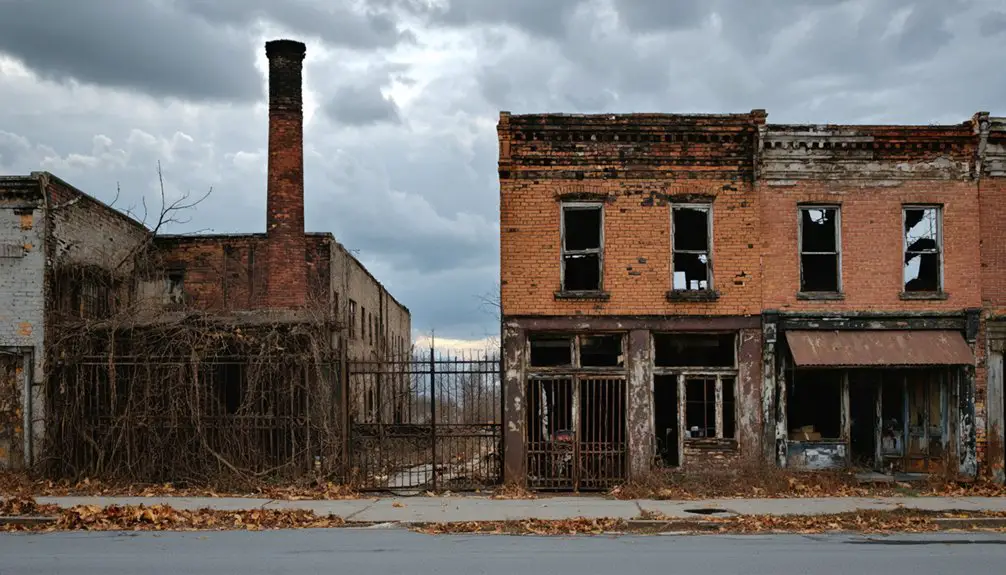
The abandoned architecture of Yellow Dog Village in Armstrong County stands as nature quietly reclaims the structures around you.
Rausch Gap in Lebanon County once housed 1,000 residents before vanishing entirely by 1910, leaving trails you can still walk today.
Crum in Somerset County was deliberately bought out in the late 1920s to protect a corporate watershed.
These sites reward independent exploration, though you should verify access rights carefully.
Each location documents distinct industrial chapters that shaped Pennsylvania’s economic and social identity beyond mainstream historical records.
How to Explore the Pennsylvania Ghost Town Trail
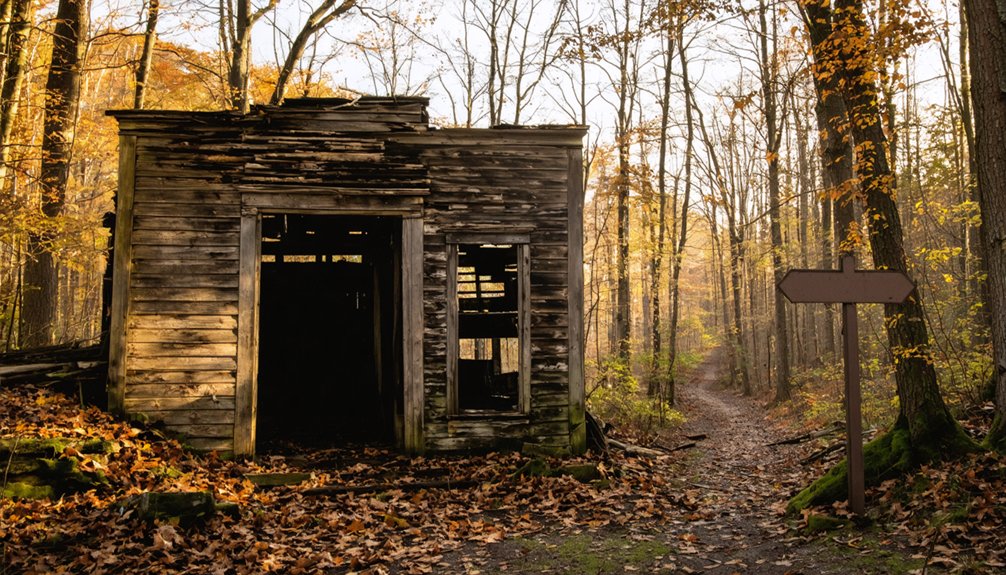
Stretching 30 miles from Indiana County to Cambria County along Blacklick Creek, the Ghost Town Trail offers direct access to the industrial ruins of former coal towns like Claghorn, Dias, and Whiskey Run. Established in 1991, the trail lets you explore abandoned architecture including iron furnaces and deteriorating tipples tied to haunted legends of the region’s coal era.
Before visiting, consider these practical steps:
- Confirm trail access points through Indiana County Parks.
- Respect private property boundaries along the route.
- Avoid structurally unstable ruins despite their photographic appeal.
- Research individual sites beforehand, as conditions vary seasonally.
You’ll move freely through documented industrial history, but responsible exploration protects both the sites and your safety.
Pennsylvania Ghost Towns Preserved as Historic Sites and Museums
A handful of Pennsylvania’s ghost towns have escaped complete decay through formal preservation efforts that transformed industrial ruins into documented historic sites.
Historical preservation gives you direct access to communities that industrial decline would’ve otherwise erased entirely. Eckley Miners’ Village in Luzerne County stands as the clearest example — it’s now an operational coal mining museum rather than a crumbling ruin you’d stumble through cautiously.
Historical preservation rescues entire communities from erasure — Eckley Miners’ Village proves it, functioning as a living museum rather than forgotten rubble.
Fricks Locks in Chester County earned a National Register of Historic Places listing in 2003, protecting its remaining structures from further deterioration. These designations matter because they secure funding, restrict demolition, and maintain public access on documented terms.
You’re not exploring private property risks or structural hazards — you’re walking through sites that authorities have deliberately stabilized and opened for informed exploration.
Unsolved Murders, Corporate Buyouts, and Strange Ghost Town Histories
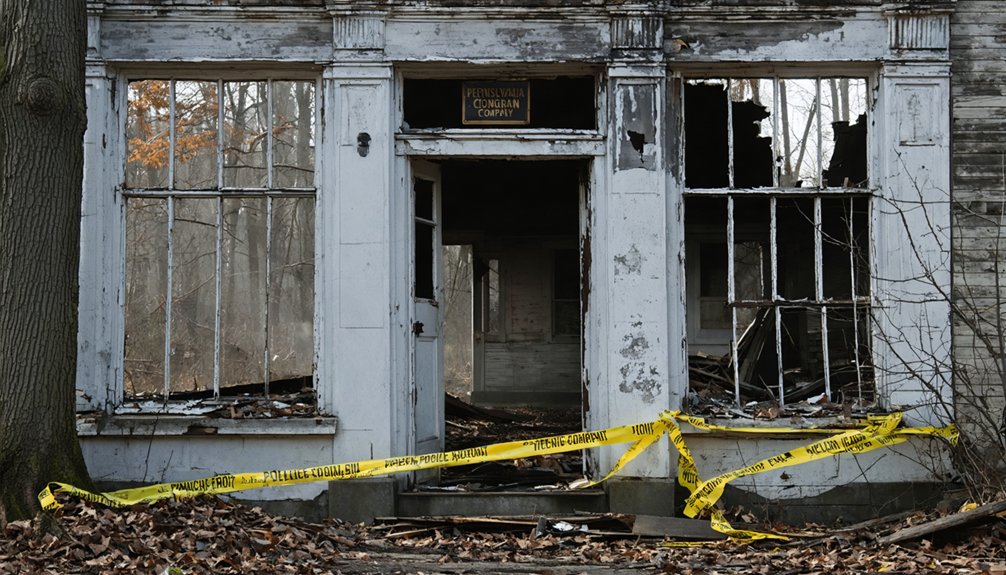
Not every ghost town earned its silence through bureaucratic designation or orderly decline — some carried darker legacies into abandonment. You’ll find that Pennsylvania’s strangest cases blend corporate strategy, violence, and forgotten lives into compelling abandoned architecture worth examining.
Consider these documented examples:
- Whiskey Run harbors multiple unsolved murders tied directly to its coal mining operations.
- Crum was quietly purchased by Berwind Corporation in the late 1920s solely to protect watershed rights.
- Cokeville now sits submerged beneath Conemaugh River Lake — an underwater ghost town.
- Concrete City’s 20 identical houses were abandoned within a decade of construction.
These haunted legends aren’t folklore embellishments — they’re documented outcomes of corporate control, resource extraction, and engineered displacement. You’re looking at freedom stripped away through calculated institutional decisions.
Tips for Visiting Pennsylvania Ghost Towns Safely
Before you visit any Pennsylvania ghost town, you’ll need to research access restrictions — many sites sit on private property, protected land, or structurally compromised terrain. Trespassing carries legal consequences, so confirm public access before exploring abandoned architecture like Concrete City’s deteriorating concrete houses or Eckley’s preserved mining structures.
Carry a physical map, since cell service fails in remote counties. Wear sturdy boots and avoid entering unstable buildings — floors collapse without warning.
Don’t dismiss haunted legends entirely; local lore often identifies genuinely dangerous areas residents once fled.
Photograph rather than remove artifacts, as Pennsylvania law protects historical remnants at designated sites. Visit during daylight, bring a companion, and notify someone of your location.
Responsible exploration preserves these sites for future visitors while keeping you legally protected and physically safe.
Frequently Asked Questions
Which Pennsylvania Ghost Town Is Completely Submerged Underwater Today?
Like a time capsule sealed beneath the waves, Cokeville’s your prime spot for submerged history. You’ll find this underwater exploration destination resting silently under Conemaugh River Lake, swallowed completely after industrial collapse claimed it forever.
How Many Miles Does the Pennsylvania Ghost Town Trail Span?
You’ll find the Ghost Town Trail spans 30 miles, stretching from Indiana County to Cambria County. It’s a documented path of abandoned mining history, offering you historic preservation insights along Blacklick Creek since 1991.
What Year Was the Ghost Town Trail Officially Established?
You’ll find the Ghost Town Trail was officially established in 1991, connecting you to abandoned structures steeped in haunted legends. It’s a documented, 30-mile corridor through Indiana and Cambria Counties, preserving coal mining history analytically for freedom-seeking explorers.
Which County Is Yellow Dog Village Located In?
You’ll find Yellow Dog Village in Armstrong County, where its historic architecture still stands as nature reclaims the site. Local legends surrounding this former mining community document its fascinating, freedom-evoking story of industrial decline and abandonment.
When Was Fricks Locks Added to the National Register of Historic Places?
Like a phoenix rising from forgotten ashes, Fricks Locks earned its place in history—it’s been listed on the National Register of Historic Places since 2003, where its architectural ruins gained formal historic preservation recognition you can explore freely.
References
- https://en.wikipedia.org/wiki/List_of_ghost_towns_in_Pennsylvania
- https://uncoveringpa.com/ghost-towns-in-pa
- https://www.youtube.com/watch?v=isRTfPKPsNo
- https://www.youtube.com/watch?v=uMtEti4E_-Q
- https://bigcityreview.com/the-ghost-towns-of-pennsylvanias-ghost-town-trail/
- https://www.youtube.com/watch?v=J8cgAdVe5ZA
- https://www.youtube.com/watch?v=jPVwps8WWvY
- https://www.youtube.com/watch?v=8ctZIHFq1E0