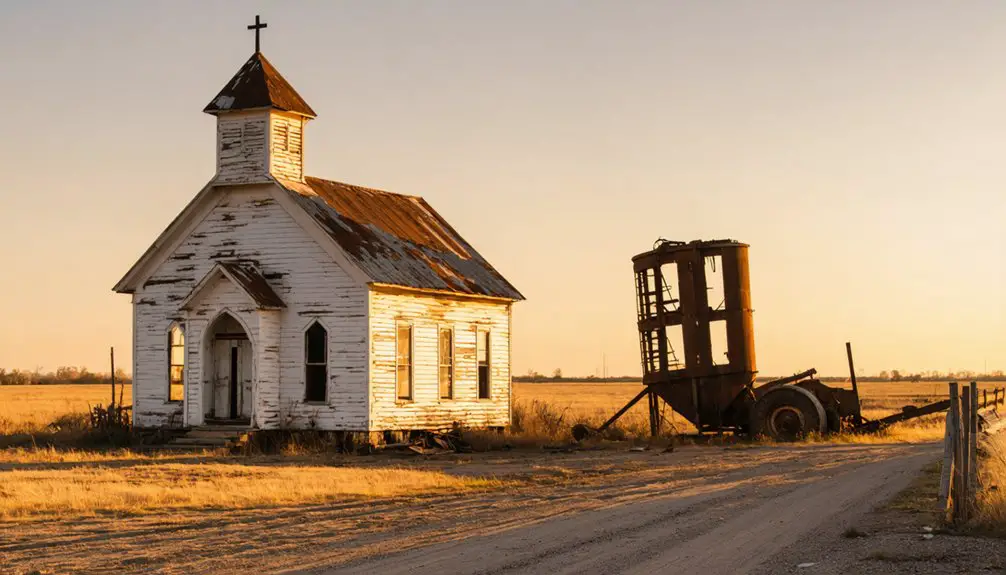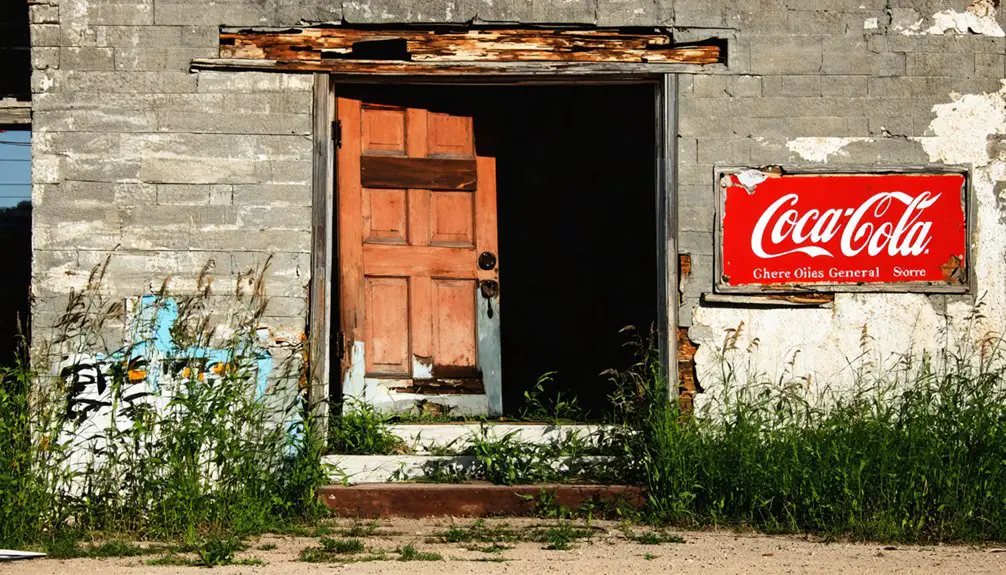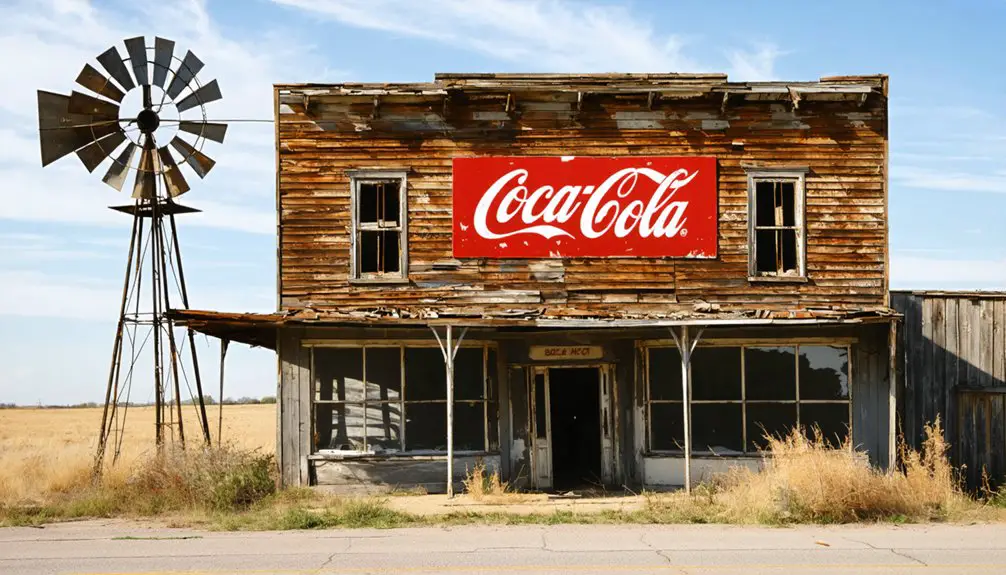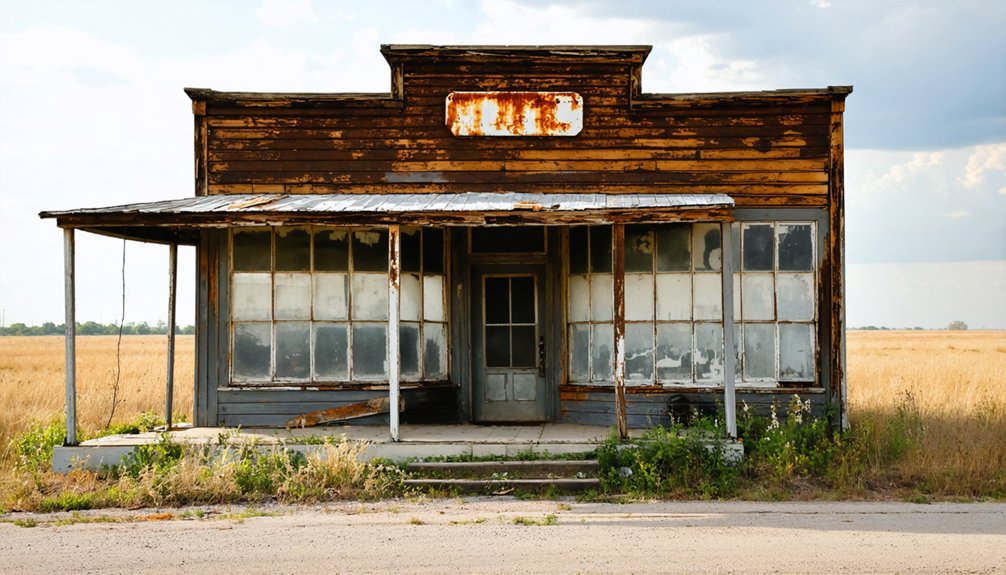
Antioch, Oklahoma is a forgotten Garvin County ghost town where a post office opened in 1895 and closed in 1932, taking the entire community with it. Today, you’ll find crumbling walls, roofless structures, and rubble scattered across open land about 10 miles west of Pauls Valley on SH 74. Bring sturdy boots, a camera, and a county map, since the site’s completely unmarked. There’s far more to this haunting road trip than you’d expect.
Key Takeaways
- Antioch, Oklahoma, located 10 miles west of Pauls Valley on SH 74, is an unmarked ghost town best navigated using a county map.
- Visit during spring or fall mornings for mild weather, optimal photography lighting, and a quieter exploration experience.
- Wear sturdy boots, bring water, sunscreen, a first aid kit, and a camera to safely navigate unstable, deteriorated structures.
- Pair Antioch with nearby ghost towns like Stratford, Wynnewood, and Hennepin for a comprehensive full-day historical road trip.
- Use Pauls Valley as a refueling and map resource stop, and always visit ghost town sites strictly during daylight hours.
What Is Antioch, Oklahoma?
Once a living, breathing community in Garvin County, Oklahoma, Antioch kept its post office running for 37 years before closing its doors for good on May 14, 1932 — and today, all that’s left is rubble and roofless buildings slowly reclaiming their place in the Oklahoma landscape.
Antioch’s post office shuttered in 1932, leaving only rubble where a living Oklahoma community once stood.
This ghost town sits 10 miles west of Pauls Valley, accessible via SH 74 near Maysville.
You’re stepping into a place where historical preservation exists purely through what nature hasn’t yet consumed. No government, no businesses, no residents — just the raw remains of a community that once thrived.
Keep visitor safety in mind when exploring crumbling structures, as deteriorating buildings present real hazards. Antioch rewards the curious traveler willing to read history written in silence and stone.
How Antioch, Oklahoma Went From Settlement to Ghost Town
Antioch’s story began with a burst of frontier optimism in 1895, when the post office opened its doors and gave the settlement its first official heartbeat. For 37 years, this small Oklahoma community carved out its identity along the plains of Garvin County.
Then, on May 14, 1932, the post office closed permanently, silencing the town’s last functioning institution.
What you’ll find today reflects that long surrender to time. No residents remain, no businesses operate, and historical preservation efforts haven’t formalized here the way they’ve elsewhere.
Yet tourist accessibility remains surprisingly straightforward — travel 10 miles west of Pauls Valley, and you’ll walk the same ground those frontier settlers once called home.
Rubble, roofless structures, and quiet land tell the rest of the story.
What’s Actually Left Standing at the Antioch Site Today
When you arrive at the Antioch site today, you won’t find much beyond piles of rubble and the skeletal remains of structures that once housed a thriving community.
What little still stands is in very bad condition, with roofless buildings slowly surrendering to time and weather.
You’re fundamentally walking through the bones of a town that kept its post office running for 37 years before quietly disappearing from Oklahoma’s map in 1932.
Remaining Structures And Rubble
What you’ll find at Antioch today tells the quiet, melancholy story of a town that simply ran out of time. Urban decay has claimed most structures, yet the site rewards curious explorers willing to look closely.
Historical preservation isn’t formalized here — nature and time are the only curators.
Expect to encounter:
- Roofless buildings standing as skeletal frames against the Oklahoma sky
- Rubble piles marking foundations where homes and businesses once operated
- Deteriorated walls in very bad condition, weathered across decades of abandonment
- Open land reclaiming spaces where a community of real people once built their daily lives
Walk the grounds carefully. Every crumbling brick represents someone’s ambition, someone’s ordinary Tuesday — now permanently suspended somewhere between 1895 and 1932.
Current Site Physical Condition
Though time has reduced much of Antioch to rubble and skeletal frames, you’ll still find roofless structures rising against the Oklahoma sky — walls that have somehow outlasted the community they once sheltered. These standing remnants represent what historical preservation looks like in its rawest form: no restoration, no curation, just honest decay frozen in place.
You’re walking through a site that closed its post office in 1932 and never recovered. The buildings left standing tell that story without embellishment.
Crumbling walls lean at unsettling angles, and debris scatters across the ground unpredictably.
Visitor safety deserves serious consideration here. Watch your footing carefully, avoid entering deteriorating structures, and treat the site with the respect a forgotten community deserves.
You’re a witness to history, not a tourist attraction.
Where Is Antioch, Oklahoma Located?
Tucked away in Garvin County, Oklahoma, Antioch sits 10 miles west of Pauls Valley, accessible via SH 74 about seven miles south of Maysville. Once a thriving community, it’s now a quiet destination where town remnants and historical artifacts tell forgotten stories.
Antioch, Oklahoma — a ghost of Garvin County, where forgotten stories linger ten miles west of Pauls Valley.
Plan your route using these landmarks:
- Pauls Valley – Drive 10 miles west from downtown
- SH 74 – Your primary access highway through Garvin County
- Maysville – Position yourself seven miles north before heading toward the site
- Garvin County maps – Essential for orienteering rural back roads accurately
You’ll find no crowds, no fees, and no restrictions — just open land and remnants of a community that thrived for 37 years before quietly fading into Oklahoma’s history.
How to Reach Antioch Via SH 74

Traveling SH 74 feels like stepping back through Oklahoma’s rural heartland — and reaching Antioch is straightforward once you’ve oriented yourself. You’ll find the turnoff seven miles south of Maysville, placing you squarely in Garvin County’s quiet landscape. From there, head ten miles west of Pauls Valley, and you’ve arrived.
Once on-site, move carefully through the remnants. Historical artifacts may surface among the rubble — fragments of a community that thrived for 37 years before its post office closed in 1932. Respect what remains.
For photography tips, arrive during golden hour when Oklahoma’s low light casts long shadows across roofless structures, revealing their haunting geometry. Shoot wide to capture scale, then close for texture. The decay tells the story better than any caption ever could.
When Should You Make the Drive to Antioch?
Once you’ve mapped your route along SH 74, timing your visit matters just as much as the drive itself. Antioch’s town symbolism speaks loudest when you’re not rushing against fading light or harsh weather.
- Spring and fall offer mild temperatures ideal for exploring historical artifacts and crumbling structures without summer heat slowing you down.
- Morning hours provide the best natural lighting for photographing remnants and reading the landscape’s quiet story.
- Weekdays keep the experience solitary, amplifying that raw, untouched freedom ghost towns uniquely deliver.
- Dry weather windows matter since unpaved county roads can become impassable after heavy rain.
You’re visiting a place that breathed its last breath in 1932, so arrive when conditions let you truly witness what remains.
What to Pack for a Ghost Town Visit in Garvin County

Stepping into Antioch means stepping into a place that hasn’t had a living soul call it home since 1932, so you’ll want to pack accordingly. Wear sturdy boots for traversing rubble and roofless structures that define this Garvin County relic.
Bring water, sunscreen, and a first aid kit since you’re exploring remote terrain ten miles west of Pauls Valley with no active businesses nearby.
Carry a camera to document historical artifacts before weather and time claim what little remains. Respect preservation efforts by leaving everything untouched — these remnants belong to the land and its story.
A printed county map beats relying solely on orientation apps in rural Oklahoma. Pack light, stay aware, and let the quiet weight of 1895 to 1932 settle over you naturally.
Ghost Towns Close Enough to Combine With an Antioch Trip
While you’re already making the drive through Garvin County, you’d be missing out if you didn’t stretch your trip to include other forgotten Oklahoma communities scattered across the same rural corridors.
Oklahoma’s ghost town density makes it easy to string together several stops along a single regional route, letting you absorb the layered history of towns that once thrived and then quietly disappeared.
Pack your county maps, plan your mileage between sites, and you’ll find that a single afternoon can carry you through decades of Oklahoma’s abandoned past.
Nearby Oklahoma Ghost Towns
Garvin County holds more than one forgotten chapter of Oklahoma history, and pairing your Antioch visit with a stop at nearby ghost towns turns a single-site detour into a rewarding full-day journey through the region’s faded past. Explore these four stops worth adding to your route:
- Elmore City – carries strong historical significance as a former trading hub with visible preservation efforts underway.
- Wynnewood – offers remnants of early oil-boom infrastructure worth photographing.
- Stratford – sits within easy driving distance and features abandoned storefronts frozen in time.
- Hennepin – a quietly vanished river community that rewards curious travelers willing to navigate rural backroads.
Each destination deepens your understanding of how swiftly thriving communities surrendered to time across Oklahoma’s southern plains.
Combining Multiple Ghost Town Stops
Plotting a route that strings several ghost towns together transforms your Antioch stop from a quick roadside curiosity into a genuine historical expedition across Garvin County’s quietly haunted landscape. You’ll find neighboring settlements scattered along rural county roads, each carrying its own abandoned story.
Walk through sites where preservation efforts have stabilized crumbling structures, giving you rare access to historical artifacts that survived decades of Oklahoma wind and neglect. Keep a detailed county map handy, since navigation apps occasionally miss these unmarked locations.
Pack water, sturdy boots, and a camera. Moving between multiple stops deepens your understanding of how entire communities quietly dissolved after economic collapse. Each site you visit adds another chapter to a larger, forgotten narrative you’re piecing together yourself.
Regional Ghost Town Driving Routes
Scattered across south-central Oklahoma, ghost towns cluster close enough to Antioch that you can weave several into a single day’s drive without backtracking across the same county roads twice. Garvin County’s forgotten settlements reward curious travelers who value historical preservation and self-guided exploration.
Plan your route strategically:
- Start at Antioch, 10 miles west of Pauls Valley, using SH 74 as your anchor road.
- Move south toward Wynnewood-area settlements, where oil-era remnants dot the landscape.
- Swing through Pauls Valley to refuel and consult county maps for rural waypoints.
- Prioritize tourist safety by visiting sites during daylight and wearing sturdy footwear around unstable structures.
This loop keeps your freedom intact while honoring the quiet dignity these vanished communities still carry.
Is Antioch, Oklahoma the Same as Antioch, California?
Although they share a name, Antioch, Oklahoma and Antioch, California couldn’t be more different. California’s Antioch is a living, breathing city with tourist attractions like the Black Diamond Mines Regional Preserve, active restaurants, and a thriving population.
Historical preservation there means maintaining structures people still use daily.
Oklahoma’s Antioch offers something rawer and more honest. You’re stepping into a place that existed fully from 1895 to 1932, then quietly surrendered to time. No crowds, no admission fees, no guided tours — just rubble, roofless buildings, and open Oklahoma sky.
It’s freedom in its purest form.
If you’re drawn to authentic ghost town experiences rather than curated attractions, Antioch, Oklahoma is your destination. California’s version simply can’t replicate that unfiltered connection to a vanished past.
Frequently Asked Questions
Did Antioch, Oklahoma Ever Have a School or Church?
The records don’t confirm it, but you’d expect Antioch’s historical architecture once included a school or church. Local legends likely echo those nostalgic community roots, waiting for free-spirited explorers like you to uncover them.
What Caused Antioch’s Post Office to Permanently Close in 1932?
Like a flame starved of oxygen, Antioch’s post office closure in 1932 reflects economic decline that quietly strangled the town. You’d find no single cause documented, but dwindling communities couldn’t sustain postal services forever.
Is Private Property Permission Required Before Visiting Antioch’s Ghost Town Site?
The knowledge doesn’t confirm whether private property rules apply, so you’ll want to research visitor permissions before exploring. Tread respectfully through Antioch’s forgotten remnants, honoring the freedom-seekers who once called this quietly fading Oklahoma settlement home.
Were Any Famous Historical Figures Ever Associated With Antioch, Oklahoma?
📜 No famous residents or notable events are documented linking historical figures to Antioch, Oklahoma. You’d find its story quietly woven into everyday frontier lives — ordinary settlers carving freedom from untamed Oklahoma soil before 1932’s silence swallowed it whole.
How Does Antioch, Oklahoma Compare to Nebraska’s Potash Mining Antioch Town?
Both towns share community decline, but Nebraska’s Antioch thrived on potash mineral extraction, boasting 2,000+ WWI-era residents before fading. Oklahoma’s Antioch was a quieter agricultural settlement that lost its post office in 1932, leaving you only ghostly ruins.
References
- https://en.wikipedia.org/wiki/Antioch
- https://www.ghosttowns.com/states/ne/antioch.html
- https://www.stripes.com/living/us_travel/2022-02-16/Explore-a-Bay-Area-ghost-town-with-a-trek-to-Black-Diamond-mine-5040410.html
- https://kids.kiddle.co/List_of_ghost_towns_in_Oklahoma
- https://freepages.rootsweb.com/~gtusa/history/usa/ok.htm
- https://en.wikipedia.org/wiki/List_of_ghost_towns_in_Oklahoma
- https://www.okhistory.org/publications/enc/entry?entry=GH002