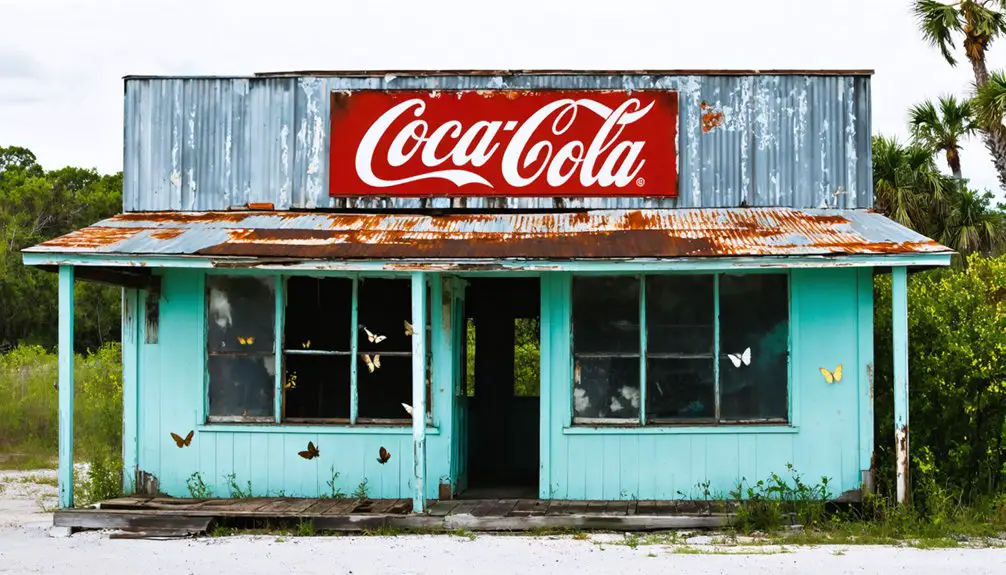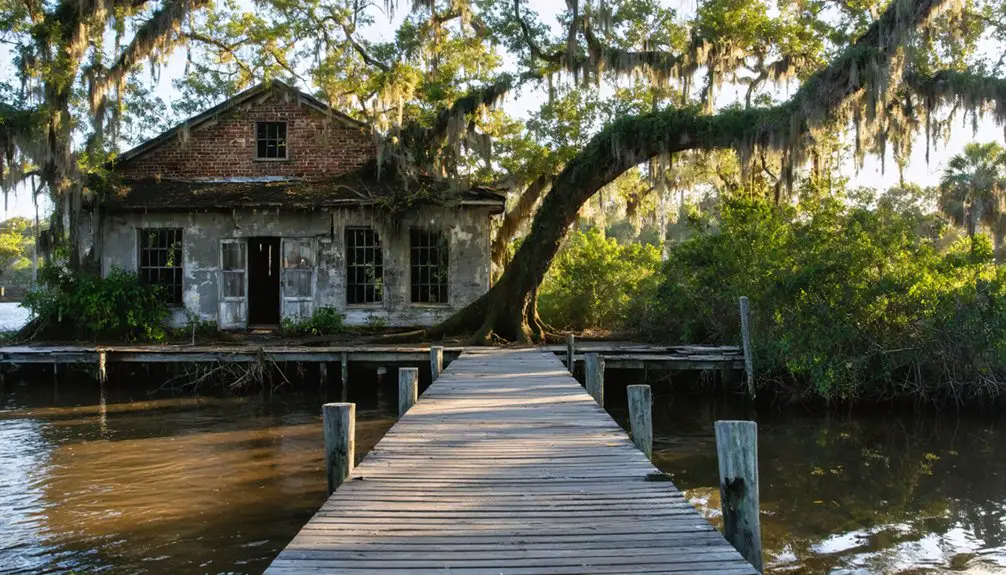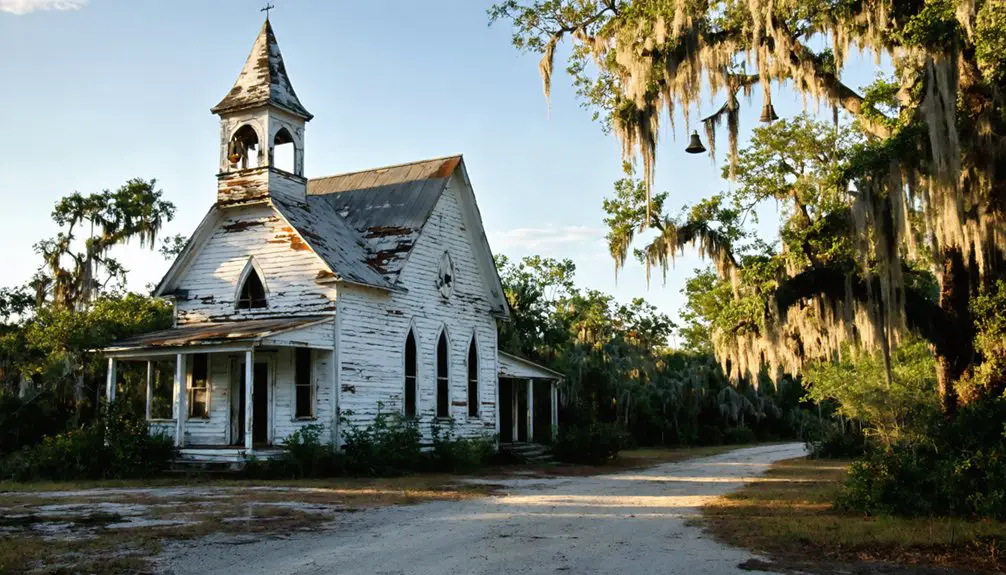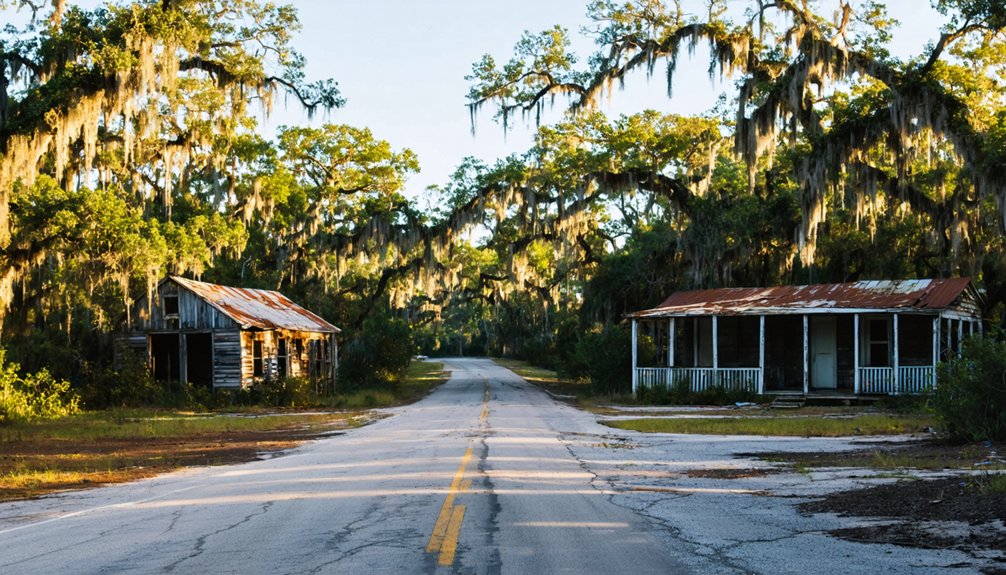
Planning a ghost town road trip to Apoxsee, Florida means heading south on US 441 through Osceola County, somewhere between Kenansville and Yeehaw Junction. You won’t find buildings or historical markers here — just quiet scrubland, open pastures, and the faint memory of a turpentine town that vanished before it ever truly thrived. Named from a Seminole-Creek word meaning “tomorrow,” Apoxsee is a place best experienced through atmosphere and curiosity, and there’s much more to uncover about its fascinating, fleeting history.
Key Takeaways
- Apoxsee sits along US 441 in Osceola County, between Kenansville and Yeehaw Junction, making it an easy rural drive.
- No GPS pin marks the site, so treat the drive itself as the core experience and watch for old rail corridor remnants.
- Pack water, snacks, and a full gas tank, as roadside amenities are extremely limited throughout rural Osceola County.
- Spring and fall offer the most comfortable temperatures; early mornings provide better lighting and atmosphere for exploration.
- Begin in Kenansville, drive south through Apoxsee, and end at Yeehaw Junction’s historic Desert Inn for a complete day trip.
What Is Apoxsee and Why Does It Count as a Florida Ghost Town?
Tucked along US 441 in Osceola County, Apoxsee is one of Florida’s quieter ghost towns — a place that rose around a railroad flag stop and a turpentine economy, then faded when both disappeared.
Its name traces back to the Seminole-Creek word *Apaksi*, meaning tomorrow, though the town never really got one. The post office ran from 1928 to 1933, the railroad pulled out in 1947, and the people followed the work elsewhere.
What makes Apoxsee count as a ghost town isn’t dramatic ruins — it’s absence. Don’t expect tourist infrastructure or historical preservation markers guiding your visit.
You’re fundamentally stopping at a coordinate with a story. That freedom to explore on your own terms is exactly what makes backroads destinations like this worth chasing.
The Railroad and Turpentine Boom That Built Apoxsee
When J. E. Ingram, vice president of the Florida East Coast Railroad, named Apoxsee in 1920, he gave a remote stretch of Osceola County its first real economic identity.
The FEC’s Kissimmee Valley Extension brought the rail access that made turpentine harvesting profitable, allowing settlers to tap the surrounding pinelands and ship resin north to enthusiastic markets.
Once the timber played out and the resin supply dried up, though, the industry collapsed, and Apoxsee lost the only engine driving it forward.
FEC Railroad Arrival
Before Apoxsee had a post office or a name most people could pronounce, it had a railroad. The Florida East Coast Railroad’s Kissimmee Valley Extension pushed through Osceola County, and Apoxsee became its first flag stop south of Kenansville.
In 1920, FEC Vice President J. E. Ingram gave the settlement its name, pulling it from the Seminole-Creek word *Apaksi*, meaning tomorrow. That single act of naming tied the town to local legends still referenced by Florida history enthusiasts today.
The railroad connected scattered settlers to broader markets, making growth possible in an otherwise remote stretch of scrubland. Preservation efforts remain minimal, but understanding the FEC’s role here gives you a sharper picture of why Apoxsee existed at all.
Turpentine Economy Thrives
The railroad didn’t just put Apoxsee on the map—it gave the settlement a reason to exist. Turpentine operations moved in quickly, tapping the longleaf pines that blanketed the surrounding flatlands. Workers extracted resin, processed it into naval stores, and shipped it out along the Florida East Coast line.
For a stretch, the economy hummed. A post office opened in 1928, signaling genuine community growth. But the timber didn’t last. As workers stripped the land of usable pine, production collapsed and people left.
Local legends suggest the decline happened faster than anyone anticipated, though urban legends about hidden prosperity never quite matched the historical record. By 1933, the post office had closed, and Apoxsee’s brief, productive chapter was effectively over.
Industry Collapse Begins
Once the pine forests gave out, Apoxsee had nothing left to stand on. Workers stripped the timber and drained the resin until the land simply couldn’t produce anymore. When the turpentine supply collapsed, residents packed up and left, leaving behind little more than local legends about a town that briefly thrived deep in Osceola County’s backroads.
You won’t find dramatic ruins here, which separates Apoxsee from ghost towns that fuel urban legends with crumbling walls and haunted structures. The decline was quieter and more practical — industry died, people followed the work elsewhere, and the post office shuttered in 1933.
What remained was silence, scrubland, and a fading name on old railroad maps. The collapse wasn’t sudden; it was a slow exhale.
Why Apoxsee Has a Seminole-Creek Name
When you look at the name Apoxsee, you’re seeing a direct link to the Seminole-Creek language, where the word *Apaksi* means “tomorrow.” Florida East Coast Railroad Vice President J. E. Ingram chose that name in 1920, embedding Indigenous cultural influence into a settlement built largely by outside industry.
That choice reflects how deeply Seminole-Creek language shaped place names across Florida, even in communities with little direct connection to the culture itself.
The Word Apaksi Explained
Buried in the name Apoxsee is a word far older than the railroad that put this Florida whistle stop on the map. That word is *Apaksi*, drawn from the Seminole-Creek language, and it means tomorrow.
When FEC Vice President J. E. Ingram named the settlement in 1920, he reached into Indigenous vocabulary to give this small turpentine outpost its identity. Local legends don’t surround the choice with drama, but the linguistic root carries quiet weight.
You’re standing in a place named after the future, yet the town itself vanished. Preservation efforts haven’t rescued much physically, but knowing that *Apaksi* means tomorrow reframes how you read the silence here. It’s a name that outlasted everything it once described.
Ingram’s 1920 Naming Decision
J. E. Ingram, Vice President of the Florida East Coast Railroad, made the naming decision in 1920 when the Kissimmee Valley Extension pushed south through Osceola County. He chose Apoxsee, drawing from the Seminole-Creek word Apaksi, meaning tomorrow. That choice wasn’t accidental.
Ingram understood the land’s indigenous roots, and honoring them felt fitting for a settlement built on new beginnings.
Today, historical preservation efforts keep that story alive even though the town itself has nearly vanished. Local legends suggest the name carried optimism, a forward-looking spirit that matched the railroad’s expansion ambitions.
When you stop along US 441, you’re standing where that decision echoed for decades. The name outlasted the tracks, the turpentine camps, and the post office that closed in 1933.
Seminole-Creek Cultural Influence
The Seminole-Creek people shaped this corner of Florida long before any railroad surveyor drew a line through Osceola County. When J. E. Ingram named this settlement in 1920, he pulled from their language, selecting *Apaksi*, meaning “tomorrow.” That single word carries centuries of cultural weight you won’t find on any highway marker.
Local legends suggest the Seminole-Creek presence lingered well after settlement arrived, influencing everything from land use to place names scattered across Osceola County’s backroads. Urban legends occasionally tie mysterious abandonments to Indigenous connections.
Though the real story here is simpler and more powerful: a railroad executive borrowed a Seminole-Creek word that quietly outlasted the tracks, the turpentine camps, and the post office itself. That name is now the only thing standing.
What You’ll Actually Find at the Apoxsee Site Today
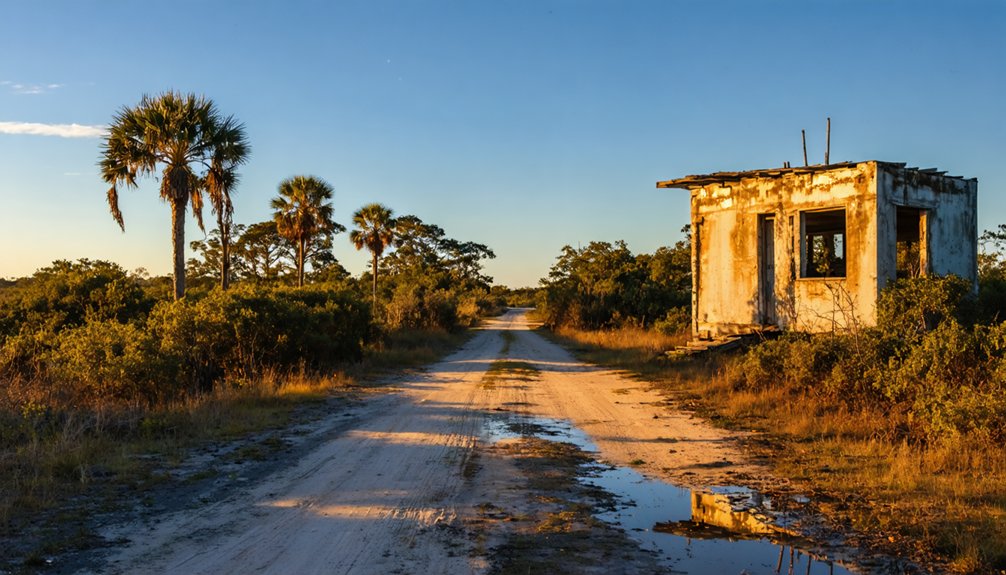
Visitors who make the drive out to Apoxsee won’t find much waiting for them — and that’s kind of the point. The site sits quietly along US 441, blending into the rural Osceola County landscape with little to distinguish it from the surrounding scrubland and scattered farms.
No preserved buildings greet you, no markers celebrate its turpentine past, and no formal preservation efforts have restored what time erased. A possible 1920s house reportedly exists nearby, but it hasn’t been reliably located.
Local legends keep the name alive more than any physical structure does. What you’ll actually experience is open road, flat horizon, and the satisfying awareness that you’re standing where a small community once operated.
For independent travelers, that quiet absence tells its own compelling story.
The Best Time to Visit Apoxsee, Florida
Once you’ve absorbed the quiet emptiness of the Apoxsee site, the next practical question is when to actually make the drive. Florida’s warm climate means you can visit year-round, but timing matters more than you’d expect.
Apoxsee rewards patience. Once you’ve felt its quiet emptiness, the only question left is when to make the drive.
Spring and fall offer the most comfortable temperatures for roadside exploring. Summer brings brutal heat and afternoon storms that turn rural shoulders muddy. Winter stays mild enough to walk the area without sweating through your shirt.
Early mornings work best regardless of season. You’ll catch better light for photographs, and the stillness amplifies the atmosphere that feeds local myths and urban legends surrounding Florida’s forgotten railroad stops.
Avoid holiday weekends if you want true solitude. Apoxsee rewards the traveler who moves at their own pace, not one chasing a crowded backroads itinerary.
How to Get to Apoxsee Along US 441
Getting to Apoxsee is straightforward: you’ll follow US 441 south through Osceola County, positioning yourself somewhere between Kenansville and Yeehaw Junction. The road cuts through a rural landscape of scattered farms and open range, giving you space to think about the urban legends and folklore tied to Florida’s forgotten settlements.
No GPS pin perfectly marks the spot, so treat the drive itself as part of the experience. You’re wayfinding by history as much as by highway. The area is 2WD-accessible, meaning any standard vehicle handles it comfortably.
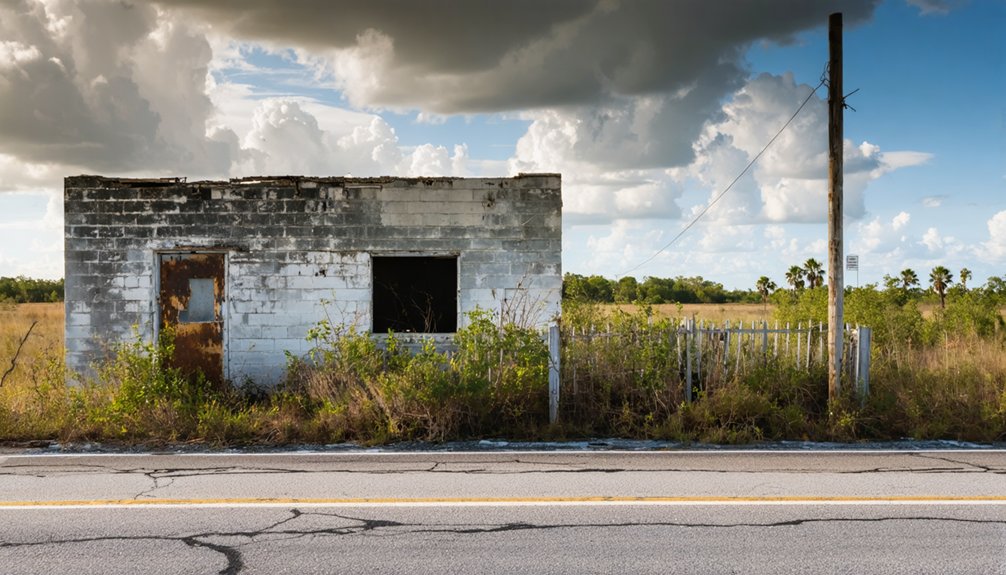
Keep your eyes open for old rail corridor remnants and roadside markers that hint at what once stood here. Pairing this stop with Kenansville and Yeehaw Junction builds a compact, rewarding backroads route worth the detour.
How to Add Apoxsee to a Kenansville and Yeehaw Junction Day Trip
Connecting Apoxsee with Kenansville and Yeehaw Junction turns a single historical stop into a full day of backroads exploration. Start in Kenansville, where local legends tied to cattle ranching and frontier settlement give you strong historical grounding.
From there, head south along US 441 and pause at Apoxsee to absorb the quiet atmosphere of a vanished turpentine town. Continue south to Yeehaw Junction, home to the Desert Inn, a piece of historic architecture that actually survived and still stands.
The entire corridor stays compact, keeping driving time low and exploration time high. You won’t need anything beyond a reliable 2WD vehicle, a paper map or downloaded offline route, and enough curiosity to appreciate what rural Florida looked like before modern development erased it.
What to Bring and Expect on a Rural Osceola County Ghost Town Drive
Driving through rural Osceola County means trading convenience for atmosphere, so pack accordingly. Roadside amenities are scarce along this stretch of US 441, so bring water, snacks, and a full tank of gas before you leave Kenansville or Yeehaw Junction. Cell service can be spotty, so download offline maps ahead of time.
Wear comfortable shoes if you plan to step off the pavement, since the terrain stays flat but uneven in spots. Wildlife observation adds unexpected reward here — keep your eyes open for sandhill cranes, gopher tortoises, and hawks working the open pastures. A pair of binoculars earns its weight.
Expect minimal signage marking Apoxsee itself. Treat the drive as the destination, and the historical stop becomes a natural, unhurried pause in a genuinely remote Florida landscape.
Frequently Asked Questions
Is Apoxsee’s Alternate Spelling Apoxee Used on Any Official Signs?
You won’t find Apoxee on any official signs, but you’ll encounter spelling variations in historical signage and old records. Embrace the mystery — that’s part of the freedom of exploring forgotten Florida ghost towns like this one!
Did J. E. Ingram Name Any Other Florida Railroad Stops Personally?
The knowledge doesn’t confirm whether J. E. Ingram personally named other Florida landmarks beyond Apoxsee. Imagine discovering he shaped railroad history across the state — you’d want to dig deeper into FEC archives for that answer.
Are There Any Local Guides Offering Tours of the Apoxsee Area?
You won’t find local tour operators or guided adventure options at Apoxsee. It’s a self-guided stop where you’re free to explore independently, cruise US 441, and uncover this ghost town’s quiet, forgotten history on your own terms.
Has Any Archaeological Survey Been Conducted at the Apoxsee Site?
Like a diary with torn-out pages, Apoxsee’s survey history stays frustratingly blank. No confirmed archaeological discoveries exist for the site, so you’re fundamentally stepping onto untouched historical ground when you visit.
Is Wild Camping Permitted on the Rural Land Surrounding Apoxsee?
You’ll need to verify wild camping regulations before pitching a tent, as rural land access around Apoxsee typically means private property. Always seek landowner permission to stay compliant while embracing that wide-open Florida freedom responsibly.
References
- https://www.ghosttowns.com/states/fl/apoxsee.html
- https://en.wikipedia.org/wiki/Apoxsee
- https://kids.kiddle.co/Apoxsee
- https://en.wikipedia.org/wiki/List_of_ghost_towns_in_Florida
- https://en.wiktionary.org/wiki/Apoxsee
- https://www.ghosttowns.com/states/fl/fl.html
- https://www.walkaboutflorida.org/guided-walks/carlton-reserve/
- http://www.gribblenation.org/2018/02/ghost-town-tuesday-yeehaw-junction-and.html
- https://usgenwebsites.org/flgenweb/FLOsceola/osceola_place_names.html
- https://www.reddit.com/r/florida/comments/2606lf/a_list_of_hundreds_of_florida_ghost_towns_and/