To plan your ghost town road trip to Eden Valley, Nebraska, head three miles east and five miles north of Plainview in Pierce County. You won’t need a special vehicle — a standard 2WD handles the route. Bring historic maps, because Eden Valley won’t appear on modern ones. Only a quiet cemetery marks where German settlers once built a church, raised a band, and refused to quit. Keep going, and the full story gets even more remarkable.
Key Takeaways
- Eden Valley is located in Pierce County, Nebraska, 3 miles east and 5 miles north of Plainview, accessible via standard 2WD vehicles.
- Only the cemetery remains visible at the site, serving as the sole physical marker of this former German settler community.
- Use historic maps, aerial photos, and drone photography to locate foundations, depressions, and vegetation patterns marking Eden Valley’s original footprint.
- The community had a church built in 1899, a school operating until 1963, and a band organized in 1927.
- Visitors should bring maps, approach the cemetery respectfully, and understand the site’s silence reflects railroad closures and agricultural economic collapse.
Where Eden Valley Sits in Pierce County, Nebraska
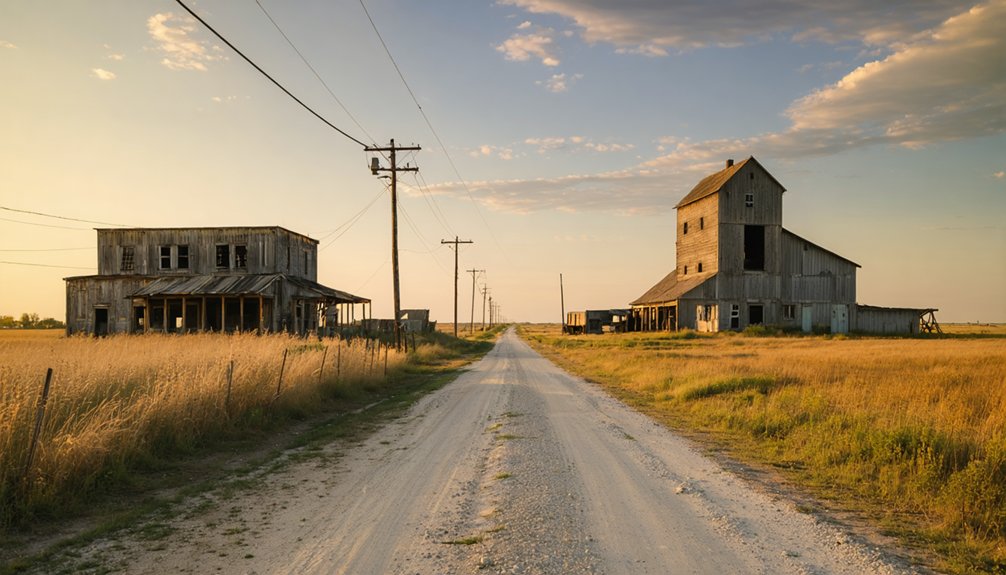
Eden Valley rests quietly in Pierce County, Nebraska, three miles east of Plainview and five miles north — a location that’s easy to miss if you don’t know what you’re looking for. You won’t find scenic overlooks or local cuisine drawing crowds out here.
What you’ll find instead is open Nebraska sky, quiet farmland, and the faint outline of a community that once held schools, a church, and even a band that played through the Depression. The road in is standard 2WD, so you don’t need anything special to reach it.
You’re fundamentally driving into a landscape that’s absorbed an entire settlement back into itself. The cemetery is what remains, standing as the only visible proof that people once built something meaningful here.
How to Reach Eden Valley From Plainview
From Plainview, the drive to Eden Valley is straightforward — head three miles east, then five miles north, and you’re there. The route is standard 2WD, so you won’t need a specialized vehicle to reach what remains of this once-active German settlement community.
Three miles east, five miles north — no special vehicle required, just curiosity about what’s left behind.
As you navigate those quiet Pierce County roads, you’re retracing paths that German settlers once traveled daily — to church, to school, to band performances during the Depression years.
Local legends and ghost town myths often romanticize such places, but Eden Valley’s story is grounded in real community effort and quiet disappearance.
When you arrive, a cemetery is all that greets you. Bring a current map alongside a historic one — that comparison tells you more than any roadside marker ever could.
Historic Maps and Aerial Photos for Finding Eden Valley’s Remains
Before you make the drive, pull up a historic Nebraska county map and compare it against a current road map—you’ll often spot the old Eden Valley footprint where roads once converged or where lot lines still ghost across the landscape.
Aerial photographs sharpen that picture further, revealing faint rectangular depressions, overgrown foundations, or the unmistakable geometry of a former schoolyard or churchyard.
Together, these two tools transform a seemingly empty stretch of Pierce County into a readable record of what once stood there.
Comparing Historic Maps
Since almost nothing physical remains at Eden Valley today, historic maps and aerial photographs become your most powerful tools for reconstructing what once stood there. Ghost town preservation starts with historic map accuracy — layering old records against current landscapes reveals what time erased.
Compare these map sources to trace Eden Valley’s footprint:
- Nebraska General Land Office surveys from the 1800s
- Pierce County plat maps showing early lot divisions
- Historic railroad maps from the 1870–1890 expansion era
- USGS topographic maps predating the town’s decline
- Sanborn fire insurance maps documenting structures in detail
Cross-referencing these sources lets you pinpoint where the church, school, and parsonage once stood. You’re not just reading maps — you’re reclaiming a community’s erased story on your own terms.
Reading Aerial Photographs
Aerial photographs reveal what maps can only suggest — the ghost of a foundation, a faint road scar cutting across a field, or a tree line that once sheltered a farmstead.
Pull up satellite imagery of the land three miles east and five miles north of Plainview, and you’ll start reading the landscape differently. Shadows fall across depressions where structures once stood. Soil discoloration marks buried foundations. Vegetation clusters where a windbreak once shielded a parsonage or schoolhouse.
Drone photography takes this further, letting you skim low over the terrain and catch angles that overhead satellites miss. Before you drive out to Eden Valley’s remaining cemetery, spend time studying these images. You’ll arrive already knowing where to look — and what the land is quietly trying to tell you.
What’s Left to See at Eden Valley Today
Though Eden Valley once supported a school, a church, a parsonage, and even a community band that performed through the hardest years of the Depression, what you’ll find there today is fundamentally one thing: a cemetery.
Once home to a school, church, parsonage, and community band, Eden Valley survives today as one thing: a cemetery.
That quiet plot of ground is where local legends breathe and ghost stories take root. Before you go, know what to expect:
- No standing structures remain on the site
- No current residents occupy the area
- The cemetery serves as the sole surviving physical marker
- Standard 2WD vehicles can reach the location
- The site sits three miles east and five miles north of Plainview
You’re free to explore, but come prepared. Bring your historic maps, respect the grounds, and let the cemetery speak for the community that once stood there.
The German Settlers Who Built Eden Valley
That cemetery didn’t appear by accident — it grew from a community that German settlers built with deliberate intention. Their German heritage shaped Eden Valley‘s settlement patterns from the start, drawing families who organized a church on November 1, 1891, before they’d even raised the building itself.
They constructed that church in 1899, only to watch a violent windstorm destroy it shortly after. Rather than abandon what they’d built, they raised another immediately.
By 1909, they’d added a parsonage. They established Eden Valley as the fourth school in the Plainview area.
They organized a band in 1927 that carried the community’s spirit through the Depression.
These weren’t temporary settlers. They were people who kept rebuilding — and that cemetery stands as their most enduring proof.
The Windstorm That Destroyed Eden Valley’s First Church
One year after those German settlers raised their church in 1899, a violent windstorm tore it down. The windstorm aftermath left the congregation with a choice: quit or rebuild. They rebuilt immediately. That resilience defines Eden Valley’s spirit.
They built it. A windstorm erased it. They built it again. That is Eden Valley.
As you imagine standing on that open Nebraska prairie, consider what those settlers faced:
- A newly built church reduced to wreckage overnight
- No insurance safety nets protecting frontier communities
- Harsh prairie weather striking without warning
- A congregation determined to push forward despite total loss
- Church reconstruction completed quickly, followed by a parsonage added in 1909
That rebuilt church anchored the community for decades. When you visit Eden Valley today, only the cemetery remains — but knowing this story makes that quiet ground feel anything but empty.
How Eden Valley’s School and Band Survived the Depression
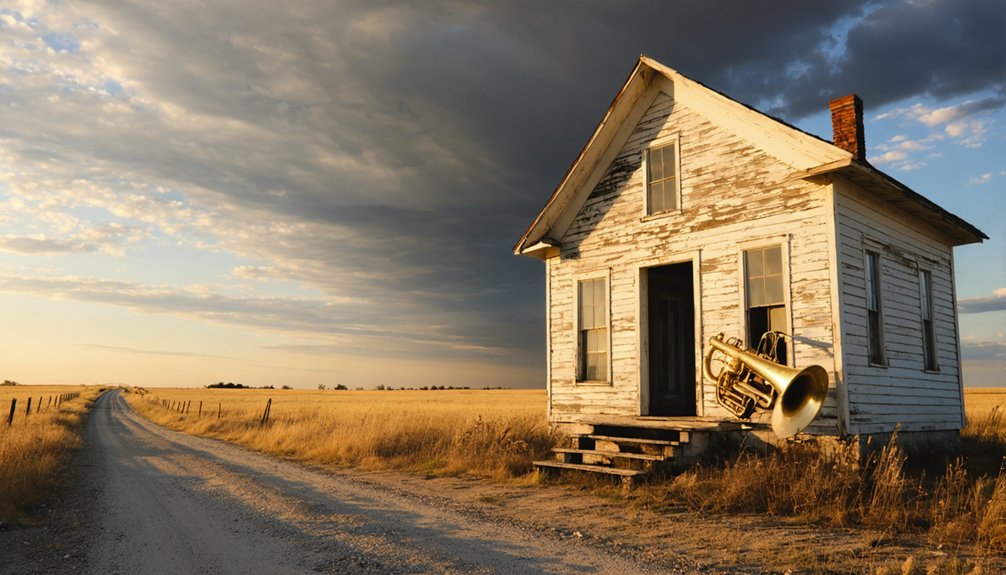
While the rebuilt church gave Eden Valley its spiritual anchor, the community’s school and band gave it something equally essential: a sense of shared identity that would carry residents through the hardest years America had ever seen.
As the fourth school organized near Plainview, Eden Valley’s institution carried real weight. School traditions shaped generations of local children, even as the building itself moved twice before a permanent structure replaced it. The school wouldn’t close until 1963.
Meanwhile, Eden Valley organized a band in 1927, and those band performances became rallying points when the Depression threatened to hollow out rural communities across Nebraska.
While neighboring towns struggled and faded, Eden Valley kept playing. That resilience tells you something important about the people who built this place and refused to let it quietly disappear.
What Killed Eden Valley and Hundreds of Nebraska Towns Like It
Eden Valley’s story of resilience makes what came next feel almost cruel. The same forces that erased hundreds of Nebraska communities swept through here too. You’re looking at a pattern, not an accident:
- Railroad branch closures cut towns off from markets overnight
- The collapsed agricultural economy drained families from the land
- Land speculation left behind temporary structures that vanished quickly
- Place names, tree groves, and cemeteries became the only surviving evidence
- Local legends faded as the last witnesses moved away
What remains at Eden Valley is that cemetery — quiet, stubborn, waiting. Cemetery restoration efforts keep these places from disappearing entirely. When you stand there, you’re reading the final chapter of a community that fought hard before the land reclaimed it.
Frequently Asked Questions
Is There an Admission Fee or Permit Required to Visit the Cemetery?
No bureaucratic mountain blocks your path! Cemetery regulations and visitor access policies here favor total freedom — you can walk straight into Eden Valley’s historic grounds, no permits, no fees, no gatekeepers standing between you and Nebraska’s haunting past.
What Is the Best Time of Year to Visit Eden Valley?
Spring or fall offers you the best visits for historical preservation exploration and photography opportunities — you’ll capture Eden Valley’s solitary cemetery bathed in golden light, breathing life into stories of German settlers who once called this Nebraska prairie home.
Are There Any Nearby Towns With Hotels or Restaurants for Visitors?
Plainview, Nebraska’s your best bet — it’s just miles away, offering nearby lodging choices and local dining options where you’ll recharge before chasing Eden Valley’s haunting, windswept history and the freedom of Nebraska’s open roads.
Can Visitors Legally Walk Through the Eden Valley Cemetery?
You can walk through Eden Valley’s cemetery, embracing your freedom to explore its historical preservation. Practice cemetery etiquette — tread respectfully among the German settlers’ stones, honoring those who built a community from Nebraska’s vast, unforgiving prairie.
Are There Guided Ghost Town Tours Available in Pierce County, Nebraska?
Imagine a local historian leading you through forgotten fields — no formal guided tours currently exist in Pierce County, but historical preservation societies and ghost town legends can connect you with passionate locals who’ll unofficially walk Eden Valley’s story with you.
References
- https://www.ghosttowns.com/states/ne/edenvalley.html
- https://history.nebraska.gov/finding-nebraskas-ghost-towns/
- https://www.forgottennevada.org/sites/eden.html
- https://www.ghosttowns.com/states/nv/eden.htm
- https://kids.kiddle.co/List_of_ghost_towns_in_Nebraska