Your ghost town road trip to Emerald Community, Kansas, takes you 14 miles from Garnett to a quiet hilltop near the Anderson-Franklin County line, where Irish immigrants settled in the 1850s. You’ll find an active 1899 brick church, haunting stone ruins, and a cemetery filled with Irish surnames spanning generations. Once home to 75 Catholic farming families, Emerald’s story of faith, resilience, and rural decline runs deeper than what meets the eye.
Key Takeaways
- Emerald Community is located near the Anderson-Franklin County line, approximately 14 miles from Garnett, Kansas, along Iantha Creek.
- Travel south from Williamsburg on Colorado Road, then turn onto Allen Road; standard 2WD vehicles can access the site.
- Key landmarks include the 1899 brick St. Patrick’s Catholic Church, stone church ruins, and a preserved functional bell at the cemetery entrance.
- The cemetery behind St. Patrick’s Church contains headstones bearing Irish surnames, reflecting over a century of Irish-Catholic heritage.
- Extend your trip by visiting nearby ghost towns Reeder, Homewood, and Selma, each featuring overgrown lots and scattered foundations.
What Is the Emerald Community Ghost Town in Kansas?
Tucked near the Anderson-Franklin County line in Kansas, Emerald is a ghost town that never fully disappeared. Irish immigrants settled here in the 1850s, naming the community after their homeland.
Near the Anderson-Franklin County line, Emerald is a Kansas ghost town Irish immigrants proudly named after their homeland.
What draws visitors today isn’t a bustling town center — it’s the historical architecture crowning a quiet hilltop. St. Patrick’s Catholic Church, a brick structure dedicated in 1899, stands where earlier log and stone buildings once served the community.
The surrounding cemetery holds generations of Irish-Catholic settlers, and local legends connect the land to those pioneering families who shaped this corner of Kansas.
You won’t find storefronts or sidewalks here. Instead, you’ll find a living landmark that survived lightning strikes, population decline, and time — telling a story most ghost towns can’t.
The Irish Settlers Who Founded Emerald in the 1850s
Before Kansas was even a state, Irish immigrants were staking their claim to this quiet stretch of land near the Anderson-Franklin County line. Fleeing their homeland and seeking open territory, these settlers arrived as early as 1856, drawn by farmable soil and the freedom to build something permanent.
Their Irish heritage shaped everything about the community, from its name — a nod to the “Emerald Isle” — to its tight-knit Catholic identity. Settler John McManus arrived by 1857, and others followed.
They established settlement patterns centered on faith, family, and farming.
When you visit today, you’re walking ground that determined people chose with purpose. They didn’t just occupy the land — they named it, prayed on it, and built a community that still carries their fingerprints.
St. Patrick’s Catholic Church: Heart of the Emerald Community
Standing on that hilltop, you immediately understand why the Irish settlers chose this spot for St. Patrick’s Catholic Church. It commands the landscape like a beacon, anchoring everything this community built.
The church itself tells a layered story through its architectural styles — beginning with a humble log structure in 1861, progressing to a stone building now standing in ruins nearby, and culminating in the brick church dedicated in 1899 that still serves worshippers today.
Among Emerald’s community landmarks, St. Patrick’s stands apart because it never fully surrendered to time. Lightning struck and burned it on September 29, 1939, causing roughly $50,000 in damage, but the community refurbished it rather than abandon it.
When you visit, you’re walking into a living piece of Irish-Kansas Catholic heritage.
What Happened to Emerald’s 75 Families?
At its peak before World War I, Emerald supported around 75 Catholic families who farmed the land and kept the community alive.
By 1936, that number had dropped to just 48 families, and the rural decline that swept across Depression-era Kansas hit Emerald hard.
Today, you won’t find a bustling town, but the church and cemetery remain active, proof that a small faithful remnant never fully let go.
Peak Community At 75
Though it’s hard to picture now, Emerald once supported around 75 Catholic farming families by the time World War I arrived — a tight-knit rural community anchored by St. Patrick’s Church on the hill. Irish immigrant roots ran deep here, shaping daily life, faith, and farming patterns across the Anderson-Franklin county line.
By 1936, that number had dropped to 48 families, and the decline continued through the decade. Rural consolidation, economic hardship, and shifting agricultural demands pulled people away from small communities like Emerald across Kansas.
What remains today reflects remarkable cultural preservation — the church, cemetery, and stone ruins still draw visitors committed to heritage tourism and Irish-Kansas history. You’re not visiting a hollow shell; you’re standing inside a story that refused to disappear completely.
Rural Decline Took Hold
The 75 families that filled Emerald’s pews during World War I didn’t vanish overnight — they left gradually, pulled away by the same forces dismantling small farming communities across Kansas. By 1936, only 48 families remained. The Dust Bowl years, economic hardship, and expanding cities drew younger generations away from the land their Irish ancestors had broken in the 1850s.
What survived was something harder to measure than population numbers — cultural heritage embedded in stone, brick, and soil. The hilltop church stood as both landmark and anchor, its architectural preservation quietly resisting erasure.
When you visit Emerald today, you’re walking through a community that lost its critical mass but never completely surrendered its identity. That distinction makes it unlike most ghost towns you’ll encounter on a Kansas road trip.
Who Still Remains Today
What remains of Emerald’s 75 families isn’t a population — it’s a presence. You won’t find bustling streets or storefronts, but you’ll sense those Irish settlers in everything still standing.
The brick church dedicated in 1899 anchors the hilltop, its architectural style a quiet testament to a community that refused to vanish completely. Local legends travel with you here — stories of faith, fire, and rebuilding after lightning struck in 1939.
Behind the church, the cemetery holds generations of the same surnames that broke this Kansas soil in the 1850s. The old stone church ruins sit nearby, weathered but visible.
When you ring the preserved bell at the cemetery entrance, you’re not mourning what’s gone. You’re acknowledging what stayed.
The Stone Church Ruins, Bell, and What Still Stands
Standing on the hill at Emerald, you’ll find more than just a single church—you’ll find layers of history compressed into one compact site.
The brick church dedicated in 1899 still stands as the centerpiece, its architectural details reflecting the determination of Irish Catholic settlers who built it.
North of the manse, the ruins of an earlier stone church remain visible, offering a quieter, rawer glimpse into the community’s past.
Preservation efforts have kept the brick structure functional despite a devastating 1939 lightning fire that caused $50,000 in damage.
Perhaps the most personal detail you’ll encounter is the old church bell, removed and placed at the cemetery entrance. It still rings.
Touch it, pull the rope, and you’re connected directly to Emerald’s living history.
Walk the Cemetery Behind St. Patrick’s
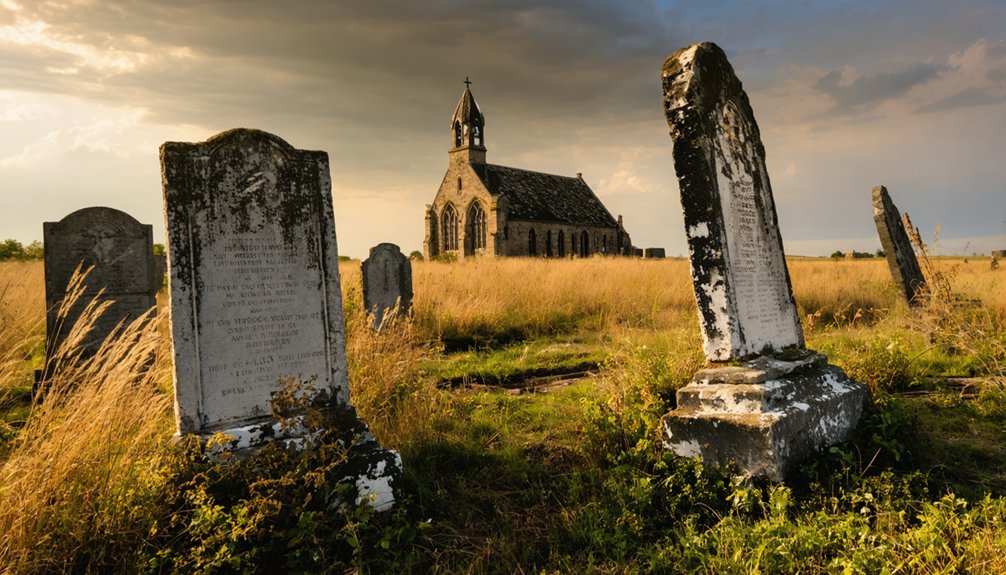
A short walk behind St. Patrick’s brings you to a cemetery that quietly holds over a century of Irish-Kansas history. Headstones bearing Irish surnames mark the lives of families who carved out farms along Iantha Creek starting in the 1850s.
The historical architecture surrounding you — from the brick church to the crumbling stone ruins nearby — frames the cemetery in a way that makes the past feel tangible. You’re standing in a place where local legends of faith, hardship, and survival aren’t just stories; they’re carved in limestone.
Take time to read the dates and names. Some markers go back to the earliest settlement years. It’s the kind of grounded, unhurried experience that reminds you why exploring forgotten places matters.
How to Find the Emerald Community From Williamsburg
Getting to Emerald is straightforward, even if the landscape feels like it’s pulling you further from the modern world with every mile. From Williamsburg, head south on Colorado Road, then turn onto Allen Road. Standard 2WD vehicles handle the route fine, so no off-road gear is necessary.
You’ll know you’re close when the hilltop silhouette of St. Patrick’s brick church rises against the Kansas sky. That historical architecture has anchored this Irish settlement since 1899, replacing earlier log and stone structures tied to local legends of immigrant faith and frontier perseverance.
Emerald sits near the Anderson-Franklin County line along Iantha Creek, roughly 14 miles from Garnett. Plan your arrival with enough daylight to explore both the church grounds and the surrounding rural landscape properly.
Other Anderson County Ghost Towns Near Emerald
Emerald isn’t the only forgotten community worth tracking down in Anderson County. Several other ghost towns dot the county’s back roads, rewarding explorers who push past the familiar routes.
Towns like Reeder, Homewood, and Selma once supported schools, churches, and general stores before rural depopulation quietly erased them from the map. Today, you’ll find little more than overgrown lots, scattered foundations, and the occasional historic markers pointing to what once stood.
Spring visits offer an unexpected bonus — wildflower blooms soften the abandoned landscapes, turning empty fields into something almost beautiful. If you’re already making the drive out to Emerald, budget extra time to trace these neighboring communities.
Each one adds another layer to Anderson County’s larger story of settlement, survival, and eventual silence.
Frequently Asked Questions
Is There an Entrance Fee to Visit the Emerald Community Site?
You’ll find no entrance fee to explore Emerald’s local landmarks! Simply drive in, roam the church grounds, and wander the cemetery freely. One of the best travel tips: bring cash for donations to help preserve this historic site.
Can Visitors Ring the Preserved Church Bell at the Cemetery?
Yes, you can ring the preserved church bell at the cemetery entrance! It’s a powerful moment of community engagement, connecting you directly to Emerald’s Irish heritage through historic preservation that keeps this remarkable ghost town’s spirit gloriously alive.
Is St. Patrick’s Catholic Church Still Holding Regular Religious Services?
You’ll find St. Patrick’s still holds regular services — it’s living historical architecture, breathing local legends into every mass. You attend, you connect, you witness a resilient Catholic community defying ghost-town expectations in rural Kansas.
What Is the Best Time of Year to Visit Emerald?
Spring and fall offer you the best seasonal weather for visiting Emerald. You’ll capture best photography of St. Patrick’s hilltop church surrounded by lush greenery or golden foliage, making your ghost town experience truly unforgettable.
Are There Any Guided Tours Available at the Emerald Community?
Ironically, no guides guard this ghost town history — you’re free to explore it all yourself! Wander the church, cemetery, and ruins, uncovering local legends at your own pace, on your own terms.
References
- https://www.ghosttowns.com/states/ks/emerald.html
- https://legendsofkansas.com/emerald-kansas/
- https://dianastaresinicdeane.wordpress.com/tag/emerald-community/
- https://legendsofkansas.com/kansas-ghost-town-list/
- https://esirc.emporia.edu/bitstream/handle/123456789/1577/McQuin Vol 8 Num 3.pdf?sequence=1
- https://www.youtube.com/watch?v=KBXINX0xqnU