Plan your ghost town road trip to Empire City, Kansas, and you’ll discover one of the Midwest’s most fascinating boom-and-bust stories. Founded in 1877, this mining town exploded to 3,000 residents almost overnight before fading into near-total abandonment by the early 1900s. You can still explore surviving homes, cemetery remnants, and ghost street patterns that hint at its former scale. Stick around, and Empire City’s wild history of rivalry, collapse, and survival gets even more compelling.
Key Takeaways
- Empire City, Kansas, founded in 1877, is a ghost town with surviving historic buildings, cemeteries, and street patterns from its mining boom era.
- Access the site from Joplin, Missouri, via US-66 or US-400 to Galena, then head north along Short Creek Road.
- Pack essentials including a camera, map, water, sturdy shoes, and a notebook to document the site’s raw historical remnants.
- Nearby towns like Galena, Baxter Springs, Joplin, and Columbus offer additional stops to enrich your ghost town road trip.
- Empire City’s quiet, open landscape and unpolished atmosphere make it ideal for independent exploration and mining history photography.
What Was Empire City, Kansas?
Before it faded into Kansas history, Empire City was a fast-rising boomtown that sprang up just north of Galena in Cherokee County, along the banks of Short Creek.
The West Joplin Lead & Zinc Company purchased 120 acres of former farmland and laid out the townsite in spring 1877, turning raw prairie into a company town almost overnight.
The Lead and Zinc Boom That Built It Almost Overnight
What turned that raw farmland into a packed company town so fast was the lead and zinc boom shaking Cherokee County in 1877. Mineral strikes pulled workers, merchants, and opportunists into the region almost overnight.
The West Joplin Lead & Zinc Company moved quickly to control the action by building Empire City on 120 acres of former farmland.
The Legendary Rivalry Between Empire City and Galena
Two boomtowns sitting less than a mile apart were never going to get along. Empire City and Galena turned their mining history into fierce town rivalry almost immediately. Here’s how it played out:
- The Stakes – Both towns competed for miners, merchants, and money flowing from lead and zinc operations.
- The Stockade – Empire City actually built a physical barrier to stop residents from drifting toward Galena.
- The Retaliation – Galena residents tore part of that stockade down in August 1877.
- The Courtroom – The conflict escalated beyond fistfights and fence-tearing straight into legal battles.
Galena eventually won because its ore deposits ran richer and deeper. You can almost feel the tension still hanging over these quiet Cherokee County roads today.
How Empire City Collapsed From 3,000 People to a Ghost Town
Once a town hits 3,000 residents in its first summer, it’s easy to assume the growth will never stop. But Empire City’s mining history tells a harder truth.
By the mid-1880s, the lead deposits that built this Cherokee County boomtown started running thin. Families packed up, businesses shuttered, and the population collapsed to just over 1,000 people in only a few years.
Town decline accelerated as the 19th century closed and the ore disappeared entirely. Galena, with its richer deposits, pulled people and commerce away for good.
Empire City lost its independence in 1907, got absorbed as Galena’s Fifth Ward in 1910, and watched its post office close in 1913. What once roared with ambition now sits quiet along Short Creek.
What Survives at the Empire City Site Today
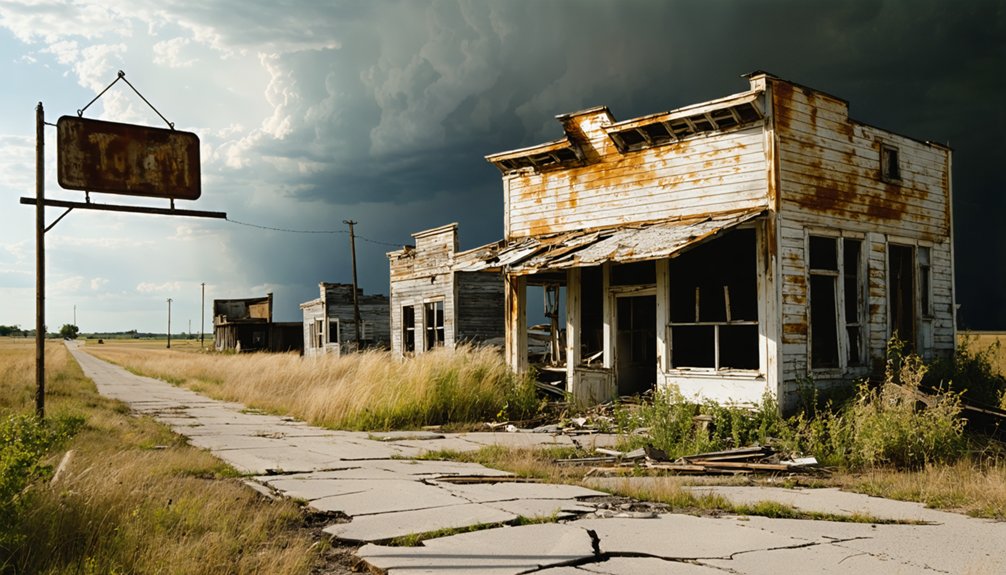
Though the town itself is long gone, the Empire City site still holds a handful of homes and historic buildings standing at the original location. You can wander through what remains and piece together the story of a once-thriving boomtown. Here’s what you’ll find:
The town is gone, but the Empire City site still holds original homes and historic buildings waiting to be explored.
- Standing homes – A few original residences still occupy the townsite.
- Historic architecture – Several buildings reflect the rapid construction style of the 1877 boom era.
- Cemetery remains – Gravesites connected to the original settlement offer a quiet, sobering stop.
- Neighborhood traces – Street patterns and lot arrangements hint at the town’s former scale.
You’re fundamentally reading history through what survived. It’s a raw, unpolished site — exactly the kind of place that rewards curious, independent explorers.
How to Get to Empire City, Kansas
Tucked just north of Galena in Cherokee County, Empire City is easy to fold into a southeast Kansas road trip. From Joplin, Missouri, head west on US-66 or US-400 into Galena, then push north along Short Creek Road to reach the original townsite.
The drive stays flat and open, giving you room to think about the boomtown that once crowded these quiet roadsides. Stop in Galena first to grab local cuisine at one of its small diners before heading out.
There aren’t dramatic scenic viewpoints here, but the wide Kansas sky and remnant structures create their own raw atmosphere. You’re moving through history on your own terms, no crowds, no entrance fees, just the open road and a town time nearly erased.
Nearby Kansas Ghost Towns Worth Combining With This Stop

If you’re already making the trip to Empire City, you might as well turn it into a fuller ghost town loop through southeast Kansas.
Several nearby towns share the same boom-and-bust mining history, making them natural companions on a single route.
Planning your stops in advance keeps the drive efficient and gives each location the attention it deserves.
Nearby Towns Worth Visiting
Since Empire City sits right on the Kansas-Missouri border in Cherokee County, you’re already well-positioned to string together a solid ghost town road trip through the old mining district. The region’s rich mining history and town rivalry stories make every stop feel connected.
- Galena, Kansas – Empire City’s fiercest rival, now a small town with preserved storefronts and deep zinc mining roots.
- Baxter Springs, Kansas – An early cattle town with Civil War history just 20 miles southwest.
- Joplin, Missouri – A short drive east offering mining museums and boomtown architecture.
- Columbus, Kansas – Cherokee County’s seat, worth a quick stop for local historical context.
Each destination adds another layer to the bigger story of southeast Kansas’s rise and fall.
Planning Your Combined Route
Once you’ve mapped out those nearby towns, you can pull the whole trip together into a single cohesive loop through southeast Kansas’s old mining corridor.
Start in Galena, where Empire City’s old rivalry still echoes through the streets, then push outward toward Baxter Springs and Treece, letting the landscape connect each stop naturally.
You’re tracing real cultural heritage here — communities that boomed, collapsed, and left their bones above ground. Keep preservation efforts in mind as you explore; photograph respectfully, stay on accessible paths, and avoid disturbing standing structures.
A loose two-day loop covers the essential sites without feeling rushed. Pack water, download offline maps since cell service gets spotty, and give yourself room to wander.
That freedom to explore at your own pace makes this corridor genuinely unforgettable.
What to Pack for a Kansas Ghost Town Road Trip
Before you load up the car and head out to Empire City, make sure you’ve packed a few essentials that’ll keep your visit comfortable and rewarding.
- Camera and notebook – Document historical artifacts, crumbling structures, and anything tied to local legends worth remembering.
- Detailed map or GPS – Cherokee County roads can be deceptive, so don’t rely solely on cell service.
- Water and snacks – There are no convenience stops near the site, so bring enough to stay energized.
- Sturdy walking shoes – Uneven terrain surrounds the remaining buildings and homesites, making solid footwear essential.
Traveling light but smart lets you move freely through the site, soak in the atmosphere, and connect genuinely with Empire City’s layered mining history.
Frequently Asked Questions
Is There an Admission Fee to Visit the Empire City Site?
Like an open book waiting to be read, Empire City’s historic architecture and local legends are yours to explore freely — there’s no admission fee, so you can roam this hauntingly quiet ghost town at will.
Are There Any Guided Tours Available at Empire City?
No official guided tours are available, but you’ll uncover Empire City’s historical significance on your own terms. Explore freely, respect preservation efforts, and let the remaining buildings and quiet streets tell their own compelling story.
Is It Legal to Metal Detect or Collect Artifacts at Empire City?
You’ll want to research local Metal detecting regulations before you dig, since artifact collection rules vary by land ownership. Always get permission first, respect private property, and check Kansas state laws to stay legally protected.
Are There Restrooms or Facilities Near the Empire City Site?
Once home to 3,000 residents, Empire City now offers virtually no restroom facilities or visitor amenities on-site. You’ll want to stop in nearby Galena before exploring, where you’ll find gas stations and basic conveniences.
What Is the Best Time of Year to Visit Empire City?
Spring and fall offer you the best seasonal weather for exploring Empire City’s quiet remains. You’ll enjoy mild temperatures during these ideal visit times, making it easier to roam freely and soak in the site’s rich mining history.
References
- https://www.legendsofamerica.com/ks-empirecity/
- https://www.hhhistory.com/2019/05/ghost-towns-of-kansas.html
- https://legendsofkansas.com/kansas-ghost-town-list/
- http://www.youtube.com/watch?v=alC1wDdSVvg
- https://en.wikipedia.org/wiki/List_of_ghost_towns_in_Kansas
- https://www.youtube.com/watch?v=KBXINX0xqnU
- https://www.facebook.com/JoshShackles/posts/empire-city-kansas-once-hailed-as-one-of-the-wildest-towns-in-america-was-a-chao/10227563321651726/
- https://www.legendsofamerica.com/ks-ghosttowns/