Planning a ghost town road trip to Federman, Michigan means visiting a place that’s almost entirely vanished. Formed in 1884 where two railroads crossed, Federman briefly thrived before declining into open farmland. You won’t find crumbling buildings or old depots — just quiet countryside and rail lines you can only view from the roadside. Bring printed maps, pack snacks, and pair it with nearby Monroe County ghost towns to make the most of your trip. There’s more to this forgotten junction than first meets the eye.
Key Takeaways
- Federman, Michigan, is a vanished railroad ghost town now surrounded by open farmland, offering little physical exploration but strong historical atmosphere.
- The rail crossing is inaccessible by vehicle, so plan for roadside observation and bring printed maps due to poor cell service.
- Pair Federman with other Monroe County ghost towns to build a fuller, more rewarding day-trip itinerary.
- Research Monroe County railroad history and local legends beforehand to better appreciate the site’s significance during your visit.
- Pack snacks, fuel up early, and keep your Federman stop brief before moving to nearby abandoned Michigan settlements.
What Was Federman, Michigan?
Where exactly does a town go when it disappears? In Federman‘s case, it fades into Monroe County farmland, leaving behind local legends and scattered community stories.
Where does a town go when it disappears? Federman simply fades into farmland, leaving only legends behind.
You’re looking at a place that formed in 1884 at the crossing of two railroads — the Lake Shore and Michigan Southern and the Toledo, Ann Arbor and Northern Michigan. That junction gave Federman its purpose and possibly its original name, Monroe Junction.
A post office operated there from 1899 to 1906, marking the community’s brief, functional life. Once rail traffic patterns shifted, the town had no reason to survive.
Today, agricultural land covers what was once a working settlement. Federman never incorporated, never expanded, and never anchored itself to anything beyond those railroad tracks.
How the Railroad Built and Abandoned Federman
Railroad tracks didn’t just pass through Federman — they created it. When the Lake Shore and Michigan Southern Railroad crossed the Toledo, Ann Arbor and Northern Michigan Railroad here in 1884, a community appeared almost overnight.
Rail junctions attracted commerce, workers, and eventually a post office, which opened in 1899. That postal address gave Federman its identity.
But railroads are capricious builders. As traffic patterns shifted and the junction lost its strategic value, Federman’s reason for existing quietly disappeared. The post office closed in 1906, just seven years after opening.
Local legends suggest the town may have originally carried the name Monroe Junction, hinting at its true purpose. Today, abandoned structures are practically gone, leaving only farmland where a railroad-born community once stood.
What’s Left at the Federman Ghost Town Today?
Almost nothing survives of Federman today. When you visit, you’ll find mostly open farmland where the rail junction once hummed with activity. No abandoned structures mark the spot, no crumbling depot greets you at the roadside.
Almost nothing survives of Federman — just open farmland where a rail junction once hummed with life.
Local folklore suggests the original depot was relocated to the Monroe County Fairgrounds, making that your best chance at connecting with any tangible remnant.
The exact rail crossing isn’t accessible by car, so plan on roadside viewing rather than on-site exploration. You’re fundamentally reading a landscape that’s erased its own history.
Bring a Monroe County map and railroad-history references to orient yourself properly. Federman rewards curious, self-directed travelers who find meaning in absence — those who can stand at the edge of a field and imagine everything that’s already gone.
How to Find the Federman Site in Monroe County
Tracking down Federman takes some deliberate preparation, since the site leaves almost no visual cues once you arrive. Pull out Monroe County railroad maps before you leave home, and cross-reference them with historical records tied to the old Lake Shore and Michigan Southern crossing.
Local legends surrounding the area won’t guide you through a marked trailhead — you’ll navigate by context, not signage.
Pioneer stories place the original junction deep within what’s now open farmland, so rural roads offer your closest approach. The exact crossing isn’t car-accessible, making roadside observation your practical option.
Bring a printed historical reference, since cell service may be inconsistent. Treat the search itself as part of the experience — finding a place this forgotten requires the same independence the original settlers carried westward.
How Should You Plan a Ghost Town Day Trip Around Federman?
Once you’ve located the general area on your map, it’s smart to fold Federman into a broader Monroe County ghost town loop rather than driving out for a single roadside stop. Pair it with other abandoned Michigan settlements, and you’ll build a richer day of exploration.
Research local legends and ghost stories tied to Monroe County’s rail history before you leave home — context makes each stop more meaningful.
Keep your visit brief since access is limited and the landscape is mostly farmland. Bring a printed county map alongside your phone navigation, as rural road coverage can be unreliable.
Pack snacks, fuel up early, and give yourself flexible timing. A loose itinerary lets you linger where the history feels strongest without rushing past something worth discovering.
Other Monroe County Ghost Towns to Pair With Federman
Monroe County holds more ghost town stories than a single stop at Federman can satisfy, so you’ll want to map out a few neighboring abandoned settlements before you hit the road.
The county quietly shelters several forgotten communities tied to railroad decline and agricultural shifts, each carrying its own local legends and faded historic landmarks worth tracking down.
Pull up a detailed Monroe County map and cross-reference railroad history sources to pinpoint former junctions and vanished postal stops scattered across the region.
Pairing these sites with Federman lets you build a full day of exploration without doubling back unnecessarily.
You’ll cover more ground, connect the dots between Michigan’s rail-driven boom-and-bust cycles, and leave with a richer understanding of how quickly rural communities can simply disappear.
What Monroe County Railroad History Reveals About Federman’s Decline
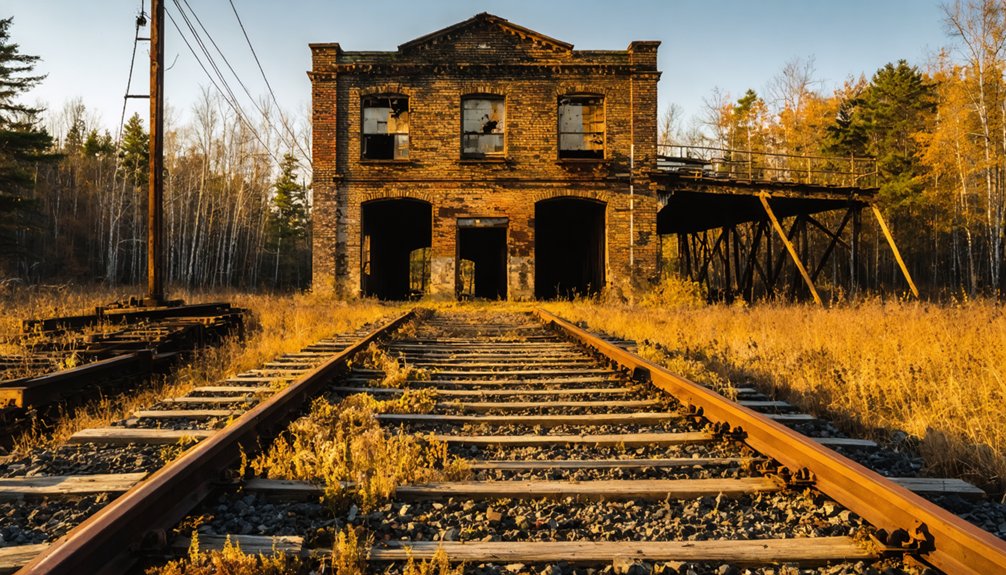
Railroad history cuts straight to the heart of why Federman never lasted. When railroad expansion drove communities like Federman into existence, it also controlled their fate.
Federman emerged in 1884 specifically because two rail lines crossed there — the Lake Shore and Michigan Southern and the Toledo, Ann Arbor and Northern Michigan Railroad. That junction created just enough activity to justify a post office by 1899.
But rail junctions weren’t guarantees. As transportation decline reshaped Monroe County’s rail network, traffic patterns shifted, routes consolidated, and small junction stops lost their purpose.
Federman’s post office closed in 1906, only seven years after opening. Without rail traffic sustaining it, the community simply dissolved.
Understanding that pattern helps you see Federman not as a failure, but as a product of forces entirely beyond local control.
Frequently Asked Questions
Was Federman Ever Officially Incorporated as a Michigan Municipality?
Like a flickering flame, Federman never officially incorporated as a Michigan municipality. You’ll find it faded into ghost town history, leaving only local legends and railroad echoes behind — it remained unincorporated throughout its brief existence.
Who Was Federman Named After, and Why?
You’ll find that ghost town history doesn’t reveal who Federman was named after or why. Available Michigan landmarks records simply don’t document the namesake’s identity, leaving that intriguing piece of this abandoned community’s story frustratingly unresolved.
Where Exactly Is the Relocated Federman Depot at the Fairgrounds?
The available sources don’t pinpoint the depot’s exact location within the Monroe County Fairgrounds, but it’s worth exploring when you’re chasing ghost town attractions and uncovering Federman’s fascinating railroad history firsthand during your visit.
Are There Any Photographs of Federman During Its Active Years?
No confirmed historical photographs of Federman’s active years have surfaced yet, but don’t let that stop your ghost town nostalgia quest. You’ll find that railroad archives and Monroe County historical collections are worth exploring for hidden visual gems.
Did Federman Have a School, Church, or Other Community Buildings?
The records don’t confirm schools or churches, but Federman’s community history likely included such abandoned structures. You’re exploring a rail-born settlement where time erased nearly every trace of daily life.
References
- https://travelswithabandon.com/2019/05/08/adventure-11-federman-and-sharon/
- https://en.wikipedia.org/wiki/Federman
- https://books.google.com/books/about/Ghost_Towns_of_Michigan.html?id=FeXhAAAAMAAJ
- https://en.wikipedia.org/wiki/List_of_ghost_towns_in_Michigan
- https://wgrd.com/michigan-ghost-town-map/
- https://www.michiganrailroads.com/stations-locations/122-monroe-county-58/1479-federman-mi
- https://www.michigan.org/itinerary-finder
- https://99wfmk.com/forman-michigan-ghost-town/
- https://www.mlive.com/news/2022/10/12-michigan-ghost-towns-and-the-stories-behind-them.html
- https://www.nps.gov/slbe/learn/historyculture/ghosttowns.htm