You’ll find Golden, Oregon tucked 20 miles north of Grants Pass, just off the Wolf Creek exit on Interstate 5. Follow Coyote Creek Road for 3.5 winding miles through dense Pacific Northwest timber and you’ll arrive at one of the West’s most unusual ghost towns — a gold rush settlement that banned saloons and built churches instead. Four original structures still stand, and the whole story behind this moral mining community is worth uncovering.
Key Takeaways
- Golden, Oregon, is a preserved ghost town 20 miles north of Grants Pass, accessed via Wolf Creek exit off Interstate 5.
- Drive 3.5 miles along Coyote Creek Road to reach four original 19th-century structures, including a church and post office.
- Visit between May and October for dry road conditions, longer daylight hours, and reliable access to the site.
- Combine your visit with nearby Buncom and Sterlingville Cemetery for a fuller ghost town road trip experience.
- Use GPS coordinates 42°41’04.6″N 123°20’21.8″W and download offline maps before leaving paved roads.
What Is Golden, Oregon and Why Visit This Ghost Town?
Tucked 20 miles north of Grants Pass in Josephine County, Golden, Oregon is a preserved ghost town that lets you step directly into Southern Oregon’s gold rush era without the crowds or admission fees. Founded during the 1840s–1850s gold rush, Golden grew into a tight-knit community of 100–150 residents before the Coyote Creek mine ran dry and the town emptied out.
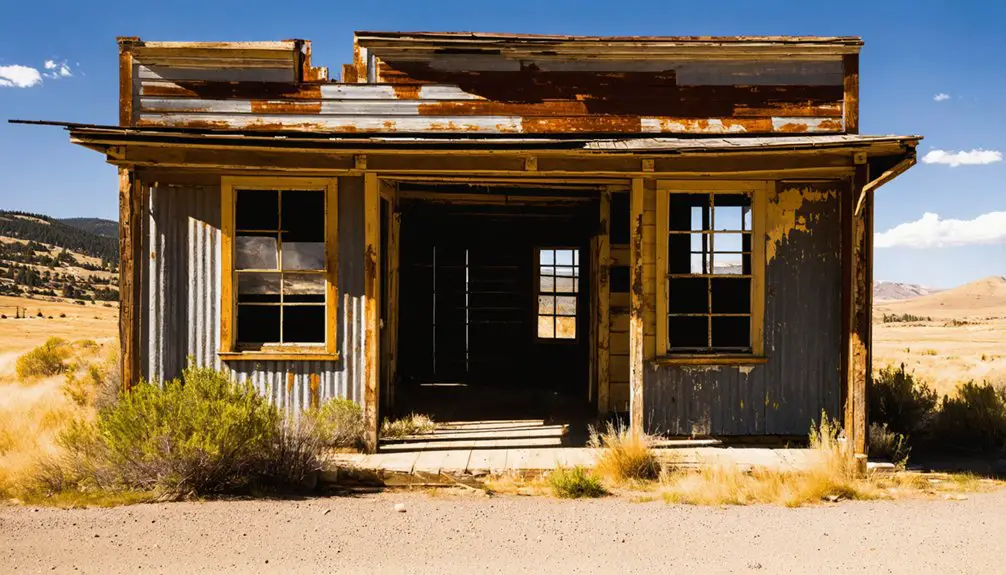
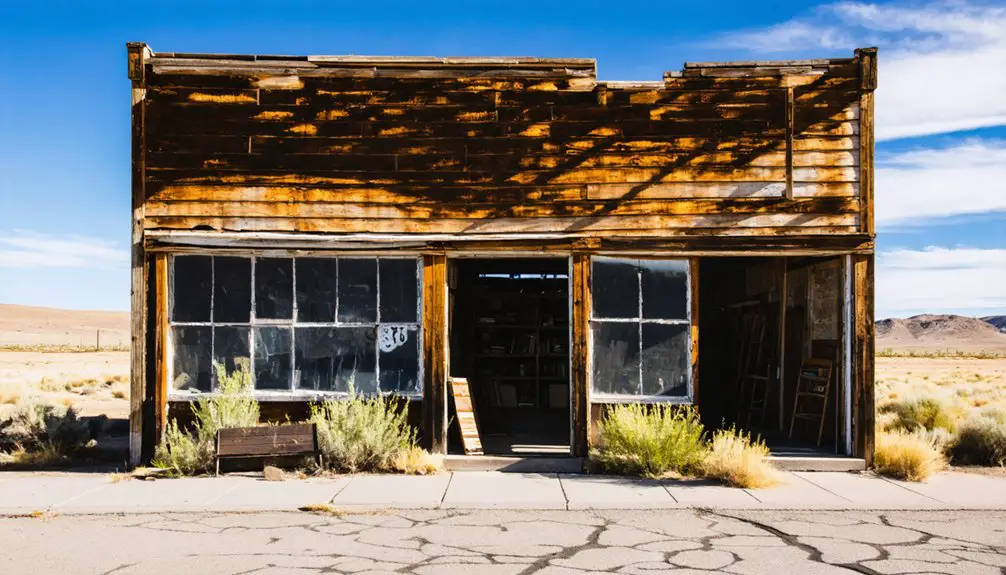
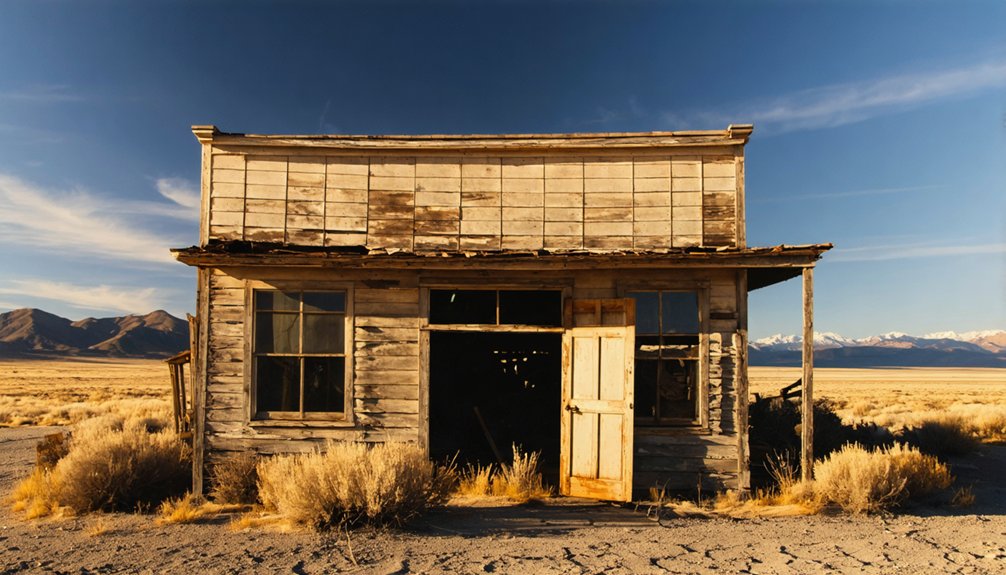
What makes Golden worth your time is its authenticity. You’ll find four standing examples of historical architecture — a church, residence, shed, and post office — frozen in their late nineteenth-century form. Mining relics and a sprawling orchard planted by founding families still dot the valley.
Unlike typical gold rush towns, Golden enforced no saloons, giving it a character that feels genuinely distinct from anything else you’ll encounter on the road.
How to Get to Golden From Interstate 5
Take the Wolf Creek exit off Interstate 5, located about 20 miles north of Grants Pass, and cross to the east side of the highway.
From there, you’ll turn onto Coyote Creek Road, a winding 3.5-mile forest drive that pulls you deeper into the tree-lined hills surrounding the ghost town.
Once you’ve navigated the curves, plug in the coordinates 42°41’04.6″N 123°20’21.8″W to confirm your final arrival at the Golden State Heritage Site.
Exit At Wolf Creek
Getting to Golden is straightforward once you know the exit. As you travel along Interstate 5, watch for the Wolf Creek Inn exit, positioned roughly 20 miles north of Grants Pass in Josephine County. Take that exit and you’ll immediately leave the highway’s rhythm behind.
From there, Coyote Creek Road winds 3.5 miles through dense forest before revealing Golden’s weathered historical architecture frozen in the late 1800s. The drive itself feels deliberate, almost like local folklore pulling you deeper into Southern Oregon‘s mining past.
For precise navigation, plug in coordinates 42°41’04.6″N 123°20’21.8″W before you leave the pavement. The Wolf Creek Inn sits on the opposite side of I-5, making it a convenient landmark confirming you’ve found the right exit.
Navigate Coyote Creek Road
Once you’ve turned off I-5 at the Wolf Creek exit, Coyote Creek Road becomes your guide for the next 3.5 miles. This winding forest drive winds through dense Pacific Northwest timber, gradually pulling you away from highway noise and into something quieter and older.
The road demands your attention — it’s narrow, it curves, and it rewards patience. You’re not just driving toward a destination; you’re crossing into a landscape shaped by Southern Oregon’s gold rush era.
Historical preservation efforts mean the site awaits you largely as miners left it.
There are no visitor amenities along Coyote Creek Road itself, so fuel up and pack water before you leave Wolf Creek.
Once the trees open up and those weathered brown buildings appear, you’ll know the drive was worth it.
Final Arrival Coordinates
When you’re ready to commit the route to memory, save these coordinates to your GPS or phone before leaving: 42°41’04.6″N 123°20’21.8″W. These pinpoint Golden’s exact location, cutting through any confusion once you’ve turned off Coyote Creek Road and entered the valley.
The site sits just east of Interstate 5, near the Wolf Creek Inn exit, making it surprisingly reachable without deep backcountry navigation.
Oregon State Parks manages Golden as a historical preservation site, keeping it open year-round at no charge, so you won’t face gates or fees when you arrive.
Visitor facilities are minimal by design — this is a ghost town, after all — but that raw, unpolished access is precisely what makes it worth every mile you’ve driven to get here.
The Moral Mining Town That Banned Saloons
When you step into Golden, you’ll quickly notice something unusual for a gold rush town — there’s not a saloon in sight.
The founder enforced a strict moral code that replaced taverns with two churches and a schoolhouse, shaping a community built on temperance rather than vice.
You’re walking through a rare piece of history where hymns drowned out the rowdy chaos that defined most mining camps of that era.
No Saloons Allowed
Unlike most gold rush towns where saloons outnumbered churches, Golden operated under a strict moral code that set it apart from nearly every other mining settlement in Southern Oregon. Its founder enforced moral values that shaped every corner of this community, creating a mining history unlike anything else in the region.
Picture yourself walking through a town where:
- Two churches stood where saloons typically dominated
- Hymns echoed through valleys instead of drunken brawls
- A schoolhouse educated miners’ children amid the surrounding hills
- Families gathered freely without fear of rowdy frontier violence
You won’t find whiskey-soaked floorboards here. Instead, you’ll discover weathered clapboard buildings that reflect a community choosing order over chaos, proving that not every gold rush story followed the same lawless script.
Churches Over Taverns
Golden’s founder drew a hard line that shaped the entire settlement: no saloons, no exceptions. While most gold rush towns built their identity around whiskey and gambling, Golden chose a different foundation entirely.
Two churches rose where taverns would’ve stood, and their architecture still anchors the site today — weathered clapboard walls standing as quiet proof that community values outlasted the ore.
You’ll notice the contrast immediately when you walk the grounds. There’s no rowdy saloon history embedded in these walls, just hymns, sermons, and a schoolhouse that once echoed with children’s voices.
Golden operated on moral conviction, not just mineral wealth. That deliberate choice made it rare among mining settlements — and it’s exactly what makes visiting feel less like tourism and more like genuine discovery.
Founder’s Moral Code
Few gold rush founders put morality before profit, but Golden’s architect did exactly that. While other mining camps drowned in whiskey and violence, this founder enforced a strict code that shaped every structure and soul here. That cultural significance still echoes through the weathered clapboard today.
Picture what that code actually built:
- No saloons — your only drinks came from Coyote Creek
- Two churches — hymns replacing barroom brawls on Sunday mornings
- A functioning schoolhouse — children learning beside working miners
- A community orchard — families planting roots, not just extracting gold
Historic preservation here isn’t just about buildings — it’s about protecting proof that frontier freedom didn’t require lawlessness. Golden chose something rarer: order without surrender.
What’s Left Standing in Golden Today?
When you step into Golden today, four original structures greet you across the quiet valley: a church, a former residence, a shed, and a post office and store. Each weathered brown clapboard building stands frozen in the late nineteenth-century aesthetic, a testament to remarkable historical preservation.
Oregon State Parks maintains the entire property as the Golden State Heritage Site, making it the only former mining community managed by the Oregon Parks and Recreation Department.
Wander freely between buildings, and you’ll notice the large orchard planted by the founding families still marking the valley floor. Wildlife observation rewards patient visitors — the surrounding hills shelter native species year-round.
The dried Coyote Creek bed stretches below, quietly narrating the town’s inevitable decline once the mine ran dry.
Best Time of Year to Visit Golden Ghost Town
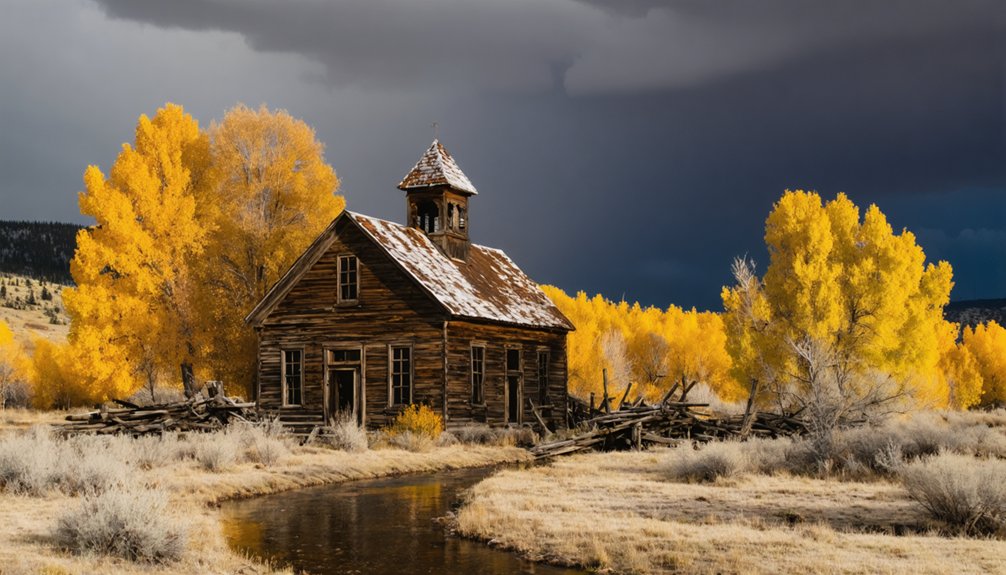
You’ll get the most out of Golden between May and October, when dry weather keeps Coyote Creek Road passable and daylight stretches long enough for a full sunrise-to-sunset circuit.
Winter rains can turn that 3.5-mile winding forest drive into a muddy, rutted challenge, so timing your visit matters more than you might expect.
If you’re pairing Golden with Buncom and Sterlingville Cemetery in a single day, aim for a mid-morning departure from Medford to complete the 120–140-mile loop comfortably before dusk.
Peak Visiting Season
Between May and October, Golden Ghost Town reveals itself at its most atmospheric, with long daylight hours stretching from sunrise to sunset and mild temperatures making the 3.5-mile drive down Coyote Creek Road genuinely enjoyable.
During peak season, you’ll experience:
- Warm golden light washing over weathered brown clapboard historical architecture, sharpening every grain and crack
- Dry creek beds where Coyote Creek once rushed, letting you walk the valley floor miners once worked
- Blooming orchard trees planted by founding families, still bearing fruit above the silent valley
- Whispered local legends carried on summer breezes through the church and post office ruins
You’re free to roam without crowds, entry fees, or restrictions, just open land and authentic nineteenth-century Southern Oregon history waiting for you.
Weather and Road Conditions
Knowing when to visit shapes how much you’ll actually enjoy the experience. Local weather in Southern Oregon swings hard between seasons, so timing matters. May through October offers the most reliable window — warm, dry days and clear skies that make Coyote Creek Road far easier to navigate.
Seasonal variations hit this stretch of Josephine County with real force. Winter brings rain, mud, and occasionally snow, turning that 3.5-mile winding forest drive into a slippery, unpredictable challenge. Spring thaw can leave the road soft and rutted.
Summer delivers ideal conditions — firm ground, long daylight hours, and full visibility of the orchard and valley below.
If you want freedom to roam without weather working against you, aim for June through September and plan around sunrise-to-sunset driving windows.
How Long Should You Spend at Golden?
Golden rewards most visitors with everything it has to offer in about 30 to 45 minutes — enough time to wander past the four original structures, photograph the weathered clapboard church, and soak in the quiet valley views above the dried Coyote Creek bed.
Historical preservation here is tangible, and local legends of a gold rush town built without saloons add depth to every glance.
Make those minutes count by focusing on:
- The church — imagine hymns echoing through unpainted walls
- The post office/store — picture miners collecting letters from distant families
- The orchard — visualize founding families planting roots alongside gold dreams
- The valley overlook — feel the silence where sluice boxes once roared
Stay longer if you’re combining Golden with Buncom and Sterlingville Cemetery.
What to Pack for a Golden Ghost Town Day Trip

Since Golden sits 3.5 miles down a winding forest road with no services, you’ll want to pack smart before leaving the highway. Bring water, snacks, and sun protection, especially between May and October when midday heat settles into the valley.
Wear sturdy shoes for uneven terrain around the weathered clapboard structures.
Tuck a notebook into your bag for sketching building details or jotting down ideas sparked by the site’s heritage, perhaps even local crafts or historical recipes tied to Southern Oregon’s mining culture. A camera is essential for capturing the late nineteenth-century aesthetic before the light shifts.
Cell service is unreliable, so download offline maps to the coordinates 42°41’04.6″N 123°20’21.8″W before you leave. Pack everything you need, because freedom out here means total self-reliance.
Where to Base Yourself for a Golden Ghost Town Day Trip
Medford makes the strongest base for this Southern Oregon mining circuit, sitting close enough to Golden, Buncom, and Sterlingville Cemetery to keep your driving efficient without cutting into exploration time. It’s your launchpad into historical preservation and local legends that shaped this rugged region.
From Medford, you’ll reach:
- Golden Ghost Town — 45 miles northwest, where weathered clapboard churches stand frozen in the 1890s.
- Buncom — tucked inside Applegate Valley, carrying Chinese mining history from 1851.
- Sterlingville Cemetery — 4.2 miles beyond Buncom, marking 1,200 vanished miners.
- Wolf Creek Inn — a quick I-5 detour offering a historic overnight option closer to Golden.
You’re positioned to run the full 120–140-mile circuit comfortably within a single day.
Add Buncom and Sterlingville Cemetery to Your Route
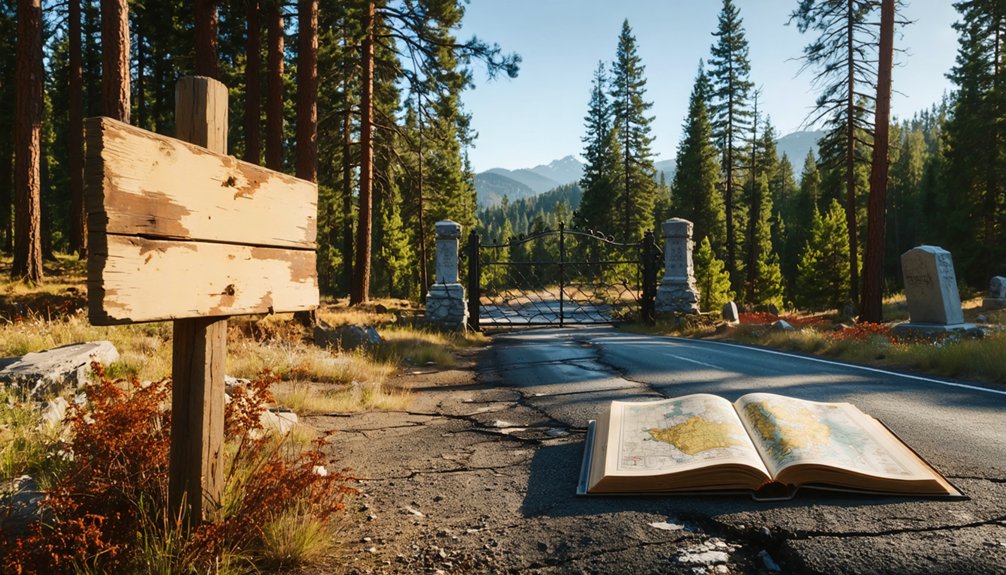
Rounding out your circuit with Buncom and Sterlingville Cemetery turns a single ghost town visit into a full arc of Southern Oregon’s mining story. Buncom, established in 1851 by Chinese miners, carries chromite-era weathered buildings that deepen your understanding of mining history beyond the gold rush narrative.
From there, Sterlingville Cemetery sits just 4.2 miles away, marking ground where 1,200 miners once thrived before disappearing entirely. Ghost town preservation feels tangible here — headstones and silence speak louder than any museum exhibit.
Starting from Medford, you can connect Golden, Buncom, and Sterlingville Cemetery into a 120–140 mile circuit spanning two counties and five decades of extraction and exodus. Budget four to six hours, and you’ll leave with something far richer than photographs.
How to String All Three Ghost Towns Into One Day
Starting from Medford, you’ll thread Golden, Buncom, and Sterlingville Cemetery into a clean 120–140 mile loop across two counties. Budget four to six hours, leave at sunrise, and keep your itinerary loose enough for wildlife spotting along Coyote Creek Road.
- Morning – Golden: Walk the four original buildings while mist still clings to the orchard below.
- Midday – Buncom: Photograph weathered chromite-era structures, then grab local cuisine in nearby Jacksonville.
- Early Afternoon – Sterlingville Cemetery: Stand quietly among 1,200 miners’ stories etched in stone.
- Late Afternoon – Return: Cross back through Applegate Valley as golden light drops behind the ridgeline.
This loop demands nothing but fuel, curiosity, and a willingness to let Southern Oregon’s raw mining past hit you hard.
Frequently Asked Questions
Is Golden, Oregon Ghost Town Suitable for Young Children or Families?
Yes, you’ll find Golden’s historical preservation makes it a fantastic family-friendly activity! Kids can freely explore weathered buildings, discover mining heritage, and roam the open valley—all at no cost, year-round.
Are Pets Allowed at the Golden State Heritage Site?
Here’s the thing — pet policies and animal restrictions for Golden State Heritage Site aren’t explicitly documented in available details. You’d want to call 800-551-6949 directly to confirm whether you can bring your furry companion along!
Can You Photograph Inside the Original Buildings at Golden?
The knowledge doesn’t specify interior access rules, so you’ll want to call 800-551-6949 before you visit. That way, you can plan your interior photography and historic building access experience without missing a single weathered detail.
Is the Coyote Creek Road Paved or Suitable for Standard Vehicles?
Like a ribbon unwinding through the forest, Coyote Creek Road’s 3.5-mile winding road surface is manageable, and its vehicle suitability means you’ll navigate it comfortably in a standard car, reaching Golden’s timeless remnants with ease.
Are There Restroom Facilities Available at the Golden Ghost Town Site?
The knowledge doesn’t confirm restroom availability or facility amenities at Golden’s site. You’ll want to call ahead at 800-551-6949 to verify, and consider stopping at Wolf Creek Inn nearby before your adventure begins!
References
- https://oregonoutdoorfamily.com/golden-oregon-a-ghost-town/
- https://melissawhitneyphotography.com/2025/06/19/the-ghost-town-of-golden-oregon/
- https://www.youtube.com/watch?v=s7t0Ui4eb5g
- https://stateparks.oregon.gov/index.cfm?do=park.profile&parkId=189
- https://myfamilytravels.com/this-unforgettable-ghost-town-road-trip-through-oregon-is-packed-with-spine-chilling-history/
- https://myfamilytravels.com/this-oregon-road-trip-through-ghost-towns-is-packed-with-creepy-history/
- https://www.roy-stevenson.com/ghost-towns-oregon.html
- https://oddity.website/a-ghost-town-worthy-of-its-title-golden/