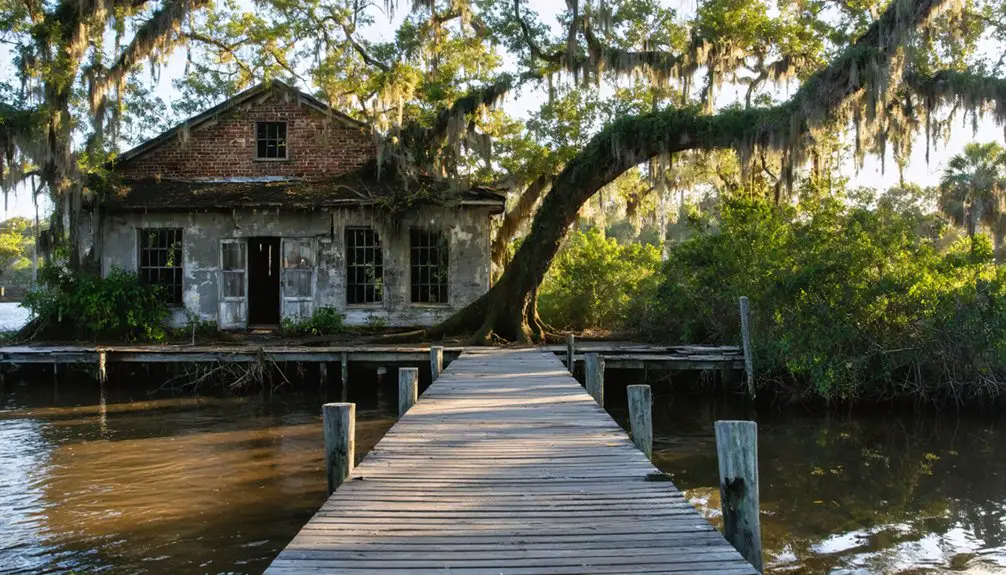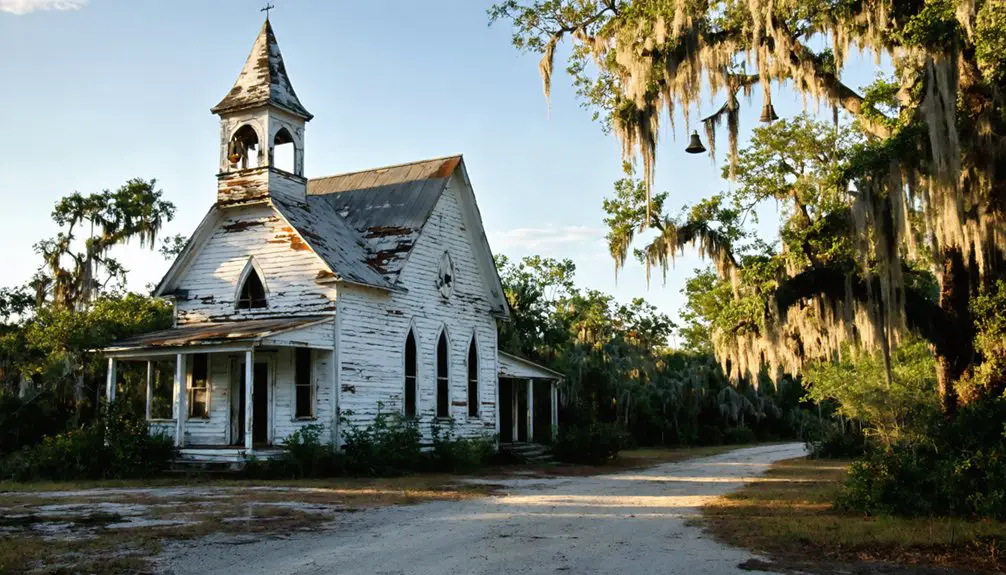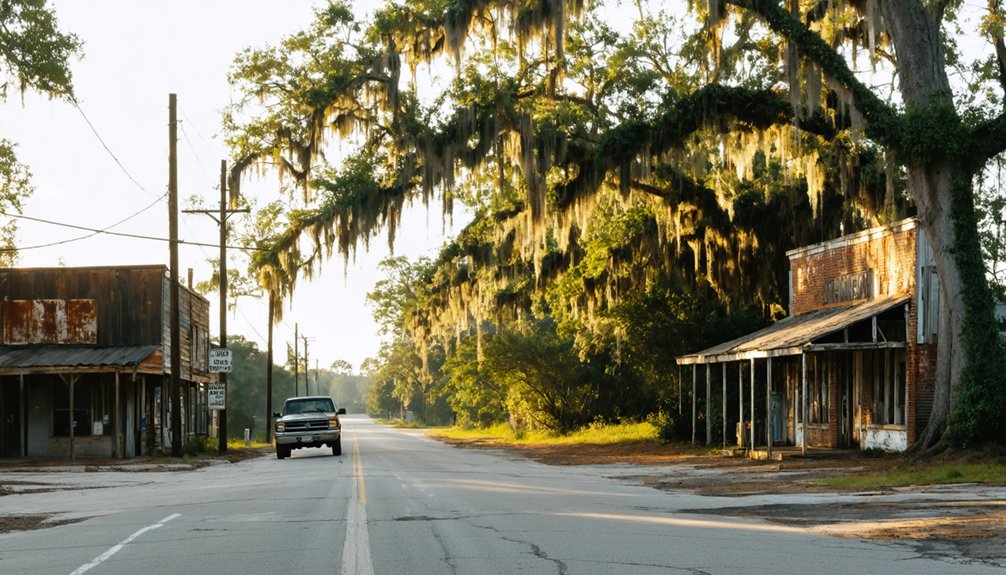
Planning a ghost town road trip to Lawtey, Florida means driving Highway 301 South into a town frozen somewhere between past glory and quiet decline. You’ll pass crumbling 1800s mansions, a nearly empty main street, and exactly 692 residents keeping a once-thriving colony alive. Watch your speed — the limit drops fast, and locals know it. Lawtey’s story runs much deeper than what you’ll spot through your windshield.
Key Takeaways
- Lawtey, Florida, founded in 1877, offers well-preserved late-1800s architecture, including the Thomas Kelly General Store and Old Train Depot.
- Drive Highway 301 South, but watch for the sudden speed limit drop from 65 to 45 MPH entering town.
- Visit the Farmers Market held within historic commercial spaces to experience Lawtey’s resilient small-town community spirit firsthand.
- Extend your trip by connecting nearby ghost towns Raiford, Starke, and Hampton into a single-day historical loop.
- Florida’s year-round favorable climate makes Lawtey accessible anytime, offering authentic rural history beyond typical tourist-oriented attractions.
What Makes Lawtey Florida an Inhabited Ghost Town
Although Lawtey, Florida officially counts 636 residents on its census rolls, locals and visitors alike describe it as “virtually a ghost town” — a striking contradiction that’s earned it a unique classification as an *inhabited* ghost town.
With 636 residents on record, Lawtey defies easy labels — too alive to abandon, too hollow to ignore.
Founded in 1877 by 30 Chicagoans, the town once thrived with mansions, schools, a cotton gin, and bustling agriculture. Today, urban decay has quietly swallowed much of that former prosperity, leaving crumbling structures alongside survivors of historical preservation efforts.
You’ll find renovated late-1800s mansions standing near ruined ones, telling a story of boom and abandonment. The converted Old Train Depot and Thomas Kelly General Store remind you that life once moved differently here.
It’s a living relic — populated enough to function, yet hollow enough to haunt.
How Lawtey Went From Thriving Colony to Semi-Ghost Town
When 30 ambitious Chicagoans staked their claim in Bradford County in 1877, they weren’t building a quiet Southern outpost — they were engineering a self-sufficient colony complete with mansions, schools, a cotton gin, and thriving agricultural networks. Named after one of their own, Lawtey buzzed with genuine economic momentum.
Then the economy shifted, populations drifted, and prosperity quietly slipped away. What remained were elegant late-1800s mansions — some renovated, others surrendering to time — alongside the Thomas Kelly General Store and the converted Old Train Depot. These structures now anchor Lawtey’s cultural preservation efforts, giving you tangible connections to its ambitious origins.
Today, historic tourism breathes purpose into these remnants. You’re not just passing through a faded town; you’re walking through a bold experiment that time partially reclaimed.
The Speed Trap on Highway 301 Every Driver Must Know
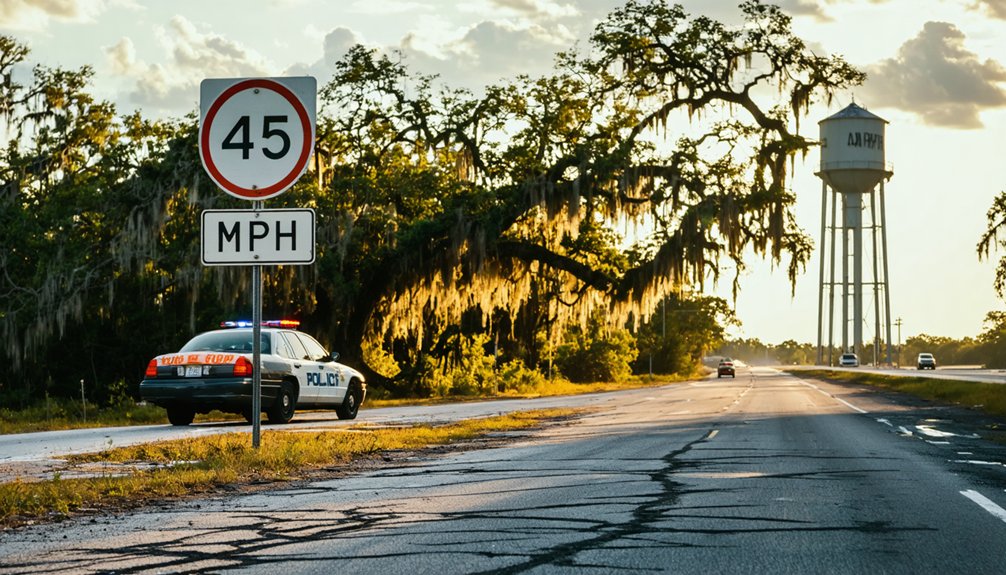
Lawtey’s faded mansions and quiet streets aren’t the only things keeping this town on the map — its nationally infamous speed trap has earned it a reputation that stretches far beyond Bradford County.
As you cruise Highway 301 admiring the historical architecture lining the roadside, you’ll suddenly watch the speed limit drop from 65 MPH to 45 MPH. Don’t blink — because Sheriff “Silver Bullet” won’t.
Traffic enforcement here isn’t casual; it’s the town’s economic engine. Speeding tickets fund Lawtey’s municipal operations, making every mile through town a financial risk if you’re not paying attention.
Slow down before you cross into city limits, keep your eyes on your speedometer, and you’ll pass through this living ghost town without an expensive souvenir in your pocket.
Where the Speed Limit Drops and What Happens If You Miss It
As you cruise down Highway 301 South, the speed limit suddenly drops from 65 MPH to 45 MPH the moment you enter Lawtey, and you’ll need to react fast.
Miss that change, and Sheriff “Silver Bullet” won’t hesitate to pull you over and hand you a fine that directly funds the town’s budget.
Lawtey’s reputation as a nationally infamous speed trap isn’t accidental — it’s the economic engine keeping this semi-ghost town running.
Speed Limit Change Zone
Traveling south on Highway 301, you’ll notice the speed limit drops abruptly from 65 MPH to 45 MPH the moment you hit Lawtey’s city limits — and that’s exactly where Sheriff “Silver Bullet” is waiting.
This isn’t a gradual shift; it’s an immediate, deliberate change that catches countless drivers off guard every single day.
Lawtey’s budget depends heavily on those tickets, making this speed trap a cornerstone of its financial survival rather than genuine historical preservation or community revitalization.
You’ll want to ease off the accelerator well before the city limits sign appears.
Watch for the posted signs, stay alert, and keep your speed honest.
Missing this zone doesn’t just cost you money — it funds an entire municipal economy built around your momentary inattention.
Fines For Speeding
Missing that speed drop doesn’t just bruise your pride — it hits your wallet hard. Lawtey’s Sheriff “Silver Bullet” actively patrols that Highway 301 corridor where the limit drops from 65 MPH to 45 MPH, and he’s not interested in warnings.
The town’s budget runs largely on those citations, making enforcement less a safety measure and more an economic engine. It’s a strange irony — a place defined by urban decay and quiet historical preservation funds itself by catching free-spirited travelers off guard.
You’re not just risking a fine; you’re potentially funding a speed trap that’s earned national notoriety. Respect the drop, stay at 45 MPH, and keep your money where it belongs — in your own pocket for the road ahead.
The Late 1800s Mansions Still Standing in Lawtey Today
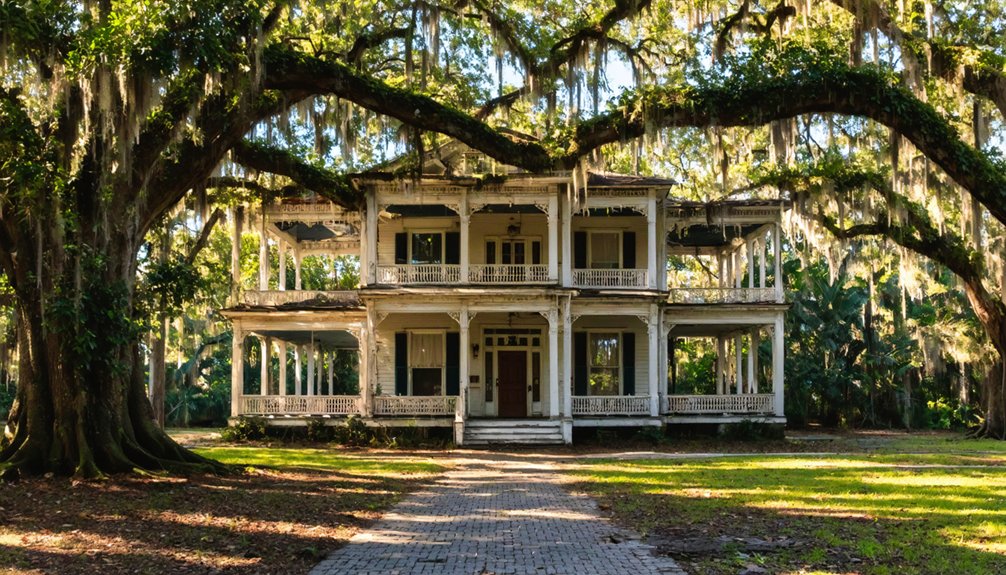
As you cruise through Lawtey’s quiet streets, you’ll spot remnants of the town’s prosperous late 1800s boom — grand mansions that once belonged to wealthy settlers who believed this Florida outpost had a golden future.
Some of these estates have been lovingly renovated, their original architectural details preserved behind fresh paint and restored facades, while others stand in various states of ruin, reclaimed by time and overgrowth.
You can wander the town grid easily in a standard vehicle, taking in these architectural contrasts that tell Lawtey’s story better than any historical marker could.
Mansions From The 1800s
While Lawtey’s reputation for speed traps dominates modern conversation, the town’s late 1800s mansions tell a far richer story. As you drive through, you’ll spot grand architectural relics from Lawtey’s prosperous era, some beautifully renovated through dedicated historical preservation efforts, others standing in weathered ruin.
These mansions once belonged to the ambitious Chicagoans who founded the town in 1877, building a thriving community complete with schools, a cotton gin, and agricultural enterprise. You can feel that ambition still embedded in the remaining structures.
Community engagement has kept some properties alive, giving locals and visitors alike a tangible connection to Lawtey’s surprisingly vibrant past. Don’t just slow down for the speed limit — slow down to actually look at what’s still standing around you.
Renovated Vs Ruined Estates
Lawtey’s late 1800s mansions split sharply into two camps: those lovingly restored by preservation-minded owners and those slowly surrendering to time and weather. Historical preservation efforts have rescued several grand structures, revealing original woodwork, wide porches, and period architectural details that transport you straight into Florida’s Gilded Age.
You’ll spot freshly painted facades sitting just blocks from collapsed rooflines and vine-swallowed walls — a striking visual contrast.
Economic decline tells the harder story. As Lawtey’s population and prosperity faded, maintaining these massive estates became impossible for many families. Owners simply walked away, leaving magnificent bones to rot beneath the subtropical sun.
When you drive these quiet streets, you’re reading that history directly through the buildings themselves — some defiant, some defeated, all worth your attention.
Architectural Remnants Worth Exploring
Though most ghost towns leave only foundations and faint outlines, Lawtey’s surviving mansions give you something far more substantial to explore. Walking through town, you’ll encounter striking architectural contrast at every turn — grand Victorian-era estates standing beside weathered shells slowly reclaimed by time.
Historical preservation efforts have kept several late 1800s structures genuinely intact, rewarding curious travelers with real craftsmanship from Florida’s frontier days. You’ll notice ornate woodwork, wide wraparound porches, and bold proportions that reflect the ambitions of Lawtey’s original Chicago founders.
Don’t overlook the Thomas Kelly General Store or the converted Old Train Depot — both anchor the town’s architectural identity.
Together, these remnants tell Lawtey’s story more honestly than any museum could, letting you read the town’s rise and quiet decline through its own walls.
The Thomas Kelly General Store and the Old Train Depot
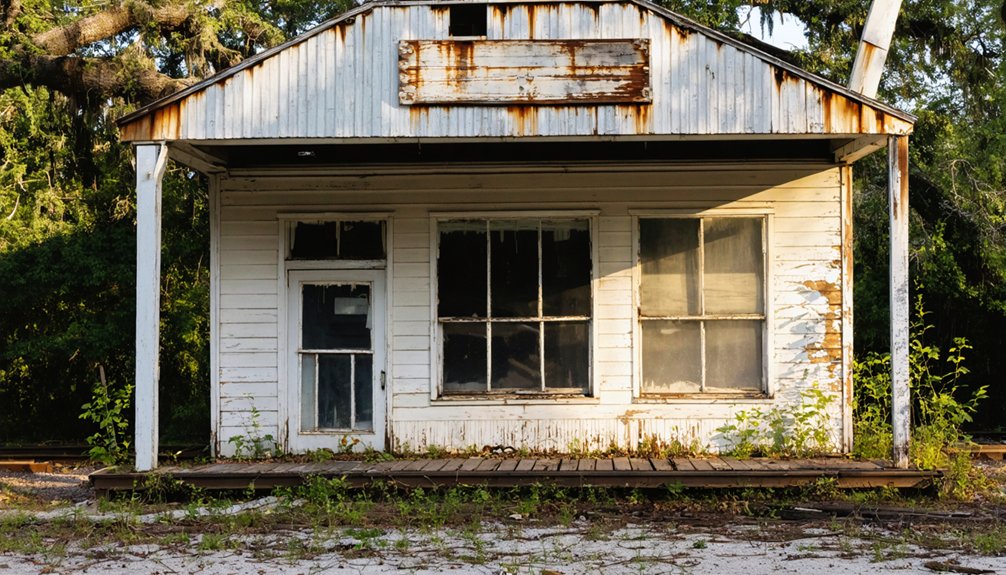
Among Lawtey’s most compelling stops, the Thomas Kelly General Store and the Old Train Depot stand as tangible anchors to the town’s late 1800s boom years. You’ll find the General Store steeped in local folklore, its weathered walls quietly narrating decades of community commerce and daily small-town life.
Historical preservation efforts have kept it recognizable, giving you a rare, unfiltered glimpse into Lawtey’s prosperous past.
The Old Train Depot, originally built by the Seaboard Air Line Railroad, now serves as a municipal building, proving that adaptive reuse can breathe new purpose into aging structures. Walk through its doors and you’re stepping across a century of history.
Both stops reward curious travelers who appreciate authenticity over polished tourist attractions, making them essential checkpoints on your Lawtey road trip.
Where Locals Still Gather in a Town That Nearly Disappeared
Despite its dwindling population and ghost town reputation, Lawtey still has a heartbeat, and you’ll feel it most clearly at the local Farmers Market. Tucked into former historic commercial spaces, this gathering spot keeps local traditions alive in a town that could’ve easily vanished entirely.
Lawtey’s Farmers Market pulses with life inside historic walls — proof that some towns refuse to disappear quietly.
You’ll find residents who’ve stuck around through the decades, trading more than goods — they’re trading stories, history, and community pride.
These community gatherings offer you a rare window into small-town resilience. Lawtey’s roughly 692 residents don’t let their semi-ghost status define them.
When you walk through the market, you’re stepping into something authentic — no tourist performance, just real people holding a quiet town together. It’s the kind of stop that reminds you why road trips through forgotten places are worth taking.
Why Lawtey Feels Like a Ghost Town Even With 692 Residents
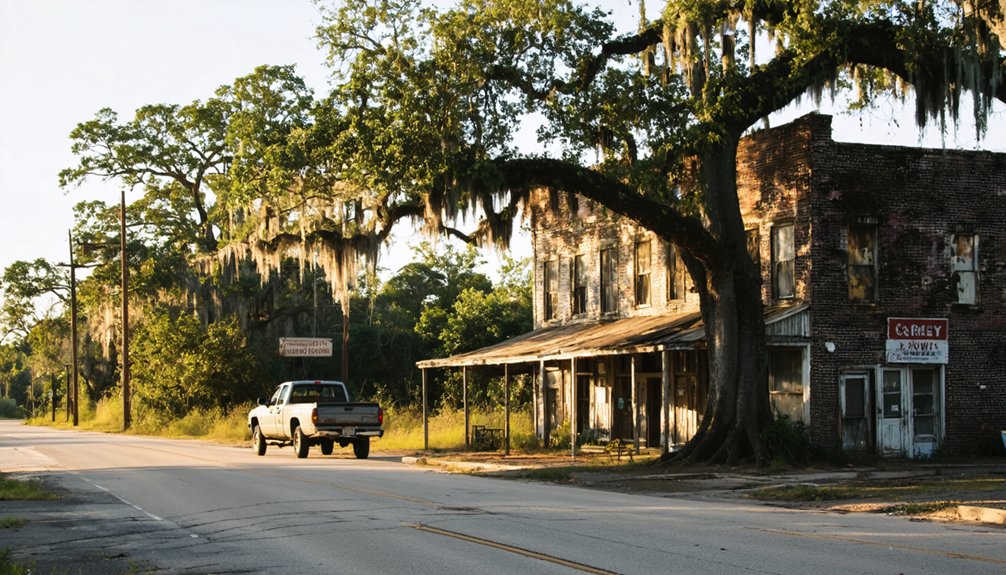
Walking through Lawtey, you’ll notice something that numbers can’t explain — 692 residents technically live here, yet the streets feel hollow. Urban decay has claimed entire blocks, leaving behind crumbling late-1800s mansions that once signaled prosperity. Some structures stand in careful historical preservation, renovated and proud. Others lean into overgrowth, slowly surrendering to time.
The economy never fully recovered after agriculture declined, and the population drop from 730 in 2010 to 636 in 2020 tells that story clearly.
What remains feels suspended — a Farmers Market operating in spaces built for a busier era, a converted train depot serving municipal functions nobody anticipated.
You’re fundamentally driving through a living photograph, where the past outnumbers the present at every turn.
When to Visit Lawtey and What the Drive Actually Looks Like
Lawtey carries an “Anytime” designation for good reason — the Fine climate makes it accessible year-round, with no seasonal window to chase or avoid.
You’ll find the drive straightforward via Highway 301 South on 2WD-friendly roads, putting you at coordinates 30°2.6’N 82°4.3’W without hassle.
Before you roll in, know these road trip essentials:
- Speed limit drops hard from 65 MPH to 45 MPH at town entry — Sheriff “Silver Bullet” isn’t forgiving
- Wildlife spotting opportunities appear along the rural stretches of 301, so keep your eyes open between stops
- Local cuisine options are minimal, so fuel up beforehand
The town grid is easy to navigate, leaving you free to explore history on your own terms.
Florida Ghost Towns Closest to Lawtey Worth Adding to the Drive
If you’re already cruising Highway 301 through Lawtey, you’re perfectly positioned to connect with several other Florida ghost towns without backtracking. Nearby Bradford and surrounding counties hold forgotten settlements that share Lawtey’s boom-and-bust story, making them natural additions to a single road trip loop.
Stringing these stops together along established two-lane routes keeps the drive efficient and rewards you with a broader picture of Florida’s quietly fading small-town history.
Nearby Ghost Towns
Since you’re already making the drive through Bradford County, it’s worth stretching the trip to take in a few of Florida’s other ghost towns scattered within reasonable distance of Lawtey. Each offers its own brand of urban decay and historical preservation worth seeing firsthand.
- Raiford, FL – Just minutes away, this small community carries a heavy history tied to Florida State Prison and a quietly fading downtown.
- Starke, FL – Bradford County’s seat shows pockets of abandonment alongside preserved civic architecture.
- Hampton, FL – Another infamous speed trap town with a skeleton crew of residents and crumbling infrastructure that tells its own story.
Map these stops together and you’ve got a genuinely compelling road trip through Florida’s forgotten corners.
Easy Route Connections
Mapping out nearby ghost towns is one thing, but stringing them together into a seamless drive is where the trip becomes something worth remembering. Highway 301 serves as your backbone, connecting Lawtey to surrounding communities that share similar stories of historical preservation and slow decline.
You’ll find that most stops sit within a reasonable driving distance, making a single-day loop entirely achievable. Towns like Raiford and Hampton carry their own quiet weight, each showing signs of community revitalization alongside visible decay.
Keep your speed in check through every small town corridor — enforcement isn’t exclusive to Lawtey. The route rewards patient drivers who stop, walk, and look closely.
Freedom here means moving at your own pace through landscapes that most travelers blow past without a second glance.
Frequently Asked Questions
Can Visitors Park Safely Near Lawtey’s Historic Buildings and Mansions?
You’ll find parking safety near Lawtey’s historic mansions and buildings quite manageable on its navigable 2WD roads. Follow visitor guidelines, respect the 45 MPH limit, and you’re free to explore this fascinating ghost town freely.
Are There Any Restaurants or Food Options Available Inside Lawtey?
You won’t find many formal restaurants, but you’ll discover the Farmers Market offering a taste of local cuisine amid Lawtey’s stunning historic architecture, making your ghost town adventure both nourishing and visually mesmerizing!
Is Lawtey’s Farmers Market Open on Weekends for Visiting Travelers?
The knowledge doesn’t confirm the Farmers’ market schedule or weekend visiting hours, but you’ll find it operating in former historic commercial spaces. Check locally before you go to confirm its current availability for your free-spirited adventure!
Does Lawtey Have Any Overnight Accommodation Options for Road Trippers?
The knowledge doesn’t mention overnight stays in Lawtey, so you’ll likely need to book accommodations nearby. Don’t let that stop you—you can explore historic architecture, soak up local legends, and return refreshed daily!
Who Originally Named Lawtey and Which Chicagoan Inspired the Town’s Name?
Curious about Lawtey’s Chicago influence and historical founding? You’ll discover that 30 bold Chicagoans established this town in 1877, naming it after one of their own group members, though records don’t specify exactly which individual inspired the name.
References
- https://www.ghosttowns.com/states/fl/lawtey.html
- https://digitalcommons.unf.edu/historical_architecture_main/6236/
- https://www.youtube.com/watch?v=VrVR1E99Y-s
- https://en.wikipedia.org/wiki/Lawtey
- https://en.wikipedia.org/wiki/List_of_ghost_towns_in_Florida