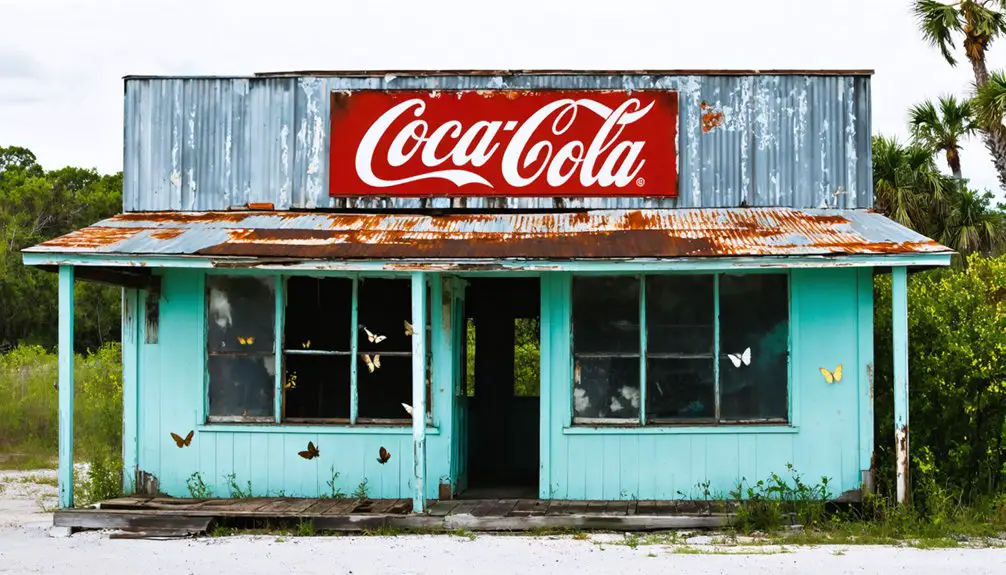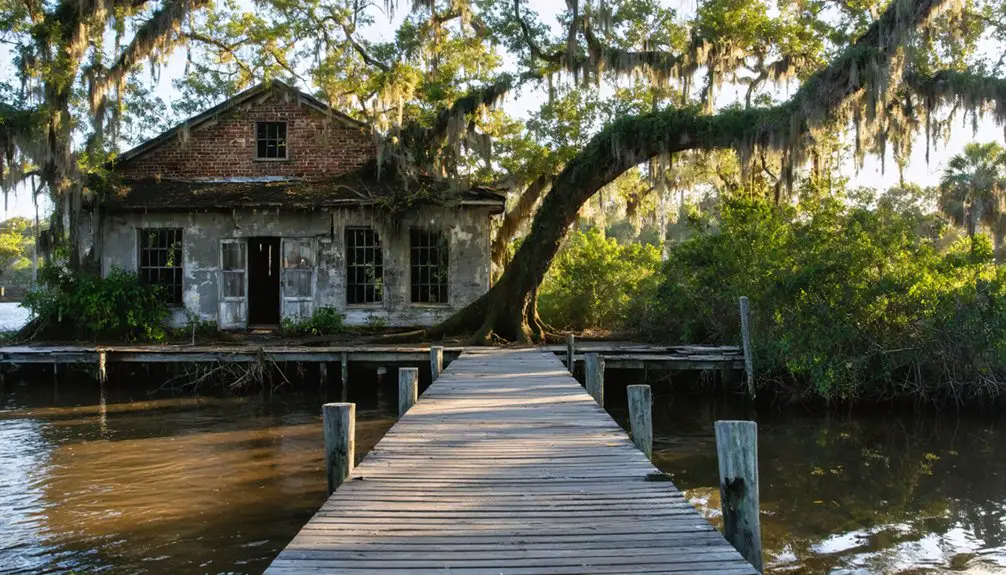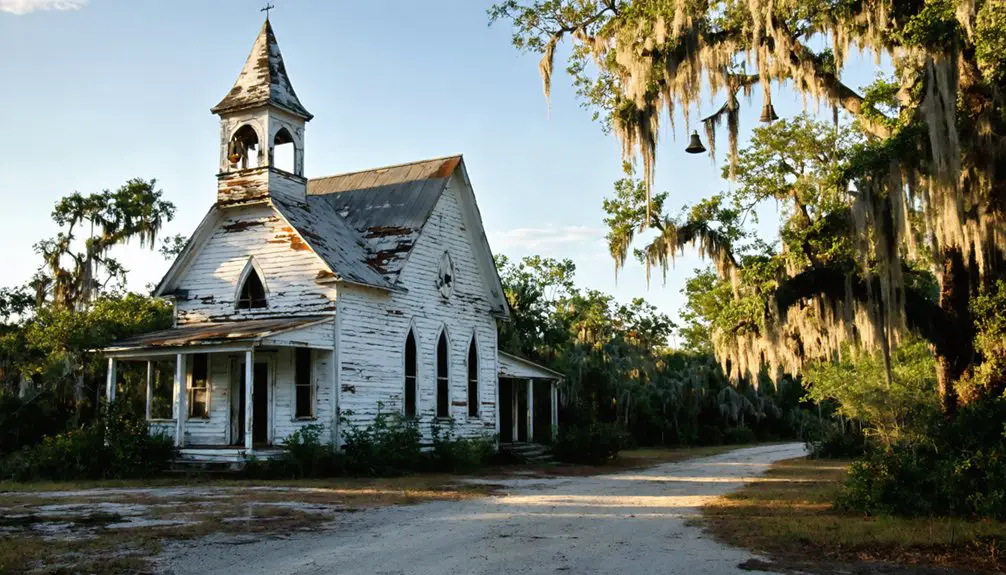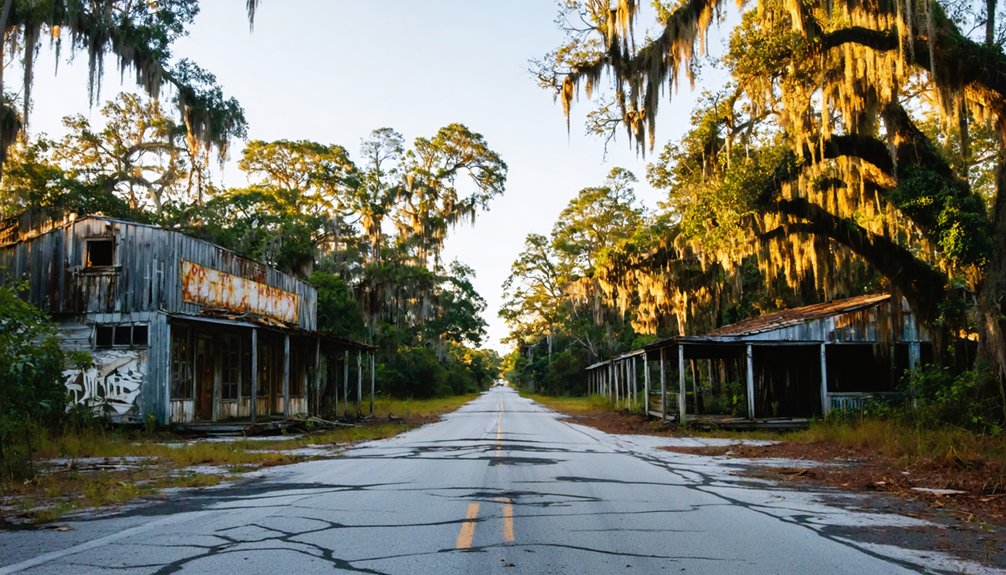
To plan your ghost town road trip to Magnolia, Florida, start at the historical marker on US 98 near Newport, then explore the small cemetery about 1.5 to 2 miles upriver on the east side of the St. Marks River. Founded in 1827, Magnolia collapsed within a decade after the railroad bypassed it in 1836. Pair it with nearby St. Marks, Natural Bridge Battlefield, and Wakulla Springs for a full day of layered Florida history you won’t want to rush.
Key Takeaways
- Magnolia, Florida, founded in 1827, was a thriving river port before its decline after the railroad bypassed it in 1836.
- Only a small cemetery and historical marker near US 98 in Newport remain as visible remnants of Magnolia’s past.
- The original settlement sits approximately 1.5 to 2 miles upriver on the east side of the St. Marks River.
- Nearby stops include St. Marks fort ruins, Natural Bridge Battlefield Monument, and Wakulla Springs for a fuller historical experience.
- Plan a southward route from Tallahassee, starting at Natural Bridge, then Wakulla Springs, Magnolia cemetery, and ending in St. Marks.
What Was Magnolia, Florida?
Before it faded into Florida’s forgotten history, Magnolia was a thriving river port founded in 1827 by four Hamlin brothers from Augusta, Maine, who saw the St. Marks River as a gateway to commerce.
Magnolia was a thriving river port — until Florida’s forgotten history swallowed it whole.
By 1829, the town had a U.S. customs house, and by the early 1830s, stores, warehouses, and a bank lined its streets.
Its historical significance lies in how quickly ambition can build a community — and how fast circumstances can erase it.
Climate challenges, navigational difficulties, and fierce competition from nearby St. Marks chipped away at Magnolia’s foundation.
When the Tallahassee-to-St. Marks railroad bypassed the town in 1836, its fate was sealed.
Today, cultural preservation efforts recognize Magnolia as a lost port settlement worth remembering, even if only a small cemetery marks where it once stood.
How Did Magnolia Rise and Collapse Within a Single Decade?
When the Hamlin brothers planted roots along the St. Marks River in 1827, Magnolia moved fast. By 1829, a U.S. customs house confirmed its historical significance as a legitimate port. Stores, warehouses, and a bank followed shortly after — a remarkable burst of growth for such a remote settlement.
Then the cracks appeared. The river’s navigational difficulties frustrated traders, and nearby St. Marks aggressively competed for business. The customs house transferred away, land litigation strangled confidence, and the 1836 Tallahassee-to-St. Marks railroad bypassed Magnolia entirely.
That railroad decision effectively killed the town. Without preservation efforts to anchor its identity, buildings disappeared and residents scattered. What once held real commercial ambition now survives only as a quiet cemetery — a decade of rise and collapse compressed into one forgotten bend of river.
What’s Left at the Magnolia Ghost Town Site Today?
Where a customs house and bank once stood, you’ll find almost nothing today. Magnolia’s cultural significance lives quietly in its small cemetery — the only tangible remnant of a port town that briefly thrived. No archaeological findings have uncovered a surviving town core, leaving the burial ground as your sole physical connection to 1827.
Here’s what you can expect when visiting:
- A small, historic cemetery marking the former settlement
- No standing structures from the original port era
- A historical marker near US 98 at Newport
- 2WD-accessible terrain requiring no special equipment
- Proximity to St. Marks and Wakulla Springs for a fuller itinerary
You’re fundamentally reading a landscape that erased itself. That absence tells its own story — one worth the short detour.
Where Exactly Is the Magnolia Cemetery Along US 98?
Traveling east or west along US 98, you’ll want to watch for the historical marker near Newport — that’s your navigational anchor for finding Magnolia. From that marker, the old settlement sat roughly 1.5 to 2 miles upriver on the east side of the St. Marks River.
Travel US 98 to the Newport historical marker — your anchor point for locating Magnolia, 1.5 miles upriver.
The cemetery is the site’s sole surviving landmark, a quiet tribute to its historical significance as a once-active port town. You won’t find signs directing you through a developed attraction — this is raw, unfiltered Florida history.
Preservation efforts have been minimal, so managing your expectations matters. Bring your own research, respect the burial ground, and treat the visit as a private discovery.
The Newport marker gives you the starting point; curiosity gets you the rest of the way.
What Can You Actually See When You Visit the Site?
Arriving at the Magnolia site, you’ll find the landscape stripped of nearly everything that once made it a thriving port town — no warehouses, no storefronts, no remnants of the bank that briefly anchored local commerce. What historical preservation has left you is modest but meaningful.
Visitor access is straightforward via US 98, and what greets you is fundamentally one defining feature:
- A small, quiet cemetery representing the town’s only surviving structure
- Weathered grave markers offering glimpses into early 19th-century Florida life
- A rural setting largely reclaimed by native vegetation
- A historical marker near Newport providing essential context
- Clear 2WD road access requiring no special equipment
You’re not walking into ruins — you’re standing inside a silence that replaced a once-busy river port.
Do You Need a Truck or Can Any Car Get There?
Unlike some Florida ghost towns that demand high clearance and four-wheel drive just to reach the site, Magnolia’s accessible via standard roads off US 98 — meaning your everyday sedan handles the trip just fine. You’ll navigate familiar rural Florida terrain without worrying about axle damage or getting stuck in sand.
That accessibility matters beyond simple convenience. When a site carries real cultural significance — a forgotten port, a buried chapter of Florida commerce — you want people actually reaching it. Preservation challenges are harder to ignore when curious visitors can show up, stand beside that small cemetery, and feel the weight of what’s gone.
Easy road access keeps Magnolia’s story alive by keeping it within reach of anyone willing to make the drive.
Which Ghost Towns and Historic Sites Are Closest to Magnolia?
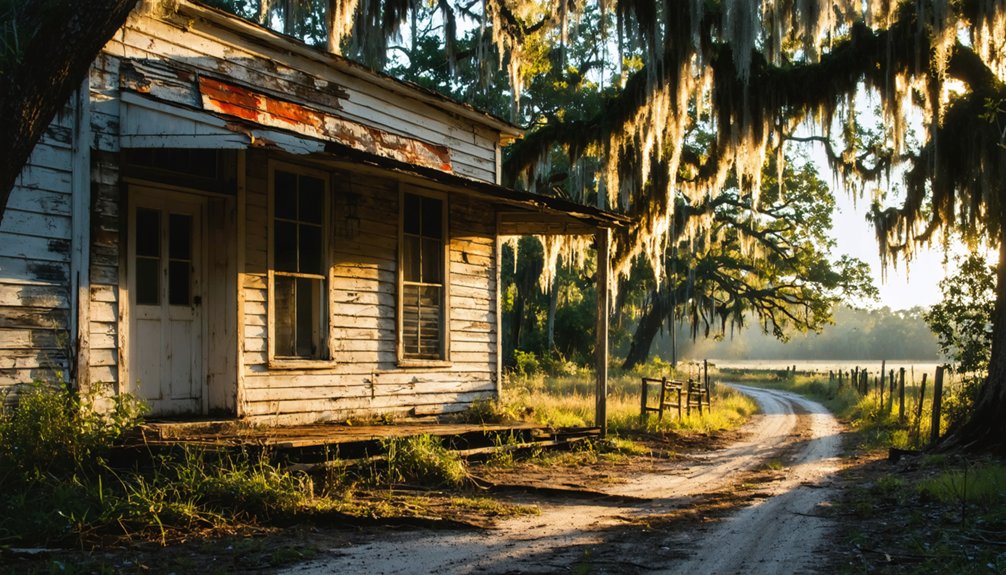
Once you’ve visited Magnolia’s cemetery, you’re already well-positioned to explore several compelling historic sites in the same stretch of Wakulla County.
St. Marks sits just downriver and offers a living continuation of the same trade history that once made Magnolia a customs port.
Wakulla Springs adds a natural landmark worth folding into your route.
If you’re drawn to Civil War history, the Natural Bridge Battlefield Monument is close enough to make it a logical third stop on the same day’s itinerary.
Nearby Ghost Town Stops
Magnolia’s rural setting along the St. Marks River puts you within easy reach of several compelling historical stops. You won’t need to detour far to find more abandoned structures and historical trade remnants scattered across this corner of Florida.
Pair your Magnolia visit with these nearby destinations:
- St. Marks – the rival port that absorbed Magnolia’s customs house and trade
- Wakulla Springs – a natural landmark with deep regional history
- Natural Bridge Battlefield Monument – a Civil War site just a short drive away
- Newport – the US 98 marker town anchoring your navigation to Magnolia
- St. Marks National Wildlife Refuge – combines natural scenery with coastal heritage
Each stop adds context to Magnolia’s story without notably extending your drive time.
Regional Historic Sites
Zooming out from those individual stops, you’ll find that north Florida’s Big Bend region holds a surprisingly dense cluster of ghost towns and historic sites within a short drive of Magnolia.
Natural Bridge Battlefield Monument preserves the site of an 1865 Civil War skirmish, carrying deep cultural significance for the state’s wartime history.
St. Marks itself offers Spanish fort ruins and a wildlife refuge that reward a longer stop.
Wakulla Springs adds natural history to the mix.
Together, these destinations form a corridor where historical preservation efforts have kept tangible connections to Florida’s past alive.
You can string them into a single day’s drive, moving between river landings, battlefields, and springs without backtracking much.
The region rewards curiosity far beyond what any single marker suggests.
How Do You Build a One-Day Road Trip Around Magnolia, Florida?
Start your day at Magnolia itself, locating the cemetery off US 98 near Newport before the midday heat sets in.
From there, you can swing south to St. Marks for a riverfront stop.
Then push west to Wakulla Springs for a natural break.
Plotting these three points on a map first keeps your route tight and your drive time under control.
Start At Magnolia
Since Magnolia itself is a quick stop, you’ll want to arrive early and treat it as your anchor rather than your main event. Pull over near the US 98 marker at Newport and let the landmark significance of this forgotten port town sink in before you move on.
Here’s what to do at the site:
- Locate the historical marker near Newport for context
- Walk the small cemetery, Magnolia’s only surviving feature
- Photograph headstones for historical preservation documentation
- Note the St. Marks River’s proximity and imagine the old port landing
- Check your map for St. Marks and Wakulla Springs nearby
You’re standing where a customs house, bank, and warehouses once operated. That context makes even a short visit feel grounded and worthwhile.
Add Nearby Stops
Because Magnolia wraps up quickly, you’ll need a few nearby stops to build a full day worth of driving. Head south on US 98 to St. Marks, where the old fort ruins and wildlife refuge carry real cultural significance — this is where river trade once shaped the entire region.
The Natural Bridge Battlefield Monument sits close by and deserves a stop for anyone who values understanding Florida’s Civil War history firsthand.
Wakulla Springs rounds out the day beautifully, offering a dramatic natural landmark tied to ongoing preservation efforts that protect both the ecosystem and its surrounding heritage sites.
Together, these stops transform a short cemetery visit into a meaningful, layered road trip through Wakulla County’s forgotten corners — no wasted miles, no filler, just history and open road.
Plan Your Route
Pulling those nearby stops together into a logical sequence makes all the difference between a scattered drive and a day that actually flows. Start from Tallahassee, move south on US 98, and let the region’s cultural significance guide your stops.
- Begin at Natural Bridge Battlefield Monument for Civil War context.
- Continue to Wakulla Springs for natural history depth.
- Stop at the Newport marker on US 98 to orient yourself.
- Find the Magnolia cemetery, the site’s last preservation effort.
- Finish in St. Marks for waterfront food and a walk around the fort.
You’re not racing between attractions — you’re tracing a corridor where river trade, railroads, and preservation efforts shaped Florida’s forgotten past. Keep it loose, keep it moving.
Frequently Asked Questions
Who Were the Hamlin Brothers Before They Founded Magnolia?
You’ll find that the Hamlin brothers were early pioneers from Augusta, Maine, before founding Magnolia in 1827. These ambitious brothers recognized river trade potential, bringing their entrepreneurial spirit from the Northeast to Florida’s frontier.
Is the Magnolia Cemetery Still Maintained or Privately Owned?
The knowledge doesn’t spell it out, but you’ll find this final resting place stands as Magnolia’s sole survivor. Historic preservation efforts and cemetery management details remain unclear, so you’d want to verify local Wakulla County records before visiting.
Are There Any Photographs of Magnolia From Its Active Years?
No historic photographs or vintage postcards of Magnolia during its active years are known to survive. You’ll find the town vanished before photography flourished, leaving only written records and that solitary cemetery to spark your imagination.
What Is the Best Time of Year to Visit Magnolia?
Florida sees over 100 million tourists annually, so you’ll want to visit Magnolia in fall or early spring—you’ll dodge peak tourist crowds and enjoy mild seasonal weather, making your ghost town exploration far more rewarding.
Has Any Archaeological Work Ever Been Done at the Site?
The available records don’t mention any excavation history or ancient artifacts uncovered at Magnolia. You’re exploring largely uncharted territory, where that small cemetery stands as your only tangible connection to this forgotten port’s mysterious past.
References
- https://usghostadventures.com/americas-most-haunted-trending/ghost-towns-to-visit-on-your-summer-road-trip-along-route-66/
- https://www.instagram.com/reel/DRLG8RhDGlG/
- https://www.reddit.com/r/roadtrip/comments/1qz9lsl/grafton_ghost_town/
- https://www.roadrunner.travel/tours/ghosts-of-mississippi-exploring-the-magnolia-state/
- https://www.ghosttowns.com/states/fl/magnolia.html
- https://www.youtube.com/watch?v=0cq2BRIdTr0
- https://www.youtube.com/watch?v=zqPF_TEeTQQ
- https://www.youtube.com/watch?v=8QapC-yk4Bo
- https://www.youtube.com/watch?v=kXGAKmjGMXg