Mariposa, Kansas was the first town platted in Saline County, founded in 1856 along the south bank of the Saline River by Plumb, Hunter, and Pierce. Today, you won’t find a single standing structure — just open prairie where an ambitious frontier settlement once stood. Before you go, you’ll want a high-clearance vehicle, offline maps, and realistic expectations. There’s far more to this ghost town‘s story than what the landscape reveals.
Key Takeaways
- Mariposa, Kansas, founded in 1856, sits on the south bank of the Saline River, leaving only open countryside where the town once stood.
- No visible structures, signs, or remnants remain, so set realistic expectations for an atmospheric, interpretive experience rather than a visually dramatic destination.
- Verify land ownership before visiting, respect private property boundaries, and check current rural road conditions, as routes can include muddy or washed-out sections.
- Bring water, snacks, a full gas tank, offline maps, and printed county plat maps, and inform someone of your route and return time.
- Explore Kansas Historical Society archives and county courthouse records to uncover deeper history about Mariposa and nearby forgotten settlements before your trip.
What Was Mariposa, Kansas?
Before Salina became the heart of Saline County, there was Mariposa. Founded in 1856 by Plumb, Hunter, and Pierce, this settlement claimed the distinction of being the county’s very first town.
You’ll find its original footprint on the south side of the Saline River, near its mouth, where early settlers carved out a community during Kansas’s raw territorial era.
Today, Mariposa is a lost town, swallowed by time and progress. Local legends connect it to Preston Plumb, giving the site a founder-focused story worth chasing.
While historical artifacts from this period are scarce, the location still carries weight for anyone drawn to forgotten places.
Mariposa didn’t survive, but its role in shaping early Kansas history makes it a compelling stop on any ghost town road trip.
Why Is Mariposa Considered the First Town in Saline County?
When Kansas was still raw, unsettled territory, Mariposa staked its claim before any other community in Saline County. Founded in 1856, it predates every other settlement in the region, earning its place in pioneer stories as the county’s original organized town.
You can trace its early presence through historical maps of the period, where it appears positioned on the south side of the Saline River near its mouth. Plumb, Hunter, and Pierce established the site during Kansas’s territorial era, when founders were carving order out of open land.
That early founding date is what separates Mariposa from later settlements. It wasn’t just another small town — it was the first attempt to build something lasting in what would eventually become Saline County.
Who Was Preston Plumb and Why Did He Come to Mariposa?
One of the names behind Mariposa’s founding carries more weight than the others — Preston Plumb wasn’t just a settler passing through early Kansas. He arrived in 1856 with purpose, helping establish what would become the first town in Saline County.
Historical anecdotes surrounding Plumb paint him as a driven figure who recognized the Saline River valley’s potential before most others did. He’d go on to become a U.S. Senator from Kansas, which gives his early presence in Mariposa a fascinating origin-story quality.
Local legends tie him to the broader free-state movement shaping Kansas during its territorial years. When you research Mariposa, you’re not just tracing a lost town — you’re following the early footsteps of someone who helped define what Kansas would eventually become.
What Did Mariposa Look Like in 1856?
Picture Mariposa in 1856 as a raw territorial outpost rather than a polished town — no brick storefronts, no established streets, just a cluster of early structures pressed against the south bank of the Saline River. You’re looking at a settlement born from ambition and necessity, where founders like Preston Plumb carved out space in untamed Kansas territory.
Expect simple timber construction, minimal infrastructure, and the kind of functional layout that prioritized survival over aesthetics.
No historical artifacts or architectural remains have survived to give you a clear visual record, so you’re working from historical accounts and geographic context. The Saline River provided water and direction, shaping where settlers built and how the community organized itself during those earliest, most uncertain months of its existence.
Where Exactly Was Mariposa Located on the Saline River?
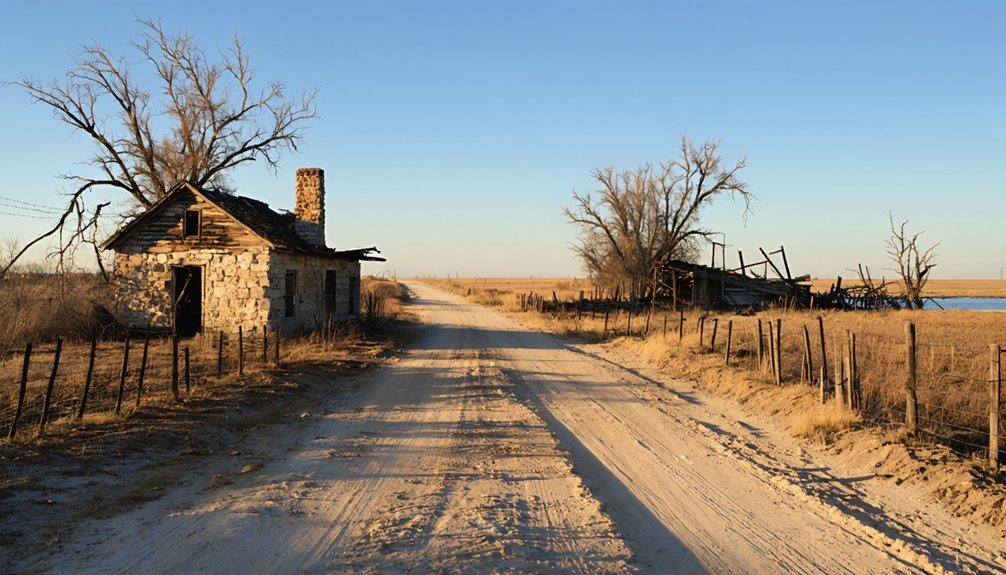
If you’re tracing Mariposa’s exact footprint, you’ll want to fix your eyes on the south bank of the Saline River, close to where it meets its mouth.
The founders chose this riverside position deliberately, as river-adjacent land offered early settlers both water access and natural orientation for a growing community.
You’re looking at a site where geography shaped destiny, making the river not just a backdrop but a defining feature of Mariposa’s brief existence.
South Bank Settlement Site
Where exactly did Mariposa sit along the Saline River? The town occupied the south bank, near the river’s mouth, placing it at a naturally strategic junction. When you study historical maps from the 1850s, you’ll notice early settlers consistently favored riverbank positions like this one — accessible, defensible, and close to fresh water.
That south bank location also carries deeper significance. Long before Mariposa’s 1856 founding, the Saline River corridor held meaning within Native American history, serving as a travel and resource corridor across the central plains. Early settlers didn’t choose this ground randomly.
If you’re tracing Mariposa’s footprint today, that river-mouth position gives you a tangible geographic anchor. You can stand near that south bank and feel the logic of why someone once planted a town exactly there.
Near The River’s Mouth
Mariposa’s founders chose a spot near the Saline River’s mouth deliberately. That position connected them to broader water systems, supporting both agriculture and early commerce.
It’s the same logic you’ll find embedded in historical architecture across the frontier — buildings and towns didn’t appear randomly; they followed the land’s natural logic.
When you visit, stand near the river and picture that calculation. The water didn’t just flow past Mariposa. It explained why Mariposa existed at all.
Why Did Mariposa Disappear?
When you look into why Mariposa vanished, you’ll find a familiar Kansas story of early hardships stacking up against a young settlement.
The town never secured a railroad connection, and without reliable transportation, growth stalled while nearby communities pulled residents and commerce away.
Salina ultimately won out, leaving Mariposa to fade into the river bottomland where it once stood.
Early Settlement Challenges
Like so many early Kansas settlements, Mariposa didn’t survive long enough to leave much behind. Founded in 1856 on the south bank of the Saline River, the town faced the brutal realities of territorial Kansas from the start. You’re looking at a place born during a period of political conflict, harsh weather, and uncertain infrastructure.
Early settlers had no guarantees. Supply lines were thin, land claims were contested, and the nearest established communities were far away. Without strong economic roots, Mariposa couldn’t hold its population.
No historical architecture remains standing today, and any archaeological findings would require serious fieldwork to uncover.
The land itself has reclaimed what settlers once built. What you’ll find now is open Kansas countryside and the quiet weight of a story most people never knew existed.
Transportation Shifts Hurt Growth
Transportation played a decisive role in which early Kansas towns survived and which ones quietly disappeared. When rail lines bypassed Mariposa in favor of more strategically positioned settlements, the town lost its competitive edge almost overnight. You can imagine how quickly commerce dried up once wagon routes shifted and merchants followed the tracks elsewhere. Without steady economic traffic, residents had little reason to stay.
Today, no historical architecture marks the spot where Saline County’s first town once stood. The land has reclaimed most of what settlers built along the south bank of the Saline River. Researchers rely on archaeological evidence to piece together the layout and daily life of this vanished community.
That fragility is exactly what makes Mariposa such a compelling destination for road-trippers who value forgotten history.
Larger Towns Won Out
As nearby Salina grew into a regional hub, Mariposa simply couldn’t compete. Larger towns pulled people, commerce, and opportunity away from smaller settlements like this one. You can see this pattern repeated across Kansas — early communities that shaped settlement patterns in their counties eventually faded once a dominant neighbor took hold.
Mariposa’s historical significance isn’t diminished by its disappearance, though. It still holds the distinction of being Saline County’s first town, founded in 1856 along the south bank of the Saline River. That matters. But founding a place and sustaining it are two different challenges entirely.
When Salina absorbed the region’s economic energy, Mariposa lost its reason to exist. Freedom, it turns out, sometimes means choosing where to plant roots — and most people chose elsewhere.
Does Anything Remain at the Mariposa Site Today?
When you arrive at the site where Mariposa once stood along the south bank of the Saline River, you won’t find a main street, a crumbling storefront, or even a weathered sign marking the spot. The land has reclaimed nearly everything. No standing structures survive, and the landscape offers little visual confirmation that Kansas’s first Saline County settlement ever existed here.
What potentially remains lies beneath the surface. Archaeological evidence could still connect present-day visitors to 1856, though no formal excavation has publicly documented the site.
Historical artifacts, if recovered, would tell the story that the ground no longer reveals on its own.
For now, Mariposa rewards the historically curious rather than the casual explorer. You’re fundamentally reading the land and trusting the record.
What Should You Know Before Driving to a Lost Kansas Town?
Before you head out to find Mariposa, you’ll want to do a little homework so the trip doesn’t catch you off guard. Rural Saline County roads can shift from paved to gravel to rutted dirt without warning, so check current road conditions before you leave.
You should also pack water, snacks, and a full tank of gas, since amenities are sparse once you leave Salina behind.
Know Before You Go
Driving out to a lost Kansas town like Mariposa isn’t quite like visiting a marked historic site with a parking lot and an interpretive sign — you’re often heading toward a location where little or nothing visibly remains. That freedom to explore comes with responsibility. Before you go:
- Research land ownership — many historical landmarks sit on private property, so verify access before you walk anywhere.
- Dig into local legends — county historical societies often hold maps, documents, and firsthand accounts that GPS simply can’t provide.
- Set realistic expectations — Mariposa has faded into the landscape, so your experience will be atmospheric and interpretive rather than visually dramatic.
Pack water, download offline maps, and treat the surrounding Saline County terrain with respect.
Road Conditions Matter
Getting your gear together and setting realistic expectations is only half the preparation — the road itself deserves just as much attention. Rural Saline County roads can shift dramatically with weather, so check current conditions before you leave.
Gravel stretches near the Saline River’s south side aren’t always well-maintained, and GPS often fails you where historical maps succeed. Download or print county plat maps before heading out — they’ll ground your navigation in the same landscape that shaped early pioneer stories.
Seasonal mud, washouts, and unmarked turnoffs are real obstacles. A high-clearance vehicle helps, but sharp awareness matters more.
Tell someone your route and expected return time. Freedom-seeking road trips reward the prepared traveler, not just the spontaneous one.
No Amenities Nearby
Once you leave the paved roads behind and head toward Mariposa’s historic site along the Saline River, you’re on your own — and that’s not a figure of speech. There’s no gas station, no convenience store, and no cell signal waiting for you out there.
Before you chase historical architecture and local legends through Saline County’s earliest settlement, prepare yourself properly.
- Fuel up in Salina before heading out — the nearest pumps are miles away.
- Pack water and food — there’s nothing between you and the horizon once you turn off the main road.
- Charge your devices fully — offline maps and a downloaded GPS route are essential.
Mariposa rewards the prepared traveler, not the spontaneous one.
Which Other Lost Towns Belong on a Saline County Road Trip?
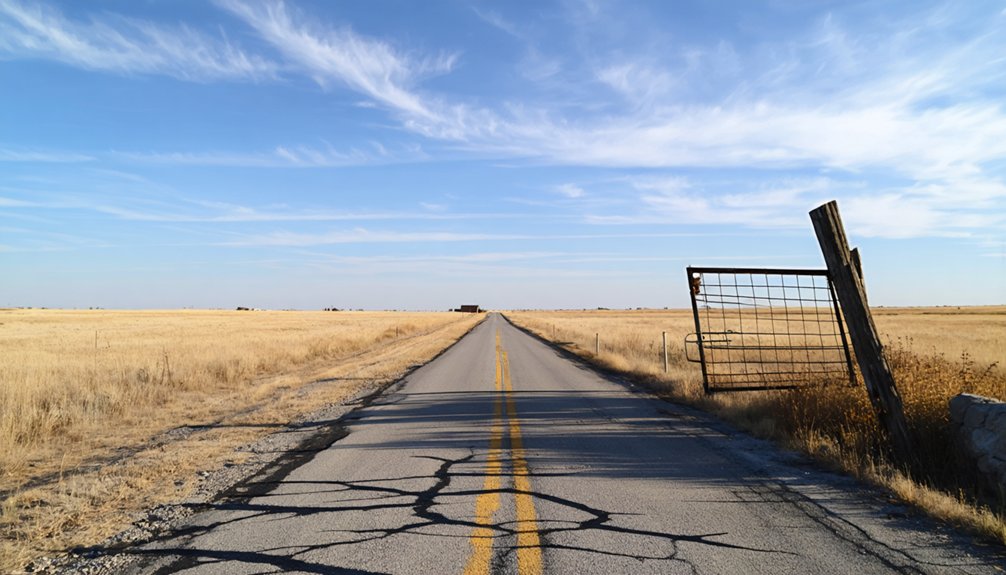
Mariposa isn’t the only ghost town worth tracking down in Saline County. The region holds several forgotten settlements where historical architecture still hints at lives once lived and ambitions once held. You’ll find crumbling foundations, weathered structures, and local legends that give each site its own distinct character.
Talking to longtime residents often uncovers stories that no roadside marker ever captures. Research Salina’s surrounding townships before you head out, since county historical records frequently reference smaller communities that vanished quietly over decades. Some sites won’t appear on modern maps at all, which makes the search half the adventure.
Pair these stops with Mariposa for a fuller picture of how early Saline County settlements rose, struggled, and ultimately faded into the Kansas landscape.
Where Can You Find Primary Sources on Early Saline County Settlement?
Tracking down primary sources on early Saline County settlement takes you straight to a few reliable anchors. These resources deepen your understanding of Mariposa’s cultural heritage and ground your road trip in real historical evidence.
- Kansas Historical Society – Holds territorial-era documents, land records, and maps directly tied to 1856 settlements along the Saline River.
- Saline County Courthouse Records – Early deed filings and plat records reveal how founders like Preston Plumb organized the county’s first communities.
- Archaeological findings reports – State and university surveys occasionally document physical traces of lost towns, giving you tangible proof of where Mariposa once stood.
Cross-referencing these sources sharpens your itinerary and transforms a casual drive into genuine historical exploration.
Frequently Asked Questions
Is Mariposa, Kansas Accessible by Public Roads Today?
You’ll find Mariposa’s site via rural Saline County roads, where historical preservation efforts keep local legends alive. Drive out, explore freely, and uncover Kansas’s earliest ghost town on your own adventurous terms.
Are There Guided Tours Available for Saline County Ghost Towns?
You’re blazing your own trail here — formal guided exploration isn’t widely available for Saline County ghost towns. You’ll rely on self-guided historical preservation resources, local historical societies, and research to uncover Mariposa’s fascinating, freedom-filled story.
What Is the Best Time of Year to Visit Mariposa?
Spring and fall offer you the best seasonal weather for exploring Mariposa’s historic grounds. You’ll enjoy mild temperatures, stunning landscapes, and you can time your visit around local festivals celebrating Saline County’s rich pioneer heritage.
Can Visitors Legally Access the Former Mariposa Townsite Property?
Before you roam, know this: property ownership determines your access. You’ll need to research current land rights, as historical preservation doesn’t guarantee public entry. Always seek permission before stepping onto the former Mariposa townsite.
Are There Any Museums Near Salina Featuring Mariposa Artifacts?
You won’t find dedicated Mariposa history museum exhibits confirmed yet, but you should explore the Smoky Hill Museum in Salina — it actively preserves early Saline County stories and may hold surprising regional artifacts connected to this lost town.
References
- http://freepages.rootsweb.com/~gtusa/history/usa/ca/mrp-co/c.htm
- https://thewanderingpigeon.com/2015/10/03/day-of-kansas-ghost-towns/
- https://www.youtube.com/watch?v=rwxsDJz3n9g
- https://legendsofkansas.com/everyplace-in-kansas-m/
- https://www.salinakansas.org/experiencesalina365blog/smoky-hill-museum-searching-for-mariposa
- https://esirc.emporia.edu/bitstream/handle/123456789/1577/McQuin Vol 8 Num 3.pdf?sequence=1
- https://legendsofkansas.com/kansas-ghost-town-list/