Planning a ghost town road trip to Marshall, Kansas means chasing a town that’s completely vanished. You won’t find walls, foundations, or markers—just open Kansas prairie where roughly 100 residents once built their lives before the railroad bypassed them. Start at Marshall’s site, then follow their footsteps south to Cheney, where they relocated entire buildings. Add Guittard Station, Bigelow, and Irving to complete the journey. There’s much more to uncover about each stop ahead.
Key Takeaways
- Marshall, Kansas, a ghost town near Cheney, vanished after the railroad bypassed it, forcing around 100 residents to relocate southward.
- Many of Marshall’s original buildings were physically moved to Cheney, which now holds the town’s architectural and cultural legacy.
- Visit Cheney first for local legends, then explore nearby ghost towns like Guittard Station, Bigelow, and Irving.
- Bring offline maps and county plat maps, as Marshall’s original site is unmarked open Kansas prairie with no structures.
- Pack sturdy boots, water, a field notebook, and a portable charger to navigate rugged terrain and document local history.
What Was Marshall, Kansas?
Before the Kansas plains swallowed it whole, Marshall was a promising little townsite perched along the Ninnescah River in Sedgwick County. It was founded in the 1870s with every expectation of becoming a lasting prairie community. For roughly a decade, it held its own.
Then the railroad came through — just two to three miles south — and Marshall’s fate was sealed. Residents packed up homes and businesses and relocated to the new rail town of Cheney, leaving nothing behind. No abandoned structures survived. No historic preservation effort ever had a chance because there was simply nothing left to preserve.
What you’ll find today is open land where a community once stood, making Marshall a ghost town in the most literal, uncompromising sense of the word.
Why the Railroad Bypassed Marshall and Ended the Town
When the railroad chose a route roughly two to three miles south of Marshall, it sealed the town’s fate before most settlers even saw it coming.
Without rail access, Marshall couldn’t compete, and businesses, residents, and even physical buildings packed up and relocated to the new railroad town of Cheney.
You’re practically visiting the ghost of a community that didn’t die slowly — it was simply picked up and moved.
Railroad Route Went South
The railroad didn’t just shape Marshall’s future — it erased it. When the line was laid roughly 2 to 3 miles south, Marshall lost its economic lifeline overnight. You’re not chasing historical artifacts here — you’re tracing a decision that wiped a town off the map.
That southern route triggered a chain reaction:
- Businesses relocated to the new rail town of Cheney, pulling commerce away completely
- Houses were physically moved, stripping Marshall of its cultural significance and built identity
- Around 100 residents followed, leaving the original townsite functionally abandoned
When you visit, you’re standing where a community once had real ambitions. The railroad didn’t pass through Marshall — it passed judgment on it, and the town never recovered.
Marshall Lost Its Future
Marshall didn’t fade quietly — it was cut off at the source. When the railroad bypassed the town by just two to three miles, it didn’t simply redirect commerce — it redirected the entire future. Businesses packed up. Houses were moved. Roughly 100 residents followed the rail line south to what became Cheney, Kansas.
You won’t find historical architecture marking the original site. No storefronts, no foundations, no preserved streetscapes. Local legends carry more weight here than any physical remnant. The town existed, thrived briefly, then dissolved into the prairie as if it had never been platted.
That erasure is exactly what makes Marshall worth understanding. The railroad didn’t just bypass a town — it deleted one. And knowing that history sharpens everything you’ll see when you visit.
Cheney Absorbed The Town
Cheney didn’t grow by accident — it grew because Marshall died. When the railroad bypassed Marshall, roughly 100 residents packed up and moved south, bringing their buildings, businesses, and ambitions with them.
You’re fundamentally visiting two towns when you visit Cheney today.
Walk through Cheney knowing that its roots run through Marshall’s abandoned soil. Local legends suggest entire structures were relocated board by board. Historical artifacts tied to Marshall’s earliest settlers may exist somewhere within Cheney’s older properties.
What Marshall contributed to Cheney:
- Its population and economic momentum
- Physical buildings relocated to the rail corridor
- The cultural identity of early Ninnescah River settlers
Marshall didn’t just disappear — it transformed into something you can still partially trace if you know where to look.
What Remains at the Marshall, Kansas Townsite Today
When you arrive at the former Marshall townsite today, you’ll find an empty stretch of Kansas prairie with no buildings, markers, or ruins to greet you.
The railroad’s decision to bypass Marshall didn’t just slow the town down — it erased it entirely, as residents packed up their homes and businesses and carried them south to Cheney.
If you want to see where Marshall ended up, you’ll get a clearer sense of the town’s legacy by driving into Cheney, the community that absorbed Marshall’s population and purpose.
An Empty Prairie Site
Unlike many ghost towns that leave behind crumbling storefronts or weathered foundations, Marshall offers you almost nothing to see at its original townsite along the Ninnescah River. No historical architecture survives. The buildings moved south when the railroad bypassed the town, and local legends are fundamentally all that remain of Marshall’s brief, ambitious life.
What you’ll find instead is open Kansas prairie — raw, honest, and quietly telling:
- Empty land where a functioning town once stood
- No markers currently anchor the site for curious visitors
- Silence that speaks louder than any preserved structure could
You’re fundamentally standing inside a disappearance. That absence makes Marshall uniquely powerful — freedom to imagine what was, without anything modern cluttering the view.
No Buildings Survived
Marshall’s story didn’t end with silence — it relocated. When the railroad bypassed the town, residents packed up their lives and moved south to Cheney, taking buildings with them. That decision left nothing behind. No foundations. No walls. No historical artifacts marking where a community once stood.
What you’ll find today is open Kansas prairie, wind, and the quiet Ninnescah River nearby. The land holds its secrets well. Local legends suggest the town had real momentum before that single railroad decision erased its future, but the site itself offers no physical confirmation.
You’re fundamentally standing on a memory. That absence is the experience here. If you need ruins or markers to feel the history, plan to continue your trip toward Cheney, where Marshall’s former life actually survived.
Cheney Absorbed Marshall
Cheney didn’t just outlast Marshall — it consumed it. When the railroad bypassed Marshall by a few miles, roughly 100 residents didn’t mourn long. They dismantled buildings, packed up businesses, and walked south to Cheney.
Local legends say the move happened fast, almost deliberately erasing what came before.
If you drive through Cheney today, you’re walking ground shaped by Marshall’s collapse. Town legends suggest some of Marshall’s original structures still stand in Cheney, quietly reframed as something newer.
What transferred from Marshall to Cheney:
- Residents seeking economic survival near the rail line
- Physical buildings relocated and repurposed
- Community identity, quietly absorbed into Cheney’s founding story
Marshall didn’t die — it migrated. Cheney carries that inherited past whether it acknowledges it or not.
Where the Marshall Townsite Actually Sits
Tucked along the Ninnescah River in Sedgwick County, the Marshall townsite sits near what’s now Cheney, Kansas — a small but telling detail that explains exactly why the town vanished. You won’t find historical landmarks marking the spot or roadside signs pointing you down a gravel path.
What you’ll find instead is open Kansas land, quietly holding local legends of a community that simply packed up and moved when the railroad drew its line two to three miles south. That geographical gap sealed Marshall’s fate.
When you visit, bring a county map and your curiosity, because the former townsite demands both. You’re essentially standing where a functioning town once operated — stores, residents, ambitions — all of it relocated, leaving nothing visible behind but the river and the wind.
Cheney, Kansas: Where Marshall’s Buildings and Residents Went
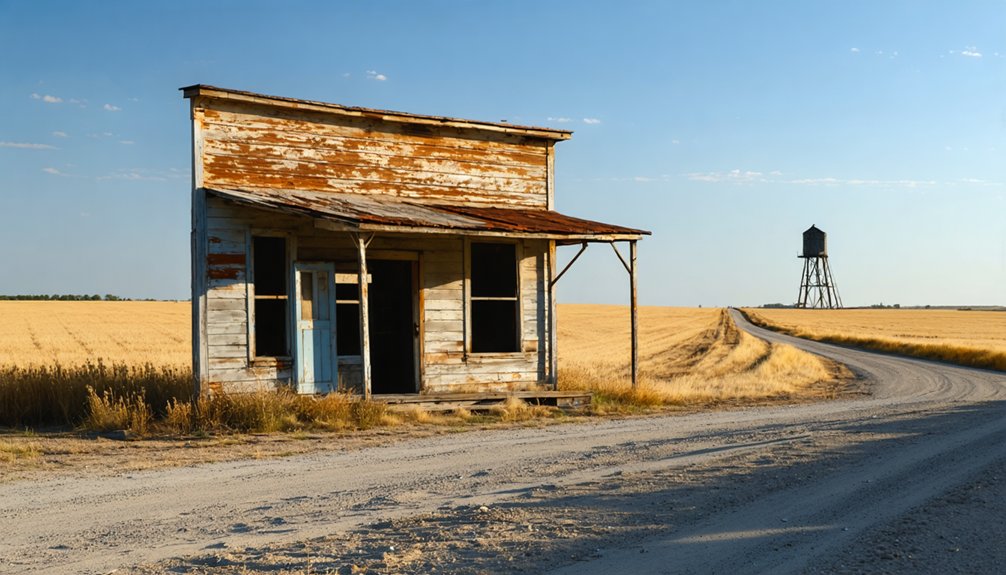
When the railroad bypassed Marshall, roughly 100 residents didn’t just give up — they packed up and moved south to Cheney, bringing their businesses and even their buildings with them.
You can drive to Cheney today and fundamentally stand in the town that replaced Marshall, since it inherited the population, structures, and economic energy the older settlement lost.
The railroad shaped Cheney into everything Marshall could’ve become, making it the living counterpart to a ghost town that left almost nothing behind.
Marshall’s Population Relocated Here
Rather than disappearing entirely, Marshall’s story continued about two to three miles south in Cheney, Kansas, where the railroad actually laid its tracks. When the rail decision came down, roughly 100 residents packed up and followed opportunity, carrying their businesses, homes, and ambitions straight into Cheney’s future.
You’re fundamentally chasing ghost town legends when you visit — the kind where an entire community simply picked up and walked away. Here’s what that migration meant:
- Cheney inherited Marshall’s buildings, making it a living archive of historical artifacts from a vanished town
- Marshall’s original site holds no structures, only open land
- The railroad’s two-mile detour erased one town while building another
Standing in Cheney today, you’re standing inside what Marshall once was.
Buildings Moved To Cheney
Cheney didn’t just absorb Marshall’s residents — it absorbed Marshall itself, building by building. When the railroad bypassed Marshall by just two to three miles, people didn’t abandon their investments — they moved them. Houses, businesses, and storefronts were physically relocated south to Cheney, leaving the original townsite stripped bare.
Today, you won’t find abandoned structures marking where Marshall once stood. The town fundamentally walked away from itself.
When you visit Cheney, you’re standing in the inherited bones of two towns. Local legends suggest that some of Marshall’s oldest buildings quietly became part of Cheney’s early streetscape, their origins forgotten over generations. That invisible history makes Cheney a worthwhile stop — it’s not just a neighbor to a ghost town; it’s the place that consumed one.
Railroad Shaped Cheney’s Growth
The railroad didn’t just save Cheney — it built it. When the line bypassed Marshall by a few miles, Cheney inherited everything: residents, businesses, and historic architecture hauled south to meet the rails. You can walk Cheney today and stand inside a town shaped by someone else’s loss.
The railroad’s influence created a layered community worth exploring:
- Economic foundation: Rail access drew commerce that Marshall never secured
- Relocated structures: Buildings physically moved from Marshall give Cheney unexpected historical depth
- Local legends: Stories of the migration still circulate among longtime residents
When you visit, you’re not just seeing Cheney — you’re seeing what Marshall became after defeat. That perspective transforms an ordinary small-town stop into something genuinely worth your time.
Marshall County’s Ghost Town Circuit: Guittard Station, Bigelow, and Irving
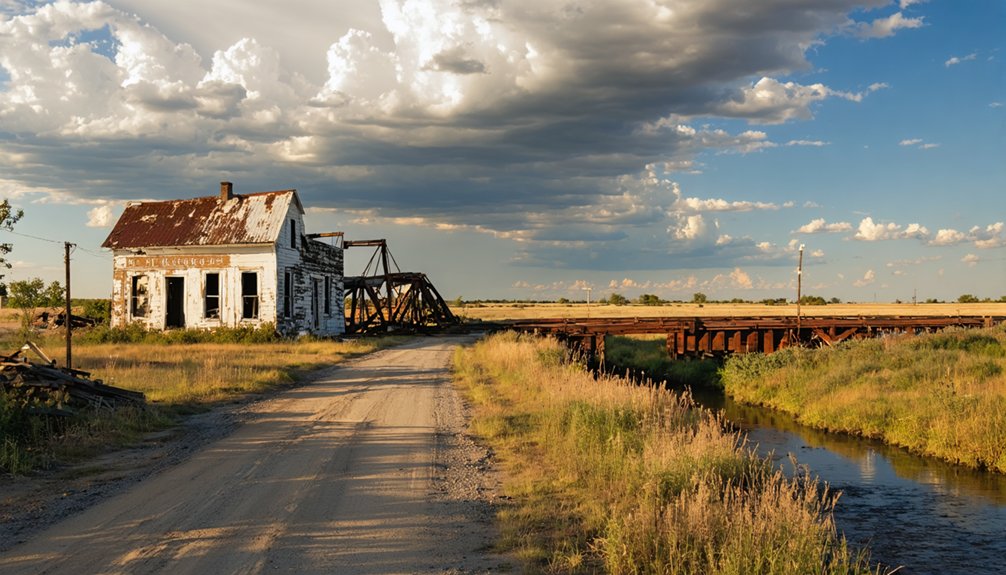
While Marshall itself offers little more than an empty field to stand in, Marshall County holds a handful of ghost town stops that’ll give your road trip some real texture. Guittard Station operated a post office from 1861 to 1900, and you’ll still find some abandoned buildings standing there — rare physical proof of a vanished community.
Pioneer cemeteries and local folklore help fill in the gaps where structures no longer exist. Bigelow once housed around 200 residents before Tuttle Creek Dam construction erased it entirely in the mid-20th century.
Irving followed a similar fate, displaced by the same reservoir project after a century of settlement. Together, these three stops build a compelling picture of how fragile prairie towns truly were.
Guittard Station: The One Stop With Visible Remains
Among all the ghost town stops on this road trip, Guittard Station stands out as the one place where history hasn’t completely disappeared into the grass. Unlike Marshall’s empty field, Guittard Station still has abandoned buildings you can actually see, making historical preservation feel tangible rather than theoretical.
Guittard Station is the rare ghost town where history hasn’t fully vanished — abandoned buildings still stand.
The station operated a post office from 1861 to 1900, meaning it served this stretch of Marshall County for nearly four decades. Local legends tied to early settlers and trail traffic add texture to what you’re looking at.
When you stop here, look for:
- Remaining abandoned structures still standing on site
- Evidence of 19th-century post office and settlement activity
- Landscape clues that reveal how communities clustered along travel routes
It’s the kind of stop that rewards curiosity.
Bigelow and Irving: Towns Lost to Tuttle Creek Lake
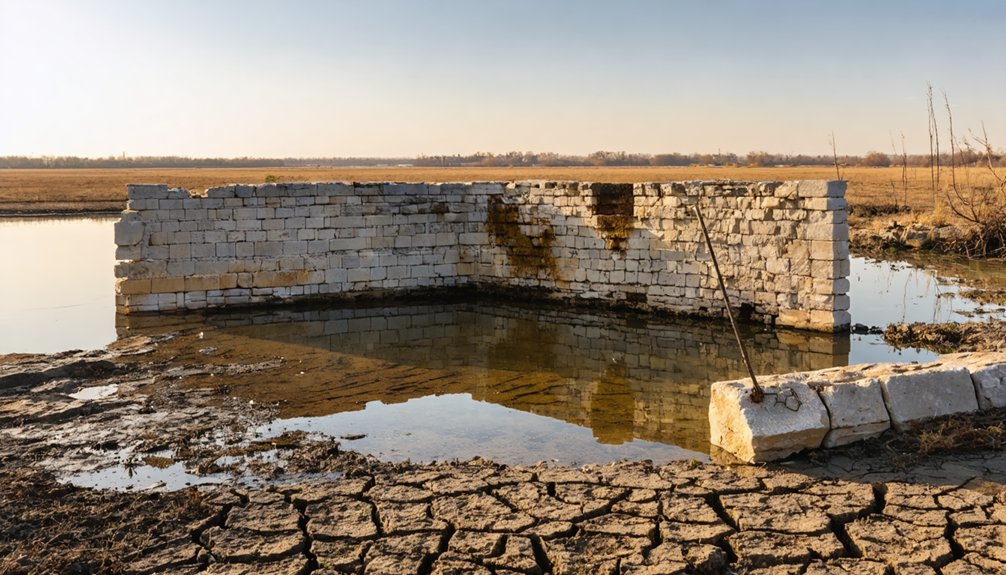
Two towns on this itinerary didn’t fade because a railroad bypassed them — they vanished underwater. Bigelow and Irving were once thriving farming communities in Marshall County, each with historical architecture, working businesses, and families building independent lives on the Kansas plains.
When Tuttle Creek Dam was constructed, both towns were sacrificed to flood control. Bigelow, founded in 1881, peaked at around 200 residents before demolition crews cleared it ahead of rising waters.
Irving, settled in 1859, held on until 1960 before displacement ended its century-long run. You won’t find standing buildings at either site today. Instead, you’ll find shoreline where streets once ran.
These towns remind you that prairie freedom could be undone not just by economics, but by government water policy.
Sequencing Your Drive: Marshall, Kansas to Marshall County in One Day
Driving this route in a single day is doable, but it works best when you treat Marshall, Kansas as your starting anchor rather than your main event. The former townsite near Cheney gives you context before you head northeast toward Marshall County’s richer stops.
Build your day around these three moves:
- Start at the Marshall townsite, then swing through Cheney to see where displaced residents landed.
- Follow the historical architecture remnants at Guittard Station, where abandoned buildings still whisper local legends.
- Close the loop at Bigelow and Irving, where Tuttle Creek Lake swallowed entire communities whole.
This sequence respects the timeline of each town’s collapse. You’re not just driving between dots on a map — you’re tracing how railroad decisions and rising water rewrote Kansas history mile by mile.
Tools, Maps, and Gear for a Kansas Ghost Town Road Trip
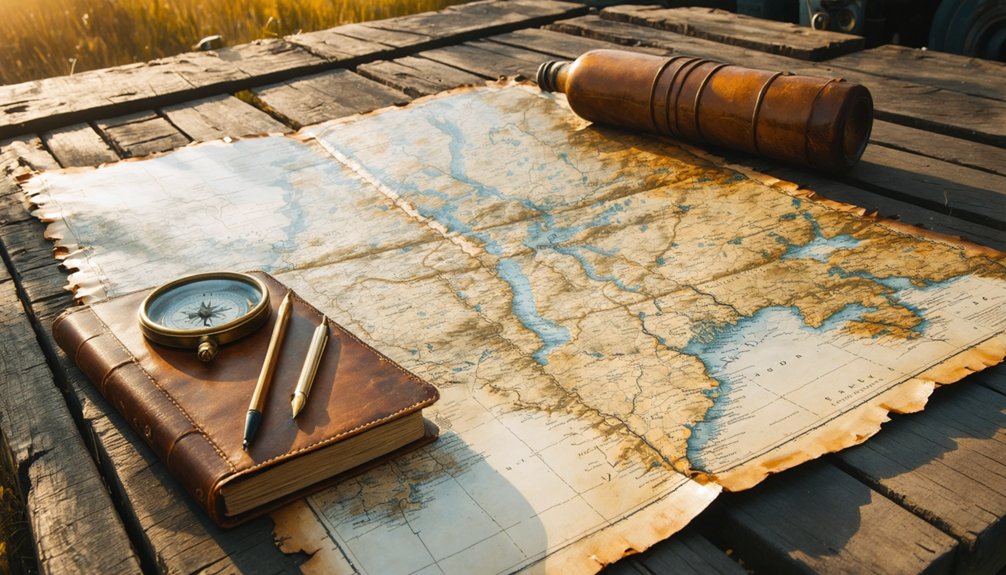
Before you leave the pavement behind, you’ll want the right tools loaded and ready — because ghost town sites like Marshall often don’t announce themselves with signs or parking lots. Download offline topographic maps through apps like Gaia GPS or OnX, since rural Sedgwick and Marshall County roads can drop your signal fast.
Ghost town hunting starts before you leave the pavement — download offline maps before the signal disappears.
Carry printed county plat maps to cross-reference land ownership and pinpoint former townsites accurately.
A good camera helps document any remaining foundations or cemetery markers tied to historical architecture long since swallowed by prairie grass. Pack a field notebook to record local legends you’ll gather from residents near Cheney or Guittard Station.
Sturdy boots, water, and a portable charger round out your kit — freedom on the Kansas plains rewards preparation, not assumptions.
Frequently Asked Questions
Are There Any Ghost Town Festivals or Events Near Marshall, Kansas?
Like whispers from the past, nearby Cheney hosts community events where you’ll find historical preservation efforts thriving. You won’t want to miss the photography opportunities these gatherings offer while exploring Marshall’s forgotten legacy.
Is Trespassing a Legal Concern When Visiting Kansas Ghost Town Sites?
Yes, trespassing is a real concern! You’ll need to respect legal restrictions and verify property access before exploring. Many Kansas ghost town sites sit on private land, so always get permission to roam freely and legally.
What Is the Best Time of Year to Visit Kansas Ghost Towns?
Spring and fall are your best windows — like golden bookends on Kansas history. You’ll find cooler temps, softer light for photography opportunities, and clearer views of historical preservation sites before summer’s thick vegetation swallows every forgotten foundation whole.
Are Kansas Ghost Town Sites Family-Friendly or Suitable for Children?
Yes, you’ll find Kansas ghost town sites family-friendly! Kids can explore open landscapes, enjoy photography opportunities, and connect with historical preservation firsthand. You’re free to roam, discover, and spark curiosity about prairie history together.
Can You Find Ghost Town Souvenirs or Books in Nearby Kansas Towns?
Towns vanish, but memories linger in local souvenir shops and historical book stores near Cheney. You’ll find Kansas ghost town books, regional maps, and unique keepsakes that keep these forgotten prairie stories alive long after your adventure ends.
References
- https://legendsofkansas.com/marshall-county-extinct-towns/
- https://www.youtube.com/watch?v=Td_gmiDMfI4
- https://en.wikipedia.org/wiki/Bigelow
- https://www.youtube.com/watch?v=iB5rHT14eVI
- https://www.youtube.com/watch?v=wocJ7F-jdrs
- https://www.youtube.com/watch?v=KBXINX0xqnU
- https://en.wikipedia.org/wiki/Irving
- https://legendsofkansas.com/kansas-ghost-town-list/
- https://www.youtube.com/watch?v=Et1EH5zkGPU