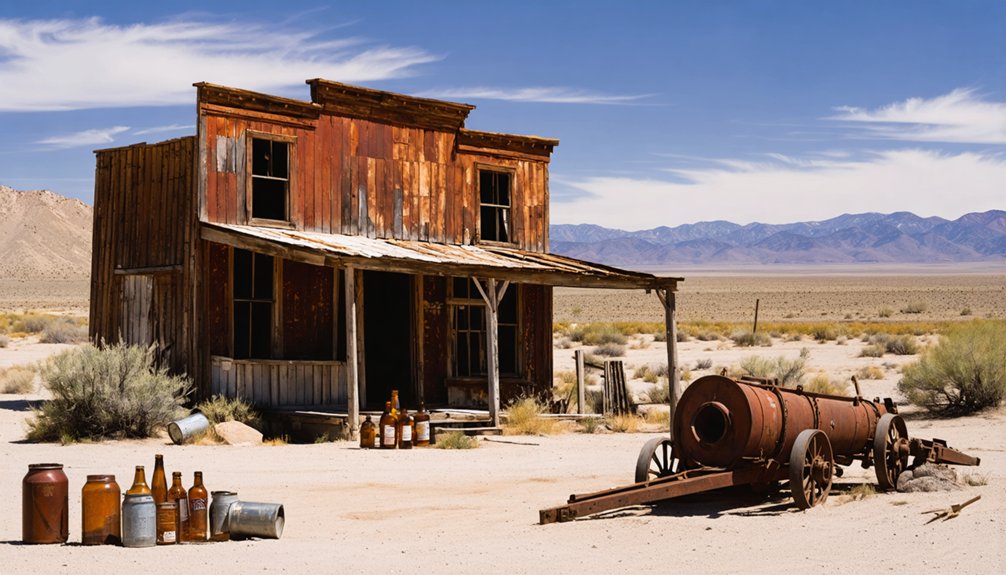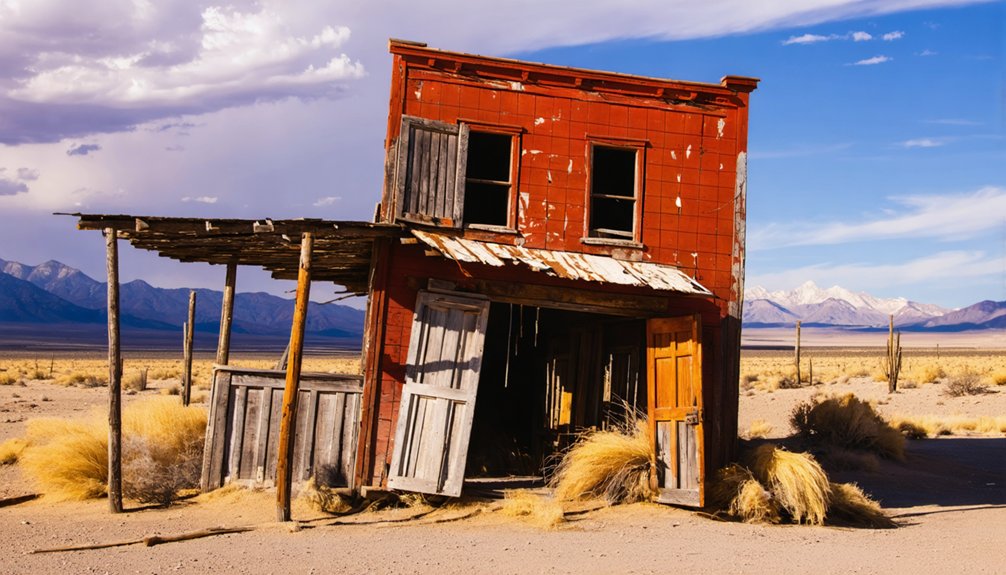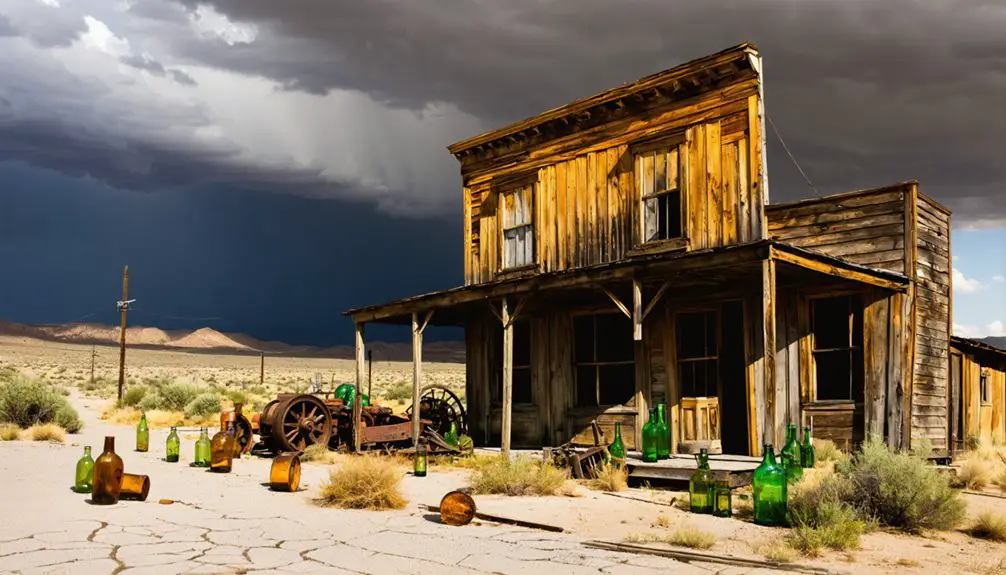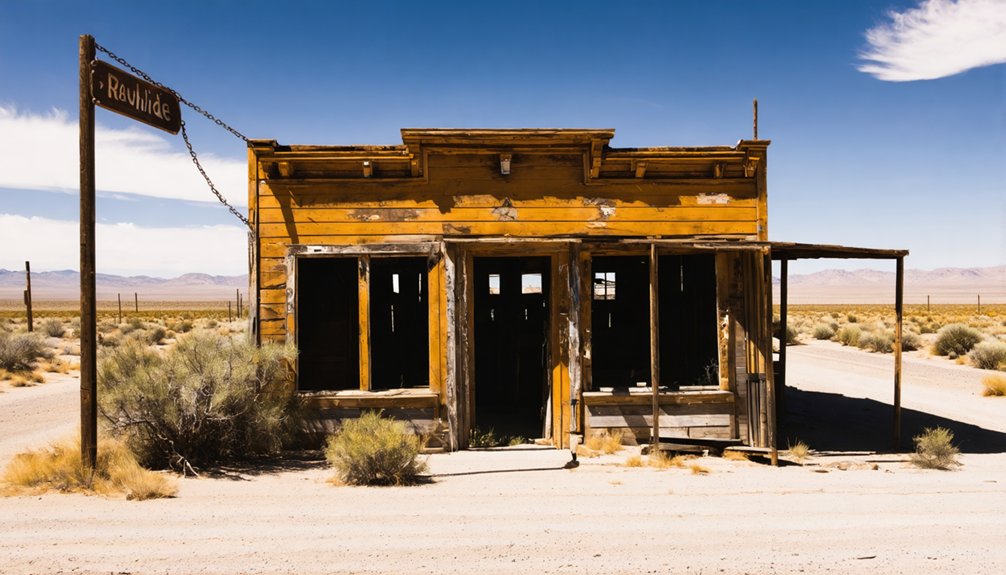
Planning a ghost town road trip to Rawhide, Nevada means driving roughly 57.5 miles from Fallon via US 50 and SR 838 into Mineral County’s open desert. Once Nevada’s most hyped boom town, Rawhide exploded to 7,000 residents after 1906 gold and silver strikes, only to collapse after an 1908 fire and 1909 floods. Today, modern mining has erased most remnants, but the history runs deep. Stick around to uncover the full story.
Key Takeaways
- Rawhide is located in Mineral County, Nevada, about 57.5 miles from Fallon via US 50 and SR 838 through open desert.
- Check road conditions with the BLM before visiting and prepare your vehicle for rough terrain near the site.
- The townsite is dominated by an open-pit mine with minimal historical remnants, as modern mining erased most structures.
- Visit the Mineral County Museum in Hawthorne for historical artifacts and context about Rawhide’s boom-and-bust mining era.
- Rawhide rapidly grew to 7,000 residents after 1906 gold strikes but collapsed after a 1908 fire and 1909 floods.
Where Is Rawhide, Nevada?
Tucked away in Mineral County, Rawhide sits roughly 20 miles outside of Fallon, Nevada — your primary jumping-off point for the journey. The coordinates land at 39° 1′ 0″ N and 118° 23′ 28″ W, positioning the site near the small town of Ione.
If you’re driving from Fallon, you’ll cover 57.5 miles via US 50 and SR 838 before reaching the area. Before you hit the road, call the Bureau of Land Management for current road conditions — desert terrain is unpredictable.
Rawhide carries deep cultural significance as a place where boom-and-bust dreams collided with harsh reality. Local legends of gold-rich hills and elaborate swindles still echo across the landscape, making this more than just a scenic detour — it’s a living chapter of Nevada’s wild history.
How Rawhide Became Nevada’s Most Hyped Boom Town
When prospectors struck gold and silver in 1906, Rawhide exploded from a dusty patch of Nevada desert into a town of 7,000 people within a single year.
You can thank the notorious swindler George Graham Rice for much of that frenzy, as he pitched Rawhide to enthusiastic investors as a mining utopia, boldly claiming the hills held “gold with a little rock in it.”
Rice’s fraudulent promises, backed by fake mining companies and manufactured hype, convinced thousands that Rawhide was the next Virginia City.
Gold Rush Origins
How does a barren stretch of Nevada desert transform into a boomtown of 7,000 people in under a year? Gold and silver. Prospectors struck it rich in 1906, igniting one of the West’s most explosive mining legends. Word spread fast, and freedom-seekers chasing fortune flooded the Nevada hills.
Picture the scene:
- Dusty prospectors staking claims across sun-baked terrain
- Wagon trains hauling supplies into a town materializing from nothing
- Investors arriving convinced they’d found the next Virginia City
- Rumors of high-grade ore sending pulses racing across the country
Within twelve months, Rawhide earned its place among ghost town legends. You could practically smell opportunity in the desert air. The rush wasn’t just about gold — it was about reinvention, risk, and raw American ambition.
Rice’s Fraudulent Promises
While gold sparked the rush, a silver-tongued con man named George Graham Rice poured gasoline on the fire. Rice wasn’t new to deception — he’d already swindled investors in Goldfield by selling stocks in fictional mining companies.
In Rawhide, he recycled the same playbook, pitching the desert hills as a mining utopia and boldly claiming the area held “gold with a little rock in it.” Investors, seduced by ghost town myths of overnight fortunes, handed over their money willingly.
Rice established fake mining companies, collected the cash, and vanished before anyone realized the scam. His mining legends were pure fiction.
He later faced multiple prison sentences, including a mail fraud conviction, proving Rawhide’s boom was built on beautiful lies.
Rapid Population Explosion
Rawhide didn’t grow — it exploded. Within a single year of its 1906 founding, 7,000 people flooded the desert, chasing whispers of riches buried in Nevada’s hills. Ghost town legends were born here, built on equal parts ambition and desperation. Mining legends spread fast, pulling dreamers from every direction.
Picture the chaos of arrival:
- Tent cities stretching across the barren desert floor
- Prospectors hauling gear across sun-baked terrain
- Investors clutching stock certificates for promises underground
- Saloons packed with strangers gambling on tomorrow
You’d have felt the electric tension — everyone convinced they’d struck the next Virginia City. The energy was raw, reckless, and intoxicating. Rawhide wasn’t just a town; it was a fever dream that an entire generation willingly caught.
George Graham Rice and the Rawhide Mining Swindle
Behind Rawhide’s explosive growth was a calculated con orchestrated by George Graham Rice, one of Nevada’s most infamous swindlers. Rice had already built his reputation on ghost town myths and mining legends from his Goldfield schemes, where he sold stocks in completely fictional mining companies.
When Rawhide emerged, he saw another golden opportunity.
Rice famously claimed the hills contained “gold with a little rock in it,” enticing enthusiastic investors from across the country. He established fake mining companies, collected substantial investments, then disappeared before anyone discovered the truth. You’d have lost everything trusting him.
Rice eventually faced justice through multiple prison sentences, including a mail fraud conviction. His manipulation transformed Rawhide from a legitimate opportunity into one of Nevada’s most notorious investment disasters.
How Fire and Flood Destroyed Rawhide
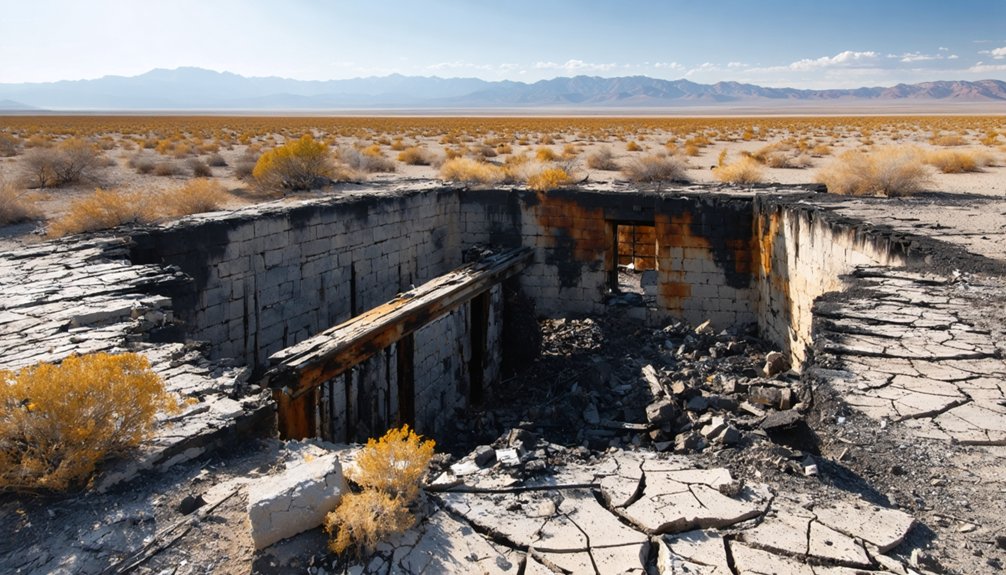
Just when Rawhide’s bubble seemed ready to burst on its own, nature stepped in to finish the job.
In 1908, a devastating fire tore through the town, reducing most of it to ash, and a flood the following year hammered what little remained.
The 1908 Fire
While Rawhide’s boom was already showing cracks, a devastating fire in 1908 delivered the killing blow to what remained of the town’s promise. The flames tore through the settlement with terrifying speed, consuming the historical architecture that miners and dreamers had built from nothing just two years prior.
Picture what the fire destroyed:
- Wooden storefronts packed tightly along dusty streets
- Saloons and boarding houses filled with hopeful prospectors
- Mining technology equipment stored near processing facilities
- The entire infrastructure of a town built on borrowed time
You can almost feel the heat as years of ambition turned to ash overnight. What took thousands of people immense effort to construct vanished within hours, leaving nothing but scorched earth and shattered dreams behind.
Flood Follows Disaster
The ashes hadn’t even cooled before Rawhide faced its next catastrophe. Just a year after the devastating 1908 fire, floodwaters tore through what little remained of the once-booming settlement. Nature wasn’t finished with Rawhide, and she made that brutally clear.
Together, fire and flood cemented Rawhide’s place among the great ghost town legends of the American West. The twin disasters crushed any real hope of recovery.
By 1910, the population had collapsed from 7,000 to a mere 500 desperate souls clinging to fading mining legends and broken promises.
You can almost feel the defeat when you stand near the site today. Those who stayed fought hard, but by the 1960s, even the last holdouts finally surrendered, leaving Rawhide to silence and memory.
Population Rapidly Declines
When fire and flood hit Rawhide back-to-back, the population didn’t just decline — it collapsed. Local legends say the town never had a fighting chance after nature struck twice in two years. Without modern mining technology to recover operations quickly, residents simply packed up and moved on.
Picture what remained by 1910:
- A once-thriving boomtown of 7,000 reduced to just 500 stubborn souls
- Charred building frames standing like skeletons against the Nevada desert sky
- Flood-damaged roads making supply runs nearly impossible
- Empty saloons and abandoned storefronts collecting dust and silence
You can almost feel the weight of those departures — families loading wagons, miners abandoning their claims. A handful of holdouts stayed until the 1960s, but Rawhide’s glory days were gone long before that.
What’s Left of Rawhide Today
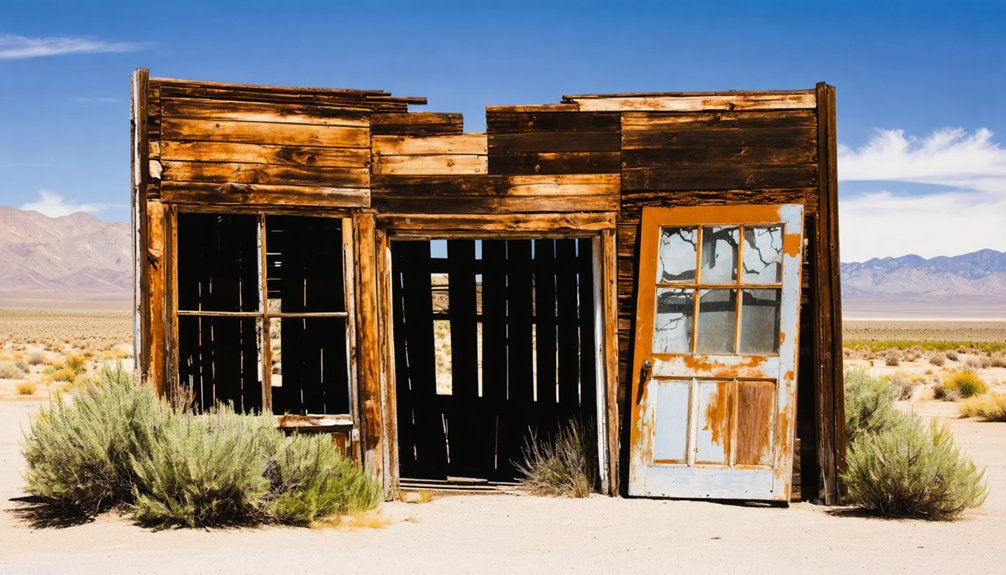
Sadly, there’s very little left for you to explore at Rawhide today. Modern mining operations have completely obliterated the historical architecture that once defined this boomtown. Where saloons, hotels, and bustling streets once stood, you’ll now find a large open-pit mine.
Modern mining has swallowed Rawhide whole — where saloons and hotels once thrived, an open-pit mine now dominates.
Don’t expect to wander freely through remnants of the past or photograph vintage mining equipment scattered across the landscape — the Rawhide Mining Company controls the site.
The jail, the one surviving structure, was relocated to Hawthorne before the site was razed. You can visit a cemetery about a mile north of the former townsite, though it’s fenced off and inaccessible.
Before making the trip, call the Bureau of Land Management for current road conditions to avoid an unnecessary detour.
Can You Still Visit the Rawhide Townsite?
Visiting the Rawhide townsite is technically possible, but don’t expect much of a payoff. Modern mining operations have completely obliterated the historical ground where thousands once chased their fortunes.
Still, the open desert surrounding the site offers its own rewards for freedom-seeking explorers drawn by local legends and wide-open skies.
Here’s what you might encounter on your visit:
- An active open-pit mine dominating the landscape where buildings once stood
- A fenced cemetery sitting about a mile north, inaccessible but visible
- Wildlife encounters with desert creatures roaming the rugged terrain
- Sweeping Nevada silence broken only by wind carrying echoes of boom-town ghosts
Before heading out, call the Bureau of Land Management to confirm current road conditions.
How to Get to Rawhide From Fallon
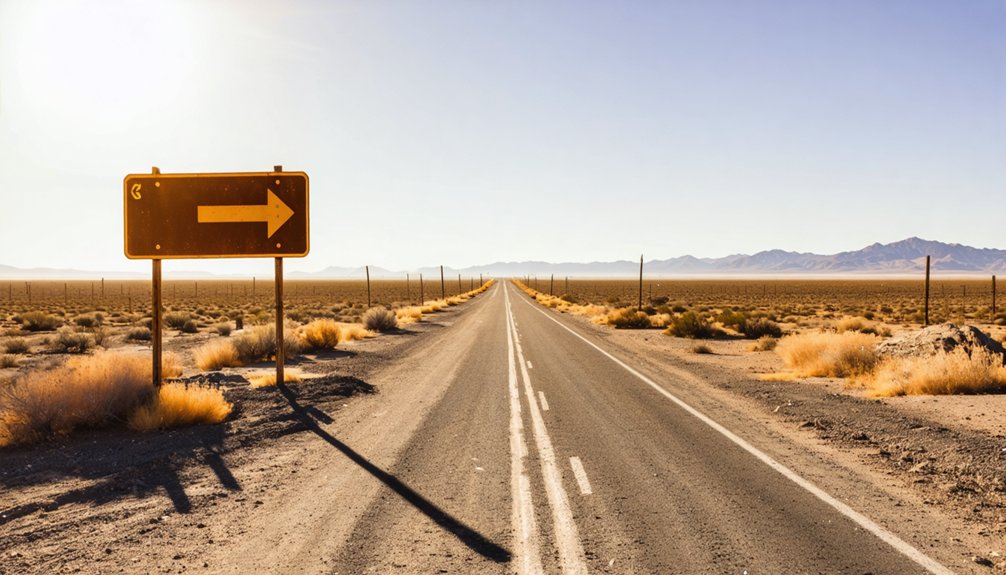
Getting to Rawhide from Fallon means covering 57.5 miles of classic Nevada highway, and the route couldn’t be more straightforward. You’ll head out on US 50, then pick up SR 838, letting the open desert carry you toward one of the state’s most compelling mining history destinations.
Before you go, call the Bureau of Land Management for current road conditions — Nevada’s backcountry doesn’t always cooperate. You’ll want your vehicle prepared for rougher stretches as you get closer to the site.
Fallon serves as your natural base camp, so fuel up and stock supplies before leaving. Ghost town preservation may have lost the battle at Rawhide itself, but the journey through this stark, honest landscape tells its own unfiltered story of boom, bust, and abandonment.
The Rawhide Jail, Cemetery, and Museum Worth the Drive
Though Rawhide itself has been swallowed by open-pit mining and razed beyond recognition, a few surviving pieces of its story are still worth tracking down. These historical preservation efforts give you a tangible connection to a town that burned, flooded, and vanished within decades.
Here’s what you can explore:
- The Rawhide Jail – relocated to Hawthorne before demolition crews moved in
- The Cemetery – sits roughly a mile north of the original townsite, fenced and visible but inaccessible
- Mineral County Museum – open Monday through Saturday in Hawthorne, housing regional artifacts
- BLM Road Conditions Line – call before you go; desert roads change fast
These tourist attractions won’t disappoint history hunters craving an authentic slice of Nevada’s wild, unfiltered past.
Frequently Asked Questions
What County Is Rawhide, Nevada Located In?
You’ll find Rawhide nestled in Mineral County, Nevada, where historical landmarks whisper local legends of boom-and-bust glory. It’s a wild, free-spirited destination sitting roughly 20 miles outside Fallon, calling your adventurous spirit forward.
How Many Prison Sentences Did George Graham Rice Serve?
While you roam free exploring ghost towns, Rice couldn’t — he served multiple prison sentences. His prison history includes several legal sentences, most prominently a mail fraud conviction that repeatedly landed him behind bars.
Is the Rawhide Cemetery Open to the Public?
You can’t access the Rawhide cemetery — it’s fenced off from the public. Although historical graves rest about a mile north of the former townsite, cemetery tours aren’t an option, leaving those buried secrets forever undisturbed.
Has the Rawhide Landfill License Ever Been Actively Used?
Despite a million chances to use it, the landfill license has never seen a single garbage transfer! You’ll find its licensing history spotless — Rawhide’s landfill regulations exist on paper, but no active use has ever occurred.
What Days Is the Mineral County Museum Open?
You’ll find the Mineral County Museum open Monday through Saturday, where you can explore historical exhibits and discover local events that bring Rawhide’s wild past to life, giving you the freedom to uncover its fascinating story.
References
- https://nevadamining.org/nevada-ghost-towns-rawhide/
- https://forgottennevada.org/sites/rawhide.html
- https://www.ghosttowns.com/states/nv/rawhide.html
- https://nvtami.com/2025/01/03/highway-95-ghost-towns/
- https://www.roadunraveled.com/blog/et-highway-ghost-towns-nevada/
- https://roadtrippers.com/magazine/dark-skies-and-ghost-towns-stops-on-a-spooky-nevada-road-trip/