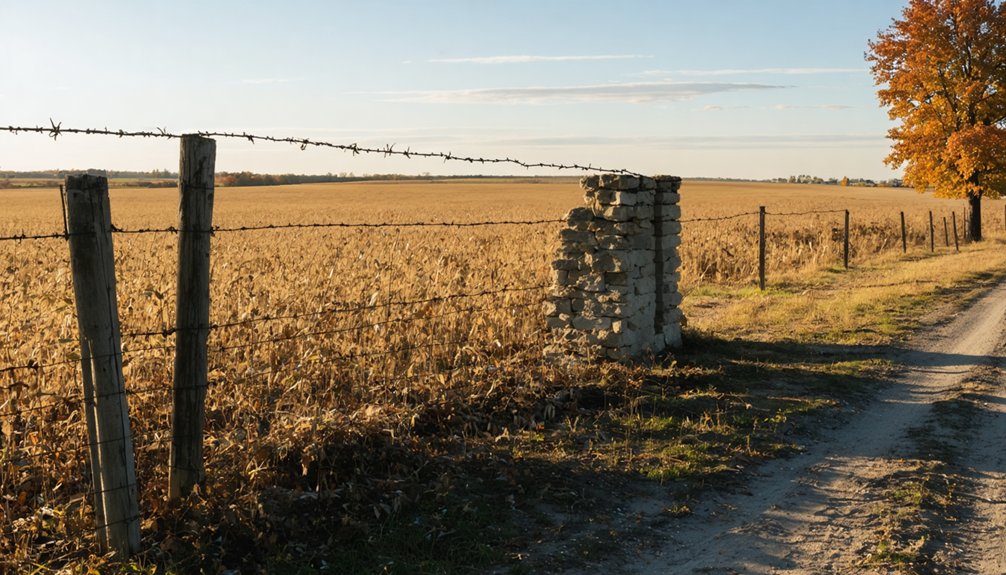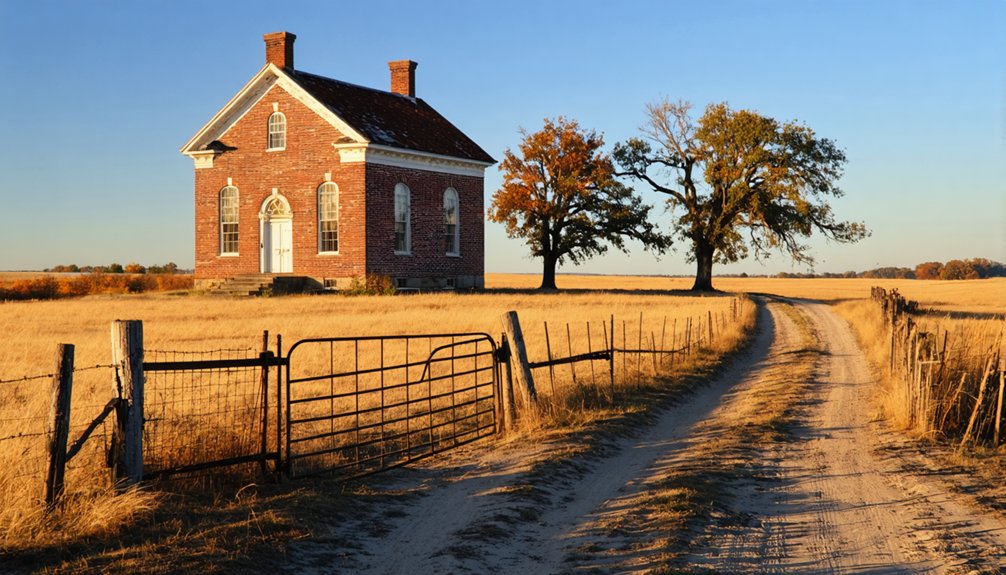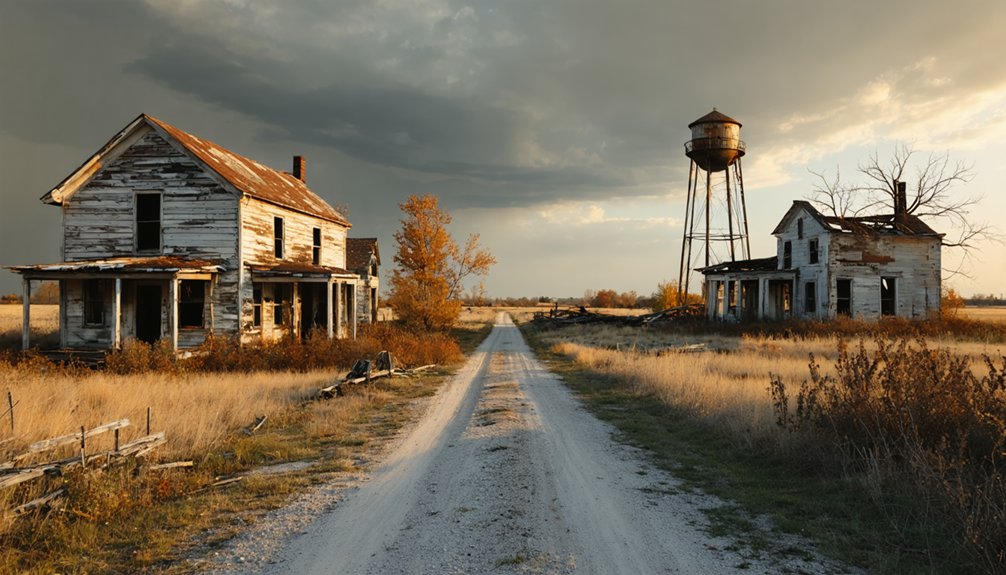
Planning a ghost town road trip to Daggett, Illinois means heading five miles south of Mount Carroll on Route 78, where quiet farmland swallows what was once a thriving frontier community. There’s no signage to guide you—just coordinates, curiosity, and open sky. Founded in the 1830s, Daggett once had a post office, railroad depot, and general stores before fading into memory by 1927. Stick around, and you’ll uncover everything this forgotten town still has to tell.
Key Takeaways
- Daggett is located five miles south of Mount Carroll along Illinois Route 78, near Timberlake and Daggert roads in Carroll County.
- No signage marks the site, so bring coordinates (42°01′57″N, 89°58′25″W) and rely on curiosity for navigation.
- The Daggitt Cemetery remains the primary tangible remnant, offering headstones and open farmland to explore.
- Visit in late spring or early fall for the best weather and clearest views of remaining landmarks.
- Pair your visit with nearby Mount Carroll’s courthouse square for a fuller Carroll County historic road trip.
What Is Daggett, Illinois?
Tucked five miles south of Mount Carroll along Illinois Route 78, Daggett is a ghost town that once thrived as an agricultural service hub in Carroll County’s Salem Township. You’ll find its coordinates at 42°01′57″N, 89°58′25″W, nestled among rolling northern Illinois terrain near Timberlake and Daggert roads.
Methodist English and Lutheran German settlers built something real here — a post office, railroad depot, blacksmith shop, and general stores.
Methodist English and Lutheran German settlers built something real here — post offices, depots, blacksmiths, and general stores.
By 1927, it was all gone, commerce swallowed by declining rail service and time.
Today, Daggett joins the ranks of historic ghost towns carrying quiet urban legends about what once was. If you crave open roads and forgotten places, this Carroll County relic offers exactly that kind of raw, unhurried freedom.
Where Is Daggett, Illinois Located?
You’ll find Daggett tucked inside Carroll County, Illinois, within the quiet boundaries of Salem Township. It sits five miles south of Mount Carroll, right along Illinois Route 78, making it an easy detour on any northern Illinois road trip.
Watch for the intersection of Timberlake and Daggert roads — that’s your landmark, and it’s about as close as you’ll get to standing in what was once a thriving agricultural community.
Carroll County Geographic Position
Nestled five miles south of Mount Carroll along Illinois Route 78, Daggett sits quietly in Carroll County’s rolling upland terrain, the kind of landscape that defines northern Illinois’s Driftless Area periphery. You’ll find its exact coordinates at 42°01′57″N 89°58′25″W within Salem Township, positioned near modern Timberlake and Daggert roads.
This agricultural heartland carries weight beyond its geography. Historical land disputes shaped early boundaries here, with Robert Daggitt’s 1837 acquisition of 3,000 acres fundamentally redrawing community lines. Local folklore still whispers about those contested early claims between Methodist English and Lutheran German settlers who carved competing identities into the same soil.
When you drive Route 78 southward, you’re tracing a corridor that once connected ambitious farming communities to something they believed would last forever.
Nearby Roads And Landmarks
Timberlake and Daggert roads mark the ghost town’s footprint today, crossing through Carroll County’s farmland like faded signatures left behind by the settlement’s founders. You’ll find Illinois Route 78 running nearby, connecting you southward from Mount Carroll toward where Daggett once hummed with daily commerce.
Drive slowly here. Local legends cling to these crossroads, whispered stories about blacksmiths, church bells, and railroad whistles that once defined this quiet stretch of northern Illinois.
What little historical architecture remains speaks through foundation lines and cemetery stones rather than standing walls.
The Daggitt Cemetery still anchors the landscape, giving you something tangible to navigate toward.
Let these rural roads guide you into the past, because out here, the land itself remembers what the maps no longer show.
Illinois Route 78 Access
Illinois Route 78 is your clearest thread into Daggett’s story, pulling you five miles south of Mount Carroll through Carroll County’s rolling farmland until the crossroads feel more like a memory than a destination.
You’ll follow the same corridor that once carried Methodist and Lutheran settlers toward something they believed would last. It didn’t, but the road remains.
Salem Township’s gentle upland terrain surrounds you quietly here, the kind of landscape that breeds ghost stories without trying.
Locals still trade urban legends about what Daggett once was versus what railroad decline made it.
Route 78 doesn’t announce the town’s location dramatically. It simply delivers you to Timberlake and Daggert roads, where the silence does the explaining.
That understated arrival is exactly the point.
Who Founded Daggett and When?
Although the story of Daggett’s founding reads like a classic frontier tale, it actually starts with two men whose names practically echo through the very roads that cross the land today.
Adam Daggert laid the groundwork in the early 1830s, and Robert Daggitt followed in 1837 by claiming 3,000 acres of Carroll County soil. Their legacy lives on through cultural heritage worth chasing down Illinois Route 78.
Here’s what shaped Daggett’s founding identity:
- Adam Daggert established the original settlement near present-day Timberlake and Daggert roads.
- Robert Daggitt expanded the community in 1837, creating the Daggitt Cemetery during that same period.
- Methodist English and Lutheran German settlers arrived together, building a community rooted in historic preservation and frontier independence.
What Did Daggett Look Like at Its Peak?
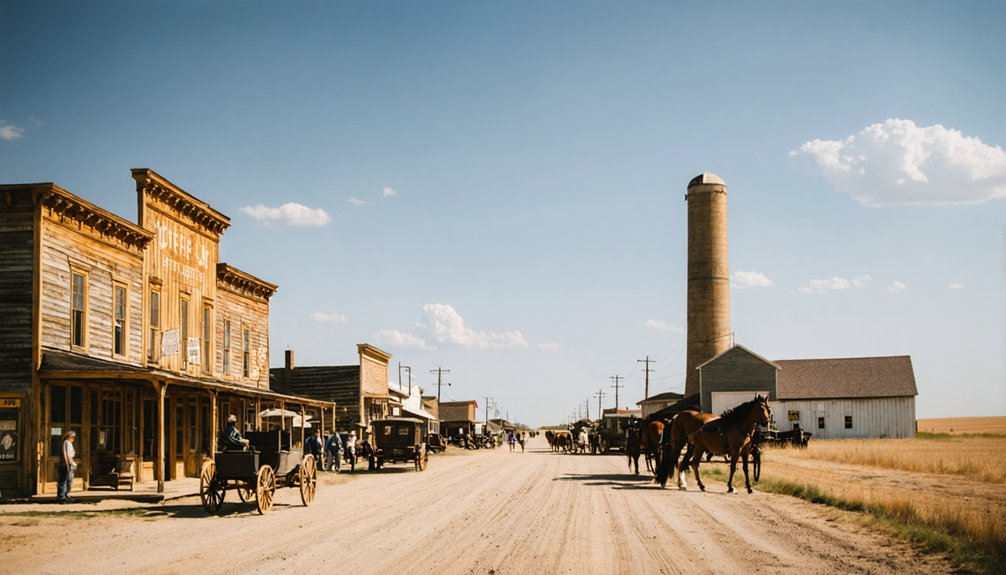
At its peak, you’d have found Daggett buzzing with the essentials of rural Illinois life — a post office, railroad depot, general stores, and a blacksmith shop keeping the farming community running.
Trinity Lutheran Church anchored the town’s spiritual and social rhythms, reflecting the Methodist English and Lutheran German roots settlers carried with them.
If you’d walked those roads in the late 1800s, you’d have seen a tight-knit agricultural hub where commerce and faith shaped everyday life.
Peak Community Infrastructure
During its heyday, Daggett wasn’t just a dot on Carroll County’s map—it was a living, breathing community hub that kept the surrounding farmland running. Local folklore tells of a town where neighbors depended on each other long before historical land disputes complicated ownership lines.
Picture yourself walking through Daggett at its peak, where three essential stops defined daily life:
- The General Store – your one-stop source for seeds, dry goods, and community gossip
- The Blacksmith Shop – where farmers brought broken plows and left with sharpened tools
- Trinity Lutheran Church – the spiritual anchor holding Methodist and Lutheran families together
The railroad depot and post office tied everything together, connecting this tight-knit settlement to the wider world beyond Carroll County’s rolling hills.
Thriving Agricultural Commerce
Behind every nail, prayer, and letter sent from Daggett’s post office ran the true engine of the town—its agricultural commerce. Historical land grants shaped how families carved up Carroll County’s rolling terrain, turning raw acreage into productive farmland that fed regional markets.
You can almost picture Methodist English and Lutheran German settlers bringing their cultural traditions straight into the fields—crop rotations, livestock practices, and seasonal rhythms passed down through generations.
General stores stocked what farmers needed, and the blacksmith kept iron tools sharp enough to meet the land’s demands.
Daggett didn’t just survive on faith and community spirit. It thrived because hardworking families understood the soil beneath their feet and built something real and self-sustaining from it.
Religious And Cultural Life
When Daggett hummed with life, Trinity Lutheran Church stood as more than a place of worship—it anchored the entire community’s cultural identity. Methodist English and Lutheran German families wove their traditions together, creating a tight-knit world you’d have genuinely wanted to experience.
Among Daggett’s famous landmarks and local traditions, three cultural touchstones defined daily life:
- Trinity Lutheran Church hosted weekly gatherings that doubled as community planning sessions
- Seasonal harvest celebrations united Methodist and German Lutheran families across cultural lines
- Shared craft and trade exchanges kept neighbors interdependent and connected
These weren’t just quaint customs—they were survival strategies dressed in celebration.
If you’re driving Illinois Route 78 today, you’re passing through ground where two distinct immigrant cultures actually figured out how to belong together.
What Killed Daggett After the Railroad Left?
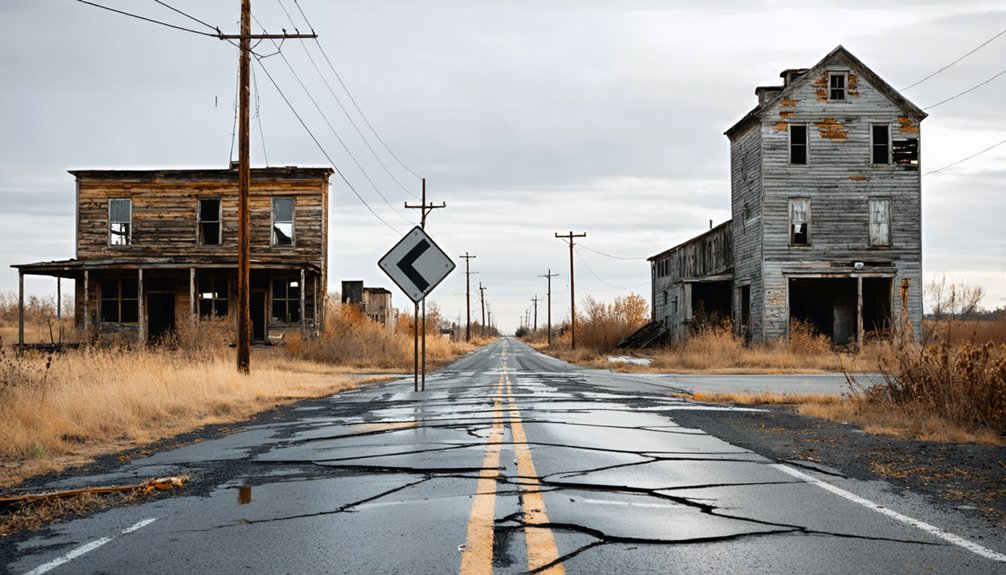
Once the railroad pulled back its services after 1909, Daggett’s slow unraveling became almost inevitable. The town that once hummed with blacksmith hammers and general store conversations fell quiet, business by business.
By 1924, trains only stopped when flagged down — a telling sign the outside world had moved on.
You can almost picture the last shopkeeper locking up in 1927, leaving behind historical artifacts that today quietly mark what once thrived here. No single disaster killed Daggett. Instead, reduced rail access simply starved its economy until nothing remained commercially viable.
Walking the land use patterns visible near Timberlake and Daggert roads today, you sense that absence. The earth remembers the settlement even when the buildings don’t.
That tension between memory and erasure is exactly what draws ghost town travelers here.
What’s Left to See in Daggett Today?
Though Daggett’s storefronts and depot are long gone, the Daggitt Cemetery still stands as the most tangible connection to the community Robert Daggitt built in 1837. Urban decay has claimed most structures, but the land itself tells the story. Drive out on Timberlake and Daggert roads and you’ll feel the quiet weight of what once thrived here.
The cemetery outlasted the storefronts. Some places survive not in buildings, but in the ground itself.
Here’s what you can still experience:
- Daggitt Cemetery – Walk among headstones marking early Methodist and Lutheran settlers who shaped Carroll County.
- Rural roadways – The original road grid hints at the town’s former layout.
- Open farmland – Historic preservation efforts keep the agricultural character intact.
You don’t need buildings to feel a place’s soul. Sometimes the absence says everything.
How to Get to Daggett on Illinois Route 78
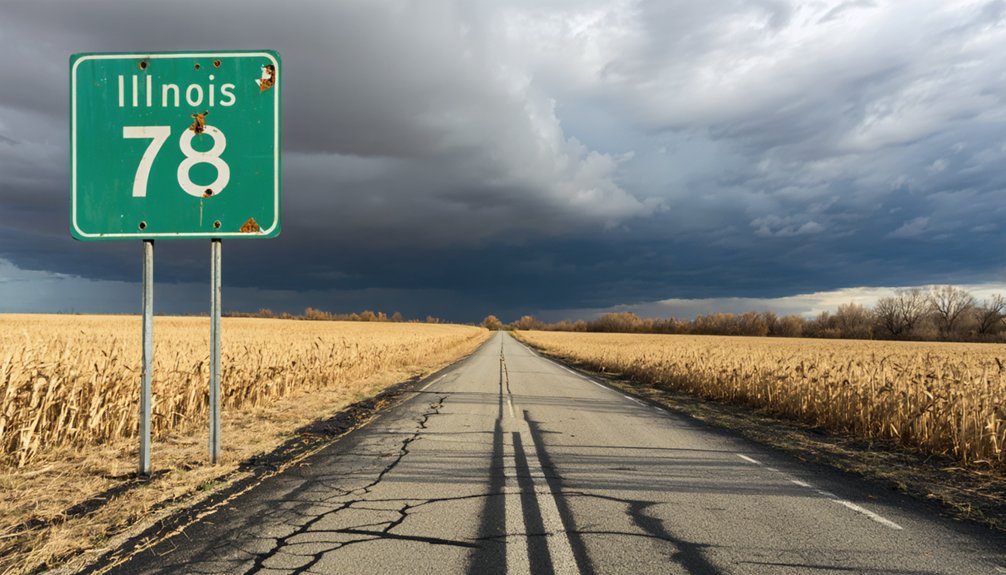
Getting to Daggett feels like stepping back into an older Illinois, where Route 78 rolls south from Mount Carroll through five miles of quiet farmland before the crossroads of Timberlake and Daggert roads mark what little remains of the settlement. You’ll want to drive slowly here.
The landscape itself holds the memory of cultural traditions brought by Methodist English and Lutheran German families who shaped this corner of Carroll County. Keep your eyes open for historical artifacts scattered across the terrain — a cemetery, a faint road trace, a field that once fed a thriving agricultural town.
No signs announce your arrival. That’s part of the draw. You’re charting your course on your own terms, guided by coordinates, curiosity, and a genuine appetite for places history quietly left behind.
Best Time of Year to Visit Daggett, Illinois?
Knowing when to make the drive matters almost as much as making it. Daggett rewards those who choose their timing wisely.
Timing your visit to Daggett isn’t an afterthought — it’s part of the journey itself.
- Late Spring (May–June): Rolling upland terrain blooms across Salem Township, making historical landmarks like the Daggett Cemetery easier to spot and photograph without harsh summer haze.
- Early Fall (September–October): Cooler temperatures invite slower exploration. You’ll feel the quiet weight of local legends more deeply when the crowds are gone and the fields turn gold.
- Avoid Winter: Illinois Route 78 gets treacherous, and frozen ground makes wandering near Timberlake and Daggert roads genuinely difficult.
You’re chasing a ghost town, not a resort. Pick a season that lets you move freely, breathe the open air, and actually feel the place.
Carroll County Stops Worth Pairing With Daggett
Daggett sits five miles south of Mount Carroll, and that proximity makes the county seat an obvious first stop on your route. Walk the historic courthouse square, where you’ll find locals still untangling historical myths about Carroll County’s earliest settlers. The architecture alone tells stories worth an afternoon.
From there, follow Illinois Route 78 south and let the rolling Driftless terrain guide you. Salem Township rewards slow drivers. Pull over near Timberlake and Daggert roads and stand where Adam Daggert once broke ground in the early 1830s.
Modern preservation efforts have kept the Daggett Cemetery accessible, and it’s worth pausing there before you leave. Carroll County doesn’t announce itself loudly, but every crossroads holds something honest if you’re willing to look.
Frequently Asked Questions
Is Daggett, Illinois the Same as Daggett, California?
They’re not the same! You’ll find Daggett, Illinois carries historical architecture and local legends rooted in Carroll County’s farmland, while California’s Daggett rose from desert railroad roots near Barstow — two distinctly different ghost town souls.
What Religious Denominations Influenced Daggett’s Early Cultural Identity?
You’d feel Daggett’s religious influence through its Methodist English and Lutheran German settlers, whose cultural heritage shaped the town’s soul. Trinity Lutheran Church still echoes their enduring spiritual traditions, grounding this free-spirited community in faith.
Did Mining Activity Contribute to Daggett’s Environmental Decline?
Yes, mining’s environmental impact absolutely scarred Daggett’s soul! You’d feel the mining legacy’s heavy shadow as you wander these forgotten roads — it introduced challenges that hastened the town’s quiet, heartbreaking fade into Illinois’ rolling, whispering landscape.
Are There Any Descendants of the Daggitt Family Still Around?
You’d be surprised — local descendants of the Daggitt family heritage might still roam Carroll County. Ask around Salem Township, and you’ll uncover anecdotal stories connecting today’s free-spirited residents to those early 1830s pioneers.
What Is the Daggitt Cemetery’s Current Condition and Accessibility?
You’ll find abandoned gravestones swallowed by nature’s reclamation project, where overgrown pathways dare you to rediscover forgotten souls. The Daggitt Cemetery’s quietly deteriorating, yet it’s freely accessible — a hauntingly beautiful reward for adventurous spirits chasing Illinois’s faded history.
References
- https://www.youtube.com/watch?v=eGc_gT-71AM
- https://en.wikipedia.org/wiki/Daggett
- http://www.parenvironmental.com/assets/articles/Of-Mines-and-Mules-A-History-of-Daggett.pdf
- https://www.youtube.com/watch?v=yg3qpVdJk9o