Planning a ghost town road trip to Red House, New York means heading to the southern edge of Cattaraugus County, about 70 miles south of Buffalo near the Pennsylvania border. This former logging boomtown once topped 1,000 residents before the mills shut down and Allegany State Park absorbed what remained. Today, you’ll find weathered landmarks, eerie trails, and rich folklore waiting to be explored. Stick around and you’ll uncover everything you need to plan your trip.
Key Takeaways
- Red House, located 70 miles south of Buffalo near the NY-Pennsylvania border, sits within Allegany State Park as a true ghost town.
- The town thrived during the lumber boom with over 1,000 residents before the logging industry collapsed, leaving abandoned structures behind.
- Key landmarks include the weathered town hall, Red House Creek, and Allegany State Park boundary markers reflecting the logging era.
- Nearby ghost towns like Limestone, Carrollton, and Portville offer additional stops to enrich your regional road trip experience.
- Check seasonal road closures, pay standard New York State park fees, and respect preservation boundaries when visiting old sites.
What Makes Red House, New York a Ghost Town?
Although Red House technically still exists on the map, it’s hard to call it a living town. With only 30 residents recorded in the 2020 census, you’re looking at one of the most extreme examples of urban decay in New York State.
The town’s decline wasn’t accidental — it was systematic. In 1921, Allegany State Park absorbed the schoolhouse, church, and massive stretches of land, stripping the community down to almost nothing. Later, highway expansion further fractured what remained.
What you’ll find today is a quiet, almost ghostly landscape surrounded by public parkland. Historical preservation efforts are minimal, leaving the town frozen somewhere between existence and erasure.
For travelers craving raw, unfiltered history, that tension makes Red House genuinely compelling.
The Ghost Story Behind the Famous Red House
When you visit Red House, you’ll almost certainly hear the Frecks family legend — a tale of tragedy, haunting, and a mysterious red house tied to a grief-stricken past.
Local lore has built the story into a ghost-town staple, pulling curious travelers in with promises of supernatural history.
But if you dig into the actual historical record, you’ll find the Frecks ghost story doesn’t hold up, and the town’s real erasure — by park expansion and infrastructure changes — is far more haunting than any legend.
The Frecks Family Legend
Every ghost town worth its salt has a haunting legend, and Red House doesn’t disappoint. Local folklore centers on the Frecks family history, weaving haunted legends into the landscape itself.
The story goes something like this:
- A tragic family once occupied the original red house, leaving behind restless energy that locals still whisper about.
- The creek and the town supposedly took their names from that infamous structure, though which came first remains disputed.
- Historical records, however, don’t support the ghost story’s darker details.
You’re free to believe whichever version calls to you. Just know that researchers have largely debunked the Frecks narrative as embellished folklore. The real erasure here isn’t supernatural — it’s the gradual disappearance of an entire community swallowed by parkland and progress.
Folklore Versus Historical Fact
Separating fact from fiction in Red House means confronting an uncomfortable truth: the ghost story is more compelling than the history, but the history is more devastating. Urban legends surrounding the Frecks family don’t hold up against historical records, yet they’ve outlasted the town’s actual story in popular memory. That’s how folklore myths work — they fill the silence that real events leave behind.
The real Red House wasn’t erased by tragedy inside a single house. It was systematically dismantled by park expansion, collapsing industry, and infrastructure decisions that nobody stopped. When you visit, you’re standing inside a quiet act of institutional erasure.
The ghost story gives you chills. The actual history should make you think.
Is the Red House Ghost Story Actually True?
How much of Red House’s ghost story actually holds up? Researchers say haunted legends tied to the Frecks family don’t match the historical record. The folklore origins sound compelling, but the documented truth is arguably more bizarre.
Here’s what the evidence actually supports:
- The “red house” name likely traces to Red House Creek, with a circular naming debate still unresolved.
- No verified historical record confirms the tragic family haunting story locals repeat.
- The real erasure — a thriving town of 1,000 swallowed by a state park — needs no ghost story.
You’re free to enjoy the legend, but don’t let it overshadow the genuine history. Red House’s quiet, park-surrounded remnant tells a more gripping story than any haunting ever could.
How Red House Went From Boomtown to Ghost Town
When you dig into Red House’s past, you find a town that once buzzed with over 1,000 residents fueled by a thriving timber and logging economy in the late 1800s.
The lumber mills collapsed once the timber ran out, and the population drained almost as fast as it had grown.
Then, in 1921, Allegany State Park absorbed huge stretches of the town’s land — including its schoolhouse and church — shrinking Red House down to the quiet, nearly empty remnant you’d encounter today.
Logging Boom Brings Growth
Few places capture the rise-and-fall arc of 19th-century boomtown life quite like Red House. After settlers arrived post-1827, the timber industry turned this quiet corner of Cattaraugus County into a thriving river town.
At its peak, the population topped 1,000 residents — hard to imagine standing there today.
The logging boom shaped everything:
- Mills and workers flooded the area, driving rapid economic and population growth
- Local folklore grew alongside the community, embedding stories into the landscape that historical preservation efforts still reference today
- Infrastructure expanded to support the booming trade along Red House Creek
You’re looking at a place that once hummed with industry. When the timber ran out, though, the mills left — and nearly everyone else followed.
Lumber Industry Collapses
The moment the last merchantable tree fell, Red House’s economy collapsed with it. The mills that once hummed with activity shut down, and the workers who’d built their lives here simply left. A population that had swelled past 1,000 residents drained away almost overnight, leaving behind empty structures and quiet roads.
What you’re walking through today is the result of that abandonment. Without historical preservation efforts, even those remnants might’ve vanished entirely. Yet something quietly remarkable happened — a handful of residents stayed.
That community resilience, however modest, kept Red House technically alive as a functioning township.
You can feel that tension when you visit: a place that should’ve disappeared completely but stubbornly refused to. The collapse set everything else in motion.
Park Expansion Erases Town
What the lumber collapse started, the state of New York finished. In 1921, New York folded much of Red House into Allegany State Park, triggering rapid urban development of public land at the town’s direct expense. You can still feel that erasure when you visit today.
The park absorbed what remained of the community’s core:
- The local schoolhouse
- The town church
- Large stretches of privately held land
This wasn’t gradual economic decline — it was institutional removal. Residents lost anchors that hold communities together.
Later, the Southern Tier Expressway corridor carved through the region, completing what the park expansion began. Today, you’re fundamentally driving through land that was once someone’s town.
The road-trip atmosphere isn’t manufactured here — the ghost-town feeling is historically earned.
Where Exactly Is Red House and How Do You Get There?
Tucked into the southern edge of Cattaraugus County, Red House sits near the New York-Pennsylvania border, roughly 70 miles south of Buffalo and about 30 miles east of Jamestown. You’ll find it nestled within Allegany State Park, which makes the drive itself part of the experience. Take I-86 to reach the Allegheny region, then follow signs toward the park’s interior.
Don’t expect much local architecture — the town hall stands as one of the few remaining man-made structures worth noting. Urban legends about haunted homesteads draw curious travelers, but the real reward is the eerie openness surrounding you.
Public land swallowed most of what once existed here, leaving you to explore a place that feels more like a memory than a municipality.
The Town Hall, Creek, and Surviving Landmarks of Red House
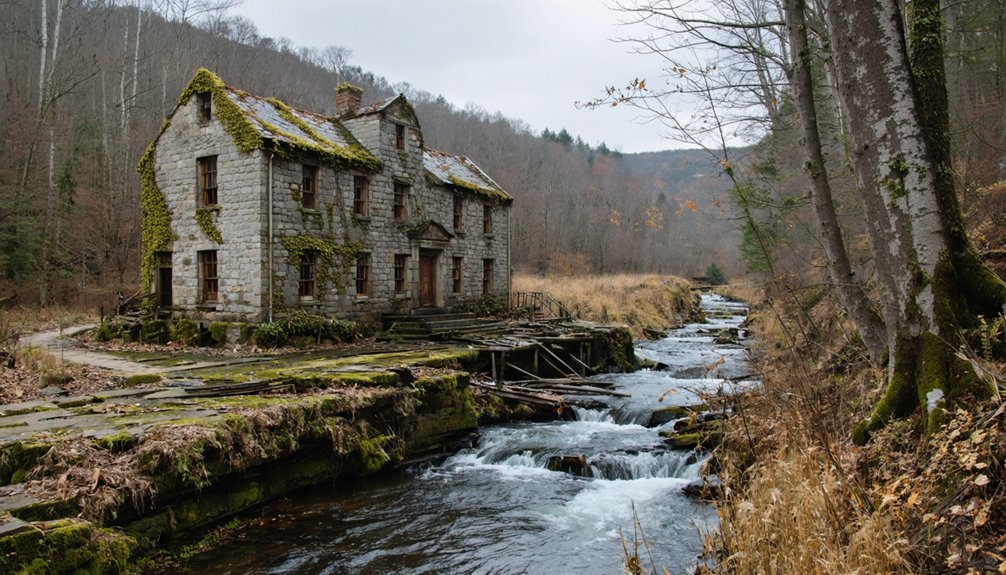
Few landmarks survive in Red House, but the ones that do tell the town’s story more plainly than any ghost legend could. The local architecture is spare and weathered, carrying community memories that stretch back well before Allegany State Park swallowed the land whole.
When you visit, keep an eye out for:
- The town hall, a small but functioning remnant that confirms Red House still technically governs itself
- Red House Creek, which winds through the park and likely gave the town its name, though locals have debated that for generations
- Allegany State Park’s boundary markers, which silently mark where the original community once spread
You won’t find a downtown. What you’ll find instead is honest, open landscape that explains everything the history books summarize.
What to Do Near Red House in Allegany State Park
Allegany State Park surrounds Red House on nearly every side, so you’d be missing the point if you drove in and turned right back around.
The park offers miles of trails where wildlife observation becomes effortless — white-tailed deer, wild turkey, and black bear move freely through the forest.
Two lakes, Quaker and Red House, invite fishing, kayaking, and quiet reflection.
Historical preservation efforts within the park protect structures and landscapes tied directly to the town’s logging-era past, giving you real context for what you’re standing in.
Camp overnight at one of the park’s sites and you’ll feel the full weight of the region’s isolation.
This park isn’t a backdrop — it’s the reason Red House survived in any recognizable form at all.
Other Ghost Towns Worth Adding to Your Southern Tier Route
The Southern Tier rewards slow, curious driving, and Red House isn’t the only forgotten community worth pulling over for. Pack a cooler, map a loose route along I-86, and let historical preservation guide your stops.
A few towns worth adding:
- Limestone, NY – Once a thriving oil town, it now offers quiet streets, faded architecture, and honest local cuisine at small diners still serving the community.
- Carrollton, NY – Sitting near Allegany County’s edge, it carries a stripped-down, post-industrial character worth exploring on foot.
- Portville, NY – A compact river town with preserved 19th-century buildings and enough personality to justify a lunch stop.
Each place adds texture to your route without demanding much time, keeping your trip moving freely through genuinely overlooked New York.
Road Conditions, Park Fees, and Access at Red House
Before you head out, knowing what to expect from road conditions, park access, and fees will save you from unwelcome surprises on arrival. Red House sits inside Allegany State Park, so you’ll encounter standard New York State park entry fees at the gate.
Roads through the park are generally well-maintained, though winter months can bring closures or hazardous conditions on narrower routes. Seasonal access matters here, so check current park status before you go.
The area’s historical preservation efforts mean some roads near older sites may be restricted. Understanding the cultural significance of this land helps explain why access rules exist — much of what remains is protected.
Travel light, respect boundaries, and you’ll move through this fascinating corridor freely and without hassle.
Frequently Asked Questions
Can You Legally Camp Overnight Within Red House Town Limits?
You’ll need to follow Allegany State Park’s camping regulations since the park surrounds Red House. Check overnight restrictions carefully before setting up camp, as you can’t freely camp outside designated park areas.
Is Red House Accessible Year-Round or Closed in Winter Months?
Year-round, you’re in luck! Red House stays open through all seasons, offering stunning winter scenery along I-86. Seasonal accessibility remains consistent, so you can freely explore this hauntingly quiet ghost town whenever the open road calls.
Are There Any Restaurants or Stores Inside Red House Itself?
You won’t find restaurants or stores inside Red House itself. The town’s Red House history reveals it’s nearly a ghost town, so pack your own supplies and focus on Local attractions like Allegany State Park’s stunning scenery.
What Is the Official Mailing Address or ZIP Code for Red House?
Like a needle in a haystack, pinning down Red House’s exact zip code proves tricky—the available knowledge doesn’t confirm it. You’ll want to explore Red House history and Red House attractions through local Cattaraugus County resources directly.
Has Red House Ever Considered Dissolving as an Official Town?
The knowledge doesn’t confirm Red House has formally pursued dissolution, but you’ll find its historical preservation efforts and fierce community identity have kept this ghost town’s official status alive, even as its population shrinks dramatically.
References
- https://chriscarosa.com/2012/10/the-secret-of-new-yorks-smallest-town/
- https://en.wikipedia.org/wiki/Red_House
- https://enchantedmountains.com/taxonomy/term/238
- https://www.loe.org/shows/segments.html?programID=04-P13-00006&segmentID=3
- https://www.youtube.com/watch?v=18nbuyL__uQ
- https://www.usatoday.com/story/news/nation/2014/09/15/smallest-new-york-town-red-house-gets-smaller/15662125/
- https://fr.wikipedia.org/wiki/Red_House_(New_York)
- https://wyrk.com/ghost-town-western-new-york/
- https://www.youtube.com/watch?v=fb-TcK3Ezwo